Thank you for visiting SNEWPapers!
Sign up free
Story
June 25, 1845
Morning Star
Limerick, York County, Maine
What is this article about?
Theological essay by A. K. M. defends 'gracious ability'—divine grace enabling depraved humans to obey God—against objections, citing scripture on carnal mind, Adam's fall effects, early sin in children, and need for grace before accountability.
Clipping
OCR Quality
98%
Excellent
Full Text
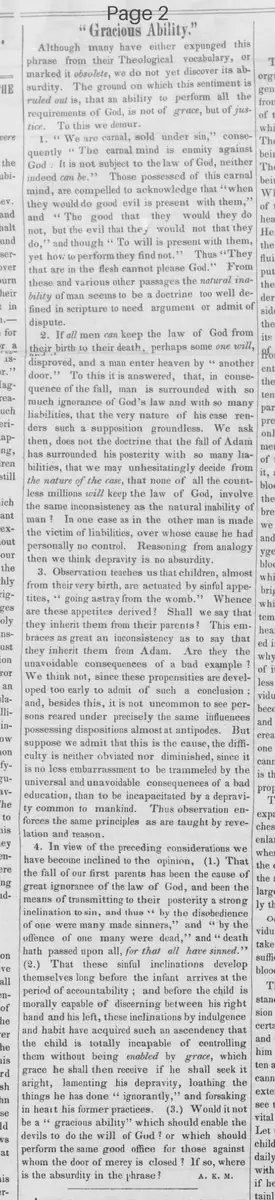
"Gracious Ability."
Although many have either expunged this phrase from their Theological vocabulary, or marked it obsolete, we do not yet discover its absurdity. The ground on which this sentiment is ruled out is, that an ability to perform all the requirements of God, is not of grace, but of justice. To this we demur.
1. "We are carnal, sold under sin," consequently "The carnal mind is enmity against God: It is not subject to the law of God, neither indeed can be." Those possessed of this carnal mind, are compelled to acknowledge that "when they would do good evil is present with them," and "The good that they would they do not, but the evil that they would not that they do," and though "To will is present with them, yet how to perform they find not." Thus "They that are in the flesh cannot please God." From these and various other passages the natural inability of man seems to be a doctrine too well defined in scripture to need argument or admit of dispute.
2. If all men can keep the law of God from their birth to their death, perhaps some one will, and the doctrine of the Saviour's atonement be disproved, and a man enter heaven by "another door." To this it is answered, that, in consequence of the fall, man is surrounded with so much ignorance of God's law and with so many liabilities, that the very nature of his case renders such a supposition groundless. We ask then, does not the doctrine that the fall of Adam has surrounded his posterity with so many liabilities, that we may unhesitatingly decide from the nature of the case, that none of all the countless millions will keep the law of God, involve the same inconsistency as the natural inability of man? In one case as in the other man is made the victim of liabilities, over whose cause he had personally no control. Reasoning from analogy then we think depravity is no absurdity.
3. Observation teaches us that children, almost from their very birth, are actuated by sinful appetites, "going astray from the womb." Whence are these appetites derived? Shall we say that they inherit them from their parents? This embraces as great an inconsistency as to say that they inherit them from Adam. Are they the unavoidable consequences of a bad example? We think not, since these propensities are developed too early to admit of such a conclusion: and, besides this, it is not uncommon to see persons reared under precisely the same influences possessing dispositions almost at antipodes. But suppose we admit that this is the cause. the difficulty is neither obviated nor diminished, since it is no less embarrassment to be trammeled by the universal and unavoidable consequences of a bad education, than to be incapacitated by a depravity common to mankind. Thus observation enforces the same principles as are taught by revelation and reason.
4. In view of the preceding considerations we have become inclined to the opinion, (1.) That the fall of our first parents has been the cause of great ignorance of the law of God, and been the means of transmitting to their posterity a strong inclination to sin, and thus by the disobedience of one were many made sinners," and "by the offence of one many were dead," and "death hath passed upon all, for that all have sinned." (2.) That these sinful inclinations develop themselves long before the infant arrives at the period of accountability; and before the child is morally capable of discerning between his right hand and his left, these inclinations by indulgence and habit have acquired such an ascendency that the child is totally incapable of controlling them without being enabled by grace, which grace he shall then receive if he shall seek it aright, lamenting his depravity, loathing the things he has done "ignorantly," and forsaking in heart his former practices. (3.) Would it not be a "gracious ability" which should enable the devils to do the will of God? or which should perform the same good office for those against whom the door of mercy is closed? If so, where is the absurdity in the phrase?
A. K. M.
Although many have either expunged this phrase from their Theological vocabulary, or marked it obsolete, we do not yet discover its absurdity. The ground on which this sentiment is ruled out is, that an ability to perform all the requirements of God, is not of grace, but of justice. To this we demur.
1. "We are carnal, sold under sin," consequently "The carnal mind is enmity against God: It is not subject to the law of God, neither indeed can be." Those possessed of this carnal mind, are compelled to acknowledge that "when they would do good evil is present with them," and "The good that they would they do not, but the evil that they would not that they do," and though "To will is present with them, yet how to perform they find not." Thus "They that are in the flesh cannot please God." From these and various other passages the natural inability of man seems to be a doctrine too well defined in scripture to need argument or admit of dispute.
2. If all men can keep the law of God from their birth to their death, perhaps some one will, and the doctrine of the Saviour's atonement be disproved, and a man enter heaven by "another door." To this it is answered, that, in consequence of the fall, man is surrounded with so much ignorance of God's law and with so many liabilities, that the very nature of his case renders such a supposition groundless. We ask then, does not the doctrine that the fall of Adam has surrounded his posterity with so many liabilities, that we may unhesitatingly decide from the nature of the case, that none of all the countless millions will keep the law of God, involve the same inconsistency as the natural inability of man? In one case as in the other man is made the victim of liabilities, over whose cause he had personally no control. Reasoning from analogy then we think depravity is no absurdity.
3. Observation teaches us that children, almost from their very birth, are actuated by sinful appetites, "going astray from the womb." Whence are these appetites derived? Shall we say that they inherit them from their parents? This embraces as great an inconsistency as to say that they inherit them from Adam. Are they the unavoidable consequences of a bad example? We think not, since these propensities are developed too early to admit of such a conclusion: and, besides this, it is not uncommon to see persons reared under precisely the same influences possessing dispositions almost at antipodes. But suppose we admit that this is the cause. the difficulty is neither obviated nor diminished, since it is no less embarrassment to be trammeled by the universal and unavoidable consequences of a bad education, than to be incapacitated by a depravity common to mankind. Thus observation enforces the same principles as are taught by revelation and reason.
4. In view of the preceding considerations we have become inclined to the opinion, (1.) That the fall of our first parents has been the cause of great ignorance of the law of God, and been the means of transmitting to their posterity a strong inclination to sin, and thus by the disobedience of one were many made sinners," and "by the offence of one many were dead," and "death hath passed upon all, for that all have sinned." (2.) That these sinful inclinations develop themselves long before the infant arrives at the period of accountability; and before the child is morally capable of discerning between his right hand and his left, these inclinations by indulgence and habit have acquired such an ascendency that the child is totally incapable of controlling them without being enabled by grace, which grace he shall then receive if he shall seek it aright, lamenting his depravity, loathing the things he has done "ignorantly," and forsaking in heart his former practices. (3.) Would it not be a "gracious ability" which should enable the devils to do the will of God? or which should perform the same good office for those against whom the door of mercy is closed? If so, where is the absurdity in the phrase?
A. K. M.
What sub-type of article is it?
Theological Essay
Doctrinal Argument
What themes does it cover?
Moral Virtue
Providence Divine
What keywords are associated?
Gracious Ability
Human Depravity
Divine Grace
Sinful Inclination
Adam Fall
What entities or persons were involved?
A. K. M.
Story Details
Key Persons
A. K. M.
Story Details
Argument defending 'gracious ability' as divine grace enabling sinful humans to fulfill God's law, using scripture, reason, and observation to affirm human depravity from Adam's fall and the need for grace.