Thank you for visiting SNEWPapers!
Sign up free
Story
March 4, 1883
Arizona Weekly Citizen
Tucson, Pima County, Arizona
What is this article about?
M. Haton de la Goupilliere highlights M. J. Raffardl's invention: a winch-based system with dual ropes and sand counterweight enabling safe, controlled descent and ascent for miners in shafts up to 30 fathoms, for single or group use.
Clipping
OCR Quality
95%
Excellent
Full Text
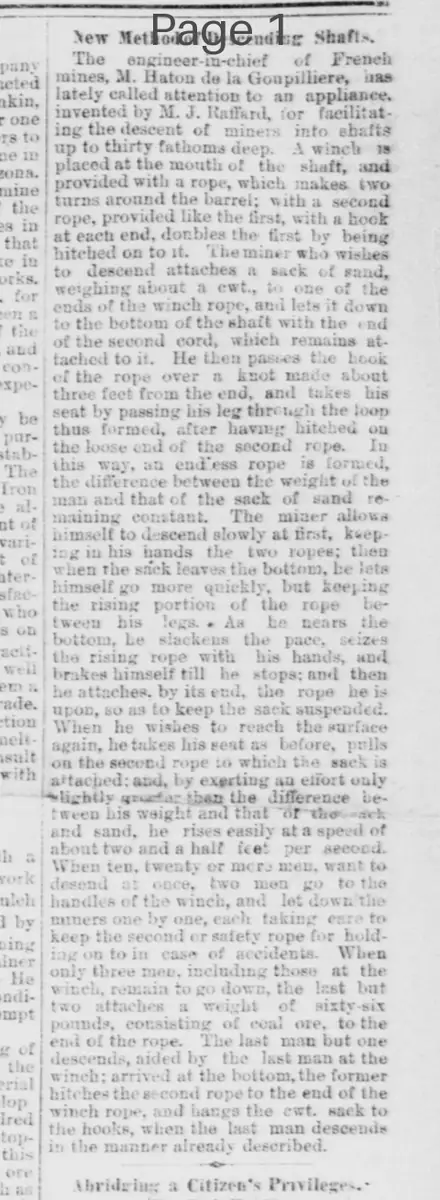
The engineer-in-chief of French mines, M. Haton de la Goupilliere, has lately called attention to an appliance, invented by M. J. Raffardl, for facilitating the descent of miners into shafts up to thirty fathoms deep. A winch is placed at the mouth of the shaft, and provided with a rope, which makes two turns around the barrel; with a second rope, provided like the first, with a hook each end doubles the first by being hitched on to it. The miner who wishes to descend attaches a sack of sand, weighing about a cwt., to one of the ends of the winch rope, and lets it down to the bottom of the shaft with the end of the second cord, which remains attached to it. He then passes the hook of the rope over a knot made about three feet from the end, and takes his seat by passing his leg through the loop thus formed, after having hitched on the loose end of the second rope. In this way, an endless rope is formed, the difference between the weight of the man and that of the sack of sand remaining constant. The miner allows himself to descend slowly at first, keeping in his hands the two ropes; then when the sack leaves the bottom, he lets himself go more quickly, but keeping the rising portion of the rope between his legs. As he nears the bottom, he slackens the pace, seizes the rising rope with his hands, and brakes himself till he stops: and then he attaches, by its end, the rope he is upon, so as to keep the sack suspended. When he wishes to reach the surface again, he takes his seat as before, pulls on the second rope to which the sack is attached: and, by exerting an effort only lightly greater than the difference between his weight and that of the sack and sand, he rises easily at a speed of about two and a half feet per second. When ten, twenty or more men want to descend once, two men go to the handles of the winch, and let down the miners one by one, each taking care to keep the second or safety rope for holding on to in case of accidents. When only three men, including those at the winch, remain to go down, the last but two attaches a weight of sixty six pounds, consisting of coal ore, to the end of the rope. The last man but one descends, aided by the last man at the winch: arrived at the bottom, the former hitches the second rope to the end of the winch rope, and hangs the cwt. sack to the hooks, when the last man descends in the manner already described.
What sub-type of article is it?
Curiosity
What themes does it cover?
Triumph
What keywords are associated?
Mining Invention
Descent Appliance
Winch Rope
Safety Device
Counterweight System
What entities or persons were involved?
M. Haton De La Goupilliere
M. J. Raffardl
Where did it happen?
French Mines
Story Details
Key Persons
M. Haton De La Goupilliere
M. J. Raffardl
Location
French Mines
Event Date
Lately
Story Details
Description of M. J. Raffardl's invention using a winch and dual ropes with a sand sack counterweight to allow safe, controlled descent and ascent for miners in shafts up to thirty fathoms deep, including procedures for single and multiple users.