Thank you for visiting SNEWPapers!
Sign up free
Literary
May 8, 1752
The Virginia Gazette
Richmond, Williamsburg, Richmond County, Virginia
What is this article about?
This philosophical essay reflects on memory as a defining human faculty, distinguishing people from animals by enabling recollection of the past and anticipation of the future. It discusses memory's role in moral agency, intellectual pleasures, and finding comfort in old age through a virtuous life reviewed without remorse.
Clipping
OCR Quality
98%
Excellent
Full Text
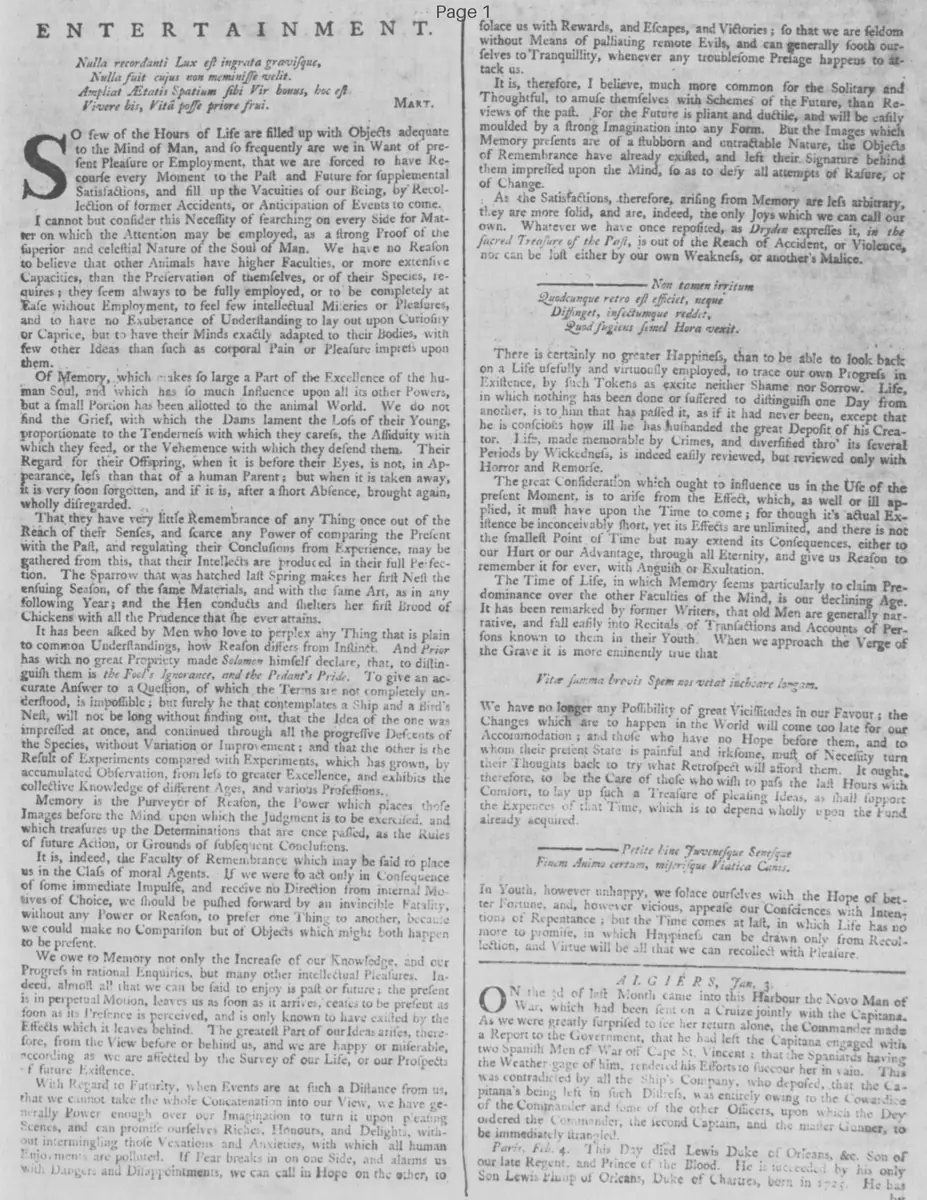
ENTERTAINMENT.
Nulla recordanti Lux est ingrataque,
Nulla fuit cujus non meminisse velit.
Ampliat Ætatis Spatium ibi Vir bonus, hoc et
Vivere bis, Vita posse priore frui.
MART.
Of few of the Hours of Life are filled up with Objects adequate to the Mind of Man, and so frequently are we in Want of present Pleasure or Employment, that we are forced to have Recourse every Moment to the Past and Future for supplemental Satisfactions, and fill up the Vacuities of our Being, by Recollection of former Accidents, or Anticipation of Events to come.
I cannot but consider this Necessity of searching on every Side for Matter on which the Attention may be employed, as a strong Proof of the superior and celestial Nature of the Soul of Man. We have no Reason to believe that other Animals have higher Faculties, or more extensive Capacities, than the Preservation of themselves, or of their Species, requires; they seem always to be fully employed, or to be completely at Ease without Employment, to feel few intellectual Miseries or Pleasures, and to have no Exuberance of Understanding to lay out upon Curiosity or Caprice, but to have their Minds exactly adapted to their Bodies, with few other Ideas than such as corporal Pain or Pleasure impress upon them.
Of Memory, which makes so large a Part of the Excellence of the human Soul, and which has so much Influence upon all its other Powers, but a small Portion has been allotted to the animal World. We do not find the Grief, with which the Dams lament the Loss of their Young, proportionate to the Tenderness with which they caress, the Assiduity with which they feed, or the Vehemence with which they defend them. Their Regard for their Offspring, when it is before their Eyes, is not, in Appearance, less than that of a human Parent; but when it is taken away, it is very soon forgotten, and if it is, after a short Absence, brought again, wholly disregarded.
That they have very little Remembrance of any Thing once out of the Reach of their Senses, and scarce any Power of comparing the Present with the Past, and regulating their Conclusions from Experience, may be gathered from this, that their Intellects are produced in their full Perfection. The Sparrow that was hatched last Spring makes her first Nest the ensuing Season, of the same Materials, and with the same Art, as in any following Year; and the Hen conducts and shelters her first Brood of Chickens with all the Prudence that she ever attains.
It has been asked by Men who love to perplex any Thing that is plain to common Understandings, how Reason differs from Instinct. And Prior has with no great Propriety made Solomon himself declare, that, to distinguish them is the Fool's Ignorance, and the Pedant's Pride. To give an accurate Answer to a Question, of which the Terms are not completely understood, is impossible; but surely he that contemplates a Ship and a Bird's Nest, will not be long without finding out, that the Idea of the one was impressed at once, and continued through all the progressive Descents of the Species, without Variation or Improvement; and that the other is the Result of Experiments compared with Experiments, which has grown, by accumulated Observation, from less to greater Excellence, and exhibits the collective Knowledge of different Ages, and various Professions.
Memory is the Purveyor of Reason, the Power which places those Images before the Mind upon which the Judgment is to be exercised, and which treasures up the Determinations that are once passed, as the Rules of future Action, or Grounds of subsequent Conclusions.
It is, indeed, the Faculty of Remembrance which may be said to place us in the Class of moral Agents. If we were to act only in Consequence of some immediate Impulse, and receive no Direction from internal Motives of Choice, we should be pushed forward by an invincible Fatality, without any Power or Reason, to prefer one Thing to another, because we could make no Comparison but of Objects which might both happen to be present.
We owe to Memory not only the Increase of our Knowledge, and our Progress in rational Enquiries, but many other intellectual Pleasures. Indeed, almost all that we can be said to enjoy is past or future; the present is in perpetual Motion, leaves us as soon as it arrives, ceases to be present as soon as its Presence is perceived, and is only known to have existed by the Effects which it leaves behind. The greatest Part of our Ideas arises, therefore, from the View before or behind us, and we are happy or miserable, according as we are affected by the Survey of our Life, or our Prospects of future Existence.
With Regard to Futurity, when Events are at such a Distance from us, that we cannot take the whole Concatenation into our View, we have generally Power enough over our Imagination to turn it upon picturing Scenes, and can promise ourselves Riches, Honours, and Delights, without intermingling those Vexations and Anxieties, with which all human Enjoyments are polluted. If Fear breaks in on one Side, and alarms us with Danger, and Disappointments, we can call in Hope on the other, to solace us with Rewards, and Escapes, and Victories; so that we are seldom without Means of palliating remote Evils, and can generally soothe ourselves to Tranquillity, whenever any troublesome Presage happens to attack us.
It is, therefore, I believe, much more common for the Solitary and Thoughtful, to amuse themselves with Schemes of the Future, than Reviews of the past. For the Future is pliant and ductile, and will be easily moulded by a strong Imagination into any Form. But the Images which Memory presents are of a stubborn and untractable Nature, the Objects of Remembrance have already existed, and left their Signature behind them impressed upon the Mind, so as to defy all attempts of Erasure, or of Change.
As the Satisfactions, therefore, arising from Memory are less arbitrary, they are more solid, and are, indeed, the only Joys which we can call our own. Whatever we have once reposited, as Dryden expresses it, in the sacred Treasure of the Past, is out of the Reach of Accident, or Violence, nor can be lost either by our own Weakness, or another's Malice.
Non tamen irritum
Quodcunque retro est efficiet, neque
Diffinget, infectumque reddet,
Quod fugiens semel Hora vexit.
There is certainly no greater Happiness, than to be able to look back on a Life usefully and virtuously employed, to trace our own Progress in Existence, by such Tokens as excite neither Shame nor Sorrow. Life, in which nothing has been done or suffered to distinguish one Day from another, is to him that has passed it, as if it had never been, except that he is conscious how ill he has husbanded the great Deposit of his Creator.
Life, made memorable by Crimes, and diversified thro' its several Periods by Wickedness, is indeed easily reviewed, but reviewed only with Horror and Remorse.
The great Consideration which ought to influence us in the Use of the present Moment, is to arise from the Effect, which, as well or ill applied, it must have upon the Time to come; for though its actual Existence be inconceivably short, yet its Effects are unlimited, and there is not the smallest Point of Time but may extend its Consequences, either to our Hurt or our Advantage, through all Eternity, and give us Reason to remember it for ever, with Anguish or Exultation.
The Time of Life, in which Memory seems particularly to claim Pre- dominance over the other Faculties of the Mind, is our declining Age. It has been remarked by former Writers, that old Men are generally narrative, and fall easily into Recitals of Transactions and Accounts of Persons known to them in their Youth. When we approach the Verge of the Grave it is more eminently true that
Vitæ summa brevis spem nos vetat inchoare longam.
We have no longer any Possibility of great Vicissitudes in our Favour; the Changes which are to happen in the World will come too late for our Accommodation; and those who have no Hope before them, and to whom their present State is painful and irksome, must of Necessity turn their Thoughts back to try what Retrospect will afford them. It ought, therefore, to be the Care of those who wish to pass the last Hours with Comfort, to lay up such a Treasure of pleasing Ideas, as shall support the Expences of that Time, which is to depend wholly upon the Fund already acquired.
Petite, hine Juveneque Senesque,
Finem Animo certum, miserisque Viatica Canis.
In Youth, however unhappy, we solace ourselves with the Hope of better Fortune, and, however vicious, appease our Consciences with Intentions of Repentance; but the Time comes at last, in which Life has no more to promise, in which Happiness can be drawn only from Recollection, and Virtue will be all that we can recollect with Pleasure.
Nulla recordanti Lux est ingrataque,
Nulla fuit cujus non meminisse velit.
Ampliat Ætatis Spatium ibi Vir bonus, hoc et
Vivere bis, Vita posse priore frui.
MART.
Of few of the Hours of Life are filled up with Objects adequate to the Mind of Man, and so frequently are we in Want of present Pleasure or Employment, that we are forced to have Recourse every Moment to the Past and Future for supplemental Satisfactions, and fill up the Vacuities of our Being, by Recollection of former Accidents, or Anticipation of Events to come.
I cannot but consider this Necessity of searching on every Side for Matter on which the Attention may be employed, as a strong Proof of the superior and celestial Nature of the Soul of Man. We have no Reason to believe that other Animals have higher Faculties, or more extensive Capacities, than the Preservation of themselves, or of their Species, requires; they seem always to be fully employed, or to be completely at Ease without Employment, to feel few intellectual Miseries or Pleasures, and to have no Exuberance of Understanding to lay out upon Curiosity or Caprice, but to have their Minds exactly adapted to their Bodies, with few other Ideas than such as corporal Pain or Pleasure impress upon them.
Of Memory, which makes so large a Part of the Excellence of the human Soul, and which has so much Influence upon all its other Powers, but a small Portion has been allotted to the animal World. We do not find the Grief, with which the Dams lament the Loss of their Young, proportionate to the Tenderness with which they caress, the Assiduity with which they feed, or the Vehemence with which they defend them. Their Regard for their Offspring, when it is before their Eyes, is not, in Appearance, less than that of a human Parent; but when it is taken away, it is very soon forgotten, and if it is, after a short Absence, brought again, wholly disregarded.
That they have very little Remembrance of any Thing once out of the Reach of their Senses, and scarce any Power of comparing the Present with the Past, and regulating their Conclusions from Experience, may be gathered from this, that their Intellects are produced in their full Perfection. The Sparrow that was hatched last Spring makes her first Nest the ensuing Season, of the same Materials, and with the same Art, as in any following Year; and the Hen conducts and shelters her first Brood of Chickens with all the Prudence that she ever attains.
It has been asked by Men who love to perplex any Thing that is plain to common Understandings, how Reason differs from Instinct. And Prior has with no great Propriety made Solomon himself declare, that, to distinguish them is the Fool's Ignorance, and the Pedant's Pride. To give an accurate Answer to a Question, of which the Terms are not completely understood, is impossible; but surely he that contemplates a Ship and a Bird's Nest, will not be long without finding out, that the Idea of the one was impressed at once, and continued through all the progressive Descents of the Species, without Variation or Improvement; and that the other is the Result of Experiments compared with Experiments, which has grown, by accumulated Observation, from less to greater Excellence, and exhibits the collective Knowledge of different Ages, and various Professions.
Memory is the Purveyor of Reason, the Power which places those Images before the Mind upon which the Judgment is to be exercised, and which treasures up the Determinations that are once passed, as the Rules of future Action, or Grounds of subsequent Conclusions.
It is, indeed, the Faculty of Remembrance which may be said to place us in the Class of moral Agents. If we were to act only in Consequence of some immediate Impulse, and receive no Direction from internal Motives of Choice, we should be pushed forward by an invincible Fatality, without any Power or Reason, to prefer one Thing to another, because we could make no Comparison but of Objects which might both happen to be present.
We owe to Memory not only the Increase of our Knowledge, and our Progress in rational Enquiries, but many other intellectual Pleasures. Indeed, almost all that we can be said to enjoy is past or future; the present is in perpetual Motion, leaves us as soon as it arrives, ceases to be present as soon as its Presence is perceived, and is only known to have existed by the Effects which it leaves behind. The greatest Part of our Ideas arises, therefore, from the View before or behind us, and we are happy or miserable, according as we are affected by the Survey of our Life, or our Prospects of future Existence.
With Regard to Futurity, when Events are at such a Distance from us, that we cannot take the whole Concatenation into our View, we have generally Power enough over our Imagination to turn it upon picturing Scenes, and can promise ourselves Riches, Honours, and Delights, without intermingling those Vexations and Anxieties, with which all human Enjoyments are polluted. If Fear breaks in on one Side, and alarms us with Danger, and Disappointments, we can call in Hope on the other, to solace us with Rewards, and Escapes, and Victories; so that we are seldom without Means of palliating remote Evils, and can generally soothe ourselves to Tranquillity, whenever any troublesome Presage happens to attack us.
It is, therefore, I believe, much more common for the Solitary and Thoughtful, to amuse themselves with Schemes of the Future, than Reviews of the past. For the Future is pliant and ductile, and will be easily moulded by a strong Imagination into any Form. But the Images which Memory presents are of a stubborn and untractable Nature, the Objects of Remembrance have already existed, and left their Signature behind them impressed upon the Mind, so as to defy all attempts of Erasure, or of Change.
As the Satisfactions, therefore, arising from Memory are less arbitrary, they are more solid, and are, indeed, the only Joys which we can call our own. Whatever we have once reposited, as Dryden expresses it, in the sacred Treasure of the Past, is out of the Reach of Accident, or Violence, nor can be lost either by our own Weakness, or another's Malice.
Non tamen irritum
Quodcunque retro est efficiet, neque
Diffinget, infectumque reddet,
Quod fugiens semel Hora vexit.
There is certainly no greater Happiness, than to be able to look back on a Life usefully and virtuously employed, to trace our own Progress in Existence, by such Tokens as excite neither Shame nor Sorrow. Life, in which nothing has been done or suffered to distinguish one Day from another, is to him that has passed it, as if it had never been, except that he is conscious how ill he has husbanded the great Deposit of his Creator.
Life, made memorable by Crimes, and diversified thro' its several Periods by Wickedness, is indeed easily reviewed, but reviewed only with Horror and Remorse.
The great Consideration which ought to influence us in the Use of the present Moment, is to arise from the Effect, which, as well or ill applied, it must have upon the Time to come; for though its actual Existence be inconceivably short, yet its Effects are unlimited, and there is not the smallest Point of Time but may extend its Consequences, either to our Hurt or our Advantage, through all Eternity, and give us Reason to remember it for ever, with Anguish or Exultation.
The Time of Life, in which Memory seems particularly to claim Pre- dominance over the other Faculties of the Mind, is our declining Age. It has been remarked by former Writers, that old Men are generally narrative, and fall easily into Recitals of Transactions and Accounts of Persons known to them in their Youth. When we approach the Verge of the Grave it is more eminently true that
Vitæ summa brevis spem nos vetat inchoare longam.
We have no longer any Possibility of great Vicissitudes in our Favour; the Changes which are to happen in the World will come too late for our Accommodation; and those who have no Hope before them, and to whom their present State is painful and irksome, must of Necessity turn their Thoughts back to try what Retrospect will afford them. It ought, therefore, to be the Care of those who wish to pass the last Hours with Comfort, to lay up such a Treasure of pleasing Ideas, as shall support the Expences of that Time, which is to depend wholly upon the Fund already acquired.
Petite, hine Juveneque Senesque,
Finem Animo certum, miserisque Viatica Canis.
In Youth, however unhappy, we solace ourselves with the Hope of better Fortune, and, however vicious, appease our Consciences with Intentions of Repentance; but the Time comes at last, in which Life has no more to promise, in which Happiness can be drawn only from Recollection, and Virtue will be all that we can recollect with Pleasure.
What sub-type of article is it?
Essay
What themes does it cover?
Moral Virtue
Death Mortality
What keywords are associated?
Memory
Recollection
Human Soul
Moral Agency
Past Future
Declining Age
Virtuous Life
Literary Details
Subject
On Memory And The Human Soul
Key Lines
Of Few Of The Hours Of Life Are Filled Up With Objects Adequate To The Mind Of Man, And So Frequently Are We In Want Of Present Pleasure Or Employment, That We Are Forced To Have Recourse Every Moment To The Past And Future For Supplemental Satisfactions, And Fill Up The Vacuities Of Our Being, By Recollection Of Former Accidents, Or Anticipation Of Events To Come.
Memory Is The Purveyor Of Reason, The Power Which Places Those Images Before The Mind Upon Which The Judgment Is To Be Exercised, And Which Treasures Up The Determinations That Are Once Passed, As The Rules Of Future Action, Or Grounds Of Subsequent Conclusions.
It Is, Indeed, The Faculty Of Remembrance Which May Be Said To Place Us In The Class Of Moral Agents.
There Is Certainly No Greater Happiness, Than To Be Able To Look Back On A Life Usefully And Virtuously Employed, To Trace Our Own Progress In Existence, By Such Tokens As Excite Neither Shame Nor Sorrow.
In Youth, However Unhappy, We Solace Ourselves With The Hope Of Better Fortune, And, However Vicious, Appease Our Consciences With Intentions Of Repentance; But The Time Comes At Last, In Which Life Has No More To Promise, In Which Happiness Can Be Drawn Only From Recollection, And Virtue Will Be All That We Can Recollect With Pleasure.