Thank you for visiting SNEWPapers!
Sign up free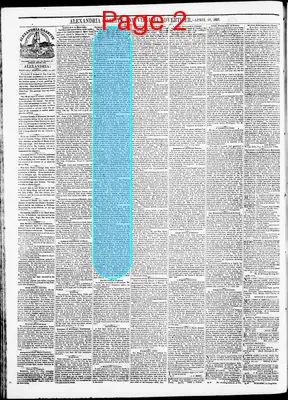
Story
April 29, 1857
Alexandria Gazette
Alexandria, Alexandria County, District Of Columbia
What is this article about?
19th-century commentary on mass westward emigration from eastern U.S. states to territories like Iowa and Nebraska, fueled by cheap land, speculation in town lots, and railways, warning of inflated prices, depopulation, and impending financial crisis affecting commerce.
Clipping

OCR Quality
95%
Excellent
Full Text
Emigration West—Land Speculations.
The remarkable Exodus now in progress from the older States into the territories newly opened for settlement, exhibits, in a striking manner, that constant craving for change of scene under the expectation of doing better elsewhere, which is a prominent trait in the American character. Very few estates remain in possession of the same family for more than one generation, and it is to this general sense of unsettledness, this consciousness that any one who desires a particular farm can obtain it if he offers the merest trifle above its estimated value, which keeps the proprietor of to-day from grappling closely with the land he owns, and making of it, as it were, a heirloom to be cherished by his descendants.
The repudiation of the old English law of primogeniture has had, of course, a good deal to do with this frequent change of ownership, from the necessity of dividing estates among the children on the death of their parents. Other causes have also operated to prevent the farmer from taking deep root in the soil he tills. The slovenly mode of cultivation that has been, until of late years, but too common in the older States, has exhausted the land, to a considerable extent, of its original fertility, while the increase of population, especially within easy distance of large cities, has given to it, as property, a value, the annual interest of which is far greater than the net profits derived from its cultivated products. Another inducement to exchange the worn out land of the Atlantic slope for fertile transmontane prairies, lies not only in the insignificant price per acre to be paid for the latter, and their superior yield, but also in the facility with which a market can be reached since the introduction of railways, and the rapidity with which these public improvements are made to pierce the wilderness through the assistance rendered by the general Government to States and corporations.
But this vast army of emigrants is not composed of agriculturists only, but comprises men of all classes of society, and of all trades and professions. For the most part, they do not go into the wilderness to sell merchandise—to cultivate the soil—or to follow the practice of medicine or of the law, but in the hope of making something beyond either of these sources of remuneration by speculating in town lots and sections of townships. Thus it comes that Western lands have latterly attracted to an unusual degree the attention of capitalists and adventurers. Large companies have been organized in many of the old States, for the express purpose of making extensive purchases of land at the Government price and holding them for a rise. In New England, New York, Pennsylvania, Ohio and Kentucky, the journals are continually referring to the mania for migration to Iowa, Minnesota, Kansas, and Nebraska. The Cincinnati Gazette notices the immense number of emigrants passing through that city, in the hope of finding a new El Dorado on the upper waters of the Missouri. The newspapers of the interior of Ohio complain that whole counties begin to show signs of depopulation, and in those places where manufactures are carried on—as at Massillon, for example—the owners of the works have found it necessary to double the usual wages of their operatives, as an inducement for them to remain.
'A few days ago,' says the Pittsburg Gazette, 'a large company of leading, active men, of the first respectability, left Perry county with considerable sums of money withdrawn from circulation in Pennsylvania to be invested in Nebraska, somewhere about Omaha.' Other sections of the country furnish us with similar reports, and, at the same time, the mania for speculation rages in the Territories to such an extent that the Times, published at St. Paul, Minnesota, states that as high as from 12 to 15 per cent. a month was being paid at that place for the loan of money.
What the end of this is to be, any one not infatuated may easily divine. Prices now are inordinately inflated, and though they may be kept up for a time, like those which ruled in California after the gold discoveries took place, they must eventually decline almost as rapidly as they rose, and reduce to absolute poverty and destitution many of those who are now so sanguine of realizing immense fortunes.
The effect of this Westward drain of specie is already felt, to some extent, at all the large commercial centres, and there is good reason to fear that more serious results will follow. The wholesale merchants of the seaboard depend for their stability upon the punctuality with which their customers in the interior meet their indebtedness at maturity. If the latter fail in making their collections in due season, owing to the causes of which we have spoken, a monetary crisis must inevitably ensue, and, as the basis upon which the Western speculations are founded, is not only unsound, but, in our opinion, wholly illusory. It would be well for our merchants, whose trade lies in that direction, to guard, as far as possible, against becoming embarrassed by risking too much of their means in the hands of persons who, however honest they may be, are yet subjected to contingencies which, from the present appearance of things, may prevent them from fulfilling their engagements within a reasonable period, and which, in the event of a sudden collapse, would be productive of disastrous consequences to themselves, and to all others connected with them.—Baltimore Patriot.
The remarkable Exodus now in progress from the older States into the territories newly opened for settlement, exhibits, in a striking manner, that constant craving for change of scene under the expectation of doing better elsewhere, which is a prominent trait in the American character. Very few estates remain in possession of the same family for more than one generation, and it is to this general sense of unsettledness, this consciousness that any one who desires a particular farm can obtain it if he offers the merest trifle above its estimated value, which keeps the proprietor of to-day from grappling closely with the land he owns, and making of it, as it were, a heirloom to be cherished by his descendants.
The repudiation of the old English law of primogeniture has had, of course, a good deal to do with this frequent change of ownership, from the necessity of dividing estates among the children on the death of their parents. Other causes have also operated to prevent the farmer from taking deep root in the soil he tills. The slovenly mode of cultivation that has been, until of late years, but too common in the older States, has exhausted the land, to a considerable extent, of its original fertility, while the increase of population, especially within easy distance of large cities, has given to it, as property, a value, the annual interest of which is far greater than the net profits derived from its cultivated products. Another inducement to exchange the worn out land of the Atlantic slope for fertile transmontane prairies, lies not only in the insignificant price per acre to be paid for the latter, and their superior yield, but also in the facility with which a market can be reached since the introduction of railways, and the rapidity with which these public improvements are made to pierce the wilderness through the assistance rendered by the general Government to States and corporations.
But this vast army of emigrants is not composed of agriculturists only, but comprises men of all classes of society, and of all trades and professions. For the most part, they do not go into the wilderness to sell merchandise—to cultivate the soil—or to follow the practice of medicine or of the law, but in the hope of making something beyond either of these sources of remuneration by speculating in town lots and sections of townships. Thus it comes that Western lands have latterly attracted to an unusual degree the attention of capitalists and adventurers. Large companies have been organized in many of the old States, for the express purpose of making extensive purchases of land at the Government price and holding them for a rise. In New England, New York, Pennsylvania, Ohio and Kentucky, the journals are continually referring to the mania for migration to Iowa, Minnesota, Kansas, and Nebraska. The Cincinnati Gazette notices the immense number of emigrants passing through that city, in the hope of finding a new El Dorado on the upper waters of the Missouri. The newspapers of the interior of Ohio complain that whole counties begin to show signs of depopulation, and in those places where manufactures are carried on—as at Massillon, for example—the owners of the works have found it necessary to double the usual wages of their operatives, as an inducement for them to remain.
'A few days ago,' says the Pittsburg Gazette, 'a large company of leading, active men, of the first respectability, left Perry county with considerable sums of money withdrawn from circulation in Pennsylvania to be invested in Nebraska, somewhere about Omaha.' Other sections of the country furnish us with similar reports, and, at the same time, the mania for speculation rages in the Territories to such an extent that the Times, published at St. Paul, Minnesota, states that as high as from 12 to 15 per cent. a month was being paid at that place for the loan of money.
What the end of this is to be, any one not infatuated may easily divine. Prices now are inordinately inflated, and though they may be kept up for a time, like those which ruled in California after the gold discoveries took place, they must eventually decline almost as rapidly as they rose, and reduce to absolute poverty and destitution many of those who are now so sanguine of realizing immense fortunes.
The effect of this Westward drain of specie is already felt, to some extent, at all the large commercial centres, and there is good reason to fear that more serious results will follow. The wholesale merchants of the seaboard depend for their stability upon the punctuality with which their customers in the interior meet their indebtedness at maturity. If the latter fail in making their collections in due season, owing to the causes of which we have spoken, a monetary crisis must inevitably ensue, and, as the basis upon which the Western speculations are founded, is not only unsound, but, in our opinion, wholly illusory. It would be well for our merchants, whose trade lies in that direction, to guard, as far as possible, against becoming embarrassed by risking too much of their means in the hands of persons who, however honest they may be, are yet subjected to contingencies which, from the present appearance of things, may prevent them from fulfilling their engagements within a reasonable period, and which, in the event of a sudden collapse, would be productive of disastrous consequences to themselves, and to all others connected with them.—Baltimore Patriot.
What sub-type of article is it?
Historical Event
Journey
What themes does it cover?
Exploration
Fortune Reversal
Misfortune
What keywords are associated?
Westward Emigration
Land Speculation
Territory Settlement
Economic Mania
Speculation Bubble
Prairie Farming
Railway Expansion
Where did it happen?
Older States To Iowa, Minnesota, Kansas, Nebraska
Story Details
Location
Older States To Iowa, Minnesota, Kansas, Nebraska
Story Details
Article discusses mass emigration from eastern states to western territories driven by land speculation, cheap fertile lands, and railway access, involving diverse classes hoping for quick fortunes in town lots, leading to inflated prices and potential economic crisis.