Thank you for visiting SNEWPapers!
Sign up free
Phenix Gazette
Alexandria, Virginia
What is this article about?
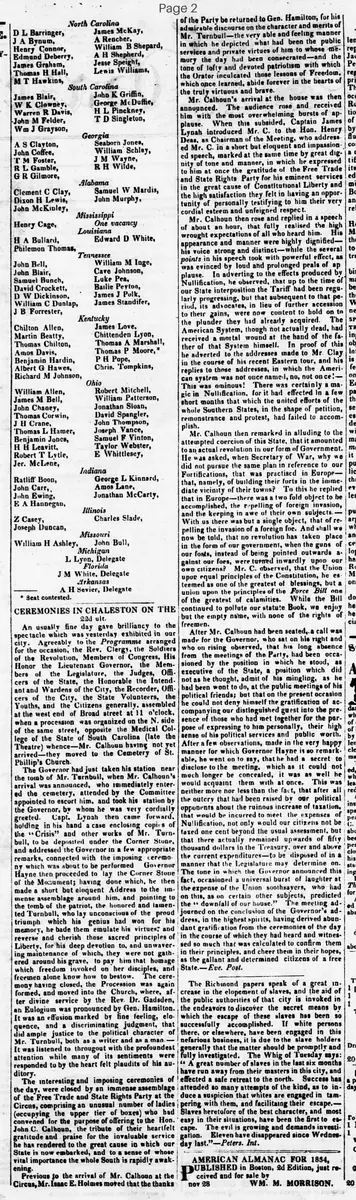
Ceremonies in Charleston on the 22nd ult. included laying the corner stone for a monument to patriot Robert Turnbull, an eulogium by Gen. Hamilton, and a Free Trade and State Rights Party meeting honoring John C. Calhoun with speeches on nullification and liberty.
Clipping
OCR Quality
Full Text
22d ult.
An unusually fine day gave brilliancy to the
spectacle which was yesterday exhibited in our
city. Agreeably to the Programme arranged
for the occasion, the Rev. Clergy, the Soldiers
of the Revolution, Members of Congress, His
Honor the Lieutenant Governor, the Members
of the Legislature, the Judges, Officers of the State, the Honorable the Intendant
and Wardens of the City, the Recorder, Officers
of the City, the State Volunteers, the
Youths, and the Citizens generally, assembled
at the west end of Broad street at 11 o'clock,
when a procession was organized on the N. side
of the same street, opposite the Medical College
of the State of South Carolina (late the
Theatre) whence—Mr. Calhoun having not yet
arrived—they moved to the Cemetery of St.
Phillip's Church.
The Governor had just taken his station near
the tomb of Mr. Turnbull, when Mr. Calhoun's
arrival was announced, who immediately entered
the cemetery, attended by the Committee
appointed to escort him, and took his station by
the Governor, by whom he was very cordially
greeted.
Capt. Lynah then came forward,
holding in his hand a case enclosing copies of
the "Crisis" and other works of Mr. Turnbull, to be deposited under the Corner Stone,
and addressed the Governor in a few appropriate
remarks, connected with the imposing ceremony
which was about to be performed.
Governor
Hayne then proceeded to lay the Corner Stone
of the Monument; having done which, he then
made a short but eloquent Address to the immense
assemblage around him, and pointing to
the tomb of the patriot, the honored and lamented
Turnbull, who lay unconscious of the proud
triumph which his genius had won for his
memory, he bade them emulate his virtues; and
reverse and cherish those sacred principles of
Liberty, for his deep devotion to, and unwavering
maintenance of which, they were not gathered
around his grave, to pay him that homage
which freedom invokes on her disciples, and
freemen alone know how to bestow.
The ceremony
having closed, the Procession was again
formed, and moved into the Church, where, after
divine service by the Rev. Dr. Gadsden,
an Eulogium was pronounced by Gen. Hamilton.
It was an effusion marked by fine feeling, eloquence,
and a discriminating judgment, that
did ample justice to the political character of
Mr. Turnbull, both as a writer and as a man.
It was listened to throughout with the profoundest
attention while many of its sentiments were
responded to by the heart-felt plaudits of his audience.
The interesting and imposing ceremonies of
the day, were closed by an immense assemblage
of the Free Trade and State Rights Party at the
Circus, comprising an unusual number of ladies
(occupying the upper tier of boxes) who had
convened for the purpose of offering to the Hon.
John C. Calhoun, the tribute of their heartfelt
gratitude and praise for the invaluable service
he has rendered to the great cause in which our
State is now embarked, and to a sense of whose
vital importance the whole South is rapidly awakening.
Previous to the arrival of Mr. Calhoun at the
Circus, Mr. Isaac E. Holmes moved that the thanks
of the Party be returned to Gen. Hamilton, for his
admirable discourse on the character and merits of
Mr. Turnbull—the very able and feeling manner
in which he depicted what had been the public
services and private virtues of him to whose memory
the day had been consecrated—and the
tone of lofty and devoted patriotism with which
the Orator inculcated those lessons of Freedom,
which once learned, abide forever in the hearts of
the truly virtuous and brave.
Mr. Calhoun's arrival at the house was then
announced. The audience rose and received
him with the most overwhelming bursts of applause.
When this subsided, Captain James
Lynah introduced Mr. C. to the Hon. Henry
Deas, as Chairman of the Meeting, who addressed
Mr. C. in a short but eloquent and impassioned
speech, marked at the same time by great dignity
of tone and manner, in which he expressed
to him at once the gratitude of the Free Trade
and State Rights Party for his eminent services
in the great cause of Constitutional Liberty and
the high satisfaction they felt in having an opportunity
of personally testifying to him their very
cordial esteem and unfeigned respect.
Mr. Calhoun then rose and replied in a speech
of about an hour, that fully realised the high
wrought expectations of all who heard him. His
appearance and manner were highly dignified—
his voice strong and distinct—while the several
points in his speech took with powerful effect, as
was evinced by loud and prolonged peals of applause.
In adverting to the effects produced by
Nullification, he observed, that up to the time of
our State interposition the Tariff had been regularly
progressing, but that subsequent to that period,
its advocates, in lieu of further accession
to their gains, were now content to hold on to
the plunder they had already acquired. The
American System, though not actually dead, had
received a mortal wound at the hand of the father
of that System himself. In proof of this
he adverted to the addresses made to Mr. Clay
in the course of his recent Eastern tour, and his
replies to those addresses, in which the American
system was not once named, no, not once!
—
This was ominous! There was certainly a magic
in Nullification, for it had effected in a few
short months that which the united efforts of the
whole Southern States, in the shape of petition,
remonstrance and protest, had failed to accomplish.
Mr. Calhoun then remarked in alluding to the
attempted coercion of this State, that it amounted
to an actual revolution in our form of Government.
He was asked, when Secretary of War, why we
did not pursue the same plan in reference to our
Fortifications, that was practised in Europe—
that, namely, of building their forts in the immediate
vicinity of their towns? To this he replied
that in Europe—there was a two fold object to be
accomplished, the repelling of foreign invasion,
and the keeping in awe of their own subjects.
With us there was but a single object, that of repelling
the invasion of a foreign foe. And shall we
now be told, that no revolution has taken place
in the form of our government, when the guns of
our forts, instead of being pointed outwards against
our foes, were turned inwardly upon our
own citizens? Mr. C. observed, that the Union
upon equal principles of the Constitution, he esteemed
as one of the greatest of blessings, but a
union upon the principles of the Force Bill one
of the greatest of calamities. While the Bill
continued to pollute our statute Book, we enjoy
but the empty name, with none of the rights of
freemen.
After Mr. Calhoun had been seated, a call was
made for the Governor, who sat on his right and
who on rising observed, that his long absence
from the meetings of the Party, had been occasioned
by the position in which he stood, as
executive of the State, a position which did
not as he thought, admit of his mingling, as he
had been wont to do, at the public meetings of his
political friends; but that on the present occasion
he could not deny himself the gratification of accompanying
our distinguished guest into the presence
of those who had met together for the purpose
of expressing to him personally, their high
sense of his political services and public worth.
After a few observations, made in the very happy
manner for which Governor Hayne is so remarkable,
he went on to say, that he had a secret to
disclose to the meeting, which as it could not
much longer be concealed, it was as well he
would acquaint them with at once. This was
neither more nor less than the fact, that after all
the outcry that had been raised by our political
opponents about the ruinous increase of taxation.
that would be incurred to meet the expenses of
Nullification, not only would our citizens not be
taxed one cent beyond the usual assessment, but
that there actually remained upwards of fifty
thousand dollars in the Treasury, over and above
the current expenditures—to be disposed of in a
manner that the Legislature may determine on.
The tone in which the Governor announced this
fact, occasioned a universal burst of laughter at
the expense of the Union soothsayers, who had
on this, as on certain other subjects, predicted
the "downfall of our house." The meeting adjourned
on the conclusion of the Governor's address,
in the highest spirits, having derived abundant
gratification from the ceremonies of the day
in the course of which they had heard and witnessed
so much that was calculated to confirm them
in their principles, and cheer them in their hopes,
as the gallant and determined citizens of a free
State.—Eve. Post
What sub-type of article is it?
What themes does it cover?
What keywords are associated?
What entities or persons were involved?
Where did it happen?
Story Details
Key Persons
Location
Charleston
Event Date
22d Ult.
Story Details
Procession and ceremony to lay the corner stone of a monument to patriot Mr. Turnbull at St. Phillip's Church Cemetery, with address by Governor Hayne; eulogium by Gen. Hamilton in church; Free Trade and State Rights Party meeting at the Circus honoring John C. Calhoun with speeches on nullification, tariff, and state liberty by Calhoun, Deas, and Hayne.