Thank you for visiting SNEWPapers!
Sign up free
Literary
March 5, 1812
Virginia Argus
Richmond, Virginia
What is this article about?
Letter XXI to the Virginia Argus editor details the post-Roman Empire formation of Italian kingdoms and principalities, including historical conflicts between emperors and popes, evolutions of states like Tuscany, Naples, and Venice, and brief biographies of notable Italian poets (Dante, Petrarch) and painters (Raphael, Michelangelo).
Clipping
OCR Quality
95%
Excellent
Full Text
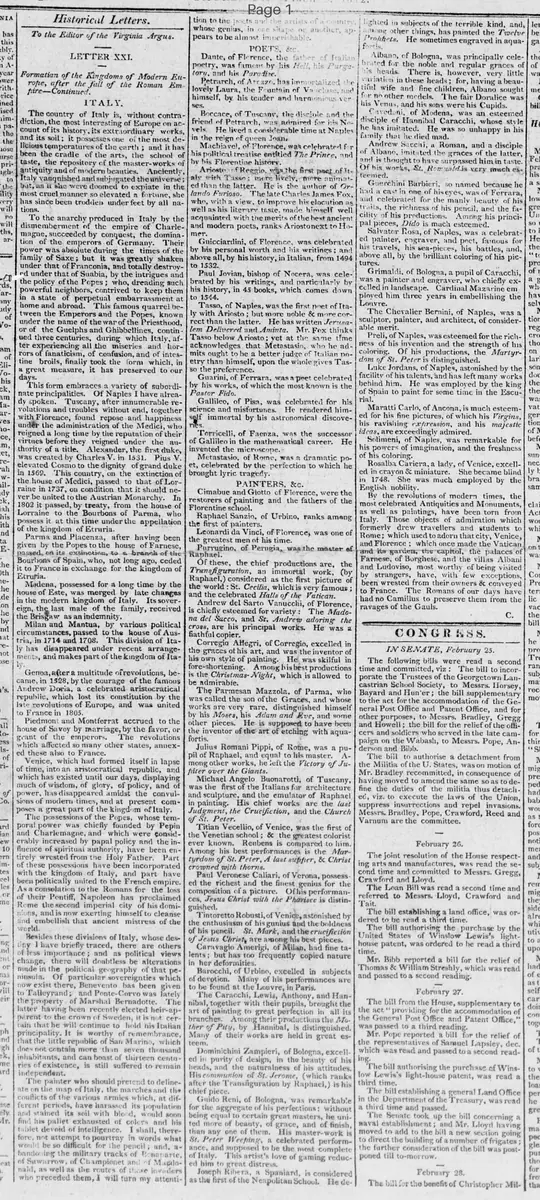
Historical Letters.
To the Editor of the Virginia Argus.
LETTER XXI
Formation of the Kingdoms of Modern Europe, after the fall of the Roman Empire—Continued.
ITALY.
The country of Italy is, without contradiction, the most interesting of Europe on account of its history, its extraordinary works, and its soil: it possesses one of the most delicious temperatures of the earth; and it has been the cradle of the arts, the school of taste, the repository of the master-works of antiquity and of modern beauties. Anciently, Italy vanquished and subjugated the universe; but, as if she were doomed to expiate in the most cruel manner so elevated a fortune, she has since been trodden under feet by all nations.
To the anarchy produced in Italy by the dismemberment of the empire of Charlemagne, succeeded conquest, the domination of the emperors of Germany. Their power was absolute during the times of the family of Saxony: but it was greatly shaken under that of Franconia, and totally destroyed under that of Suabia, by the intrigues and the policy of the Popes; who, dreading such powerful neighbors, contrived to keep them in a state of perpetual embarrassment at home and abroad. This famous quarrel between the Emperors and the Popes, known under the name of the war of the Priesthood, or of the Guelphs and Ghibellines, continued three centuries, during which Italy, after experiencing all the miseries and horrors of fanaticism, of confusion, and of intestine broils, finally took the form which, in a great measure, it has preserved to our days.
This form embraces a variety of subordinate principalities. Of Naples I have already spoken. Tuscany, after innumerable revolutions and troubles without end, together with Florence, found repose and happiness under the administration of the Medici, who reigned a long time by the reputation of their virtues before they reigned under the authority of a title. Alexander, the first duke, was created by Charles V. in 1531. Pius V. elevated Cosmo to the dignity of grand duke in 1569. This country, on the extinction of the house of Medici, passed to that of Lorraine in 1737, on condition that it should never be united to the Austrian Monarchy. In 1802 it passed, by treaty, from the house of Lorraine to the Bourbons of Parma, who possess it at this time under the appellation of the kingdom of Etruria.
Parma and Piacenza, after having been given by the Popes to the house of Farnese, passed, on its extinction, to a branch of the Bourbons of Spain, who, not long ago, ceded it to France in exchange for the kingdom of Etruria.
Modena, possessed for a long time by the house of Este, was merged by late changes in the modern kingdom of Italy. Its sovereign, the last male of the family, received the Brisgau as an indemnity.
Milan and Mantua, by various political circumstances, passed to the house of Austria, in 1714 and 1708. This division of Italy has disappeared under recent arrangements, and makes part of the kingdom of Italy.
Genoa, after a multitude of revolutions, became, in 1528, by the courage of the famous Andrew Doria, a celebrated aristocratical republic, which lost its constitution by the late revolutions of Europe, and was united to France in 1805.
Piedmont and Montferrat accrued to the house of Savoy by marriage, by the favor, or grant of the emperors. The revolutions which affected so many other states, annexed these also to France.
Venice, which had formed itself in lapse of time, into an aristocratical republic, and which has existed until our days, displaying much of wisdom, of glory, of policy, and of power, has disappeared amidst the convulsions of modern times, and at present composes a great part of the kingdom of Italy.
The possessions of the Popes, whose temporal power was chiefly founded by Pepin and Charlemagne, and which were considerably increased by papal policy and the influence of spiritual authority, have been entirely wrested from the Holy Father. Part of these possessions have been incorporated with the kingdom of Italy, and part have been politically united to the French empire. As a consolation to the Romans for the loss of their Pontiff, Napoleon has proclaimed Rome the second imperial city of his dominions, and is now exerting himself to cleanse and embellish that ancient mistress of the world.
Besides these divisions of Italy, whose destiny I have briefly traced, there are others of less importance; and as political views change, there will doubtless be alterations made in the political geography of that peninsula. Of particular sovereignties which now exist there, Benevento has been given to Talleyrand; and Ponte-Corvo was lately the property of Marshal Bernadotte. The latter having been recently elected heir-apparent to the crown of Sweden, it is not certain that he will continue to hold his Italian principality. It is worthy of remembrance, that the little republic of San Marino, which does not contain more than seven thousand inhabitants, and can boast of thirteen centuries of existence, is still suffered to remain independent.
The painter who should pretend to delineate on the map of Italy, the marches and the conflicts of the various armies which, at different periods, have harassed its population and stained its soil with blood, would soon find his palette exhausted of colors and his tablet devoid of intelligence. I shall, therefore, not attempt to portray in words what would be so difficult for the pencil; and, abandoning the military tracks of Bonaparte, of Suwarrow, of Championet and MacDonald, as well as the routes of those invaders who preceded them, I will turn my attention to the poets and the artists of a country whose genius, in one stage or another, appears to be almost imperishable.
POETS. &C
Dante, of Florence, the father of Italian poetry, was famous by his Hell, his Purgatory, and his Paradise.
Petrarch, of Arezzo, has immortalized the lovely Laura, the Fountain of Vaucluse, and himself, by his tender and harmonious verses.
Boccace, of Tuscany, the disciple and the friend of Petrarch, was admired for his Novels. He lived a considerable time at Naples in the reign of queen Joan.
Machiavel, of Florence, was celebrated for his political treatise entitled The Prince, and by his Florentine history.
Ariosto of Reggio, was the first poet of Italy with Tasso: more lively, more animated than the latter. He is the author of Orlando Furioso. The late Charles James Fox, who, with a view to improve his elocution as well as his literary taste, made himself well acquainted with the merits of the best ancient and modern poets, ranks Ariosto next to Homer.
Guicciardini, of Florence, was celebrated by his personal worth and his writings; and above all, by his history, in Italian, from 1494 to 1532.
Paul Jovius, bishop of Nocera, was celebrated by his writings, and particularly by his history, in 45 books, which comes down to 1544.
Tasso, of Naples, was the first poet of Italy with Ariosto: but more noble & more correct than the latter. He has written Jerusalem Delivered and Aminta. Mr. Fox thinks Tasso below Ariosto; yet at the same time acknowledges that Metastasio, who he admits ought to be a better judge of Italian poetry than himself, upon the whole gives Tasso the preference.
Guarini, of Ferrara, was a poet celebrated by his works, of which the most known is the Pastor Fido.
Gallileo, of Pisa, was celebrated for his science and misfortunes. He rendered himself immortal by his astronomical discoveries.
Torricelli, of Faenza, was the successor of Gallileo in the mathematical career. He invented the microscope.
Metastasio, of Rome, was a dramatic poet, celebrated by the perfection to which he brought lyric tragedy.
PAINTERS. &c.
Cimabue and Giotto of Florence, were the restorers of painting and the fathers of the Florentine school.
Raphael Sanzio, of Urbino, ranks among the first of painters.
Leonardi da Vinci, of Florence, was one of the greatest men of his time.
Perugino, of Perugia, was the master of Raphael.
Of these, the chief productions are, the Transfiguration, an immortal work, (by Raphael,) considered as the first picture of the world: St. Cecilia, which is very famous; and the celebrated Halls of the Vatican.
Andrew del Sarto Vanucchi, of Florence, is chiefly esteemed for variety: The Madonna del Sacco, and St. Andrew adoring the cross, are his principal works. He was a faithful copier.
Correggio Allegri, of Correggio, excelled in the graces of his art, and was the inventor of his own style of painting. He was skilful in fore-shortening. Among his best productions is the Christmas-Night, which is allowed to be admirable.
The Parmesan Mazzola, of Parma, who was called the son of the Graces, and whose works are very rare, distinguished himself by his Moses, his Adam and Eve, and some other pieces. He is supposed to have been the inventor of the art of etching with aqua-fortis.
Julius Romani Pippi, of Rome, was a pupil of Raphael, and equal to his master. Among other works, he left the Victory of Jupiter over the Giants.
Michael Angelo Buonarotti, of Tuscany, was the first of the Italians for architecture and sculpture, and the emulator of Raphael in painting. His chief works are the last Judgment, the Crucifixion, and the Church of St. Peter.
Titian Vecellio, of Venice, was the first of the Venetian school; & the greatest colorist ever known. Rubens is compared to him. Among his best performances is the Martyrdom of St. Peter, A last supper, & Christ crowned with thorns.
Paul Veronese Caliari, of Verona, possessed the richest and the finest genius for the composition of a picture. Of his performances, Jesus Christ with the Pharisee is distinguished.
Tintoretto Robusti, of Venice, astonished by the enthusiasm of his genius and the boldness of his pencil. St. Mark, and the crucifixion of Jesus Christ, are among his best pieces.
Caravaggio Amerigi, of Milan, had fine talents; but has too frequently copied nature in her deformities.
Barocchi, of Urbino, excelled in subjects of devotion. Many of his performances are to be found at the Louvre, in Paris.
The Caracci, Lewis, Anthony, and Hannibal, together with their pupils, brought the art of painting to great perfection in all its branches. Among their productions the Mother of Piety, by Hannibal, is distinguished. Many of their works are held in great esteem.
Domenichini Zampieri, of Bologna, excelled in purity of design, in the beauty of his heads, and the naturalness of his attitudes. His communion of St. Jerome, (which ranks after the Transfiguration by Raphael,) is his chief piece.
Guido Reni, of Bologna, was remarkable for the aggregate of his perfections: without being equal to certain great masters, he united more of beauty, of grace, and of finish, than any one of them. His master-work is St. Peter Weeping, a celebrated performance, and supposed to be the most complete of Italy. This artist's love of gaming reduced him to great distress.
Joseph Ribera, a Spaniard, is considered as the first of the Neapolitan School. He delighted in subjects of the terrible kind, and, among other things, has painted the Twelve Prophets. He sometimes engraved in aqua-fortis.
Albano, of Bologna, was principally celebrated for the noble and regular graces of his heads. There is, however, very little variation in these heads: for, having a beautiful wife and fine children, Albano sought for no other models. The fair Doralice was his Venus, and his sons were his Cupids.
Cavedone, of Modena, was an esteemed disciple of Hannibal Caracci, whose style he has imitated. He was so unhappy in his family that he died mad.
Andrew Sacchi, a Roman, and a disciple of Albano, imitated the graces of the latter, and is thought to have surpassed him in taste. Of his works, St. Romuald is very much esteemed.
Guercino Barbieri, so named because he had a cast in one of his eyes, was of Ferrara, and celebrated for the manly beauty of his traits, the richness of his pencil, and the facility of his productions. Among his principal pieces, Dido is much esteemed.
Salvator Rosa, of Naples, was a celebrated painter, engraver, and poet, famous for his travels, his sea-pieces, his battles, and, above all, by the brilliant coloring of his pictures.
Grimaldi, of Bologna, a pupil of Caracci, was a painter and engraver, who chiefly excelled in landscape. Cardinal Mazarine employed him three years in embellishing the Louvre.
The Chevalier Bernini, of Naples, was a sculptor, painter, and architect, of considerable merit.
Preti, of Naples, was esteemed for the richness of his invention and the strength of his coloring. Of his productions, the Martyrdom of St. Peter is distinguished.
Luca Giordano, of Naples, astonished by the facility of his talents, and has left many works behind him. He was employed by the king of Spain to paint for some time in the Escurial.
Maratti Carlo, of Ancona, is much esteemed for his fine pictures, of which his Virgins, his ravishing expression, and his majestic ideas, are exceedingly admired.
Solimena, of Naples, was remarkable for his powers of imagination, and the freshness of his coloring.
Rosalba Carriera, a lady, of Venice, excelled in crayon & miniature. She became blind in 1748. She was much employed by the English nobility.
By the revolutions of modern times, the most celebrated Antiquities and Monuments, as well as paintings, have been torn from Italy. Those objects of admiration which formerly drew travellers and students to Rome; which used to adorn that city, Venice, and Florence; which once made the Vatican and its gardens, the capitol, the palaces of Farnese, of Borghese, and the villas Albani and Ludovisi, most worthy of being visited by strangers, have, with few exceptions, been wrested from their owners & conveyed to France. The Romans of our days have had no Camillus to preserve them from the ravages of the Gauls.
c.
To the Editor of the Virginia Argus.
LETTER XXI
Formation of the Kingdoms of Modern Europe, after the fall of the Roman Empire—Continued.
ITALY.
The country of Italy is, without contradiction, the most interesting of Europe on account of its history, its extraordinary works, and its soil: it possesses one of the most delicious temperatures of the earth; and it has been the cradle of the arts, the school of taste, the repository of the master-works of antiquity and of modern beauties. Anciently, Italy vanquished and subjugated the universe; but, as if she were doomed to expiate in the most cruel manner so elevated a fortune, she has since been trodden under feet by all nations.
To the anarchy produced in Italy by the dismemberment of the empire of Charlemagne, succeeded conquest, the domination of the emperors of Germany. Their power was absolute during the times of the family of Saxony: but it was greatly shaken under that of Franconia, and totally destroyed under that of Suabia, by the intrigues and the policy of the Popes; who, dreading such powerful neighbors, contrived to keep them in a state of perpetual embarrassment at home and abroad. This famous quarrel between the Emperors and the Popes, known under the name of the war of the Priesthood, or of the Guelphs and Ghibellines, continued three centuries, during which Italy, after experiencing all the miseries and horrors of fanaticism, of confusion, and of intestine broils, finally took the form which, in a great measure, it has preserved to our days.
This form embraces a variety of subordinate principalities. Of Naples I have already spoken. Tuscany, after innumerable revolutions and troubles without end, together with Florence, found repose and happiness under the administration of the Medici, who reigned a long time by the reputation of their virtues before they reigned under the authority of a title. Alexander, the first duke, was created by Charles V. in 1531. Pius V. elevated Cosmo to the dignity of grand duke in 1569. This country, on the extinction of the house of Medici, passed to that of Lorraine in 1737, on condition that it should never be united to the Austrian Monarchy. In 1802 it passed, by treaty, from the house of Lorraine to the Bourbons of Parma, who possess it at this time under the appellation of the kingdom of Etruria.
Parma and Piacenza, after having been given by the Popes to the house of Farnese, passed, on its extinction, to a branch of the Bourbons of Spain, who, not long ago, ceded it to France in exchange for the kingdom of Etruria.
Modena, possessed for a long time by the house of Este, was merged by late changes in the modern kingdom of Italy. Its sovereign, the last male of the family, received the Brisgau as an indemnity.
Milan and Mantua, by various political circumstances, passed to the house of Austria, in 1714 and 1708. This division of Italy has disappeared under recent arrangements, and makes part of the kingdom of Italy.
Genoa, after a multitude of revolutions, became, in 1528, by the courage of the famous Andrew Doria, a celebrated aristocratical republic, which lost its constitution by the late revolutions of Europe, and was united to France in 1805.
Piedmont and Montferrat accrued to the house of Savoy by marriage, by the favor, or grant of the emperors. The revolutions which affected so many other states, annexed these also to France.
Venice, which had formed itself in lapse of time, into an aristocratical republic, and which has existed until our days, displaying much of wisdom, of glory, of policy, and of power, has disappeared amidst the convulsions of modern times, and at present composes a great part of the kingdom of Italy.
The possessions of the Popes, whose temporal power was chiefly founded by Pepin and Charlemagne, and which were considerably increased by papal policy and the influence of spiritual authority, have been entirely wrested from the Holy Father. Part of these possessions have been incorporated with the kingdom of Italy, and part have been politically united to the French empire. As a consolation to the Romans for the loss of their Pontiff, Napoleon has proclaimed Rome the second imperial city of his dominions, and is now exerting himself to cleanse and embellish that ancient mistress of the world.
Besides these divisions of Italy, whose destiny I have briefly traced, there are others of less importance; and as political views change, there will doubtless be alterations made in the political geography of that peninsula. Of particular sovereignties which now exist there, Benevento has been given to Talleyrand; and Ponte-Corvo was lately the property of Marshal Bernadotte. The latter having been recently elected heir-apparent to the crown of Sweden, it is not certain that he will continue to hold his Italian principality. It is worthy of remembrance, that the little republic of San Marino, which does not contain more than seven thousand inhabitants, and can boast of thirteen centuries of existence, is still suffered to remain independent.
The painter who should pretend to delineate on the map of Italy, the marches and the conflicts of the various armies which, at different periods, have harassed its population and stained its soil with blood, would soon find his palette exhausted of colors and his tablet devoid of intelligence. I shall, therefore, not attempt to portray in words what would be so difficult for the pencil; and, abandoning the military tracks of Bonaparte, of Suwarrow, of Championet and MacDonald, as well as the routes of those invaders who preceded them, I will turn my attention to the poets and the artists of a country whose genius, in one stage or another, appears to be almost imperishable.
POETS. &C
Dante, of Florence, the father of Italian poetry, was famous by his Hell, his Purgatory, and his Paradise.
Petrarch, of Arezzo, has immortalized the lovely Laura, the Fountain of Vaucluse, and himself, by his tender and harmonious verses.
Boccace, of Tuscany, the disciple and the friend of Petrarch, was admired for his Novels. He lived a considerable time at Naples in the reign of queen Joan.
Machiavel, of Florence, was celebrated for his political treatise entitled The Prince, and by his Florentine history.
Ariosto of Reggio, was the first poet of Italy with Tasso: more lively, more animated than the latter. He is the author of Orlando Furioso. The late Charles James Fox, who, with a view to improve his elocution as well as his literary taste, made himself well acquainted with the merits of the best ancient and modern poets, ranks Ariosto next to Homer.
Guicciardini, of Florence, was celebrated by his personal worth and his writings; and above all, by his history, in Italian, from 1494 to 1532.
Paul Jovius, bishop of Nocera, was celebrated by his writings, and particularly by his history, in 45 books, which comes down to 1544.
Tasso, of Naples, was the first poet of Italy with Ariosto: but more noble & more correct than the latter. He has written Jerusalem Delivered and Aminta. Mr. Fox thinks Tasso below Ariosto; yet at the same time acknowledges that Metastasio, who he admits ought to be a better judge of Italian poetry than himself, upon the whole gives Tasso the preference.
Guarini, of Ferrara, was a poet celebrated by his works, of which the most known is the Pastor Fido.
Gallileo, of Pisa, was celebrated for his science and misfortunes. He rendered himself immortal by his astronomical discoveries.
Torricelli, of Faenza, was the successor of Gallileo in the mathematical career. He invented the microscope.
Metastasio, of Rome, was a dramatic poet, celebrated by the perfection to which he brought lyric tragedy.
PAINTERS. &c.
Cimabue and Giotto of Florence, were the restorers of painting and the fathers of the Florentine school.
Raphael Sanzio, of Urbino, ranks among the first of painters.
Leonardi da Vinci, of Florence, was one of the greatest men of his time.
Perugino, of Perugia, was the master of Raphael.
Of these, the chief productions are, the Transfiguration, an immortal work, (by Raphael,) considered as the first picture of the world: St. Cecilia, which is very famous; and the celebrated Halls of the Vatican.
Andrew del Sarto Vanucchi, of Florence, is chiefly esteemed for variety: The Madonna del Sacco, and St. Andrew adoring the cross, are his principal works. He was a faithful copier.
Correggio Allegri, of Correggio, excelled in the graces of his art, and was the inventor of his own style of painting. He was skilful in fore-shortening. Among his best productions is the Christmas-Night, which is allowed to be admirable.
The Parmesan Mazzola, of Parma, who was called the son of the Graces, and whose works are very rare, distinguished himself by his Moses, his Adam and Eve, and some other pieces. He is supposed to have been the inventor of the art of etching with aqua-fortis.
Julius Romani Pippi, of Rome, was a pupil of Raphael, and equal to his master. Among other works, he left the Victory of Jupiter over the Giants.
Michael Angelo Buonarotti, of Tuscany, was the first of the Italians for architecture and sculpture, and the emulator of Raphael in painting. His chief works are the last Judgment, the Crucifixion, and the Church of St. Peter.
Titian Vecellio, of Venice, was the first of the Venetian school; & the greatest colorist ever known. Rubens is compared to him. Among his best performances is the Martyrdom of St. Peter, A last supper, & Christ crowned with thorns.
Paul Veronese Caliari, of Verona, possessed the richest and the finest genius for the composition of a picture. Of his performances, Jesus Christ with the Pharisee is distinguished.
Tintoretto Robusti, of Venice, astonished by the enthusiasm of his genius and the boldness of his pencil. St. Mark, and the crucifixion of Jesus Christ, are among his best pieces.
Caravaggio Amerigi, of Milan, had fine talents; but has too frequently copied nature in her deformities.
Barocchi, of Urbino, excelled in subjects of devotion. Many of his performances are to be found at the Louvre, in Paris.
The Caracci, Lewis, Anthony, and Hannibal, together with their pupils, brought the art of painting to great perfection in all its branches. Among their productions the Mother of Piety, by Hannibal, is distinguished. Many of their works are held in great esteem.
Domenichini Zampieri, of Bologna, excelled in purity of design, in the beauty of his heads, and the naturalness of his attitudes. His communion of St. Jerome, (which ranks after the Transfiguration by Raphael,) is his chief piece.
Guido Reni, of Bologna, was remarkable for the aggregate of his perfections: without being equal to certain great masters, he united more of beauty, of grace, and of finish, than any one of them. His master-work is St. Peter Weeping, a celebrated performance, and supposed to be the most complete of Italy. This artist's love of gaming reduced him to great distress.
Joseph Ribera, a Spaniard, is considered as the first of the Neapolitan School. He delighted in subjects of the terrible kind, and, among other things, has painted the Twelve Prophets. He sometimes engraved in aqua-fortis.
Albano, of Bologna, was principally celebrated for the noble and regular graces of his heads. There is, however, very little variation in these heads: for, having a beautiful wife and fine children, Albano sought for no other models. The fair Doralice was his Venus, and his sons were his Cupids.
Cavedone, of Modena, was an esteemed disciple of Hannibal Caracci, whose style he has imitated. He was so unhappy in his family that he died mad.
Andrew Sacchi, a Roman, and a disciple of Albano, imitated the graces of the latter, and is thought to have surpassed him in taste. Of his works, St. Romuald is very much esteemed.
Guercino Barbieri, so named because he had a cast in one of his eyes, was of Ferrara, and celebrated for the manly beauty of his traits, the richness of his pencil, and the facility of his productions. Among his principal pieces, Dido is much esteemed.
Salvator Rosa, of Naples, was a celebrated painter, engraver, and poet, famous for his travels, his sea-pieces, his battles, and, above all, by the brilliant coloring of his pictures.
Grimaldi, of Bologna, a pupil of Caracci, was a painter and engraver, who chiefly excelled in landscape. Cardinal Mazarine employed him three years in embellishing the Louvre.
The Chevalier Bernini, of Naples, was a sculptor, painter, and architect, of considerable merit.
Preti, of Naples, was esteemed for the richness of his invention and the strength of his coloring. Of his productions, the Martyrdom of St. Peter is distinguished.
Luca Giordano, of Naples, astonished by the facility of his talents, and has left many works behind him. He was employed by the king of Spain to paint for some time in the Escurial.
Maratti Carlo, of Ancona, is much esteemed for his fine pictures, of which his Virgins, his ravishing expression, and his majestic ideas, are exceedingly admired.
Solimena, of Naples, was remarkable for his powers of imagination, and the freshness of his coloring.
Rosalba Carriera, a lady, of Venice, excelled in crayon & miniature. She became blind in 1748. She was much employed by the English nobility.
By the revolutions of modern times, the most celebrated Antiquities and Monuments, as well as paintings, have been torn from Italy. Those objects of admiration which formerly drew travellers and students to Rome; which used to adorn that city, Venice, and Florence; which once made the Vatican and its gardens, the capitol, the palaces of Farnese, of Borghese, and the villas Albani and Ludovisi, most worthy of being visited by strangers, have, with few exceptions, been wrested from their owners & conveyed to France. The Romans of our days have had no Camillus to preserve them from the ravages of the Gauls.
c.
What sub-type of article is it?
Essay
What themes does it cover?
Political
What keywords are associated?
Italy History
European Kingdoms
Medici Family
Italian Poets
Renaissance Painters
Guelphs Ghibellines
Napoleonic Era
Literary Details
Title
Letter Xxi Formation Of The Kingdoms Of Modern Europe, After The Fall Of The Roman Empire—Continued. Italy.
Subject
Historical Overview Of Italian Principalities And Notable Figures In Poetry And Painting
Key Lines
The Country Of Italy Is, Without Contradiction, The Most Interesting Of Europe On Account Of Its History, Its Extraordinary Works, And Its Soil: It Possesses One Of The Most Delicious Temperatures Of The Earth; And It Has Been The Cradle Of The Arts, The School Of Taste, The Repository Of The Master Works Of Antiquity And Of Modern Beauties.
This Famous Quarrel Between The Emperors And The Popes, Known Under The Name Of The War Of The Priesthood, Or Of The Guelphs And Ghibellines, Continued Three Centuries, During Which Italy, After Experiencing All The Miseries And Horrors Of Fanaticism, Of Confusion, And Of Intestine Broils, Finally Took The Form Which, In A Great Measure, It Has Preserved To Our Days.
Dante, Of Florence, The Father Of Italian Poetry, Was Famous By His Hell, His Purgatory, And His Paradise.
Raphael Sanzio, Of Urbino, Ranks Among The First Of Painters.
By The Revolutions Of Modern Times, The Most Celebrated Antiquities And Monuments, As Well As Paintings, Have Been Torn From Italy.