Thank you for visiting SNEWPapers!
Sign up free
The Kentucky Gazette
Lexington, Fayette County, Kentucky
What is this article about?
On May 4, 1789, the US House of Representatives met, received a petition from Baltimore shipwrights, Mr. Madison announced plans to propose constitutional amendments, and debated tonnage duties on vessels, rejecting amendments to exempt coasting vessels and to remove treaty-based discriminations, passing initial articles.
Clipping
OCR Quality
Full Text
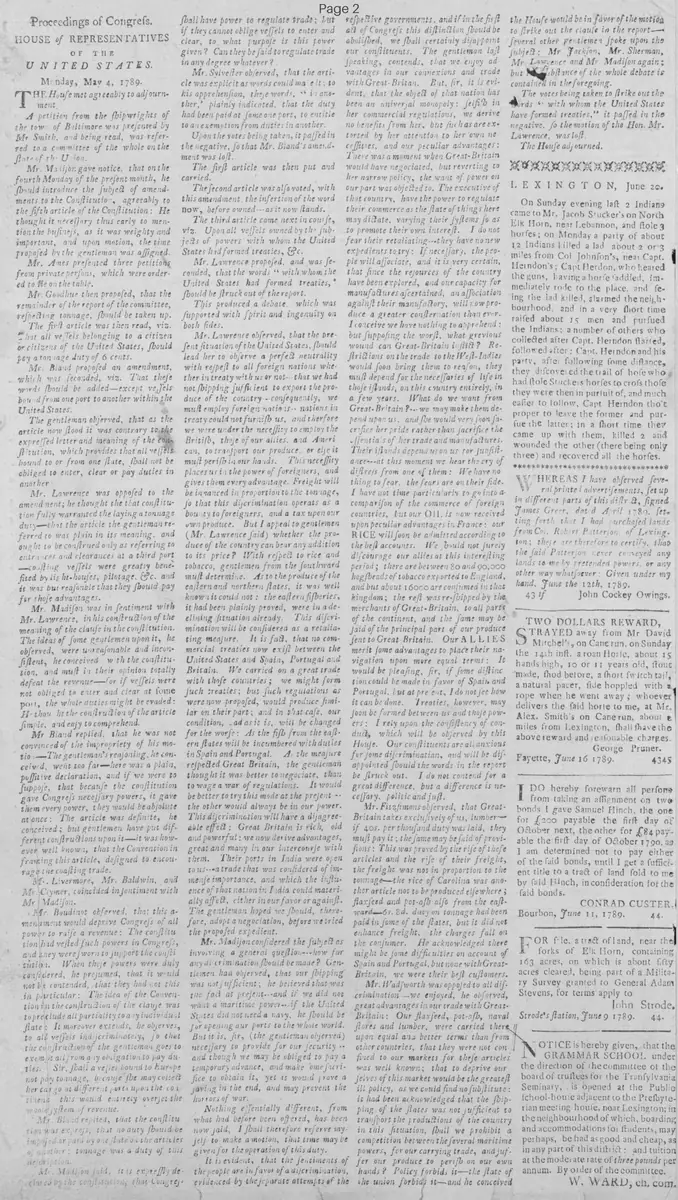
The House met agreeably to adjournment.
A petition from the shipwrights of the town of Baltimore was presented by Mr. Smith, and being read, was referred to a committee of the whole on the state of the Union.
Mr. Madison gave notice, that on the fourth Monday of the present month, he should introduce the subject of amendments to the Constitution, agreeably to the fifth article of the Constitution: He thought it necessary thus early to mention the business, as it was weighty and important, and upon motion, the time proposed by the gentleman was assigned.
Mr. Ames presented three petitions from private persons, which were ordered to lie on the table.
Mr. Goodhue then proposed, that the remainder of the report of the committee, respecting tonnage, should be taken up.
The first article was then read, viz. That all vessels belonging to a citizen or citizens of the United States, should pay a tonnage duty of 6 cents.
Mr. Bland proposed an amendment, which was seconded, viz. That these words should be added—except vessels bound from one port to another within the United States.
The gentleman observed, that as the article now stood it was contrary to the expressed letter and meaning of the constitution, which provides that all vessels bound to or from one state, shall not be obliged to enter, clear or pay duties in another.
Mr. Lawrence was opposed to the amendment; he thought the constitution fully warranted the laying a tonnage duty—that the article the gentleman referred to was plain in its meaning, and ought to be construed only as referring to entrances and clearances at a third port—coasting vessels were greatly benefited by light-houses, pilotage, &c. and it was but reasonable that they should pay for those advantages.
Mr. Madison was in sentiment with Mr. Lawrence, in his construction of the meaning of the clause in the constitution. The ideas of some gentlemen upon it, he observed, were unreasonable and inconsistent, he conceived with the constitution, and must in their opinion totally defeat the revenue—for if vessels were not obliged to enter and clear at some port, the whole duties might be evaded: He thought the construction of the article simple, and easy to comprehend.
Mr. Bland replied, that he was not convinced of the impropriety of his motion—The gentleman's reasoning, he conceived, went too far—here was a plain, positive declaration, and if we were to suppose, that because the constitution gave Congress necessary powers, it gave them every power, they would be absolute at once: The article was definite, he conceived; but gentlemen have put different constructions upon it—it was however well known, that the Convention in framing this article, designed to encourage the coasting trade.
Mr. Livermore, Mr. Baldwin, and Mr. Clymer, coincided in sentiment with Mr. Madison.
Mr. Boudinot observed, that this amendment would deprive Congress of all power to raise a revenue: The constitution had vested such powers in Congress, and they were sworn to support the constitution. When these powers were duly considered, he presumed, that it would not be contended, that they had not this in particular: The idea of the Convention in the construction of the clause was to preclude all partiality to any individual state: It moreover extends, he observes, to all vessels indiscriminately, so that the construction of the gentleman goes to exempt all, from any obligation to pay duties. Sir, shall a vessel bound to Europe not pay tonnage, because she may collect her cargo at different ports upon the continent? this would entirely overturn the whole system of revenue.
Mr. Bland replied, that the constitution was express, that no duty should be imposed or paid at one state to the articles of another: tonnage was a duty of this description.
Mr. Madison said, it is expressly declared by the constitution, that Congress shall have power to regulate trade; but if they cannot oblige vessels to enter and clear, to what purpose is this power given? Can they be said to regulate trade in any degree whatever?
Mr. Sylvester observed, that the article was explicit as words could make it: to his apprehension, these words, 'in another,' plainly indicated, that the duty had been paid at some other port, to entitle to an exemption from duties in another.
Upon the votes being taken, it passed in the negative, so that Mr. Bland's amendment was lost.
The first article was then put and carried.
The second article was also voted, with this amendment, the insertion of the word now, before owned.—as it now stands.
The third article came next in course, viz. Upon all vessels owned by the subjects of powers with whom the United States had formed treaties, &c.
Mr. Lawrence proposed, and was seconded, that the words 'with whom the United States had formed treaties,' should be struck out of the report.
This produced a debate, which was supported with spirit and ingenuity on both sides.
Mr. Lawrence observed, that the present situation of the United States, should lead her to observe a perfect neutrality with respect to all foreign nations whether in treaty with us or not—that we had not shipping sufficient to export the produce of the country—consequently, we must employ foreign nations.—nations in treaty could not furnish us, and therefore we were under the necessity to employ the British, those of our allies, and American, to transport our produce, or else it must perish in our hands. Thus necessity places us in the power of foreigners, and gives them every advantage. Freight will be enhanced in proportion to the tonnage, so that this discrimination operates as a bounty to foreigners, and a tax upon our own produce. But I appeal to gentlemen (Mr. Lawrence said) whether the produce of the country can bear any addition to its price? With respect to rice and tobacco, gentlemen from the southward must determine. As to the produce of the eastern and northern states, it was well known it could not: the eastern fisheries, it had been plainly proved, were in a declining situation already. This discrimination will be considered as a retaliating measure. It is fact, that no commercial treaties now exist between the United States and Spain, Portugal and Britain. We carried on a great trade with those countries; we might form such treaties; but such regulations as were now proposed, would produce similar on their part; and in that case, our condition, as it is, will be changed for the worse: As the fish from the eastern states will be encumbered with duties in Spain and Portugal. As the measure respected Great Britain, the gentleman thought it was better to negotiate, than to wage a war of regulations. It would be better to try this mode at the present—the other would always be in our power.
This discrimination will have a disagreeable effect: Great Britain is rich, old and powerful: we now derive advantages, great and many in our intercourse with them. Their ports in India were open to us—a trade that was considered of immense importance, and which the influence of that nation in India could materially affect, either in our favor or against. The gentleman hoped we should, therefore, adopt a negociation, before we tried the proposed expedient.
Mr. Madison considered the subject as involving a general question—how far any discrimination should be made? Gentlemen had observed, that our shipping was insufficient; he believed that was the fact at present—and if we did not want a maritime power—if the United States did not need a navy, he should be for opening our ports to the whole world. But it is, sir, (the gentleman observed) necessary to provide for our security—and though we may be obliged to pay a temporary advance, and make some sacrifice to obtain it, yet it would prove a saving in the end, and may prevent the horrors of war.
Nothing essentially different, from what had before been offered, has been now said, I shall therefore reserve myself to make a motion, that time may be given for the operation of this duty.
It is evident, that the sentiments of the people are in favor of a discrimination, evidenced by the separate attempts of the respective governments, and if in the first act of Congress this distinction should be abolished, we shall certainly disappoint our constituents. The gentleman last speaking, contends, that we enjoy advantages in our connexions and trade with Great Britain. But, sir, it is evident, that the object of that nation has been an universal monopoly: Selfish in her commercial regulations, we derive no benefits from her, but such as are extorted by her attention to her own necessities, and our peculiar advantages: There was a moment when Great-Britain would have negotiated, but reverting to her narrow policy, the want of power on our part was objected to. The executive of that country, have the power to regulate their commerce as the state of things here may dictate, varying their systems so as to promote their own interest. I do not fear their retaliating—they have no new expedients to try: If necessary, the people will associate, and it is very certain, that since the resources of the country have been explored, and our capacity for manufactures ascertained, an association against their manufactory, will produce a greater consternation than ever. I conceive we have nothing to apprehend: but supposing the worst, what grievous wound can Great-Britain inflict? Restrictions on the trade to the West-Indies would soon bring them to reason, they must depend for the necessaries of life in those islands, on this country entirely, in a few years. What do we want from Great Britain?—we may make them depend upon us, and she would very soon sacrifice her pride rather than sacrifice the vent of her trade and manufactures. Their islands depend upon us for subsistence—at this moment we hear the cry of distress from one of them: We have nothing to fear, the fears are on their side.
I have not time particularly to go into a comparison of the commerce of foreign countries, but our oil is now received upon peculiar advantages in France: our rice will soon be admitted according to the best accounts. We should not surely discourage our allies at this interesting period; there are between 80 and 90,000 hogsheads of tobacco exported to England, and but about 16,000 are consumed in that kingdom; the rest was re-shipped by the merchants of Great-Britain, to all parts of the continent, and the same may be said of the principal part of our produce sent to Great Britain. Our ALLIES merit some advantages to place their navigation upon more equal terms: It would be pleasing, sir, if some distinction could be made in favor of Spain and Portugal, but at present, I do not see how it can be done. Treaties, however, may soon be formed between us and those powers: I rely upon the consistency of conduct, which will be observed by this House. Our constituents are all anxious for some discrimination, and will be disappointed should the words in the report be struck out. I do not contend for a great difference, but a difference is necessary, politic and just.
Mr. Fitzsimons observed, that Great-Britain takes exclusively of us, lumber—if 40s. per thousand duty was laid, they must pay it; the same may be said of provisions: This was proved by the rise of these articles and the rise of their freight, the freight was not in proportion to the tonnage the rice of Carolina was another article not to be produced elsewhere; flaxseed and pot-ash also from the eastward—6s.8d. duty on tonnage had been paid in some of the states, but it did not enhance freight, the charges fall on the consumer. He acknowledged there might be some difficulties on account of Spain and Portugal, but none with Great-Britain, we were their best customers.
Mr. Wadsworth was opposed to all discrimination—we enjoyed, he observed, great advantages in our trade with Great-Britain: Our flaxseed, pot-ash, naval stores and lumber, were carried there upon equal and better terms than from other countries, that they were not confined to our markets for these articles was well known; that to deprive ourselves of this market would be the greatest ill policy, as we could find no substitute: it had been acknowledged that the shipping of the states was not sufficient to transport the productions of the country in this situation, shall we prohibit a competition between the several maritime powers, for our carrying trade, and suffer our produce to perish on our own hands? Policy forbids it—the state of the union forbids it—and he conceived the House would be in favor of the motion to strike out the clause in the report—several other gentlemen spoke upon the subject: Mr. Jackson, Mr. Sherman, Mr. Lawrence and Mr. Madison again; but the substance of the whole debate is contained in the foregoing.
The votes being taken to strike out the words 'with whom the United States have formed treaties,' it passed in the negative. So the motion of the Hon. Mr. Lawrence, was lost.
The House adjourned.
What sub-type of article is it?
What keywords are associated?
What entities or persons were involved?
Domestic News Details
Event Date
Monday, May 4, 1789
Key Persons
Outcome
petition referred to committee; time assigned for amendments discussion; mr. bland's amendment to exempt coasting vessels rejected; first and second articles passed with minor amendment; mr. lawrence's motion to strike treaty clause rejected.
Event Details
The House met and handled a petition from Baltimore shipwrights, notice of constitutional amendments by Mr. Madison, petitions from private persons, and debate on tonnage report. Debate focused on duties for US citizen vessels, rejecting exemption for coasting trade, and on discrimination for treaty nations, rejecting removal of treaty clause.