Thank you for visiting SNEWPapers!
Sign up free
Story
September 15, 1864
Rutland Weekly Herald
Rutland, Rutland County, Vermont
What is this article about?
An article refuting claims that President Lincoln started the Civil War, listing Southern seizures of U.S. forts and property from December 1860 to March 1861 before his inauguration, arguing these acts initiated the rebellion.
Clipping
OCR Quality
95%
Excellent
Full Text
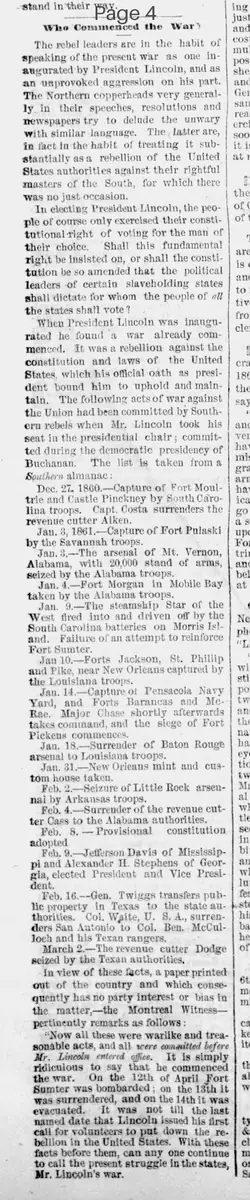
Who Commenced the War?
The rebel leaders are in the habit of speaking of the present war as one inaugurated by President Lincoln, and as an unprovoked aggression on his part. The Northern copperheads very generally in their speeches, resolutions and newspapers try to delude the unwary with similar language. The latter are, in fact, in the habit of treating it substantially as a rebellion of the United States authorities against their rightful masters of the South, for which there was no just occasion.
In electing President Lincoln, the people of course only exercised their constitutional right of voting for the man of their choice. Shall this fundamental right be insisted on, or shall the constitution be so amended that the political leaders of certain slaveholding states shall dictate for whom the people of all the states shall vote?
When President Lincoln was inaugurated he found a war already commenced. It was a rebellion against the constitution and laws of the United States, which his official oath as president bound him to uphold and maintain. The following acts of war against the Union had been committed by Southern rebels when Mr. Lincoln took his seat in the presidential chair; committed during the democratic presidency of Buchanan. The list is taken from a Southern almanac:
Dec. 27, 1860.—Capture of Fort Moultrie and Castle Pinckney by South Carolina troops. Capt. Coste surrenders the revenue cutter Aiken.
Jan. 3, 1861. Capture of Fort Pulaski by the Savannah troops.
Jan. 3.—The arsenal of Mt. Vernon, Alabama, with 20,000 stand of arms, seized by the Alabama troops.
Jan. 4.—Fort Morgan in Mobile Bay taken by the Alabama troops.
Jan. 9.—The steamship Star of the West fired into and driven off by the South Carolina batteries on Morris Island. Failure of an attempt to reinforce Fort Sumter.
Jan 10. Forts Jackson, St. Phillip and Pike, near New Orleans captured by the Louisiana troops.
Jan. 14.—Capture of Pensacola Navy Yard, and Forts Barrancas and McRae. Major Chase shortly afterwards takes command, and the siege of Fort Pickens commences.
Jan. 18.—Surrender of Baton Rouge arsenal to Louisiana troops.
Jan. 31.—New Orleans mint and custom house taken.
Feb. 2.—Seizure of Little Rock arsenal by Arkansas troops.
Feb. 4.—Surrender of the revenue cutter Cass to the Alabama authorities.
Feb. 8.—Provisional constitution adopted.
Feb. 9.—Jefferson Davis of Mississippi and Alexander H. Stephens of Georgia, elected President and Vice President.
Feb. 16.—Gen. Twiggs transfers public property in Texas to the state authorities. Col. Waite, U. S. A., surrenders San Antonio to Col. Ben. McCulloch and his Texan rangers.
March 2.—The revenue cutter Dodge seized by the Texan authorities.
In view of these facts, a paper printed out of the country and which consequently has no party interest or bias in the matter,—the Montreal Witness— pertinently remarks as follows:
"Now all these were warlike and treasonable acts, and all were committed before Mr. Lincoln entered office. It is simply ridiculous to say that he commenced the war. On the 12th of April Fort Sumter was bombarded; on the 13th it was surrendered, and on the 14th it was evacuated. It was not till the last named date that Lincoln issued his first call for volunteers to put down the rebellion in the United States. With these facts before them, can any one continue to call the present struggle in the states, Mr. Lincoln's war."
The rebel leaders are in the habit of speaking of the present war as one inaugurated by President Lincoln, and as an unprovoked aggression on his part. The Northern copperheads very generally in their speeches, resolutions and newspapers try to delude the unwary with similar language. The latter are, in fact, in the habit of treating it substantially as a rebellion of the United States authorities against their rightful masters of the South, for which there was no just occasion.
In electing President Lincoln, the people of course only exercised their constitutional right of voting for the man of their choice. Shall this fundamental right be insisted on, or shall the constitution be so amended that the political leaders of certain slaveholding states shall dictate for whom the people of all the states shall vote?
When President Lincoln was inaugurated he found a war already commenced. It was a rebellion against the constitution and laws of the United States, which his official oath as president bound him to uphold and maintain. The following acts of war against the Union had been committed by Southern rebels when Mr. Lincoln took his seat in the presidential chair; committed during the democratic presidency of Buchanan. The list is taken from a Southern almanac:
Dec. 27, 1860.—Capture of Fort Moultrie and Castle Pinckney by South Carolina troops. Capt. Coste surrenders the revenue cutter Aiken.
Jan. 3, 1861. Capture of Fort Pulaski by the Savannah troops.
Jan. 3.—The arsenal of Mt. Vernon, Alabama, with 20,000 stand of arms, seized by the Alabama troops.
Jan. 4.—Fort Morgan in Mobile Bay taken by the Alabama troops.
Jan. 9.—The steamship Star of the West fired into and driven off by the South Carolina batteries on Morris Island. Failure of an attempt to reinforce Fort Sumter.
Jan 10. Forts Jackson, St. Phillip and Pike, near New Orleans captured by the Louisiana troops.
Jan. 14.—Capture of Pensacola Navy Yard, and Forts Barrancas and McRae. Major Chase shortly afterwards takes command, and the siege of Fort Pickens commences.
Jan. 18.—Surrender of Baton Rouge arsenal to Louisiana troops.
Jan. 31.—New Orleans mint and custom house taken.
Feb. 2.—Seizure of Little Rock arsenal by Arkansas troops.
Feb. 4.—Surrender of the revenue cutter Cass to the Alabama authorities.
Feb. 8.—Provisional constitution adopted.
Feb. 9.—Jefferson Davis of Mississippi and Alexander H. Stephens of Georgia, elected President and Vice President.
Feb. 16.—Gen. Twiggs transfers public property in Texas to the state authorities. Col. Waite, U. S. A., surrenders San Antonio to Col. Ben. McCulloch and his Texan rangers.
March 2.—The revenue cutter Dodge seized by the Texan authorities.
In view of these facts, a paper printed out of the country and which consequently has no party interest or bias in the matter,—the Montreal Witness— pertinently remarks as follows:
"Now all these were warlike and treasonable acts, and all were committed before Mr. Lincoln entered office. It is simply ridiculous to say that he commenced the war. On the 12th of April Fort Sumter was bombarded; on the 13th it was surrendered, and on the 14th it was evacuated. It was not till the last named date that Lincoln issued his first call for volunteers to put down the rebellion in the United States. With these facts before them, can any one continue to call the present struggle in the states, Mr. Lincoln's war."
What sub-type of article is it?
Historical Event
What themes does it cover?
Deception
Justice
What keywords are associated?
Civil War Origins
Southern Seizures
Fort Captures
Lincoln Inauguration
Rebel Acts
Buchanan Presidency
What entities or persons were involved?
President Lincoln
Jefferson Davis
Alexander H. Stephens
Gen. Twiggs
Capt. Coste
Major Chase
Col. Waite
Col. Ben. Mcculloch
Where did it happen?
Southern United States
Story Details
Key Persons
President Lincoln
Jefferson Davis
Alexander H. Stephens
Gen. Twiggs
Capt. Coste
Major Chase
Col. Waite
Col. Ben. Mcculloch
Location
Southern United States
Event Date
December 1860 To March 1861
Story Details
Rebel leaders claim President Lincoln started the war unprovoked, but article lists Southern captures of U.S. forts, arsenals, and property before his inauguration under Buchanan, arguing these acts commenced the rebellion against the Union.