Thank you for visiting SNEWPapers!
Sign up free
Editorial
November 27, 1801
The National Intelligencer And Washington Advertiser
Washington, District Of Columbia
What is this article about?
An editorial praising the rational foundations of American republican government and the U.S. Constitution, contrasting it with monarchical and aristocratic systems. It defends republican leaders, critiques past abuses like the Alien and Sedition Acts, and calls for constitutional safeguards against misconstruction.
Clipping
OCR Quality
98%
Excellent
Full Text
FOR THE NATIONAL INTELLIGENCER.
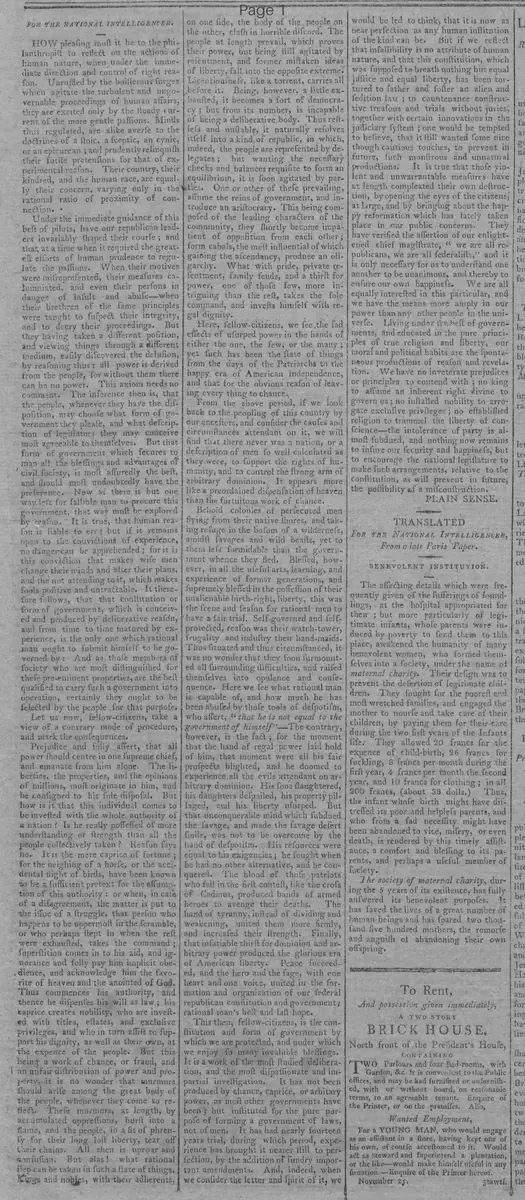
How pleasing must it be to the philanthropist to reflect on the actions of human nature, when under the immediate direction and control of right reason. Unruffled by the boisterous surges which agitate the turbulent and ungovernable proceedings of human affairs, they are excited only by the steady current of the more gentle passions. Minds thus regulated, are alike averse to the doctrines of a stoic, a skeptic, an cynic, or an epicurean; and prudently relinquish their futile pretensions for that of experimental reason. Their country, their kindred, and the human race, are equally their concern, varying only in the rational ratio of proximity of connection.
Under the immediate guidance of this best of pilots, have our republican leaders invariably shaped their course; and that at a time when it required the greatest efforts of human prudence to regulate the passions. When their motives were misrepresented, their measures calumniated, and even their persons in danger of insult and abuse—when their brethren of the same principles were taught to suspect their integrity, and to decry their proceedings. But they having taken a different position, and viewing things through a different medium, easily discovered the delusion, by reasoning thus: all power is derived from the people, for without them there can be no power. This axiom needs no comment. The inference then is, that the people, whenever they have the disposition, may choose what form of government they please, and what description of legislators they may conceive most agreeable to themselves. But that form of government which secures to man all the blessings and advantages of civil society, is most assuredly the best, and should most undoubtedly have the preference. Now as there is but one way left for fallible man to procure this government, that way must be explored by reason. It is true, that human reason is liable to err; but if it remains open to the convictions of experience, no danger can be apprehended; for it is this conviction that makes wise men change their minds and alter their plans, and the not attending to it, which makes fools positive and untractable. It therefore follows, that that constitution or form of government, which is conceived and produced by deliberative reason, and from time to time matured by experience, is the only one which rational man ought to submit himself to be governed by: And as those members of society who are most distinguished for these pre-eminent properties, are the best qualified to carry such a government into operation, certainly they ought to be selected by the people for that purpose.
Let us now, fellow-citizens, take a view of a contrary mode of procedure, and mark the consequences.
Prejudice and folly assert, that all power should centre in one supreme chief, and emanate from him alone. The liberties, the properties, and the opinions of millions, must originate in him, and be consigned to his sole disposal. But how is it that this individual comes to be invested with the whole authority of a nation? Is he really possessed of more understanding or strength than all the people collectively taken? Reason says no. It is the mere caprice of fortune: for the neighing of a horse, or the accidental flight of birds, have been known to be a sufficient pretext for the assumption of this authority: or when, in case of a disagreement, the matter is put to the issue of a struggle, that person who happens to be uppermost in the scramble, or who perhaps stept in when the rest were exhausted, takes the command; superstition comes in to his aid, and ignorance and folly pay him implicit obedience, and acknowledge him the favorite of heaven and the anointed of God. Thus commences his authority, and thence he dispenses his will as law; his caprice creates nobility, who are invested with titles, estates, and exclusive privileges, and who in turn assist to support his dignity, as well as their own, at the expense of the people. But this being a work of chance, or fraud, and an unfair distribution of power and property, it is no wonder that murmurs should arise among the great body of the people, whenever they come to reflect. These murmurs, at length, by accumulated oppressions, burst into a flame, and the people, in a fit of phrensy for their long lost liberty, tear off their chains. All then is uproar and confusion. But alas! what rational step can be taken in such a state of things.
Kings and nobles, with their adherents, on one side, the body of the people on the other, clash in horrible discord. The people at length prevail, which proves their power, but being still agitated by resentment, and former mistaken ideas of liberty, fall into the opposite extreme. Licentiousness, like a torrent, carries all before it. Being, however, a little exhausted, it becomes a sort of democracy; but from its number, is incapable of being a deliberative body. Thus restless and unstable, it naturally resolves itself into a kind of republic, in which, indeed, the people are represented by delegates; but wanting the necessary checks and balances requisite to form an equilibrium, it is soon agitated by parties. One or other of these prevailing, assume the reins of government, and introduce an aristocracy. This being composed of the leading characters of the community, they shortly become impatient of opposition from each other; form cabals, the most influential of which gaining the ascendancy, produce an oligarchy. What with pride, private resentment, family feuds, and a thirst for power, one of those few, more intriguing than the rest, takes the sole command, and invests himself with regal dignity.
Here, fellow-citizens, we see the sad effects of usurped power in the hands of either the one, the few, or the many; yet such has been the state of things from the days of the Patriarchs to the happy era of American independence, and that for the obvious reason of leaving every thing to chance.
From the above period, if we look back to the peopling of this country by our ancestors, and consider the causes and circumstances attendant on it, we will find that there never was a nation, or a description of men so well calculated as they were, to support the rights of humanity, and to control the strong arm of arbitrary dominion. It appears more like a preordained dispensation of heaven than the fortuitous work of chance. Behold colonies of persecuted men flying from their native shores, and taking refuge in the bosom of a wilderness, amidst savages and wild beasts, yet to them less formidable than the government whence they fled. Blessed, however, in all the useful arts, learning, and experience of former generations, and supremely blest in the possession of their unalienable birth-right, liberty, this was the scene and season for rational men to have a fair trial. Self-governed and self-protected, reason was their watch-tower, frugality and industry their hand-maids. Thus situated and thus circumstanced, it was no wonder that they soon surmounted all surrounding difficulties, and raised themselves into opulence and consequence. Here we see what rational man is capable of, and how much he has been abused by those tools of despotism, who assert, "that he is not equal to the government of himself." The contrary, however, is the fact; or the moment that the hand of regal power laid hold of him, that moment were all his fair prospects blighted, and he doomed to experience all the evils attendant on arbitrary dominion. His sons slaughtered, his daughters defiled, his property pillaged, and his liberty usurped. But that unconquerable mind which subdued the savage, and made the savage desert smile, was not to be overcome by the hand of despotism. His resources were equal to his exigencies; he fought when he had no other alternative, and he conquered. The blood of those patriots who fell in the first contest, like the teeth of Cadmus, produced bands of armed heroes to avenge their deaths. The hand of tyranny, instead of dividing and weakening, united them more firmly, and increased their strength. Finally, that insatiable thirst for dominion and arbitrary power produced the glorious era of American liberty. Peace succeeded, and the hero and the age, with one heart and one voice, united in the formation and organization of our federal republican constitution and government; rational man's best and last hope.
This then, fellow-citizens, is the constitution and form of government by which we are protected, and under which we enjoy so many invaluable blessings. It is a work of the most studied deliberation, and the most dispassionate and impartial investigation. It has not been produced by chance, caprice, or arbitrary power, as most other governments have been; but instituted for the pure purpose of forming a government of laws, not of men. It has had nearly fourteen years trial, during which period, experience has brought it nearer still to perfection, by the addition of sundry important amendments. And, indeed, when we consider the letter and spirit of it, we would be led to think, that it is now as near perfection as any human institution of the kind can be. But if we reflect that infallibility is no attribute of human nature, and that this constitution, which was supposed to breathe nothing but equal justice and equal liberty, has been tortured to father and foster an alien and sedition law; to countenance constructive treason and trials without juries, together with certain innovations in the judiciary system; one would be tempted to believe, that it still wanted some nice though cautious touches, to prevent in future, such monstrous and unnatural productions. It is true that those violent and unwarrantable measures have at length completed their own destruction, by opening the eyes of the citizens at large, and by bringing about the happy reformation which has lately taken place in our public concerns. They have verified the assertion of our enlightened chief magistrate, "we are all republicans, we are all federalists," and it is only necessary for us to understand one another to be unanimous, and thereby to ensure our own happiness. We are all equally interested in this particular, and we have the means more amply in our power than any other people in the universe. Living under the best of governments, and educated in the pure principles of true religion and liberty, our moral and political habits are the spontaneous productions of reason and revelation. We have no inveterate prejudices or principles to contend with; no king to assume an inherent right divine to govern us; no installed nobility to arrogate exclusive privileges; no established religion to trammel the liberty of conscience—the intolerance of party is almost subdued, and nothing now remains to insure our security and happiness, but to encourage the national legislature to make such arrangements, relative to the constitution, as will prevent in future, the possibility of a misconstruction.
How pleasing must it be to the philanthropist to reflect on the actions of human nature, when under the immediate direction and control of right reason. Unruffled by the boisterous surges which agitate the turbulent and ungovernable proceedings of human affairs, they are excited only by the steady current of the more gentle passions. Minds thus regulated, are alike averse to the doctrines of a stoic, a skeptic, an cynic, or an epicurean; and prudently relinquish their futile pretensions for that of experimental reason. Their country, their kindred, and the human race, are equally their concern, varying only in the rational ratio of proximity of connection.
Under the immediate guidance of this best of pilots, have our republican leaders invariably shaped their course; and that at a time when it required the greatest efforts of human prudence to regulate the passions. When their motives were misrepresented, their measures calumniated, and even their persons in danger of insult and abuse—when their brethren of the same principles were taught to suspect their integrity, and to decry their proceedings. But they having taken a different position, and viewing things through a different medium, easily discovered the delusion, by reasoning thus: all power is derived from the people, for without them there can be no power. This axiom needs no comment. The inference then is, that the people, whenever they have the disposition, may choose what form of government they please, and what description of legislators they may conceive most agreeable to themselves. But that form of government which secures to man all the blessings and advantages of civil society, is most assuredly the best, and should most undoubtedly have the preference. Now as there is but one way left for fallible man to procure this government, that way must be explored by reason. It is true, that human reason is liable to err; but if it remains open to the convictions of experience, no danger can be apprehended; for it is this conviction that makes wise men change their minds and alter their plans, and the not attending to it, which makes fools positive and untractable. It therefore follows, that that constitution or form of government, which is conceived and produced by deliberative reason, and from time to time matured by experience, is the only one which rational man ought to submit himself to be governed by: And as those members of society who are most distinguished for these pre-eminent properties, are the best qualified to carry such a government into operation, certainly they ought to be selected by the people for that purpose.
Let us now, fellow-citizens, take a view of a contrary mode of procedure, and mark the consequences.
Prejudice and folly assert, that all power should centre in one supreme chief, and emanate from him alone. The liberties, the properties, and the opinions of millions, must originate in him, and be consigned to his sole disposal. But how is it that this individual comes to be invested with the whole authority of a nation? Is he really possessed of more understanding or strength than all the people collectively taken? Reason says no. It is the mere caprice of fortune: for the neighing of a horse, or the accidental flight of birds, have been known to be a sufficient pretext for the assumption of this authority: or when, in case of a disagreement, the matter is put to the issue of a struggle, that person who happens to be uppermost in the scramble, or who perhaps stept in when the rest were exhausted, takes the command; superstition comes in to his aid, and ignorance and folly pay him implicit obedience, and acknowledge him the favorite of heaven and the anointed of God. Thus commences his authority, and thence he dispenses his will as law; his caprice creates nobility, who are invested with titles, estates, and exclusive privileges, and who in turn assist to support his dignity, as well as their own, at the expense of the people. But this being a work of chance, or fraud, and an unfair distribution of power and property, it is no wonder that murmurs should arise among the great body of the people, whenever they come to reflect. These murmurs, at length, by accumulated oppressions, burst into a flame, and the people, in a fit of phrensy for their long lost liberty, tear off their chains. All then is uproar and confusion. But alas! what rational step can be taken in such a state of things.
Kings and nobles, with their adherents, on one side, the body of the people on the other, clash in horrible discord. The people at length prevail, which proves their power, but being still agitated by resentment, and former mistaken ideas of liberty, fall into the opposite extreme. Licentiousness, like a torrent, carries all before it. Being, however, a little exhausted, it becomes a sort of democracy; but from its number, is incapable of being a deliberative body. Thus restless and unstable, it naturally resolves itself into a kind of republic, in which, indeed, the people are represented by delegates; but wanting the necessary checks and balances requisite to form an equilibrium, it is soon agitated by parties. One or other of these prevailing, assume the reins of government, and introduce an aristocracy. This being composed of the leading characters of the community, they shortly become impatient of opposition from each other; form cabals, the most influential of which gaining the ascendancy, produce an oligarchy. What with pride, private resentment, family feuds, and a thirst for power, one of those few, more intriguing than the rest, takes the sole command, and invests himself with regal dignity.
Here, fellow-citizens, we see the sad effects of usurped power in the hands of either the one, the few, or the many; yet such has been the state of things from the days of the Patriarchs to the happy era of American independence, and that for the obvious reason of leaving every thing to chance.
From the above period, if we look back to the peopling of this country by our ancestors, and consider the causes and circumstances attendant on it, we will find that there never was a nation, or a description of men so well calculated as they were, to support the rights of humanity, and to control the strong arm of arbitrary dominion. It appears more like a preordained dispensation of heaven than the fortuitous work of chance. Behold colonies of persecuted men flying from their native shores, and taking refuge in the bosom of a wilderness, amidst savages and wild beasts, yet to them less formidable than the government whence they fled. Blessed, however, in all the useful arts, learning, and experience of former generations, and supremely blest in the possession of their unalienable birth-right, liberty, this was the scene and season for rational men to have a fair trial. Self-governed and self-protected, reason was their watch-tower, frugality and industry their hand-maids. Thus situated and thus circumstanced, it was no wonder that they soon surmounted all surrounding difficulties, and raised themselves into opulence and consequence. Here we see what rational man is capable of, and how much he has been abused by those tools of despotism, who assert, "that he is not equal to the government of himself." The contrary, however, is the fact; or the moment that the hand of regal power laid hold of him, that moment were all his fair prospects blighted, and he doomed to experience all the evils attendant on arbitrary dominion. His sons slaughtered, his daughters defiled, his property pillaged, and his liberty usurped. But that unconquerable mind which subdued the savage, and made the savage desert smile, was not to be overcome by the hand of despotism. His resources were equal to his exigencies; he fought when he had no other alternative, and he conquered. The blood of those patriots who fell in the first contest, like the teeth of Cadmus, produced bands of armed heroes to avenge their deaths. The hand of tyranny, instead of dividing and weakening, united them more firmly, and increased their strength. Finally, that insatiable thirst for dominion and arbitrary power produced the glorious era of American liberty. Peace succeeded, and the hero and the age, with one heart and one voice, united in the formation and organization of our federal republican constitution and government; rational man's best and last hope.
This then, fellow-citizens, is the constitution and form of government by which we are protected, and under which we enjoy so many invaluable blessings. It is a work of the most studied deliberation, and the most dispassionate and impartial investigation. It has not been produced by chance, caprice, or arbitrary power, as most other governments have been; but instituted for the pure purpose of forming a government of laws, not of men. It has had nearly fourteen years trial, during which period, experience has brought it nearer still to perfection, by the addition of sundry important amendments. And, indeed, when we consider the letter and spirit of it, we would be led to think, that it is now as near perfection as any human institution of the kind can be. But if we reflect that infallibility is no attribute of human nature, and that this constitution, which was supposed to breathe nothing but equal justice and equal liberty, has been tortured to father and foster an alien and sedition law; to countenance constructive treason and trials without juries, together with certain innovations in the judiciary system; one would be tempted to believe, that it still wanted some nice though cautious touches, to prevent in future, such monstrous and unnatural productions. It is true that those violent and unwarrantable measures have at length completed their own destruction, by opening the eyes of the citizens at large, and by bringing about the happy reformation which has lately taken place in our public concerns. They have verified the assertion of our enlightened chief magistrate, "we are all republicans, we are all federalists," and it is only necessary for us to understand one another to be unanimous, and thereby to ensure our own happiness. We are all equally interested in this particular, and we have the means more amply in our power than any other people in the universe. Living under the best of governments, and educated in the pure principles of true religion and liberty, our moral and political habits are the spontaneous productions of reason and revelation. We have no inveterate prejudices or principles to contend with; no king to assume an inherent right divine to govern us; no installed nobility to arrogate exclusive privileges; no established religion to trammel the liberty of conscience—the intolerance of party is almost subdued, and nothing now remains to insure our security and happiness, but to encourage the national legislature to make such arrangements, relative to the constitution, as will prevent in future, the possibility of a misconstruction.
What sub-type of article is it?
Constitutional
Partisan Politics
Moral Or Religious
What keywords are associated?
Republican Government
Us Constitution
American Liberty
Alien Sedition Laws
Rational Governance
Arbitrary Power
Political Reformation
What entities or persons were involved?
Republican Leaders
Kings And Nobles
Enlightened Chief Magistrate
National Legislature
Editorial Details
Primary Topic
Defense Of Republican Government And The Us Constitution Against Monarchical Alternatives
Stance / Tone
Strongly Supportive Of Rational Republican Principles And Critical Of Arbitrary Power
Key Figures
Republican Leaders
Kings And Nobles
Enlightened Chief Magistrate
National Legislature
Key Arguments
Power Derives From The People, Who Choose Their Government Form
Republican Government Based On Reason And Experience Is Superior
Monarchical Power Arises From Chance, Fraud, Or Superstition Leading To Oppression
American Colonists Were Ideally Situated To Establish Liberty Through Self Governance
The Us Constitution Is A Deliberate Work Of Laws, Not Men, Matured By Amendments
Past Abuses Like Alien And Sedition Acts Show Need For Constitutional Safeguards
All Citizens Are United As Republicans And Federalists Under The Best Government