Thank you for visiting SNEWPapers!
Sign up free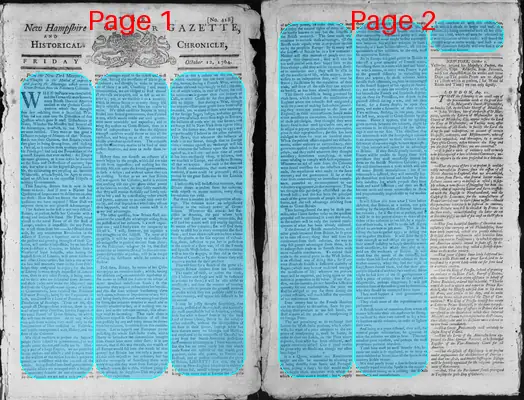
The New Hampshire Gazette And Historical Chronicle
Portsmouth, Greenland, Rockingham County, New Hampshire
What is this article about?
An editorial from the New-York Mercury argues that Britain should secure its Northern American colonies through naval power and liberty, ensuring loyalty and preventing revolt. It highlights economic benefits from colonial trade and military support, suggesting trade expansions like to neutral West Indies ports to maximize advantages.
Merged-components note: This is a single continuous opinionated essay on the benefits, security, and improvement of British colonies in America, spanning pages 1 and 2 with seamless text flow in reading order. Labeled as editorial due to its argumentative and political tone.
Clippings
1 of 2
OCR Quality
Full Text
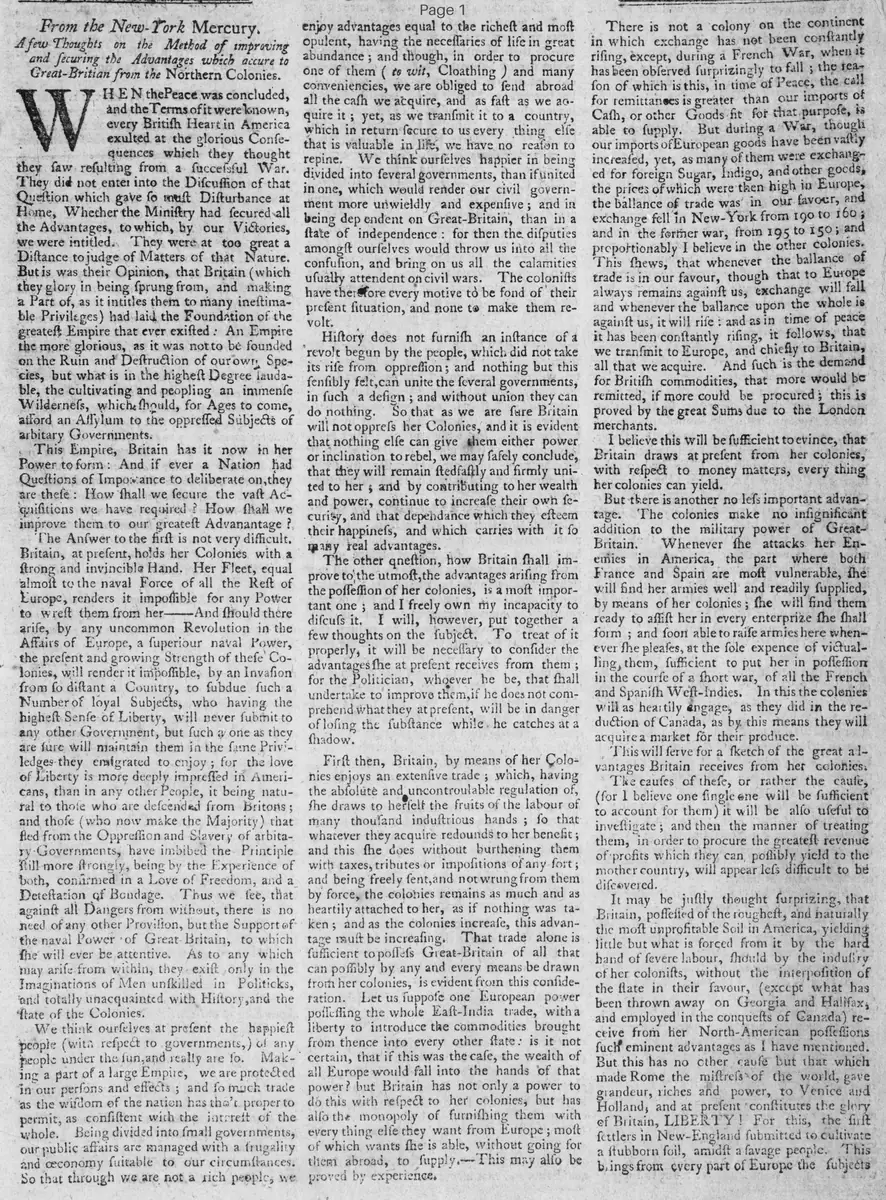
A few Thoughts on the Method of improving and securing the Advantages which accrue to Great-Britain from the Northern Colonies.
WHEN the Peace was concluded, and the Terms of it were known, every British Heart in America exulted at the glorious Consequences which they thought they saw resulting from a successful War. They did not enter into the Discussion of that Question which gave so much Disturbance at Home. Whether the Ministry had secured all the Advantages, to which, by our Victories, we were entitled. They were at too great a Distance to judge of Matters of that Nature. But it was their Opinion, that Britain (which they glory in being sprung from, and making a Part of, as it entitles them to many inestimable Privileges) had laid the Foundation of the greatest Empire that ever existed: An Empire the more glorious, as it was not to be founded on the Ruin and Destruction of our own Species, but what is in the highest Degree laudable, the cultivating and peopling an immense Wilderness, which, should, for Ages to come, afford an Asylum to the oppressed Subjects of arbitrary Governments.
This Empire, Britain has it now in her Power to form: And if ever a Nation had Questions of Importance to deliberate on, they are these: How shall we secure the vast Acquisitions we have acquired? How shall we improve them to our greatest Advantage?
The Answer to the first is not very difficult. Britain, at present, holds her Colonies with a strong and invincible Hand. Her Fleet, equal almost to the naval Force of all the Rest of Europe, renders it impossible for any Power to wrest them from her--And should there arise, by any uncommon Revolution in the Affairs of Europe, a superior naval Power, the present and growing Strength of these Colonies, will render it impossible, by an Invasion from so distant a Country, to subdue such a Number of loyal Subjects, who having the highest Sense of Liberty, will never submit to any other Government, but such as one as they are sure will maintain them in the same Privileges-they emigrated to enjoy; for the love of Liberty is more deeply impressed in Americans, than in any other People, it being natural to those who are descended from Britons: and those (who now make the Majority) that fled from the Oppression and Slavery of arbitrary-Governments, have imbibed the Principle still more strongly, being by the Experience of both, confirmed in a Love of Freedom, and a Detestation of Bondage. Thus we see, that against all Dangers from without, there is no need of any other Provision, but the Support of the naval Power of Great-Britain, to which they will ever be attentive. As to any which may arise from within, they exist only in the Imaginations of Men unskilled in Politicks, and totally unacquainted with History, and the State of the Colonies.
We think ourselves at present the happiest people (with respect to governments,) of any people under the sun, and really are so. Making a part of a large Empire, we are protected in our persons and effects; and so much trade as the wisdom of the nation has thought proper to permit, as consistent with the interest of the whole. Being divided into small governments, our public affairs are managed with a frugality and oeconomy suitable to our circumstances. So that though we are not a rich people, we
enjoy advantages equal to the richest and most opulent, having the necessaries of life in great abundance: and though, in order to procure one of them (to wit, Cloathing) and many conveniencies, we are obliged to send abroad all the cash we acquire, and as fast as we acquire it; yet, as we transmit it to a country, which in return secures to us every thing else that is valuable in life, we have no reason to repine. We think ourselves happier in being divided into several governments, than if united in one, which would render our civil government more unwieldy and expensive: and in being dependent on Great-Britain, than in a state of independence: for then the disputes amongst ourselves would throw us into all the confusion, and bring on us all the calamities usually attendant on civil wars. The colonists have therefore every motive to be fond of their present situation, and none to make them revolt.
History does not furnish an instance of a revolt begun by the people, which did not take its rise from oppression; and nothing but this sensibly felt, can unite the several governments, in such a design; and without union they can do nothing. So that as we are sure Britain will not oppress her Colonies, and it is evident that nothing else can give them either power or inclination to rebel, we may safely conclude, that they will remain steadfastly and firmly united to her: and by contributing to her wealth and power, continue to increase their own security, and that dependence which they esteem their happiness, and which carries with it so many real advantages.
The other question, how Britain shall improve to the utmost, the advantages arising from the possession of her colonies, is a most important one; and I freely own my incapacity to discuss it. I will, however, put together a few thoughts on the subject. To treat of it properly, it will be necessary to consider the advantages she at present receives from them; for the Politician, whoever he be, that shall undertake to improve them, if he does not comprehend what they at present, will be in danger of losing the substance while he catches at a shadow.
First then, Britain, by means of her Colonies enjoys an extensive trade; which, having the absolute and uncontroulable regulation of, she draws to herself the fruits of the labour of many thousand industrious hands: so that whatever they acquire redounds to her benefit: and this she does without burthening them with taxes, tributes or impositions of any sort; and being freely sent, and not wrung from them by force, the colonies remain as much and as heartily attached to her, as if nothing was taken; and as the colonies increase, this advantage must be increasing. That trade alone is sufficient to possess Great-Britain of all that can possibly by any and every means be drawn from her colonies, is evident from this consideration. Let us suppose one European power possessing the whole East-India trade, with a liberty to introduce the commodities brought from thence into every other state: is it not certain, that if this was the case, the wealth of all Europe would fall into the hands of that power? but Britain has not only a power to do this with respect to her colonies, but has also the monopoly of furnishing them with every thing else they want from Europe; most of which wants she is able, without going for them abroad, to supply.--This may also be proved by experience.
There is not a colony on the continent in which exchange has not been constantly rising, except, during a French War, when it has been observed surprisingly to fall; the reason of which is this. in time of Peace, the call for remittances is greater than our imports of Cash, or other Goods fit for that purpose, is able to supply. But during a War, though our imports of European goods have been vastly increased, yet, as many of them were exchanged for foreign Sugar, Indigo, and other goods, the prices of which were then high in Europe, the ballance of trade was in our favour, and exchange fell in New-York from 190 to 160; and in the former war, from 195 to 150; and proportionably I believe in the other colonies.
This shews, that whenever the ballance of trade is in our favour, though that to Europe always remains against us, exchange will fall and whenever the ballance upon the whole is against us, it will rise: and as in time of peace it has been constantly rising. it follows, that we transmit to Europe. and chiefly to Britain, all that we acquire. And such is the demand for British commodities, that more would be remitted, if more could be procured; this is proved by the great Sums due to the London merchants.
I believe this will be sufficient to evince, that Britain draws at present from her colonies, with respect to money matters, every thing her colonies can yield.
But there is another no less important advantage. The colonies make no insignificant addition to the military power of Great-Britain. Whenever he attacks her Enemies in America, the part where both France and Spain are most vulnerable, she will find her armies well and readily supplied, by means of her colonies; she will find them ready to assist her in every enterprize she shall form: and soon able to raise armies here whenever she pleases, at the sole expence of victualling, them, sufficient to put her in possession in the course of a short war, of all the French and Spanish West-Indies. In this the colonies will as heartily engage, as they did in the reduction of Canada, as by this means they will acquire a market for their produce.
This will serve for a sketch of the great advantages Britain receives from her colonies. The causes of these, or rather the cause, (for I believe one single one will be sufficient to account for them) it will be also useful to investigate; and then the manner of treating them, in order to procure the greatest revenue of profits which they can, possibly yield to the mother country, will appear less difficult to be discovered.
It may be justly thought surprizing, that Britain, possessed of the roughest, and naturally the most unprofitable Soil in America, yielding little but what is forced from it by the hard hand of severe labour, should by the industry of her colonists, without the interposition of the late in their favour, (except what has been thrown away on Georgia and Halifax; and employed in the conquests of Canada) receive from her North-American possessions such eminent advantages as I have mentioned. But this has no other cause but that which made Rome the mistress of the world, gave grandeur, riches and power, to Venice and Holland, and at present constitutes the glory of Britain, LIBERTY! For this, the first settlers in New-England submitted to cultivate a stubborn soil, amidst a savage people. This brings from every part of Europe the subjects
of arbitrary power, in order that they may here enjoy the natural rights of men, at present hardly known to any but the subjects of the British monarch. The same cause will continue to increase these advantages, till the British trade equals what is at present carried on by the people in Europe: for so many will the subjects of Britain be in a few centuries: Neither will this increase of people ever endanger their dependence; they will ever be too well pleased with their happy state to desire a change; and they will be too much divided to enterprise one; they will be rich in all the necessaries of life, while money, so necessary to an independent state, will ever be scarce; for Britain by the regulation of their trade, will draw all the cash they can acquire to herself, as has been already demonstrated. This liberty consists in being governed by those laws, which formed the constitution of England when the colonists first emigrated; with the power of making such others (providing they were not contrary to the laws of England) as their circumstances should make either necessary or convenient. In consequence of these privileges, they thought they were firmly fixed in that most invaluable one, not to be obliged to pay any tax, without their own consent, given by their representatives; for this has been indulged to them for near an hundred years. When the publick affairs required any disbursements, either ordinary or extraordinary, their governors applied to the representatives of the people, and they raised whatever they thought necessary; sometimes complying, at other times refusing to comply with such regulations. Whenever an aid of men from the Colonies were found necessary for the reduction of Canada, the requisitions were made in the same manner; and the government so far at that time from commanding an immediate compliance, promised an encouragement to our voluntary engagement, in that enterprise. Thus we thought this privilege established on the firmest basis; and this has been the principal cause of the great increase of people in the colonies, and the vast advantage resulting from them to Great-Britain. Thus having cleared the way by these premises, what I have further to say on the question proposed will be contained in a very few words, as the answer will be only the natural consequences of what has been already observed. If the demand of British manufactures, and other goods imported from Britain, be so great as to take off every thing that will serve for remittances from these colonies, the way to reap still greater advantages from them, is so to enlarge their trade as to furnish them with more valuable remittances. To extend their trade to the neutral ports in the West-Indies, is an effectual way of doing this; for if our own islands do furnish a sufficient quantity of Sugars (which may be now reckoned amongst the necessaries of life) whatever we procure more will be exported, and bring again to the nation in proportion to its value. If our islanders, on the contrary, do not furnish a sufficient quantity for our consumption, the price we shall be obliged to pay for them during the present restraint, will much lessen the quantity of our remittances home. Even money sent to the French islanders can be no injury to the nation, since by purchasing their produce at the first hands, we shall acquire all the profits of transporting it to foreign Ports. The not permitting us to exchange that lumber for West-India produce, which otherwise, for want of a price adequate to the expence of transporting it, must be burnt, in order to clear our Lands, in the Place where it grows, from what has been observed, must appear extremely absurd. Can a good reason be given why we should not change our ashes into sugar? It is a Quere, whether our Remittances might not also be encreased by allowing us to bring directly from Spain and Portugal, wines, paying a duty; for this would enable us to supply those countries with wheat, for which they often want a market: but to supply
What sub-type of article is it?
What keywords are associated?
What entities or persons were involved?
Editorial Details
Primary Topic
Improving And Securing British Advantages From Northern Colonies
Stance / Tone
Supportive Of Colonial Dependence And Trade Expansion
Key Figures
Key Arguments