Thank you for visiting SNEWPapers!
Sign up free
Gazette Of The United States & Evening Advertiser
Philadelphia, Philadelphia County, Pennsylvania
What is this article about?
A citizen defends President Washington against 'Gracchus's' criticisms in the General Advertiser, accusing Gracchus of political hypocrisy and factionalism. The letter praises Washington's integrity, references incidents involving French minister Genet, consuls Du Plaine and Henfield, and affirms public confidence in the administration.
Merged-components note: Continuation of the same letter to the editor criticizing Gracchus, signed A.B., split across pages.
Clippings
1 of 2
OCR Quality
Full Text
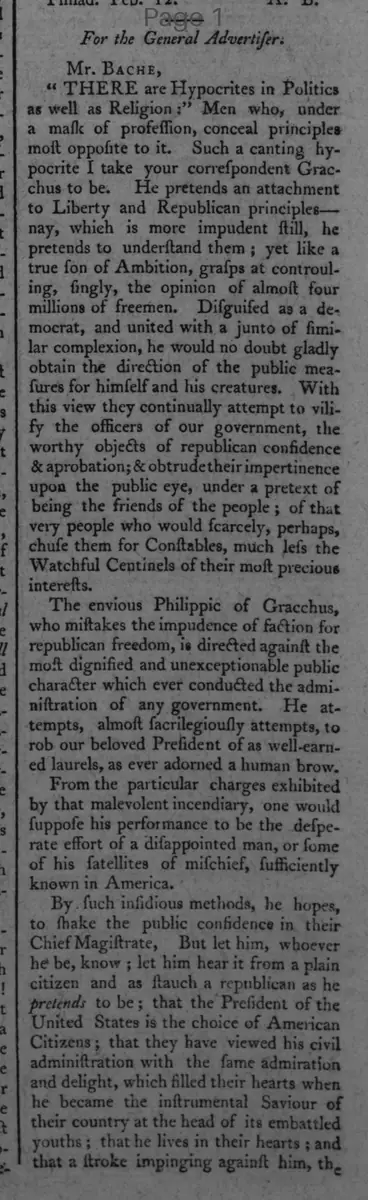
Mr. Bache,
" THERE are Hypocrites in Politics as well as Religion:" Men who, under a mask of profession, conceal principles most opposite to it. Such a canting hypocrite I take your correspondent Gracchus to be. He pretends an attachment to Liberty and Republican principles—nay, which is more impudent still, he pretends to understand them; yet like a true son of Ambition, grasps at controuling, singly, the opinion of almost four millions of freemen. Disguised as a democrat, and united with a junto of similar complexion, he would no doubt gladly obtain the direction of the public measures for himself and his creatures. With this view they continually attempt to vilify the officers of our government, the worthy objects of republican confidence & approbation; & obtrude their impertinence upon the public eye, under a pretext of being the friends of the people ; of that very people who would scarcely, perhaps, choose them for Constables, much less the Watchful Sentinels of their most precious interests.
The envious Philippic of Gracchus, who mistakes the impudence of faction for republican freedom, is directed against the most dignified and unexceptionable public character which ever conducted the administration of any government. He attempts, almost sacrilegiously attempts, to rob our beloved President of as well-earned laurels, as ever adorned a human brow. From the particular charges exhibited by that malevolent incendiary, one would suppose his performance to be the desperate effort of a disappointed man, or some of his satellites of mischief, sufficiently known in America.
By such insidious methods, he hopes, to shake the public confidence in their Chief Magistrate, But let him, whoever he be, know ; let him hear it from a plain citizen and as staunch a republican as he pretends to be; that the President of the United States is the choice of American Citizens; that they have viewed his civil administration with the same admiration and delight, which filled their hearts when he became the instrumental Saviour of their country at the head of its embattled youths; that he lives in their hearts ; and that a stroke impinging against him, that the feeling of every real American citizen, in the remotest corner of the United States, who feels himself personally insulted thereby. Let Gracchus, let his abetters know, that thousands and ten thousands in this extensive country, cherish the name of Washington, as the vital blood which animates their hearts. Let these men know that the envenomed shafts of envy which they aim at this beloved character, will fall, like arrows shot against the sun, with vengeful force upon their own heads. Let them know that the people of America, are men of principle, of steady character and the most solid judgment; that they do not change their opinions, men and manners with every moon; and that they subject neither the heads of their deserving citizens to the bloody Guillotine of France, nor their fame to the unceasing guillotine of malicious pens.
Having yielded thus far to the emotions of an indignant, honest heart, roused by its attachment to liberty, which has been wounded in the character of her first-born Son, I can proceed the more patiently to consider the production of Gracchus, in some detail, and offer a few strictures upon it.
His general positions in the beginning are true in themselves, but without an object at this day. They are certainly inapplicable to the case, with which he connects them. He seems, either not to understand, or not to distinguish between an "implicit reliance upon influential men; and a generous confidence in those servants of the public, whose fidelity has been severely tested on many important occasions, and proved incorruptible. Unequivocal proofs of the most inviolable integrity directed the choice of America to the President of these United States; and continued experience confirms their opinion of his merit.
His eminent capacity for executing important trusts and his unparalleled fidelity have united all generous, judicious, noble spirits in his favor.
This has called him repeatedly and unanimously to that conspicuous post in which he so worthily represents the sovereignty of the American States.
He is the people collectively; for he is chosen by their suffrage; to speak in their name; to act with their power; and to manage with singular responsibility certain specified and important concerns of the government, on their behalf. He is thus a sovereign not of the people, but for the people, to transact our business with foreign sovereignties, and to carry into execution the public will, lawfully expressed.
This kind of supremacy he has obtained by the only legitimate title, the OPINION, the KNOWLEDGE, the CHOICE of the people. And will Gracchus dare to say, that the opinion, the will of the people thus largely collected, ought not to prevail? Will he avow such a sentiment and yet, with unblushing front, pretend to republicanism? Will he impertinently suppose for a moment, that we ought to submit our opinion to his, and withdraw our confidence from the man of our hearts, to place it—upon whom? Enlightened fellow citizens! upon whom? upon some disguised foe to our liberty, happiness, and peace; some dark assassin, whose best security is—his unknown name!! To mention this monstrous phenomenon, as a possible event, even in our era of political wonders, is to expose it to the most expressive contempt.
The allusions to Tuscany and Rome are the wildest imaginable. Can ignorance itself suppose, or is prejudice hardy enough to suggest a parallel between George Washington, the first of men, and the artful Cato, the bloody and terrific Sylla, or the ambitious Cæsar? between power committed in trust by frequent, unbiased choice, and, power assumed and indefinitely exercised, thro' the insidious arts, or the military force devoted to the ambitious will of those despots? between an enlightened and comparatively virtuous nation, in the youth of freedom; and people enervated by luxury and ready to submit their servile necks to the first master who was bold enough to command them or rich enough to purchase their prostration, by furnishing unbounded entertainments and expensive raree-shows?
As Gracchus has erred egregiously in the application of ancient facts to the present situation of America, so he is not less mistaken in his interpretation of the recent governmental acts of the President, which he has specified, and which he affirms to have been "incompatible with the spirit of a free government."
The dismission of Du Plaine from his consular functions for a daring outrage upon the authority of this country, a fact authenticated by the clearest evidence, was an act the most salutary in itself, the most necessary from its circumstances, and performed in a constitutional manner by the President, who in all such public transactions, is the only organ to express the National will. To talk of a trial by jury in a case of that sort, is a weak attempt to mislead by the sound of words; and is just as ridiculous as to expect that the Indians should be tried by a jury before Gen. Wayne shall treat them as enemies; or Great Britain, before Congress had discussed Mr. Madison's Resolutions. Yet Gracchus asserts that this necessary severity was an outrage upon the trial by jury,' which in fact, as has been shewn, was not applicable to a circumstance of that nature; and that the Consul's conduct was sub judice, when the proclamation declared his guilt;' nay further, he insinuates, that a jury of our country acquitted him in the very instance wherein the proclamation passed sentence upon him.
Is this fact? Or is it not a gross misrepresentation calculated to deceive the unwary? If Du Plaine was tried by a jury at all; was it not with regard to a question of property or damages; altogether distinct from the public breach of the peace, for which his exequatur was revoked? Does this writer ignorantly or insidiously thus confound these two different objects?
The same ignorance or insidious design, has induced Gracchus, to separate, as Mr. Genet also usually does, the people of America, from their government.
This he has attempted in his statement of Henfield's case, as well as that of Du Plaine. But, as well might the body be distinguished from its form, or matter from its colour and shape, as under our constitution, the people and their government be separated. How long time will these unfledged republicans require, to learn, that our government is the appointment of the people themselves, their ostensible representative; and the organ whereby they express their will? Surely the general voice of counties, cities and towns, in various parts of America, in favour of the President's official conduct, is a decided proof that there is no repulsion between the people and their own constituted authority; as falsely asserted by Gracchus from the proceedings of one or two uninformed juries: and the tremendous resolves of a county or two in Virginia, buried in ignorance of what passes in the political world, except what they receive thro' the partial medium of a disappointed party!
The firmness and wisdom with which the President baffled the repeated attempts of Genet to disturb our happiness and peace, have been decidedly and honourably approved by Congress. The dignity and candor of that Minister is sufficiently obvious to all, who compare his unqualified declarations on his first arrival in America, with his succeeding and avowed attempts to involve us in war; and those public instructions which he afterwards pulled out of his pocket' as the French interpretation of the treaty. His factious and intemperate conduct, and his undisguised impertinence, not so much to the President as an individual, or to the delicate sensibilities of some imaginary court, as to the 'Sovereign and independent Republic of America,' in her Representative or Chief Magistrate, has involved him in just suspicion, and degraded him into an object of just contempt. Finally the affair of the Southern Sicarii, who have received commissions from him to commit the peace of their country with Spain, and his wretched explanation of that dark business has finished his career, and rendered him an odious object of abhorrence. The palliative complaints therefore of Gracchus upon the subject of this, almost, ex-minister of France, and his coarse reflections upon the worthiest Magistrate in all the world; are nothing but the effusions of a fretted and cankered heart, and deserve nothing but indignant reproach, from every honest man.
To conclude, though I dislike and reprobate the resolves of Amelia county, the resolves of which were published; I believe also, re-published in our newspapers; and which speak so loftily about Citizen Genet, and so pointedly against Mr. Hamilton, is the native place, and the usual residence of Mr. G-s. Albemarle, which passed similar resolves, contains Mr. J-n's seat.
To probe the language and the design of Gracchus, I am neither a slave nor a tyrant.' I have not tameness for the one, nor power and influence, nor congeniality enough with Gracchus, Genet or hollow democrats of any party, for the other. I have no more connexion with the President or the officers of government, than the most remote or obscure of our fellow-citizens in the wilderness. I never attended a levee, because no business called me there; and have never seen Mr. Hamilton or Gen. Knox, since their residence in this city. My feelings as a free citizen, on reading the slander of Gracchus, have been my sole prompters upon the present occasion. Urged by these, I have attacked the slanderer in the style he deserved, and leave him to his fate with the public.
A. B.
What sub-type of article is it?
What themes does it cover?
What keywords are associated?
What entities or persons were involved?
Letter to Editor Details
Author
A. B.
Recipient
Mr. Bache
Main Argument
the letter vehemently defends president washington's administration and character against 'gracchus's' hypocritical and factional attacks, asserting that washington embodies the people's will and integrity, while dismissing gracchus's criticisms of governmental actions involving french diplomats as misrepresentations.
Notable Details