Thank you for visiting SNEWPapers!
Sign up free
Domestic News
July 17, 1918
The Brattleboro Daily Reformer
Brattleboro, Windham County, Vermont
What is this article about?
U.S. Department of Agriculture provides detailed instructions for housewives on successful jelly making, emphasizing proper fruit selection, pectin and acid balance, juice preparation, sugar amounts, boiling times, and sealing to ensure reliable results without relying on luck.
Merged-components note: Continuation of the instructional article on jelly making.
Clipping
OCR Quality
98%
Excellent
Full Text
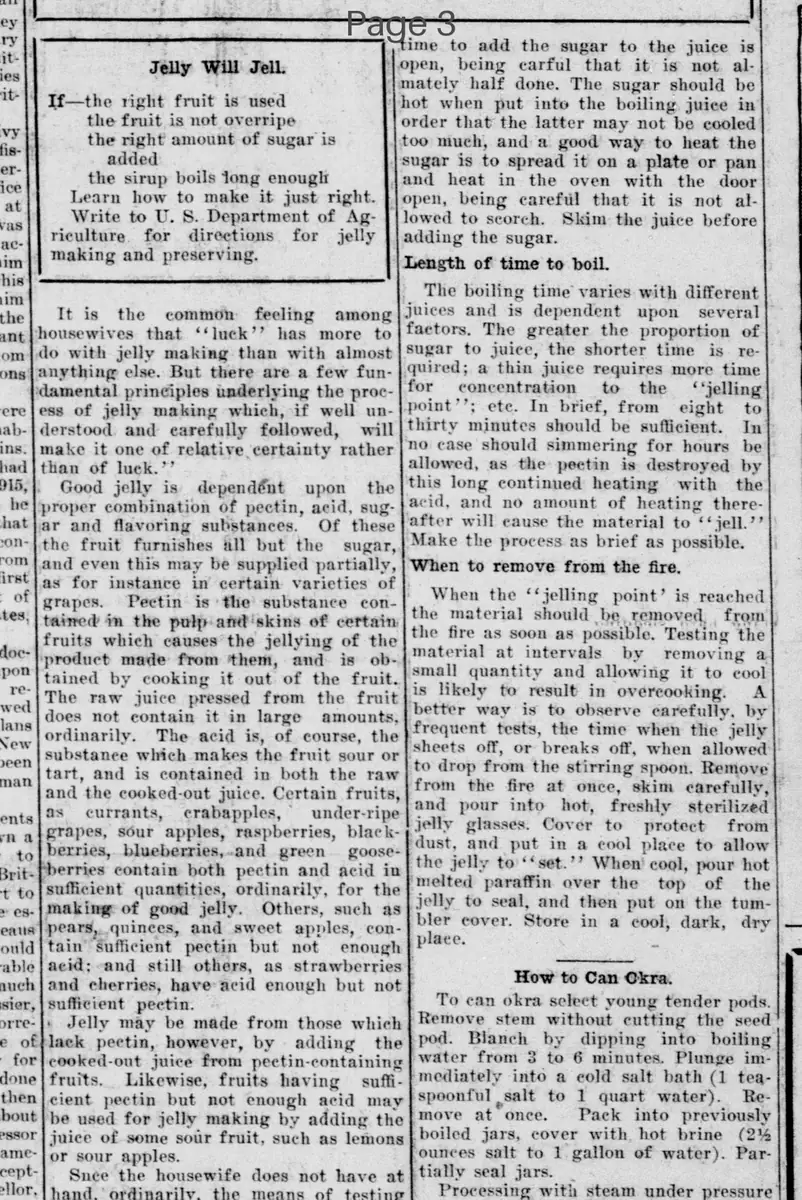
If the right fruit is used the fruit is not overripe the right amount of sugar is added the sirup boils long enough Learn how to make it just right.
Write to U. S. Department of Agriculture for directions for jelly making and preserving.
It is the common feeling among housewives that 'luck', has more to do with jelly making than with almost anything else. But there are a few fundamental principles underlying the process of jelly making which, if well understood and carefully followed, will make it one of relative certainty rather than of luck.
Good jelly is dependent upon the proper combination of pectin, acid, sugar and flavoring substances. Of these the fruit furnishes all but the sugar, and even this may be supplied partially, as for instance in certain varieties of grapes. Pectin is the substance contained in the pulp and skins of certain fruits which causes the jellying of the product made from them, and is obtained by cooking it out of the fruit. The raw juice pressed from the fruit does not contain it in large amounts, ordinarily. The acid is, of course, the substance which makes the fruit sour or tart, and is contained in both the raw and the cooked-out juice. Certain fruits, as currants, crabapples, under-ripe grapes, sour apples, raspberries, blackberries, blueberries, and green gooseberries contain both pectin and acid in sufficient quantities, ordinarily, for the making of good jelly. Others, such as pears, quinces, and sweet apples, contain sufficient pectin but not enough acid; and still others, as strawberries and cherries, have acid enough but not sufficient pectin.
Jelly may be made from those which lack pectin, however, by adding the cooked-out juice from pectin-containing fruits. Likewise, fruits having sufficient pectin but not enough acid may be used for jelly making by adding the juice of some sour fruit, such as lemons or sour apples.
Since the housewife does not have at hand, ordinarily, the means of testing the amount of acid in a particular juice by accurate methods, she must rely upon taste. As good a rule as can be given is that the juice from which jelly is made should be as tart as a good sour apple.
Preparing the juice.
Wash the fruit, remove stems and decayed portions, and cut large fruits into small pieces. Do not peel, unless citrus fruits, as lemons or oranges, are being used, in which case the yellow portion only should be removed, leaving the white which is rich in pectin. When juicy fruits are being employed, add just enough water to prevent burning while cooking. In using those which are not very juicy, cover them with water. Cook slowly until soft, and strain through a bag made of flannel or double thickness of cheesecloth. Do not use pressure if a clear jelly is desired.
Amount of sugar to use.
The consistency of jelly prepared from fruits having sufficient pectin and acid is dependent upon the amount of sugar used. Too little sugar results in a small quantity of jelly which is tough and unpleasantly sour. Too much sugar, on the other hand, gives a larger volume of jelly, but it is soft and will not "stand alone." Jelly which is tender and yet holds its form when taken from the glass is what is desired, and this will be obtained by carefully adjusting the amount of sugar to the kind of juice used. Juice rich in pectin and having sufficient acid will, as a rule, give best results if equal measures of sugar and juice are used. If the juice is more watery a smaller amount of sugar is required-three-fourths as much, or perhaps less.
Experiments indicate that the best
time to add the sugar to the juice is when the latter is approximately half done. The sugar should be hot when put into the boiling juice in order that the latter may not be cooled too much, and a good way to heat the sugar is to spread it on a plate or pan and heat in the oven with the door open, being careful that it is not allowed to scorch. Skim the juice before adding the sugar.
Length of time to boil.
The boiling time varies with different juices and is dependent upon several factors. The greater the proportion of sugar to juice, the shorter time is required; a thin juice requires more time for concentration to the "jelling point": etc. In brief, from eight to thirty minutes should be sufficient. In no case should simmering for hours be allowed, as the pectin is destroyed by this long continued heating with the acid, and no amount of heating thereafter will cause the material to "jell."
Make the process as brief as possible.
When to remove from the fire.
When the "jelling point" is reached the material should be removed from the fire as soon as possible. Testing the material at intervals by removing a small quantity and allowing it to cool is likely to result in overcooking. A better way is to observe carefully, by frequent tests, the time when the jelly sheets off, or breaks off, when allowed to drop from the stirring spoon. Remove from the fire at once, skim carefully, and pour into hot, freshly sterilized jelly glasses. Cover to protect from dust, and put in a cool place to allow the jelly to "set." When cool, pour hot melted paraffin over the top of the jelly to seal, and then put on the tumbler cover. Store in a cool, dark, dry place.
Write to U. S. Department of Agriculture for directions for jelly making and preserving.
It is the common feeling among housewives that 'luck', has more to do with jelly making than with almost anything else. But there are a few fundamental principles underlying the process of jelly making which, if well understood and carefully followed, will make it one of relative certainty rather than of luck.
Good jelly is dependent upon the proper combination of pectin, acid, sugar and flavoring substances. Of these the fruit furnishes all but the sugar, and even this may be supplied partially, as for instance in certain varieties of grapes. Pectin is the substance contained in the pulp and skins of certain fruits which causes the jellying of the product made from them, and is obtained by cooking it out of the fruit. The raw juice pressed from the fruit does not contain it in large amounts, ordinarily. The acid is, of course, the substance which makes the fruit sour or tart, and is contained in both the raw and the cooked-out juice. Certain fruits, as currants, crabapples, under-ripe grapes, sour apples, raspberries, blackberries, blueberries, and green gooseberries contain both pectin and acid in sufficient quantities, ordinarily, for the making of good jelly. Others, such as pears, quinces, and sweet apples, contain sufficient pectin but not enough acid; and still others, as strawberries and cherries, have acid enough but not sufficient pectin.
Jelly may be made from those which lack pectin, however, by adding the cooked-out juice from pectin-containing fruits. Likewise, fruits having sufficient pectin but not enough acid may be used for jelly making by adding the juice of some sour fruit, such as lemons or sour apples.
Since the housewife does not have at hand, ordinarily, the means of testing the amount of acid in a particular juice by accurate methods, she must rely upon taste. As good a rule as can be given is that the juice from which jelly is made should be as tart as a good sour apple.
Preparing the juice.
Wash the fruit, remove stems and decayed portions, and cut large fruits into small pieces. Do not peel, unless citrus fruits, as lemons or oranges, are being used, in which case the yellow portion only should be removed, leaving the white which is rich in pectin. When juicy fruits are being employed, add just enough water to prevent burning while cooking. In using those which are not very juicy, cover them with water. Cook slowly until soft, and strain through a bag made of flannel or double thickness of cheesecloth. Do not use pressure if a clear jelly is desired.
Amount of sugar to use.
The consistency of jelly prepared from fruits having sufficient pectin and acid is dependent upon the amount of sugar used. Too little sugar results in a small quantity of jelly which is tough and unpleasantly sour. Too much sugar, on the other hand, gives a larger volume of jelly, but it is soft and will not "stand alone." Jelly which is tender and yet holds its form when taken from the glass is what is desired, and this will be obtained by carefully adjusting the amount of sugar to the kind of juice used. Juice rich in pectin and having sufficient acid will, as a rule, give best results if equal measures of sugar and juice are used. If the juice is more watery a smaller amount of sugar is required-three-fourths as much, or perhaps less.
Experiments indicate that the best
time to add the sugar to the juice is when the latter is approximately half done. The sugar should be hot when put into the boiling juice in order that the latter may not be cooled too much, and a good way to heat the sugar is to spread it on a plate or pan and heat in the oven with the door open, being careful that it is not allowed to scorch. Skim the juice before adding the sugar.
Length of time to boil.
The boiling time varies with different juices and is dependent upon several factors. The greater the proportion of sugar to juice, the shorter time is required; a thin juice requires more time for concentration to the "jelling point": etc. In brief, from eight to thirty minutes should be sufficient. In no case should simmering for hours be allowed, as the pectin is destroyed by this long continued heating with the acid, and no amount of heating thereafter will cause the material to "jell."
Make the process as brief as possible.
When to remove from the fire.
When the "jelling point" is reached the material should be removed from the fire as soon as possible. Testing the material at intervals by removing a small quantity and allowing it to cool is likely to result in overcooking. A better way is to observe carefully, by frequent tests, the time when the jelly sheets off, or breaks off, when allowed to drop from the stirring spoon. Remove from the fire at once, skim carefully, and pour into hot, freshly sterilized jelly glasses. Cover to protect from dust, and put in a cool place to allow the jelly to "set." When cool, pour hot melted paraffin over the top of the jelly to seal, and then put on the tumbler cover. Store in a cool, dark, dry place.
What sub-type of article is it?
Food Preservation
Home Economics
What keywords are associated?
Jelly Making
Fruit Preservation
Pectin
Acid
Sugar
Usda Directions
Domestic News Details
Event Details
Instructional guide from the U.S. Department of Agriculture on making jelly, covering principles of pectin, acid, sugar; preparing juice; amount of sugar; boiling time; and sealing jelly.