Thank you for visiting SNEWPapers!
Sign up free
Editorial
November 7, 1831
Constitutional Whig
Richmond, Virginia
What is this article about?
Editorial defends US tariff system, arguing it fairly funds government debt and expenses from war, countering South Carolina's view of it as oppressive Northern favoritism; explains historical necessity and equal burden sharing.
Clipping
OCR Quality
98%
Excellent
Full Text
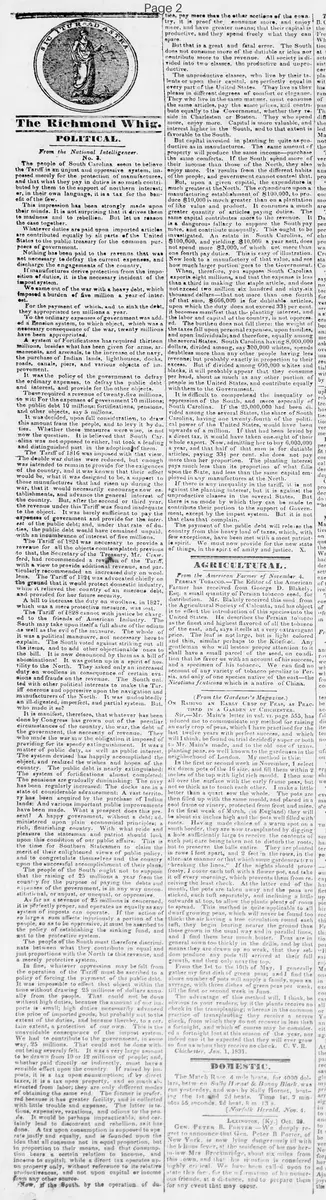
The Richmond Whig
POLITICAL.
From the National Intelligencer
No. 3.
The people of South Carolina seem to believe the Tariff is an unjust and oppressive system, imposed merely for the protection of manufactures, and that what they pay in duties is so much contributed by them to the support of northern interest; or, in their own language, it is a tax for the benefit of the few.
This impression has been strongly made upon their minds. It is not surprising that it drives them to madness and to rebellion.
But let us reason the case together.
Whatever duties are paid upon imported articles are contributed equally by all parts of the United States to the public treasury for the common purposes of government.
Nothing has been paid to the revenue that was not necessary to defray the current expenses, and discharge the engagements of the country.
If manufactures derive protection from the imposition of duties, it is the necessary incident of the impost system.
We came out of the war with a heavy debt, which imposed a burden of five millions a year of interest.
For the payment of which, and to sink the debt, they appropriated ten millions a year.
To the ordinary expenses of government was added a Pension system, to which object, which was a necessary consequence of the war, twenty millions have been appropriated.
A system of Fortifications has required thirteen millions, besides what has been given for arms, armaments, and arsenals, to the increase of the navy, the purchase of Indian lands, lighthouses, docks, roads, canals, piers, and various objects of improvement.
It was the policy of the government to defray the ordinary expenses, to defray the public debt and interest, and provide for the other objects.
These required a revenue of twenty-five millions, to wit: For the expenses of government 10 millions; the public debt 10 millions: fortifications, pensions, and other objects, say 5 millions.
It was decided, upon full consideration, to draw this amount from the people, and to levy it by duties. Whether these measures were wise, is not now the question. It is believed that South Carolina was not opposed to either, but took a leading and distinguished part in the adoption of them.
The Tariff of 1816 was imposed with that view. The double war duties were reduced, but enough was intended to remain to provide for the exigencies of the country, and it was known that their effect would be, what it was designed to be, a support to those manufactures that had risen up during the war, that it would necessarily encourage new establishments, and advance the general interest of the country. But, after the second or third year, the revenue under this Tariff was found inadequate to the object. It was barely sufficient to pay the expenses of government and provide for the interest of the public debt; and, under that rate of duties, the public debt would have remained unpaid, with an incumbrance of interest of five millions.
The Tariff of 1824 was necessary to provide a revenue for all the objects contemplated; previous to that, the Secretary of the Treasury, Mr. Crawford, had recommended a revision of the Tariff, with a view to provide additional revenue, and particularly recommended an increased duty on woollens. The Tariff of 1824 was advocated chiefly on the ground that it would protect domestic industry, while it relieved the country of an onerous debt, and provided for her future security.
A bill to increase the duty on woollens, in 1827, which was a mere protective measure, was lost.
The Tariff of 1828 cannot with justice be charged to the friends of American Industry. The South may take upon itself a full share of the odium as well as the evil of the measure. The whole of it was a political manœuvre, not necessary here to explain. The South voted against striking out all the items, and to add other objectionable ones to the bill. It is now denounced by them as a bill of abominations! It was gotten up in a spirit of hostility to the North. They asked only an increased duty on woollens in consequence of certain evasions and frauds on the revenue. The South united with other political interests to make the Tariff onerous and oppressive upon the navigation and manufacturers of the North. It was undoubtedly an ill-digested, imperfect, and partial system. But who made it so?
It is manifest, therefore, that whatever has been done by Congress has grown out of the peculiar circumstances of the country, the war, the debt of the government, the necessity of revenue. They who made the war saw the obligation it imposed of providing for its speedy extinguishment. It was a matter of public duty, as well as public interest.
The system devised has happily accomplished the object, and realized the wishes and hopes of the country. The public debt is nearly extinguished: The system of fortifications almost completed: The pensions are gradually diminishing: The navy has been regularly increased: The docks are in a state of considerable advancement: A vast territory has been acquired by the purchase of Indian lands: And various important public improvements have been made. What a prospect does this present? A happy government, without a debt; administered upon plain economical principles; a rich, flourishing country. With what pride and pleasure the statesman and patriot should look upon this condition of our public affairs. This is the time for Southern Statesmen to claim the merit of their enlightened views of public policy, and to congratulate themselves and the country upon the successful accomplishment of their plans.
The people of the South ought not to suppose that the raising of 25 millions a year from the country for the purpose of paying the debts and expenses of the government, is in any way unconstitutional, or unjust, or unequal, or oppressive.
As far as a revenue of 25 millions is concerned, it is perfectly proper, and operates as equally as any system of imposts can operate. If the action of so large a sum affects injuriously a portion of the people, so as to be oppressive, it must be ascribed to the policy of establishing the sinking fund, and not to the protective system.
The people of the South must therefore discriminate between what they contribute in equal and just proportions with the North to this revenue, and a merely protective system.
In fine, whatever oppression may be felt from the operation of the Tariff must be ascribed to a policy of forcing the payment of the public debt. It was impossible to effect that object within the time without drawing 25 millions of dollars annually from the people. That could not be done without high duties, because the amount of our imports is small; high duties necessarily advanced the price of imported goods, but probably not to the extent of the duties, and became thereby, to a certain extent, a protection of our own. This is the unavoidable consequence of the impost system.
We had to contribute to the government, in some way, 25 millions. That could not be done without being severely felt. It was a very large amount to be drawn from 10 or 12 millions of people; and, whether paid directly or indirectly, must have a sensible effect upon the country. If raised by imposts, it is a tax upon consumption; if by direct taxes, it is a tax upon property, and so much abstracted from labor; they are only different modes of obtaining the same end. The former is preferred because it has greater facility, and is collected with little trouble and expense. The latter is tedious, expensive, vexatious, and odious to the people. It would be perhaps impracticable, and certainly lead to discontent and rebellion, as it has done. A tax upon consumption is supposed to operate justly and equally, and is founded upon the idea that all consume not in equal proportion, but in proportion to their means, and that Consumption bears a certain relation to income, and income to capital; while a direct tax operates upon property only, without reference to its relative productiveness, and not upon capital or income from any other source.
Now, if the South, by the operation of duties, pay more than the other sections of the country, it is proof they consume more, and enjoy more, and have greater means; that their capital is productive, and they spend freely what they can spare.
But that is a great and fatal error. The South does not consume more of the dutiable articles nor contribute more to the revenue. All society is divided into two classes, the productive and unproductive.
The unproductive classes, who live by their talents or upon their capital, are perfectly equal in every part of the United States. They live as they please in different degrees of comfort or elegance. They who live in the same manner, must consume the same articles, pay the same prices, and contribute equally to the Government, whether they reside in Charleston or Boston. They who spend more, enjoy more. Capital is more valuable, and interest higher in the South, and to that extent is favorable to the South.
But capital invested in planting is quite as productive as in manufactures. The same amount of property will produce the same income--purchase the same comforts. If the South spend more of their income than those of the North, they also enjoy more. It results from the different habits of the people, and government cannot control that.
But, upon a given capital, the expenditure is much greater at the North. The expenditure upon a manufacturing establishment of $100,000, to produce $10,000 is much greater than on a plantation of like value and product. It consumes a much greater quantity of articles paying duties. The same capital contributes more to the revenue. It is a dangerous fallacy to suppose the South pay more, and contribute unequally. This ought to be investigated. An estate in South Carolina, of $100,000, and yielding $10,000 a year nett, does not spend more $3,000, of which not more than one fourth pay duties. This is easy of illustration.
Now look to a manufactory of that value, and see how much larger portion goes to the Government.
When, therefore, you suppose South Carolina exports eight millions, and that the expense is less than a third in making the staple article, and does not exceed two million six hundred and sixty-six thousand dollars--that not more than one fourth of that sum, $666,000 is for dutiable articles, upon which the duty does not exceed 33 1/3 per cent. it becomes manifest that the planting interest, and the labor and capital of the country, is not oppressed. The burthen does not fall there: the weight of the taxes fall upon personal expenses, upon families, and upon individuals; and therefore, equally among the several States. South Carolina having $8,000,000 divided among, say 300,000 whites, spends doubtless more than any other people having less revenue; but probably exactly in proportion to their excess. But if divided among 600,000 whites and blacks, it will probably appear that they consume per head, about as much as any other portion of people in the United States, and contribute equally with them to the Government.
It is difficult to comprehend the inequality or oppression of the South, and more especially of South Carolina. If the 25,000,000 had been divided among the several States, the share of South Carolina, having one twenty-fourth of the political power of the United States, would have been upwards of a million. If that had been levied by a direct tax, it would have taken one-eighth of their whole export. Now, admitting her to buy $6,000,000 a year, and that half of that sum is for dutiable articles, paying 33 per cent. she does not pay more than her proportion. The planting interest pays much less than its proportion of what falls upon the State, and less than the same capital employed in any manufactures at the North.
If there is any inequality in the tariff, it is not against the planting interest, but it is against the unproductive classes in the several States. But there is no mode by which they can be made to contribute their portion to the support of Government, except by the impost system. But it is not that class that complain.
The payment of the public debt will release the country from this heavy load of taxes, which, with few exceptions, have been met with a most patriotic spirit. We must now provide for the new state of things, in the spirit of amity and justice. X.
POLITICAL.
From the National Intelligencer
No. 3.
The people of South Carolina seem to believe the Tariff is an unjust and oppressive system, imposed merely for the protection of manufactures, and that what they pay in duties is so much contributed by them to the support of northern interest; or, in their own language, it is a tax for the benefit of the few.
This impression has been strongly made upon their minds. It is not surprising that it drives them to madness and to rebellion.
But let us reason the case together.
Whatever duties are paid upon imported articles are contributed equally by all parts of the United States to the public treasury for the common purposes of government.
Nothing has been paid to the revenue that was not necessary to defray the current expenses, and discharge the engagements of the country.
If manufactures derive protection from the imposition of duties, it is the necessary incident of the impost system.
We came out of the war with a heavy debt, which imposed a burden of five millions a year of interest.
For the payment of which, and to sink the debt, they appropriated ten millions a year.
To the ordinary expenses of government was added a Pension system, to which object, which was a necessary consequence of the war, twenty millions have been appropriated.
A system of Fortifications has required thirteen millions, besides what has been given for arms, armaments, and arsenals, to the increase of the navy, the purchase of Indian lands, lighthouses, docks, roads, canals, piers, and various objects of improvement.
It was the policy of the government to defray the ordinary expenses, to defray the public debt and interest, and provide for the other objects.
These required a revenue of twenty-five millions, to wit: For the expenses of government 10 millions; the public debt 10 millions: fortifications, pensions, and other objects, say 5 millions.
It was decided, upon full consideration, to draw this amount from the people, and to levy it by duties. Whether these measures were wise, is not now the question. It is believed that South Carolina was not opposed to either, but took a leading and distinguished part in the adoption of them.
The Tariff of 1816 was imposed with that view. The double war duties were reduced, but enough was intended to remain to provide for the exigencies of the country, and it was known that their effect would be, what it was designed to be, a support to those manufactures that had risen up during the war, that it would necessarily encourage new establishments, and advance the general interest of the country. But, after the second or third year, the revenue under this Tariff was found inadequate to the object. It was barely sufficient to pay the expenses of government and provide for the interest of the public debt; and, under that rate of duties, the public debt would have remained unpaid, with an incumbrance of interest of five millions.
The Tariff of 1824 was necessary to provide a revenue for all the objects contemplated; previous to that, the Secretary of the Treasury, Mr. Crawford, had recommended a revision of the Tariff, with a view to provide additional revenue, and particularly recommended an increased duty on woollens. The Tariff of 1824 was advocated chiefly on the ground that it would protect domestic industry, while it relieved the country of an onerous debt, and provided for her future security.
A bill to increase the duty on woollens, in 1827, which was a mere protective measure, was lost.
The Tariff of 1828 cannot with justice be charged to the friends of American Industry. The South may take upon itself a full share of the odium as well as the evil of the measure. The whole of it was a political manœuvre, not necessary here to explain. The South voted against striking out all the items, and to add other objectionable ones to the bill. It is now denounced by them as a bill of abominations! It was gotten up in a spirit of hostility to the North. They asked only an increased duty on woollens in consequence of certain evasions and frauds on the revenue. The South united with other political interests to make the Tariff onerous and oppressive upon the navigation and manufacturers of the North. It was undoubtedly an ill-digested, imperfect, and partial system. But who made it so?
It is manifest, therefore, that whatever has been done by Congress has grown out of the peculiar circumstances of the country, the war, the debt of the government, the necessity of revenue. They who made the war saw the obligation it imposed of providing for its speedy extinguishment. It was a matter of public duty, as well as public interest.
The system devised has happily accomplished the object, and realized the wishes and hopes of the country. The public debt is nearly extinguished: The system of fortifications almost completed: The pensions are gradually diminishing: The navy has been regularly increased: The docks are in a state of considerable advancement: A vast territory has been acquired by the purchase of Indian lands: And various important public improvements have been made. What a prospect does this present? A happy government, without a debt; administered upon plain economical principles; a rich, flourishing country. With what pride and pleasure the statesman and patriot should look upon this condition of our public affairs. This is the time for Southern Statesmen to claim the merit of their enlightened views of public policy, and to congratulate themselves and the country upon the successful accomplishment of their plans.
The people of the South ought not to suppose that the raising of 25 millions a year from the country for the purpose of paying the debts and expenses of the government, is in any way unconstitutional, or unjust, or unequal, or oppressive.
As far as a revenue of 25 millions is concerned, it is perfectly proper, and operates as equally as any system of imposts can operate. If the action of so large a sum affects injuriously a portion of the people, so as to be oppressive, it must be ascribed to the policy of establishing the sinking fund, and not to the protective system.
The people of the South must therefore discriminate between what they contribute in equal and just proportions with the North to this revenue, and a merely protective system.
In fine, whatever oppression may be felt from the operation of the Tariff must be ascribed to a policy of forcing the payment of the public debt. It was impossible to effect that object within the time without drawing 25 millions of dollars annually from the people. That could not be done without high duties, because the amount of our imports is small; high duties necessarily advanced the price of imported goods, but probably not to the extent of the duties, and became thereby, to a certain extent, a protection of our own. This is the unavoidable consequence of the impost system.
We had to contribute to the government, in some way, 25 millions. That could not be done without being severely felt. It was a very large amount to be drawn from 10 or 12 millions of people; and, whether paid directly or indirectly, must have a sensible effect upon the country. If raised by imposts, it is a tax upon consumption; if by direct taxes, it is a tax upon property, and so much abstracted from labor; they are only different modes of obtaining the same end. The former is preferred because it has greater facility, and is collected with little trouble and expense. The latter is tedious, expensive, vexatious, and odious to the people. It would be perhaps impracticable, and certainly lead to discontent and rebellion, as it has done. A tax upon consumption is supposed to operate justly and equally, and is founded upon the idea that all consume not in equal proportion, but in proportion to their means, and that Consumption bears a certain relation to income, and income to capital; while a direct tax operates upon property only, without reference to its relative productiveness, and not upon capital or income from any other source.
Now, if the South, by the operation of duties, pay more than the other sections of the country, it is proof they consume more, and enjoy more, and have greater means; that their capital is productive, and they spend freely what they can spare.
But that is a great and fatal error. The South does not consume more of the dutiable articles nor contribute more to the revenue. All society is divided into two classes, the productive and unproductive.
The unproductive classes, who live by their talents or upon their capital, are perfectly equal in every part of the United States. They live as they please in different degrees of comfort or elegance. They who live in the same manner, must consume the same articles, pay the same prices, and contribute equally to the Government, whether they reside in Charleston or Boston. They who spend more, enjoy more. Capital is more valuable, and interest higher in the South, and to that extent is favorable to the South.
But capital invested in planting is quite as productive as in manufactures. The same amount of property will produce the same income--purchase the same comforts. If the South spend more of their income than those of the North, they also enjoy more. It results from the different habits of the people, and government cannot control that.
But, upon a given capital, the expenditure is much greater at the North. The expenditure upon a manufacturing establishment of $100,000, to produce $10,000 is much greater than on a plantation of like value and product. It consumes a much greater quantity of articles paying duties. The same capital contributes more to the revenue. It is a dangerous fallacy to suppose the South pay more, and contribute unequally. This ought to be investigated. An estate in South Carolina, of $100,000, and yielding $10,000 a year nett, does not spend more $3,000, of which not more than one fourth pay duties. This is easy of illustration.
Now look to a manufactory of that value, and see how much larger portion goes to the Government.
When, therefore, you suppose South Carolina exports eight millions, and that the expense is less than a third in making the staple article, and does not exceed two million six hundred and sixty-six thousand dollars--that not more than one fourth of that sum, $666,000 is for dutiable articles, upon which the duty does not exceed 33 1/3 per cent. it becomes manifest that the planting interest, and the labor and capital of the country, is not oppressed. The burthen does not fall there: the weight of the taxes fall upon personal expenses, upon families, and upon individuals; and therefore, equally among the several States. South Carolina having $8,000,000 divided among, say 300,000 whites, spends doubtless more than any other people having less revenue; but probably exactly in proportion to their excess. But if divided among 600,000 whites and blacks, it will probably appear that they consume per head, about as much as any other portion of people in the United States, and contribute equally with them to the Government.
It is difficult to comprehend the inequality or oppression of the South, and more especially of South Carolina. If the 25,000,000 had been divided among the several States, the share of South Carolina, having one twenty-fourth of the political power of the United States, would have been upwards of a million. If that had been levied by a direct tax, it would have taken one-eighth of their whole export. Now, admitting her to buy $6,000,000 a year, and that half of that sum is for dutiable articles, paying 33 per cent. she does not pay more than her proportion. The planting interest pays much less than its proportion of what falls upon the State, and less than the same capital employed in any manufactures at the North.
If there is any inequality in the tariff, it is not against the planting interest, but it is against the unproductive classes in the several States. But there is no mode by which they can be made to contribute their portion to the support of Government, except by the impost system. But it is not that class that complain.
The payment of the public debt will release the country from this heavy load of taxes, which, with few exceptions, have been met with a most patriotic spirit. We must now provide for the new state of things, in the spirit of amity and justice. X.
What sub-type of article is it?
Economic Policy
Taxation
Trade Or Commerce
What keywords are associated?
Tariff Defense
South Carolina
Public Debt
Revenue Duties
Protectionism
Impost System
Economic Equality
What entities or persons were involved?
South Carolina
Congress
Mr. Crawford
National Intelligencer
Editorial Details
Primary Topic
Defense Of The Tariff System Against South Carolina's Objections
Stance / Tone
Supportive Of Tariffs As Necessary And Fair
Key Figures
South Carolina
Congress
Mr. Crawford
National Intelligencer
Key Arguments
Duties On Imports Contribute Equally From All Parts Of The Us To The Public Treasury For Government Purposes
Tariffs Were Necessary To Pay War Debt, Interest, Pensions, Fortifications, And Other Expenses Totaling 25 Million Annually
South Carolina Participated In Adopting Earlier Tariffs Like 1816 And 1824
The 1828 Tariff Was A Political Maneuver Involving Southern Votes Against Northern Interests
The System Has Successfully Reduced Public Debt And Funded Improvements
Southern Complaints Stem From Misunderstanding; Tariffs Operate Equally As A Tax On Consumption
Planting Interests Pay Less Proportionally Than Manufacturing
High Duties Were Unavoidable To Raise Required Revenue Without Direct Taxes