Thank you for visiting SNEWPapers!
Sign up free
Alexandria Daily Advertiser
Alexandria, Virginia
What is this article about?
James Elliot, in Letter III to his constituents, opposes the constitutional amendment separating ballots for president and vice president. He argues it reduces small states' influence, makes the system less republican, and was unnecessary after the 1800 election crisis, prioritizing large states' power.
Merged-components note: This is a single continuous letter (Letter III) from Mr. Elliot to his constituents, spanning pages 2 and 3 with sequential reading order and flowing text; the third part was mislabeled as editorial but is part of the letter.
Clippings
1 of 2
OCR Quality
Full Text
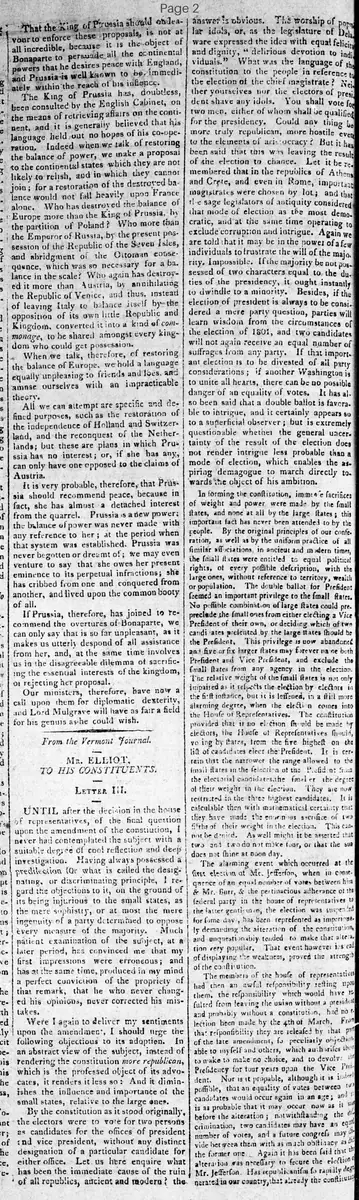
MR. ELLIOT,
TO HIS CONSTITUENTS.
Letter III.
UNTIL after the decision in the house of representatives, of the final question upon the amendment of the constitution, I never had contemplated the subject with a suitable degree of cool reflection and deep investigation: Having always possessed a predilection for what is called the designating, or discriminating principle, I regard the objections to it, on the ground of its being injurious to the small states, as the mere sophistry, or at most the mere ingenuity of a party determined to oppose every measure of the majority. Much patient examination of the subject, at a later period, has convinced me that my first impressions were erroneous; and has at the same time, produced in my mind a perfect conviction of the propriety of that remark, that he who never changed his opinions, never corrected his mistakes.
Were I again to deliver my sentiments upon the amendment: I should urge the following objections to its adoption. In an abstract view of the subject. instead of rendering the constitution more republican, which is the professed object of its advocates, it renders it less so: And it diminishes the influence and importance of the small states, relative to the large ones.
By the constitution as it stood originally. the electors were to vote for two persons as candidates for the offices of president and vice president, without any distinct designation of a particular candidate for either office. Let us here enquire what has been the immediate cause of the ruin of all republics, ancient and modern? the answer is obvious. The worship of popular idols, or, as the legislature of Delaware expressed the idea with equal felicity and dignity, "delirious devotion to individuals." What was the language of the constitution to the people in reference to the election of the chief magistrate? Neither yourselves nor the electors of president shall have any idols. You shall vote for two men, either of whom shall be qualified for the presidency. Could anything be more truly republican, more hostile even to the elements of aristocracy? But it has been said that this was leaving the result of the election to chance. Let it be remembered that in the republics of Athens and Crete, and even in Rome, important magistrates were chosen by lot; and that the sage legislators of antiquity considered that mode of election as the most democratic, and at the same time operating to exclude corruption and intrigue. Again we are told that it may be in the power of a few individuals to frustrate the will of the majority. Impossible. If the majority be not possessed of two characters equal to, the duties of the presidency, it ought instantly to dwindle to a minority. Besides, if the election of president is always to be considered a mere party question, parties will learn wisdom from the circumstances of the election of 1800, and two candidates will not again receive an equal number of suffrages from any party. If that important election is to be divested of all party considerations; if another Washington is to unite all hearts, there can be no possible danger of an equality of votes. It has also been said that a double ballot is favorable to intrigue, and it certainly appears so to a superficial observer; but is extremely questionable whether the general uncertainty of the result of the election does not render intrigue less probable than a mode of election, which enables the aspiring demagogue to march directly towards the object of his ambition.
In forming the constitution. immense sacrifices of weight and power were made by the small states, and none at all by the large states; this important fact has never been attended to by the people. By the original principles of our confederation, as well as by the uniform practice of all similar associations, in ancient and modern times, the small states were entitled to equal political rights, of every possible description, with the large ones, without reference to territory, wealth or population. The double ballot for President seemed an important privilege to the small states. No possible combination of large states could preclude the small ones from either electing a Vice President of their own, or deciding which of two candidates presented by the large states should be the President. This privilege is now abandoned and five or six larger states may forever name both President and Vice President, and exclude the small states from any agency in the election.
The relative weight of the small states is not only impaired as it respects the election by electors in the first instance, but it is lessened, in a still more alarming degree, when the election comes into the House of Representatives. The constitution provided that it no election should be made by electors, the House of Representatives should, voting by states, from the five highest on the list of candidates elect the President. It is certain that the narrower the range allowed to the small states in the election of the President from the electoral candidates,the smaller the degree of their weight in the election. They are now restricted to the three highest candidates. It is calculable then with mathematical certainty that they have made the enormous sacrifice of two fifths of their weight in the election. This cannot be denied. As well might it be asserted that two and two do not make four, or that the sun does not shine at noon day.
The alarming event which occurred at the first election of Mr. Jefferson. when in consequence of an equal number of votes between him & Mr. Burr, & the pertinacious adherence of the federal party in the house of representatives to the latter gentleman, the election was suspended for some days, has been represented as imperiously demanding the alteration of the constitution, and unquestionably tended to make that alteration very popular. That event however is as much evidence of displaying the weakness, proved the strength of the constitution.
The members of the house of representatives had then an awful responsibility resting upon them, the responsibility which would have resulted from leaving the union without a president and probably without a constitution. had no election been made by the 4th of March. From that responsibility they are released by that part of the late amendment, so peculiarly objectionable. to myself and others, which authorizes them to make no choice, and to devolve the Presidency for four years upon the Vice President. Nor is it probable, although it is indi-possible, that an equality of votes between two candidates would occur again in an age; and it is as probable that it may occur now as it was before the alteration ; notwithstanding the dis-crimination, two candidates may have an equal number of votes, and a future congress may be as pertinacious as the former one. Again it has been said that the alteration was necessary to secure the election of Mr. Jefferson. Has republicanism so rapidly degenerated in our country,that already the constitution Must be altered with a view to the promotion, individual, however eminent for talents and patriotism. Emolument, or continuance in office, of an individual? But the reverse of the assertion was the fact. With or without the alteration, the result was equally certain. Witness the election of Mr. Jefferson, in all human probability, more destructive of the rights of the small states. But other alterations of the constitution, will be in contemplation; and of the creation of an aristocracy of large states to be guided and governed by Virginia, the amendment in question was considered the harbinger. The evidence to support this assertion, and the character of the intended innovations, will form the subject of a future letter. Equally in a single community and in a confederated republic, there is a natural effort to make the strong stronger, and the weak weaker. When it has recorded the remark, that I have never intentionally given a vote calculated to reduce the weight of the small state of Vermont in the American Union, and the promise that I never will give such a vote in future.
JAMES ELLIOT.
What sub-type of article is it?
What themes does it cover?
What keywords are associated?
What entities or persons were involved?
Letter to Editor Details
Author
James Elliot
Recipient
His Constituents
Main Argument
the constitutional amendment introducing separate ballots for president and vice president diminishes the influence of small states, renders the system less republican by encouraging idol worship, and was unnecessary as the original method better protected against corruption and intrigue.
Notable Details