Thank you for visiting SNEWPapers!
Sign up free
Alexandria Daily Advertiser
Alexandria, Virginia
What is this article about?
Transcript from the Richmond Enquirer of witness testimonies in Colonel Aaron Burr's trial on September 24, 1807, detailing Harman Blennerhassett's recruitment for a river expedition involving land settlement in Ouachita but hinting at resistance against Spaniards and possible separation from the Union, with Burr as a leader.
Merged-components note: The component on page 3 is a direct continuation of the Burr trial transcript from page 2, as indicated by sequential reading orders and content flow starting with 'Cross Examination.'
Clippings
1 of 2
OCR Quality
Full Text
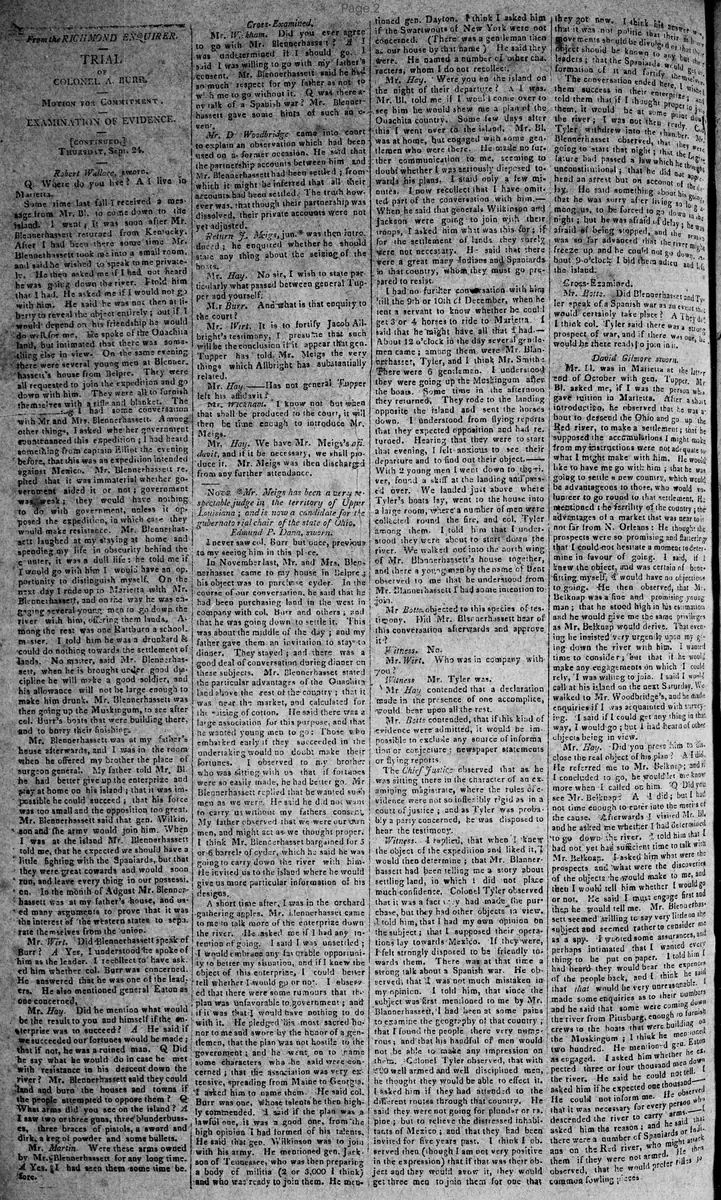
TRIAL
OF
COLONEL A. BURR
MOTION FOR COMMITMENT.
EXAMINATION OF EVIDENCE.
CONTINUED
Thursday Sept 24.
Robert Wallace, sworn.
Q. Where do you live? A. I live in Marietta.
Some time last fall I received a message from Mr. B. to come down to the island. I went. It was soon after Mr. Blennerhassett returned from Kentucky.
After I had been there some time Mr. Blennerhassett took me into a small room, and said he wished to speak to me private.
Mr. H. then asked me if I had not heard he was going down the river. I told him that I had. He asked me if I would not go with him. He said he was not then able to reveal the object entirely; but if I would depend on his friendship he would do well for me. He spoke of the Ouachita land, but intimated that there was something else in view. On the same evening there were several young men at Blennerhassett's house from Belpre. They were all requested to join the expedition and go down with him. They were all to furnish themselves with a rifle and blanket. The general had some conversation with Mr. and Mrs. Blennerhassett: Among other things, I asked whether government countenanced this expedition; I had heard something from captain Eliot the evening before, that this was an expedition intended against Mexico. Mr. Blennerhassett replied that it was immaterial whether government aided it or not; government was weak; they would have nothing to do with government, unless it opposed the expedition, in which case they would make resistance. Mr. Blennerhassett laughed at my staying at home and spending my life in obscurity behind the counter, it was a dull life: he told me if I would go with him I would have an opportunity to distinguish myself. On the next day I rode up to Marietta with Mr. Blennerhassett, and on the way he was engaging several young men to go down the river with him, offering them lands. Among the rest was one Bartburn a schoolmaster. I told him he was a drunkard and could do nothing towards the settlement of lands. No matter, said Mr. Blennerhassett, when he is brought under good discipline he will make a good soldier, and his allowance will not be large enough to make him drunk. Mr. Blennerhassett was then going up the Muskingum, to see after col. Burr's boats that were building there, and to hurry their finishing.
Mr. Blennerhassett was at my father's house afterwards, and I was in the room when he offered my brother the place of surgeon general. My father told Mr. Bl. he had better give up the enterprize and stay at home on his island; that it was impossible he could succeed; that his force was too small and the opposition too great.
Mr. Blennerhassett said that gen. Wilkinson and the army would join him. When I was at the island Mr. Blennerhassett told me, that he expected we should have a little fighting with the Spaniards, but that they were great cowards and would soon run, and leave every thing in our possession. In the month of August Mr. Blennerhassett was at my father's house, and used many arguments to prove that it was the interest of the western states to separate themselves from the union.
Mr. Wirt. Did Blennerhassett speak of Burr? A. Yes. I understood he spoke of him as the leader. I recollect to have asked him whether col. Burr was concerned. He answered that he was one of the leaders. He also mentioned general Eaton as one concerned.
Mr. Hoy. Did he mention what would be the result to you and himself if the enterprize was to succeed? A. He said if we succeeded our fortunes would be made; that if not, he was a ruined man. Q. Did he say what he would do in case he met with resistance in his descent down the river? Mr. Blennerhassett said they could land and burn the houses and towns if the people attempted to oppose them? Q. What arms did you see on the island? A. I saw two or three guns, three blunderbusses, three braces of pistols, a sword and dirk, a keg of powder and some bullets.
Mr. Martin. Were these arms owned by Mr. Blennerhassett for any long time? A. Yes. I had seen them some time before.
Cross Examined
Mr. Wickham: Did you ever before to go with Mr. Blennerhassett? A. I was determined. If I should go. I consent. Mr. Blennerhassett said he had so much respect for my father as not to wish me to go without it. A. Was there any talk of a Spanish war? Mr. Blennerhassett gave some hints of such an event.
Dr. Woodbridge came into court to explain an observation which had been used on a former occasion. He said that the partnership accounts between him and Mr. Blennerhassett had been settled; from which it might be inferred that all their accounts had been settled. The truth however was, that though their partnership was dissolved, their private accounts were not yet adjusted.
Return J. Meigs, jun. was then recalled; he enquired whether he should state anything about the seizing of the boats.
Mr. Hay. No sir, I wish to state particularly what passed between general Tupper and yourself.
Mr. Burr. And what is that enquiry to the court?
Mr. Wirt. It is to fortify Jacob Allbright's testimony, I presume that such will be the conclusion if it appear that gen. Tupper has told Mr. Meigs the very things which Allbright has substantially related.
Mr. Hay. Has not general Tupper left his affidavit?
Mr. Wickham. I know not but when that shall be produced to the court, it will then be time enough to introduce Mr. Meigs.
Mr. Hay. We have Mr. Meigs's affidavit, and if it be necessary, we shall produce it. Mr. Meigs was then discharged from any further attendance.
Note Mr. Meigs has been a very respectable judge in the territory of Upper Louisiana; and is now a candidate for the gubernatorial chair of the state of Ohio.
Edmund P. Dana, sworn.
I never saw col. Burr but once, previous to my seeing him in this place.
In November last, Mr. and Mrs. Blennerhassett came to my house in Belpre and his object was to purchase cider. In the course of our conversation, he said that he had been purchasing land in the west in company with col. Burr and others; and that he was going down to settle it. This was about the middle of the day; and my father gave them an invitation to stay to dinner. They stayed; and there was a good deal of conversation during dinner on these subjects. Mr. Blennerhassett stated the particular advantages of the Ouachita land above the rest of the country: that it was near the market, and calculated for the raising of cotton. He said there was a large association for this purpose, and that he wanted young men to go: Those who embarked early if they succeeded in the undertaking would no doubt make their fortunes. I observed to my brother who was sitting with us that if fortunes were so easily made, he had better go. Mr. Blennerhassett replied that he wanted such men as we were. He said he did not want to carry us without my father's consent. My father observed that we were our own men, and might act as we thought proper.
I think Mr. Blennerhassett bargained for 5 or 6 barrels of cyder, which he said he was going to carry down the river with him. He invited us to the island where he would give us more particular information of his designs.
A short time after. I was in the orchard gathering apples. Mr. Blennerhassett came to me to talk more of the enterprize down the river. He asked me if I had any intention of going. I said I was unsettled; I would embrace any favorable opportunity to better my situation, and if I knew the object of this enterprize, I could better tell whether I would go or not. I observed that there were some rumours that the plan was unfavorable to government; and if it was that I would have nothing to do with it. He pledged his most sacred honor to me and swore by the honor of a gentleman, that the plan was not hostile to the government; and he went on to name some characters who he said were concerned; that the association was very extensive, spreading from Maine to Georgia.
I asked him to name them. He said col. Burr was one, whose talents he then highly commended. I said if the plan was a lawful one, it was a good one, from the high opinion I had formed of his talents. He said that gen. Wilkinson was to join with his army. He mentioned gen. Jackson of Tennessee, who was then preparing a body of militia (2 or 3,000 I think) and who was ready to join them.
He mentioned gen. Dayton I think I asked him if the Swartwouts of New York were not concerned. (There was a gentleman then at our house by that name) He said they were. He named a number of other characters, whom I do not recollect.
Mr. Hay. Were you on the island on the night of their departure? A. I was.
Mr. Bl. told me if I would come over to see him he would show me a plan of the Ouachita country. Some few days after this I went over to the island. Mr. Bl. was at home, but engaged with some gentlemen who were there. He made no further communication to me, seeming to doubt whether I was seriously disposed towards his plans. I stayed only a few minutes. I now recollect that I have omitted part of the conversation with him. When he said that generals Wilkinson and Jackson were going to join with their troops, I asked him what was this for; if for the settlement of lands they surely were not necessary. He said that there were a great many Indians and Spaniards in that country, whom they must go prepared to resist.
I had no further conversation with him till the 9th or 10th of December, when he sent a servant to know whether he could get 3 or 4 horses to ride to Marietta. I said that he might have all that I had. About 12 o'clock in the day several gentlemen came; among them, were Mr. Blennerhassett, Tyler, and I think Mr. Smith: There were 6 gentlemen. I understood they were going up the Muskingum after the boats. Some time in the afternoon they returned. They rode to the landing opposite the island and sent the horses down. I understood from flying reports that they expected opposition and had returned. Hearing that they were to start that evening, I felt anxious to see their departure and to find out their object. With 2 young men I went down to the river, found a skiff at the landing and passed over. We landed just above where Tyler's boats lay, went to the house into a large room, where a number of men were collected round the fire, and col. Tyler among them. I told him that I understood they were about to start down the river. We walked out into the north wing of Mr. Blennerhassett's house together, and there a young man by the name of Bent observed to me that he understood from Mr. Blennerhassett I had some intention to join.
Mr. Botts, objected to this species of testimony. Did Mr. Blennerhassett hear of this conversation afterwards and approve it?
Witness, No.
Mr. Wirt. Who was in company with you?
Witness, Mr. Tyler was.
Mr. Hay contended that a declaration made in the presence of one accomplice, would bear upon all the rest.
Mr. Botts contended, that if this kind of evidence were admitted, it would be impossible to exclude any source of information or conjecture; newspaper statements or flying reports.
The Chief Justice observed that as he was sitting there in the character of an examining magistrate, where the rules of evidence were not so intolerably rigid as in a court of justice; and as Tyler was probably a party concerned, he was disposed to hear the testimony.
Witness. I replied, that when I knew the object of the expedition and liked it, I would then determine; that Mr. Blennerhassett had been telling me a story about settling land, in which I did not place much confidence, Colonel Tyler observed that it was a fact they had made the purchase, but they had other objects in view. I told him, that I had my own opinion on the subject; that I supposed their operations lay towards Mexico. If they were, I felt strongly disposed to be friendly towards them. There was at that time a strong talk about a Spanish war. He observed, that I was not much mistaken in my opinion. I told him, that since the subject was first mentioned to me by Mr. Blennerhassett, I had been at some pains to examine the geography of that country; that I found the people there very numerous; and that his handful of men would not be able to make any impression on them. Colonel Tyler observed, that with 500 well armed and well disciplined men, he thought they would be able to effect it. I asked him if they had attended to the different routes through that country. He said they were not going for plunder or rapine; but to relieve the distressed inhabitants of Mexico; and that they had been invited for five years past. I think I observed then (though I am not very positive in the expression) that if that was their object and they would avow it, they would get three men to join them for one that they got now. I think his answer was, that it was not politic that their military movements should be divulged; that the object should be known to any but the leaders: that the Spaniards would get information of it and fortify themselves.
The conversation ended here, I wished them success in their enterprize; and told them that if I thought proper to join them, it would be at some point down the river; I was not then ready.
Tyler withdrew into the chamber. Mr. Blennerhassett observed, that they were going to start that night; that the Legislature had passed a law which he thought unconstitutional; that he did not apprehend an arrest but on account of the dye; that he was sorry after living so long among us, to be forced to go down in the night but he was afraid of delay; he was afraid of being stopped, and the season was so far advanced that the river might freeze up. and he could not go down. About 9 o'clock: I bid them adieu and left the island.
Cross-Examined:
Mr. Botts. Did Blennerhassett and Tyler speak of a Spanish war as an event which would certainly take place? A. They did. I think col. Tyler said there was a strong prospect of war, and if there was one, he would be there ready to join in it.
David Gilmore sworn.
Mr. G. was in Marietta at the latter end of October with gen. Tupper. Mr. Bl. asked me, if I was the person who gave tuition in Marietta. After a short introduction, he observed that he was about to descend the Ohio and go up the Red river, to make a settlement; that he supposed the accumulations I might make from my instructions were not adequate to what I might take with him. He would like to have me go with him; that he was going to settle a new country, which would be advantageous to those, who would volunteer to go round to that settlement. He mentioned the fertility of the country; the advantages of a market that was near to it not far from N. Orleans: He thought the prospects were so promising and flattering that I could not hesitate a moment to determine in favour of going. I said, if I knew the object, and was certain of benefiting myself, I would have no objections to going. He then observed, that Mr. Belknap was a fine and promising young man; that he stood high in his estimation and he would give me the same privileges as Mr. Belknap would derive. That evening he insisted very urgently upon my going down the river with him. I wanted time to consider; but that if he would make any engagements on which I could rely, I was willing to join. I said I would call at his island on the next Saturday. We walked to Mr. Woodbridge's, and he made enquiries if I was acquainted with surveying. I said if I could get any thing in that way, I would go; but I had heard of other objects being in view.
Mr. Hay. Did you press him to disclose the real object of his plan? A. I did. He referred me to Mr. Belknap; and if I concluded to go, he would let me know more when I called on him. Q. Did you see Mr. Belknap? A. I did: but I had not time enough to enter into the merits of the cause. Afterwards I visited Mr. Bl. and he asked me whether I had determined to go down the river, I told him that I had not yet had sufficient time to talk with Mr. Belknap. I asked him what were the prospects and what were the discoveries of the objects he would make to me, and then I would tell him whether I would go or not. He said I must engage first and then I would tell him. Mr. Blennerhassett seemed willing to say very little on the subject and seemed rather to consider me as a spy. I wanted some assurances, and perhaps intimated that I wanted every thing to be put on paper. I told him I made some enquiries as to their numbers that that would be very unreasonable. I had heard they would bear the expences and he said that some were coming down the river from Pittsburgh, enough to furnish crews to the boats that were building on the Muskingum; I think he mentioned three or four thousand men down as engaged. I asked him whether he expected one thousand--- He could not inform me. I asked him if he expected two hundred. He mentioned gen. Eaton the river. He said he could not tell.
He observed that it was necessary for every person who descended the river to carry arms. I asked him the reason; and he said that there were a number of Spaniards or Indians on the Red river, who might attack them if they were not armed. He then observed. that he would prefer rifles over common fowling pieces.
Cross Examination.
John's affidavit, but the Chief Justice refused.
Mr. Hay heretofore conferred with Commodore Titus.
The alias.
We are willing to admit these notes but not
testimony. And the counsel for the accused
remarked that he had very full notes of his.
What sub-type of article is it?
What themes does it cover?
What keywords are associated?
What entities or persons were involved?
Where did it happen?
Story Details
Key Persons
Location
Marietta, Blennerhassett's Island, Ohio River, Muskingum River
Event Date
Thursday Sept 24
Story Details
Witnesses testify about Blennerhassett's recruitment for a river expedition to Ouachita lands, involving Burr as leader, hints of fighting Spaniards, possible separation from Union, and military support from generals; arms seen on island; trial proceedings include objections and cross-examinations.