Thank you for visiting SNEWPapers!
Sign up free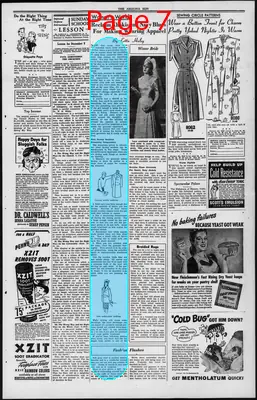
Story
December 6, 1946
Arizona Sun
Phoenix, Maricopa County, Arizona
What is this article about?
Post-WWII guide for repurposing khaki and navy military uniforms into civilian wear via dyeing, alteration, and styling tips to create fashionable garments like boxy jackets and accented suits.
Clipping

OCR Quality
98%
Excellent
Full Text
By
NOW that so many boys have marched home from overseas service, many a homemaker has begun to wonder about the possibility of using those wonderful khaki and navy blue clothes for something useful. It's very true that the fabric in these clothes is much too good to be shut up in mothproof bags or closets. They can be converted into excellent civilian wearing apparel.
The main problem in using clothing of this type is to really change the appearance, and experience proves that it can be done. Sad-colored olive drab can actually be dyed so you won't know the origin. And as for navy blue, it's a good substantial color which you probably won't change, especially if you change the style of the garment sufficiently.
If you've had a WAVE in the family, then you'll be surprised how beautifully her navy blue suit alters into something very attractive. If the girl herself is using the suit, it probably won't need much alteration in fitting. Remove the insignia, and add some bright red braid around the shoulders and sleeves, or run the braiding all around the bustline in several rows, and you'll be surprised at how nicely the garment reconverts.
It's only natural that you might hesitate at dyeing the heavy olive drab garments but it really can be done.
Wool Dyeing Requires
Simmering Temperature
The important points to remember when dyeing woolens can be summarized in five steps. These are particularly applicable when you are dyeing such things as ex-service clothing.
1. Measure the garment before dyeing or draw its outline on a large sheet of paper for measuring purposes.
2. Make sure you have enough dye for the quantity of fabric you are dyeing. Because of their heavy weight woolens require more dye per yard than cottons or rayons.
3. Use a simmering temperature all during the dyeing period. Use a large enough vessel for the purpose so that you can stir the garment gently in its dye bath. Avoid rough treatment as this makes the garment shrink.
4. Remember that wools appear much darker when wet than when dry. Test a small strip of fabric by ironing dry to make sure you have the shade desired.
5. When you are satisfied with the color, rinse the garment thoroughly. Then stretch it to its original proportions, using the pencilled figure or measurements mentioned above.
Iron the woolens while they are just barely damp. Of course you understand this has to be done with a pressing cloth or the wool will develop an ugly shine. If the garment has not stretched to its proper shape, it can be stretched even more while you are pressing the fabric.
Convert service uniforms...
Into fashionable clothing.
While dyeing will cause some shrinkage, the most shrinkage you can expect of a properly treated garment should not exceed three-quarters of an inch. It can certainly be a lot less if you give the garment your most gentle treatment.
If you've been following fashion news lately, you know that the hip length boxy jacket is one of the
Fashion
Soft gray wool is another fashion favorite and is a wonderful neutral that you can use with gay accents of color. Green of course is very popular and so is magenta.
Want to give gloves a lift? Sew bands of contrasting colored material on the cuffs or make them glitter with sequins that highlight the colors of your costume.
NOW that so many boys have marched home from overseas service, many a homemaker has begun to wonder about the possibility of using those wonderful khaki and navy blue clothes for something useful. It's very true that the fabric in these clothes is much too good to be shut up in mothproof bags or closets. They can be converted into excellent civilian wearing apparel.
The main problem in using clothing of this type is to really change the appearance, and experience proves that it can be done. Sad-colored olive drab can actually be dyed so you won't know the origin. And as for navy blue, it's a good substantial color which you probably won't change, especially if you change the style of the garment sufficiently.
If you've had a WAVE in the family, then you'll be surprised how beautifully her navy blue suit alters into something very attractive. If the girl herself is using the suit, it probably won't need much alteration in fitting. Remove the insignia, and add some bright red braid around the shoulders and sleeves, or run the braiding all around the bustline in several rows, and you'll be surprised at how nicely the garment reconverts.
It's only natural that you might hesitate at dyeing the heavy olive drab garments but it really can be done.
Wool Dyeing Requires
Simmering Temperature
The important points to remember when dyeing woolens can be summarized in five steps. These are particularly applicable when you are dyeing such things as ex-service clothing.
1. Measure the garment before dyeing or draw its outline on a large sheet of paper for measuring purposes.
2. Make sure you have enough dye for the quantity of fabric you are dyeing. Because of their heavy weight woolens require more dye per yard than cottons or rayons.
3. Use a simmering temperature all during the dyeing period. Use a large enough vessel for the purpose so that you can stir the garment gently in its dye bath. Avoid rough treatment as this makes the garment shrink.
4. Remember that wools appear much darker when wet than when dry. Test a small strip of fabric by ironing dry to make sure you have the shade desired.
5. When you are satisfied with the color, rinse the garment thoroughly. Then stretch it to its original proportions, using the pencilled figure or measurements mentioned above.
Iron the woolens while they are just barely damp. Of course you understand this has to be done with a pressing cloth or the wool will develop an ugly shine. If the garment has not stretched to its proper shape, it can be stretched even more while you are pressing the fabric.
Convert service uniforms...
Into fashionable clothing.
While dyeing will cause some shrinkage, the most shrinkage you can expect of a properly treated garment should not exceed three-quarters of an inch. It can certainly be a lot less if you give the garment your most gentle treatment.
If you've been following fashion news lately, you know that the hip length boxy jacket is one of the
Fashion
Soft gray wool is another fashion favorite and is a wonderful neutral that you can use with gay accents of color. Green of course is very popular and so is magenta.
Want to give gloves a lift? Sew bands of contrasting colored material on the cuffs or make them glitter with sequins that highlight the colors of your costume.
What sub-type of article is it?
Practical Advice
Fashion Guide
What keywords are associated?
Military Uniforms
Dyeing Wool
Fashion Conversion
Postwar Clothing
Wave Suit Alteration
Story Details
Story Details
Advice for homemakers on converting military uniforms into civilian apparel by dyeing olive drab fabrics, altering navy blue suits with braid, and following wool dyeing steps to minimize shrinkage and achieve fashionable results.