Thank you for visiting SNEWPapers!
Sign up free
Literary
October 8, 1839
The Caledonian
Saint Johnsbury, Caledonia County, Vermont
What is this article about?
A reflective prose essay on autumn's decay, evoking melancholy memories of youth and family, yet finding beauty in nature's cycles as symbols of immortality, renewal, and eternal life beyond death.
Clipping
OCR Quality
98%
Excellent
Full Text
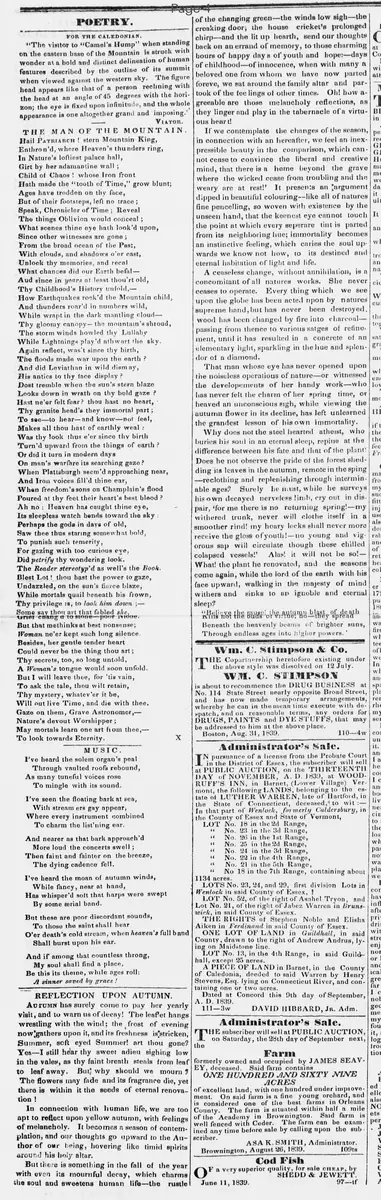
REFLECTION UPON AUTUMN.
Autumn has surely come to pay her yearly visit, and to warn us of decay! The leaf hangs wrestling with the wind; the frost of evening now gathers upon it, and its freshness is stricken.
Summer, soft eyed Summer! art thou gone?
Yes—I still hear thy sweet adieu sighing low in the vales, as thy faint breath steals from leaf to leaf away. But why should we mourn?
The flowers may fade and its fragrance die, yet there is within it the seeds of eternal renovation!
In connection with human life, we are too apt to reflect upon yellow autumn, with feelings of melancholy. It becomes a season of contemplation, and our thoughts go upward to the Author of our being, hovering like timid spirits around his holy altar.
But there is something in the fall of the year with even its mournful decay, which charms the soul and sweetens human life—the rustle of the changing green—the winds low sigh—the croaking door; the house cricket's prolonged chirp—and the lit up hearth, send our thoughts back on an errand of memory, to those charming hours of happy days of youth and hope:—days of childhood—of innocence, when with many a beloved one from whom we have now parted forever, we sat around the family altar and partook of the feelings of other times. Oh! how agreeable are those melancholy reflections, as they linger and play in the tabernacle of a virtuous heart!
If we contemplate the changes of the season in connection with an hereafter, we feel an inexpressible beauty in the comparison, which cannot cease to convince the liberal and creative mind, that there is a home beyond the grave where the wicked cease from troubling and the weary are at rest! It presents an argument dipped in beautiful colouring—like all of nature's fine pencilling, so woven with existence by the unseen hand, that the keenest eye cannot touch the point at which every separate tint is parted from its neighboring hue; immortality becomes an instinctive feeling, which carries the soul upwards we know not how, to its destined and eternal habitation of light and life.
A ceaseless change, without annihilation, is a concomitant of all nature's works. She never ceases to operate. Every thing which we see upon the globe has been acted upon by nature's supreme hand, but has never been destroyed. Wood has been changed by fire into charcoal—passing from thence to various stages of refinement, until it has resulted in a concrete of elementary light, sparkling in the hue and splendor of a diamond.
That man whose eye has never opened upon the noiseless operations of nature—or witnessed the developments of her handy work—who has never felt the charm of her spring time, or heaved an unconscious sigh, while viewing the autumn flower in its decline, has left unlearned the grandest lesson of his own immortality.
Why does not the steel hearted atheist, who buries his soul in an eternal sleep, repine at the difference between his fate and that of the plant! Does he not observe the pride of the forest shedding its leaves in the autumn, remote in the spring—reclothing and replenishing through interminable ages? Surely he must, while he surveys his own decayed nerveless limb, cry out in despair, 'for me there is no returning spring!—my withered trunk, never will clothe itself in a smoother rind! my hoary locks shall never more receive the gloss of youth!—no young and vigorous sap will circulate through these chilled collapsed vessels!' Alas! it will not be so!—What! the plant he renovated, and the seasons come again, while the lord of the earth with his face upward, walking in the majesty of mind withers and sinks to an ignoble and eternal sleep?
Beneath the heavenly beams of brighter suns,
Through endless ages into higher powers.
Autumn has surely come to pay her yearly visit, and to warn us of decay! The leaf hangs wrestling with the wind; the frost of evening now gathers upon it, and its freshness is stricken.
Summer, soft eyed Summer! art thou gone?
Yes—I still hear thy sweet adieu sighing low in the vales, as thy faint breath steals from leaf to leaf away. But why should we mourn?
The flowers may fade and its fragrance die, yet there is within it the seeds of eternal renovation!
In connection with human life, we are too apt to reflect upon yellow autumn, with feelings of melancholy. It becomes a season of contemplation, and our thoughts go upward to the Author of our being, hovering like timid spirits around his holy altar.
But there is something in the fall of the year with even its mournful decay, which charms the soul and sweetens human life—the rustle of the changing green—the winds low sigh—the croaking door; the house cricket's prolonged chirp—and the lit up hearth, send our thoughts back on an errand of memory, to those charming hours of happy days of youth and hope:—days of childhood—of innocence, when with many a beloved one from whom we have now parted forever, we sat around the family altar and partook of the feelings of other times. Oh! how agreeable are those melancholy reflections, as they linger and play in the tabernacle of a virtuous heart!
If we contemplate the changes of the season in connection with an hereafter, we feel an inexpressible beauty in the comparison, which cannot cease to convince the liberal and creative mind, that there is a home beyond the grave where the wicked cease from troubling and the weary are at rest! It presents an argument dipped in beautiful colouring—like all of nature's fine pencilling, so woven with existence by the unseen hand, that the keenest eye cannot touch the point at which every separate tint is parted from its neighboring hue; immortality becomes an instinctive feeling, which carries the soul upwards we know not how, to its destined and eternal habitation of light and life.
A ceaseless change, without annihilation, is a concomitant of all nature's works. She never ceases to operate. Every thing which we see upon the globe has been acted upon by nature's supreme hand, but has never been destroyed. Wood has been changed by fire into charcoal—passing from thence to various stages of refinement, until it has resulted in a concrete of elementary light, sparkling in the hue and splendor of a diamond.
That man whose eye has never opened upon the noiseless operations of nature—or witnessed the developments of her handy work—who has never felt the charm of her spring time, or heaved an unconscious sigh, while viewing the autumn flower in its decline, has left unlearned the grandest lesson of his own immortality.
Why does not the steel hearted atheist, who buries his soul in an eternal sleep, repine at the difference between his fate and that of the plant! Does he not observe the pride of the forest shedding its leaves in the autumn, remote in the spring—reclothing and replenishing through interminable ages? Surely he must, while he surveys his own decayed nerveless limb, cry out in despair, 'for me there is no returning spring!—my withered trunk, never will clothe itself in a smoother rind! my hoary locks shall never more receive the gloss of youth!—no young and vigorous sap will circulate through these chilled collapsed vessels!' Alas! it will not be so!—What! the plant he renovated, and the seasons come again, while the lord of the earth with his face upward, walking in the majesty of mind withers and sinks to an ignoble and eternal sleep?
Beneath the heavenly beams of brighter suns,
Through endless ages into higher powers.
What sub-type of article is it?
Essay
Poem
What themes does it cover?
Seasonal Cycle
Nature
Death Mortality
What keywords are associated?
Autumn Reflection
Seasonal Decay
Nature Cycles
Immortality
Melancholy Memories
Eternal Renewal
Atheist Critique
Literary Details
Title
Reflection Upon Autumn.
Subject
Autumn And Immortality
Key Lines
Summer, Soft Eyed Summer! Art Thou Gone?
The Flowers May Fade And Its Fragrance Die, Yet There Is Within It The Seeds Of Eternal Renovation!
Oh! How Agreeable Are Those Melancholy Reflections, As They Linger And Play In The Tabernacle Of A Virtuous Heart!
Immortality Becomes An Instinctive Feeling, Which Carries The Soul Upwards We Know Not How, To Its Destined And Eternal Habitation Of Light And Life.
Beneath The Heavenly Beams Of Brighter Suns,
Through Endless Ages Into Higher Powers.