Thank you for visiting SNEWPapers!
Sign up free
Literary
May 5, 1864
Wood County Reporter
Wisconsin Rapids, Wood County, Wisconsin
What is this article about?
In Brooklyn, a family eagerly anticipates their wealthy neighbors, the Lollards, returning from abroad. Narrator Isabel Marston's brother-in-law Paul, embittered by past love, reunites with his former beloved Azalia Glome, now the Lollards' ward, through a misdelivered package and social encounters, leading to reconciliation and romance. Meanwhile, Charles confesses his love for Amy.
Clipping
OCR Quality
95%
Excellent
Full Text
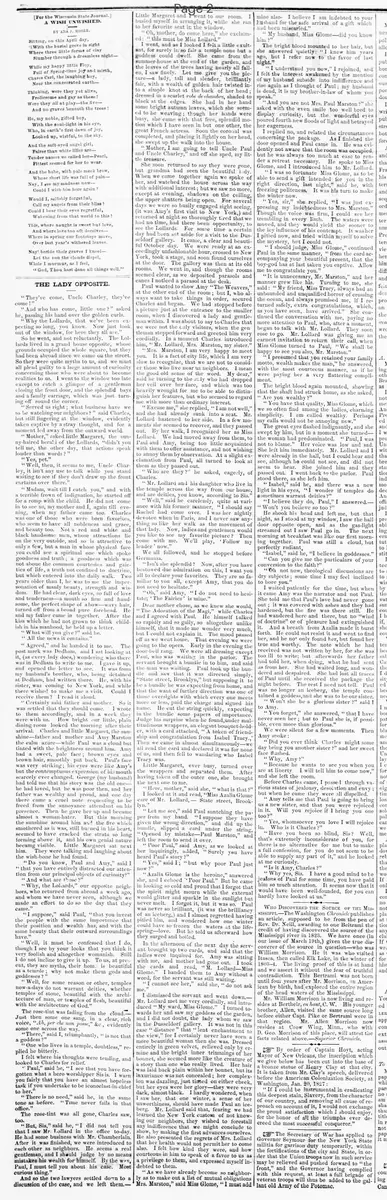
THE LADY OPPOSITE.
"They've come, Uncle Charley, they've come!"
"And who has come, little one?" asked he, passing his hand over the golden curls.
"Why the Lollards, that we've been expecting so long, you know. Now just look out of the window, for here they all are."
So he went, and not reluctantly. The Lollards lived in a grand house opposite, whose grounds occupied the whole square, but they had been abroad since we came on the street. So they were quite myths to us, and we must all plead guilty to a large amount of curiosity concerning those who were about to become realities to us. I went to the window too late except to catch a glimpse of a gentleman losing the front door, and the splendid bays and a family carriage, which was just turning off round the corner.
"Served us right; what business have we to be watching our neighbors?" said Charles but still lingering at the window, evidently taken captive by a stray thought, and for a moment led away from the outward world.
"Mother," asked little Margaret, the sunny-haired herald of the Lollards, "didn't you tell me, the other day, that actions speak louder than words?"
"Yes, pet."
"Well, then, it seems to me, Uncle Charley, it isn't any use to talk while you stand waiting to see if they don't draw up the front curtains over there."
"Madam, wait till I catch you," and with a terrible frown of indignation, he started off for a romp with the child. He did not come in to see us, my mother and I, again till evening, when my father came too. Charles was one of those who were born favorites, who seem to have all nobleness and grace, and beauty too. Not a red and white and black handsome man, whose attractions lie on the very outside, and so is attractive to only a few, but a man in whose physical face you could see a spiritual one which spoke goodness and truth; a goodness which was not above the common courtesies and gaieties of life, a truth not confined to doctrine, but which entered into the daily walk. Two years older than I, he was to me the impersonation of manly beauty, strength and wisdom. He had clear, dark eyes, so full of love and tenderness—a mouth so firm and handsome, the perfect shape of a bow—wavy hair, turned off from a broad pure forehead. He and my father came in together. After the kiss which he had not grown to think childish in his manhood, he held up a letter.
"What will you give?" said he.
"All the news it contains."
"Agreed," and he handed it to me. The post mark was Dedham, and I sat looking at it, (as every lady does,) wondering who there was in Dedham to write to me. I gave it up, and opened the letter to see. It was from my husband's brother, who, being detained at Dedham, had written there. He, with his sister, was coming to New York, and while there wished to make me a visit. Could I receive them? I read it aloud
"Certainly said father and mother. So it was settled that they should come. I wrote to them accordingly, and in a week they were with us.
How bright our little, plain dining-room looked the morning after their arrival. Charles and little Margaret, the sunshine—father and mother and Amy Marston the calm azure—while Paul was a cloud but tinted with the brightness around him. Amy had a sweet, pale face; brown eyes and brown hair, smoothly put back. Paul's face was very striking; his eyes were like Amy's but the contemptuous expression of his mouth scarcely ever changed. George (my husband) had told me that his story was the old one—he had loved, but he was poor then, and her father was wealthy and proud, and one day there came a cruel note requesting to be freed from the annoyance attendant on his presence. Then he gave her up and became almost a woman-hater. But this morning the sunshine around him and the fire which smothered as it was, still burned in his heart seemed to have cracked the strata so long forming above it, and his own genial nature became visible. Little Margaret sat next him. They were talking and laughing about the wish-bone he had found
"Do you know, Paul and Amy," said I "that you have entirely distracted our attention from our principal objects of curiosity?"
"And what are those?"
"Why, the Lollards, our opposite neighbors, who returned from abroad a week ago, and whom we have never seen, although we made an effort to do so the day that they came."
"I suppose," said Paul, "that you invest the people with the same importance that their position and wealth has, and with the same beauty that their outward surroundings have."
"Well, it must be confessed that I do, though I see by your looks that you think it very foolish and altogether womanish. Still I do not incline to give it up. To us, at present, they are myths, their home is beautiful as a temple; why not make them gods and goddesses?"
"Well, for some reason or other, temples now-a-days do not warrant deities, whether temples of stone, beautiful with the architecture of man, or temples of flesh, beautiful with the architecture of God."
The rose-tint was fading from the cloud. Just then some one sang, in a clear, rich voice, "Ah, per che non posse," &c, evidently some one across the way.
"There," said I, triumphantly, "is not that a goddess?"
"One who lives in a temple, doubtless," replied he bitterly.
I felt where his thoughts were tending, and looked to Charles for relief.
"Paul," said he, "I see that you have forgotten what a hero worshipper Sis is. I warn you fairly that you have an almost hopeless task if you undertake to be iconoclast-in-chief to her."
"There is no need," said he, in the same tone as before. "Time never fails in that office."
The rose-tint was all gone, Charles saw, too.
"But, Sis," said he, "I did not tell you that I saw Mr. Lollard in the office to-day. He had some business with Mr. Chamberlain. After it was finished, we were introduced to each other as neighbors. He seems a real gentleman, and I should judge by no means mistakes his wealth for himself. By the way, Paul, I must tell you about his case. Most curious thing."
And so the two lawyers settled down to a discussion of the case, and we left them.
Little Margaret and I went to our room. I busied myself in arranging it, while she ran to her favorite seat in the window.
"Oh, mother, do come here," she exclaimed: "this must be Miss Lollard."
I went, and as I looked I felt a little exultant, for surely in so fair a temple none but a goddess could dwell. She came from the summer-house at the end of the garden, and the leaves of the trees having nearly all fallen, I saw finely. Let me give you the picture—a lady, tall and slender, brilliantly fair, with a wealth of golden hair twisted into a simple knot at the back of her head; dressed in a scarlet robe de chambre, shaded to black at the edges. She had in her hand some bright autumn leaves, which she seemed to be weaving; though her hands were busy, she came with that free, splendid motion which I have seen in but one other, the great French actress. Soon the coronal was completed, and placing it lightly on her head, she swept up the walk into the house.
"Mother, I am going to tell Uncle Paul and Uncle Charley," and off she sped, my little treasure.
She soon returned to say they were gone, but grandma had seen the beautiful lady.
When we came together again we spoke of her, and watched the house across the way with additional interest; but we saw no more, except at evening, shadows on the ceiling the upper shutters being open. For several days we were so busily engaged sight seeing. (it was Amy's first visit to New York,) and returned at night so thoroughly tired that we had no time, had there been opportunity, to see the Lollards. For some time a certain day had been set aside for a visit to the Dusseldorf gallery. It came, a clear and beautiful October day. We were ready at an exceedingly unfashionable hour, crossed to New York, took a stage, and soon found ourselves at the door. The gallery was then at its old rooms. We went in, and though the rooms seemed clear, as we deposited parasols and canes I noticed a parasol at the desk.
Paul wanted to show Amy "The Weavers," at the other end of the room; but I, who always want to take things in order, secured Charles and began. We had stopped before a picture just at the entrance to the smaller room, when I discovered a lady and gentleman within. I was about to say to Charles that we were not the only visitors, when the gentleman stepped forward and greeted him very cordially. In a moment Charles introduced him, "Mr. Lollard, Mrs. Marston, my sister."
"Mrs. Marston, I am very happy to meet you. It is a fact of city life, which I am very slow to recognize, that we are not to consider those who live near us neighbors. I mean the good old sense of the word. My dear," said he turning to the lady who had dropped her veil over her face, and which was too heavily wrought for me to be able to distinguish her features, but who seemed to regard me with more than ordinary interest.
"Excuse me," she replied, "I am not well," and she had already sunk into a seat. Mr. Lollard hastened to her side. In a few moments she seemed to recover, and they passed out. By her walk, I recognized her as Miss Lollard. We had moved away from them, to Paul and Amy, being too little acquainted with them to offer assistance, and not wishing to annoy them by observation. At a slight exclamation from Paul, all turned to look at them as they passed out.
"Who are they?" he asked, eagerly, of Charles.
"Mr. Lollard and his daughter who live in the temple across the way from our house, and are deities, you know, according to Sis."
"Well," said he carelessly, quite at variance with his former manner, "I should say Rachel had come over. I was her nightly devotee when in Paris, and I never saw anything so like her walk as the movement of that lady. Now, ladies and gentlemen would you like to see my favorite picture? Then come with me. We'll play, Follow my leader' now."
We all followed, and he stopped before Germania.
"Isn't she splendid? Now, after you have bestowed due admiration on this, I want you all to declare your favorites. They are so familiar to you all, except Amy, that you do not need to hesitate."
"Oh," said Amy, "I do not need to hesitate; 'The Fairies' is mine."
Dear mother chose, as we knew she would. "The Adoration of the Magi," while Charles and I agreed with Paul. He himself talked so rapidly and so gaily, so altogether unlike himself, that it made me wonder very much, but I could not explain it. The mood passed off as we went home. That evening we were going to the opera. Early in the evening the door-bell rang. We were all dressing except Paul, who was waiting in the parlor. The servant brought a bundle in to him, and said the man was waiting. Paul took up the bundle and saw that it was directed simply, "State street, Brooklyn," but supposing it to be a bundle he was expecting from home, and that the want of further direction was one of those oversights with which every one meets more or less, paid the charge and signed his name. He cut the string quickly, expecting in the bundle some papers of importance. Judge his surprise when he found, under multitudinous wrappers, an elegant bouquet-holder, with a card attached, "A token of friendship and congratulation from Isabel Tracy."
Then we came in almost simultaneously—we all read the card and declared it was for none of us, and then fell to wondering who Isabel Tracy was.
Little Margaret, ever busy, turned over the wrappers and separated them. After having taken off the outer one, she brought the next one to me.
"Here, mother," said she, "what is that?"
I looked at it and read, "Miss Azalia Glome care of Mr. Lollard, - State street, Brooklyn."
"Let me see," said Paul snatching the paper from my hand. "I suppose they have given the wrong direction," and did up the bundle, slipped a card under the string, "Opened by mistake—Paul Marston," and left the room to send it over.
"Poor Paul," said Amy, as we looked at her inquiringly, added, "Surely you have heard Paul's story?"
"Yes." said I; "but why poor Paul just now?"
"Azalia Glome is the heroine," answered she, and I echoed "Poor Paul." But he came in looking so cold and proud that I forgot that the spirit might mourn while the external would glitter and sparkle in the sunlight but never melt. I forgot it, but it was so. Paul was never so brilliant, (it was the brilliancy of an iceberg,) and I almost regretted having pitied him, and wondered how one winter could have so frozen the waters at the life-spring—love. But he told us afterward how they surged and boiled.
In the afternoon of the next day the servant brought up two cards, and said that the ladies were inquired for. Amy was sitting with me, and mother had gone out. I took the cards and read, "M. Lollard—Miss Glome." I handed them to Amy without a word, for the servant was still waiting.
"I cannot see her," said she, "do not ask me."
I dismissed the servant and went down. Mr. Lollard met me very cordially, and introduced "My ward, Miss Glome." I turned towards her and saw my goddess of the garden, and I did not doubt, the lady whom we saw in the Dusseldorf gallery. It was not in this case "distance" that "lent enchantment to the view," for I certainly never have seen a more beautiful woman than she was. Dressed entirely in green velvet, relieved only by ermine and the bright inner trimmings of her bonnet, she seemed more like the creature of a story than one who really lived. Her hair was laid back plain within her bonnet, but its luxuriance was not concealed; her complexion was dazzling, just tinted on either cheek. but her eyes were her glory—they were very dark, almost black. I hardly wondered, when I saw her, that one winter, a sense of her unworthiness, should have made Paul an iceberg. Mr. Lollard said that, fearing we had learned the New York custom of not knowing our neighbors, they wished to forestall any indifference that we might conclude to show, by making the first advances ourselves. He also presented the regrets of Mrs. Lollard that her health would not permit her to come also. I felt how kind they were, and how courteous in him to speak of a favor to us as a privilege to them, and expressed myself indebted to them.
"As we have already become so neighborly as to make out a list of mutual obligations Mrs. Marston," said Miss Glome, "I must add mine also—I believe I am indebted to your husband for the safe arrival of a gift which had been miscarried."
"My husband, Miss Glome—did you know him?"
The bright blood mounted to her hair, but she answered quietly: "I knew him years ago, but I refer now to the favor of last night."
"I understand you now," I rejoined, and I felt the interest awakened by the mention of my husband subside into indifference and rise again as I thought of Paul; my husband is dead, it is my brother-in-law of whom you speak.
"And you are not Mrs. Paul Marston?" she asked with the even smile too well bred to display curiosity, but the wonderful eyes poured forth new floods of light and betrayed her eagerness.
I replied no, and related the circumstances concerning the package. As I finished the door opened and Paul came in. He was evidently not aware that the room was occupied, but he was always too much at ease to render a retreat necessary. He spoke to Miss Glome, and I introduced him to Mr. Lollard.
"I was so fortunate Miss Glome, as to be able to send a gift intended for you in the right direction, last night," said he, with freezing politeness. It was his turn to make the winter now.
"Yes, sir," she replied, "I was just expressing my indebtedness to Mrs. Marston."
Though the voice was firm, I could see her trembling in every limb. The waters were moved, and they would yield the sooner to the icy influence of his contempt. It was her I pitied now, and tried within myself to solve the mystery, but I could not.
"I should judge, Miss Glome," continued Paul in the same manner, "from the card accompanying your beautiful present, that the boy-god has at last taken you captive. Allow me to congratulate you."
"It is unnecessary, Mr. Marston," and her manner grew like his. Turning to me, she said: "My friend, Miss Tracy, always had an unbounded and unqualified horror of crossing the ocean, and always promised me, if I returned safely, extra congratulations, which, as you have seen, have arrived." She continued the conversation with me, paying no more attention to Paul, who, after a moment, began to talk with Mr. Lollard. They soon rose to go. Mr. Lollard was giving me an earnest invitation to return their call, when Miss Glome turned to Paul, "We shall be happy to see you also, Mr. Marston."
"I presumed that you retained your family motto, wealth makes the man," he answered, with the most courteous manner, as if he were paying her a very flattering compliment.
The bright blood again mounted, showing that the shaft had struck home, as she asked, "Are you wealthy?"
"You have that quality, Miss Glome, which we so often find among the ladies, charming simplicity. I am called wealthy. Perhaps my calls would not be annoying now."
The great eyes flashed indignantly, and she swept by him, but in a moment she turned the woman had predominated. "Paul, I was not to blame." Her voice was low and sad.
She left him immediately. Mr. Lollard and I were already in the hall. but I could hear and see, although he could not see, and did not seem to hear. She joined him and they passed out. I went back to the parlor. Paul stood there, as she left him.
"Isabel," said he, and there was a new light in his eyes, "I wonder if temples do sometimes warrant deities?"
"I believe they do, Paul," I answered.
"Won't you believe so too?"
He shook his head and left me, but that night, as I stood at my window, I saw the hall door opposite open, and as the gas-light streamed out I saw Paul go in. The next morning at breakfast was like our first morning together. Paul was still a cloud, but perfectly radiant
"Isabel," said he, "I believe in goddesses."
"Can you give me the particulars of your conversion to the faith?"
"Oh not now, theological discussions are dry subjects; some time I may feel inclined to bore you."
I waited patiently for the time, but when it came Amy was the narrator and not Paul.
She told me that Paul's love had never gone out; it was covered with ashes and they had hardened, but the fire was there still. He had wandered here and there, but no "wind of doctrine" or of pleasure had extinguished it. And a breath from Azalia made it burst forth. He could not resist it and went to find her, and he not only found her, but found her true and worthy. The note which he had received was not written by her, for she was too ill to write; but afterwards her father had told her, when dying, what he had sent as from her. She had waited long, and wondered and despaired. She had lost all traces of Paul until she received the package the night before. The rest I need not tell. Paul was no longer an iceberg, the temple contained a goddess, and she was to be our sister.
"Won't she be a glorious sister?" said I to Amy.
"You forget," she answered, "that I have never seen her; but to Paul she is, if possible, even more than glorious."
We were silent for a few moments. Then Amy spoke:
"Did you ever think Charles might some day bring you another sister?" and her sweet face flushed.
"Why, Amy?"
"Because he wants to see you when you are at liberty. I will tell him to come now," and she left the room.
Before Charles came, I passed through various states of jealousy, desolation and envy; but when he came they were all dispelled.
"Amy tells me that Paul is going to bring us a new sister, and that you were rejoiced in it. Will you rejoice if I bring you one too?"
"Yes, whomsoever you love I will rejoice in. Who is it Charles?"
"Have you been so blind, Sis? Well, that's extremely inconsiderate of you, for there is no alternative for me but to make a full confession, for you do not seem to be able to supply any part of it," and he looked at me curiously.
"Is it Amy, Charles?"
"Why yes, Sis. I have a good mind to be jealous of Paul for some time, you have paid him so much attention. It seems now that it would have been well-founded, for you can hardly have looked at us."
"They've come, Uncle Charley, they've come!"
"And who has come, little one?" asked he, passing his hand over the golden curls.
"Why the Lollards, that we've been expecting so long, you know. Now just look out of the window, for here they all are."
So he went, and not reluctantly. The Lollards lived in a grand house opposite, whose grounds occupied the whole square, but they had been abroad since we came on the street. So they were quite myths to us, and we must all plead guilty to a large amount of curiosity concerning those who were about to become realities to us. I went to the window too late except to catch a glimpse of a gentleman losing the front door, and the splendid bays and a family carriage, which was just turning off round the corner.
"Served us right; what business have we to be watching our neighbors?" said Charles but still lingering at the window, evidently taken captive by a stray thought, and for a moment led away from the outward world.
"Mother," asked little Margaret, the sunny-haired herald of the Lollards, "didn't you tell me, the other day, that actions speak louder than words?"
"Yes, pet."
"Well, then, it seems to me, Uncle Charley, it isn't any use to talk while you stand waiting to see if they don't draw up the front curtains over there."
"Madam, wait till I catch you," and with a terrible frown of indignation, he started off for a romp with the child. He did not come in to see us, my mother and I, again till evening, when my father came too. Charles was one of those who were born favorites, who seem to have all nobleness and grace, and beauty too. Not a red and white and black handsome man, whose attractions lie on the very outside, and so is attractive to only a few, but a man in whose physical face you could see a spiritual one which spoke goodness and truth; a goodness which was not above the common courtesies and gaieties of life, a truth not confined to doctrine, but which entered into the daily walk. Two years older than I, he was to me the impersonation of manly beauty, strength and wisdom. He had clear, dark eyes, so full of love and tenderness—a mouth so firm and handsome, the perfect shape of a bow—wavy hair, turned off from a broad pure forehead. He and my father came in together. After the kiss which he had not grown to think childish in his manhood, he held up a letter.
"What will you give?" said he.
"All the news it contains."
"Agreed," and he handed it to me. The post mark was Dedham, and I sat looking at it, (as every lady does,) wondering who there was in Dedham to write to me. I gave it up, and opened the letter to see. It was from my husband's brother, who, being detained at Dedham, had written there. He, with his sister, was coming to New York, and while there wished to make me a visit. Could I receive them? I read it aloud
"Certainly said father and mother. So it was settled that they should come. I wrote to them accordingly, and in a week they were with us.
How bright our little, plain dining-room looked the morning after their arrival. Charles and little Margaret, the sunshine—father and mother and Amy Marston the calm azure—while Paul was a cloud but tinted with the brightness around him. Amy had a sweet, pale face; brown eyes and brown hair, smoothly put back. Paul's face was very striking; his eyes were like Amy's but the contemptuous expression of his mouth scarcely ever changed. George (my husband) had told me that his story was the old one—he had loved, but he was poor then, and her father was wealthy and proud, and one day there came a cruel note requesting to be freed from the annoyance attendant on his presence. Then he gave her up and became almost a woman-hater. But this morning the sunshine around him and the fire which smothered as it was, still burned in his heart seemed to have cracked the strata so long forming above it, and his own genial nature became visible. Little Margaret sat next him. They were talking and laughing about the wish-bone he had found
"Do you know, Paul and Amy," said I "that you have entirely distracted our attention from our principal objects of curiosity?"
"And what are those?"
"Why, the Lollards, our opposite neighbors, who returned from abroad a week ago, and whom we have never seen, although we made an effort to do so the day that they came."
"I suppose," said Paul, "that you invest the people with the same importance that their position and wealth has, and with the same beauty that their outward surroundings have."
"Well, it must be confessed that I do, though I see by your looks that you think it very foolish and altogether womanish. Still I do not incline to give it up. To us, at present, they are myths, their home is beautiful as a temple; why not make them gods and goddesses?"
"Well, for some reason or other, temples now-a-days do not warrant deities, whether temples of stone, beautiful with the architecture of man, or temples of flesh, beautiful with the architecture of God."
The rose-tint was fading from the cloud. Just then some one sang, in a clear, rich voice, "Ah, per che non posse," &c, evidently some one across the way.
"There," said I, triumphantly, "is not that a goddess?"
"One who lives in a temple, doubtless," replied he bitterly.
I felt where his thoughts were tending, and looked to Charles for relief.
"Paul," said he, "I see that you have forgotten what a hero worshipper Sis is. I warn you fairly that you have an almost hopeless task if you undertake to be iconoclast-in-chief to her."
"There is no need," said he, in the same tone as before. "Time never fails in that office."
The rose-tint was all gone, Charles saw, too.
"But, Sis," said he, "I did not tell you that I saw Mr. Lollard in the office to-day. He had some business with Mr. Chamberlain. After it was finished, we were introduced to each other as neighbors. He seems a real gentleman, and I should judge by no means mistakes his wealth for himself. By the way, Paul, I must tell you about his case. Most curious thing."
And so the two lawyers settled down to a discussion of the case, and we left them.
Little Margaret and I went to our room. I busied myself in arranging it, while she ran to her favorite seat in the window.
"Oh, mother, do come here," she exclaimed: "this must be Miss Lollard."
I went, and as I looked I felt a little exultant, for surely in so fair a temple none but a goddess could dwell. She came from the summer-house at the end of the garden, and the leaves of the trees having nearly all fallen, I saw finely. Let me give you the picture—a lady, tall and slender, brilliantly fair, with a wealth of golden hair twisted into a simple knot at the back of her head; dressed in a scarlet robe de chambre, shaded to black at the edges. She had in her hand some bright autumn leaves, which she seemed to be weaving; though her hands were busy, she came with that free, splendid motion which I have seen in but one other, the great French actress. Soon the coronal was completed, and placing it lightly on her head, she swept up the walk into the house.
"Mother, I am going to tell Uncle Paul and Uncle Charley," and off she sped, my little treasure.
She soon returned to say they were gone, but grandma had seen the beautiful lady.
When we came together again we spoke of her, and watched the house across the way with additional interest; but we saw no more, except at evening, shadows on the ceiling the upper shutters being open. For several days we were so busily engaged sight seeing. (it was Amy's first visit to New York,) and returned at night so thoroughly tired that we had no time, had there been opportunity, to see the Lollards. For some time a certain day had been set aside for a visit to the Dusseldorf gallery. It came, a clear and beautiful October day. We were ready at an exceedingly unfashionable hour, crossed to New York, took a stage, and soon found ourselves at the door. The gallery was then at its old rooms. We went in, and though the rooms seemed clear, as we deposited parasols and canes I noticed a parasol at the desk.
Paul wanted to show Amy "The Weavers," at the other end of the room; but I, who always want to take things in order, secured Charles and began. We had stopped before a picture just at the entrance to the smaller room, when I discovered a lady and gentleman within. I was about to say to Charles that we were not the only visitors, when the gentleman stepped forward and greeted him very cordially. In a moment Charles introduced him, "Mr. Lollard, Mrs. Marston, my sister."
"Mrs. Marston, I am very happy to meet you. It is a fact of city life, which I am very slow to recognize, that we are not to consider those who live near us neighbors. I mean the good old sense of the word. My dear," said he turning to the lady who had dropped her veil over her face, and which was too heavily wrought for me to be able to distinguish her features, but who seemed to regard me with more than ordinary interest.
"Excuse me," she replied, "I am not well," and she had already sunk into a seat. Mr. Lollard hastened to her side. In a few moments she seemed to recover, and they passed out. By her walk, I recognized her as Miss Lollard. We had moved away from them, to Paul and Amy, being too little acquainted with them to offer assistance, and not wishing to annoy them by observation. At a slight exclamation from Paul, all turned to look at them as they passed out.
"Who are they?" he asked, eagerly, of Charles.
"Mr. Lollard and his daughter who live in the temple across the way from our house, and are deities, you know, according to Sis."
"Well," said he carelessly, quite at variance with his former manner, "I should say Rachel had come over. I was her nightly devotee when in Paris, and I never saw anything so like her walk as the movement of that lady. Now, ladies and gentlemen would you like to see my favorite picture? Then come with me. We'll play, Follow my leader' now."
We all followed, and he stopped before Germania.
"Isn't she splendid? Now, after you have bestowed due admiration on this, I want you all to declare your favorites. They are so familiar to you all, except Amy, that you do not need to hesitate."
"Oh," said Amy, "I do not need to hesitate; 'The Fairies' is mine."
Dear mother chose, as we knew she would. "The Adoration of the Magi," while Charles and I agreed with Paul. He himself talked so rapidly and so gaily, so altogether unlike himself, that it made me wonder very much, but I could not explain it. The mood passed off as we went home. That evening we were going to the opera. Early in the evening the door-bell rang. We were all dressing except Paul, who was waiting in the parlor. The servant brought a bundle in to him, and said the man was waiting. Paul took up the bundle and saw that it was directed simply, "State street, Brooklyn," but supposing it to be a bundle he was expecting from home, and that the want of further direction was one of those oversights with which every one meets more or less, paid the charge and signed his name. He cut the string quickly, expecting in the bundle some papers of importance. Judge his surprise when he found, under multitudinous wrappers, an elegant bouquet-holder, with a card attached, "A token of friendship and congratulation from Isabel Tracy."
Then we came in almost simultaneously—we all read the card and declared it was for none of us, and then fell to wondering who Isabel Tracy was.
Little Margaret, ever busy, turned over the wrappers and separated them. After having taken off the outer one, she brought the next one to me.
"Here, mother," said she, "what is that?"
I looked at it and read, "Miss Azalia Glome care of Mr. Lollard, - State street, Brooklyn."
"Let me see," said Paul snatching the paper from my hand. "I suppose they have given the wrong direction," and did up the bundle, slipped a card under the string, "Opened by mistake—Paul Marston," and left the room to send it over.
"Poor Paul," said Amy, as we looked at her inquiringly, added, "Surely you have heard Paul's story?"
"Yes." said I; "but why poor Paul just now?"
"Azalia Glome is the heroine," answered she, and I echoed "Poor Paul." But he came in looking so cold and proud that I forgot that the spirit might mourn while the external would glitter and sparkle in the sunlight but never melt. I forgot it, but it was so. Paul was never so brilliant, (it was the brilliancy of an iceberg,) and I almost regretted having pitied him, and wondered how one winter could have so frozen the waters at the life-spring—love. But he told us afterward how they surged and boiled.
In the afternoon of the next day the servant brought up two cards, and said that the ladies were inquired for. Amy was sitting with me, and mother had gone out. I took the cards and read, "M. Lollard—Miss Glome." I handed them to Amy without a word, for the servant was still waiting.
"I cannot see her," said she, "do not ask me."
I dismissed the servant and went down. Mr. Lollard met me very cordially, and introduced "My ward, Miss Glome." I turned towards her and saw my goddess of the garden, and I did not doubt, the lady whom we saw in the Dusseldorf gallery. It was not in this case "distance" that "lent enchantment to the view," for I certainly never have seen a more beautiful woman than she was. Dressed entirely in green velvet, relieved only by ermine and the bright inner trimmings of her bonnet, she seemed more like the creature of a story than one who really lived. Her hair was laid back plain within her bonnet, but its luxuriance was not concealed; her complexion was dazzling, just tinted on either cheek. but her eyes were her glory—they were very dark, almost black. I hardly wondered, when I saw her, that one winter, a sense of her unworthiness, should have made Paul an iceberg. Mr. Lollard said that, fearing we had learned the New York custom of not knowing our neighbors, they wished to forestall any indifference that we might conclude to show, by making the first advances ourselves. He also presented the regrets of Mrs. Lollard that her health would not permit her to come also. I felt how kind they were, and how courteous in him to speak of a favor to us as a privilege to them, and expressed myself indebted to them.
"As we have already become so neighborly as to make out a list of mutual obligations Mrs. Marston," said Miss Glome, "I must add mine also—I believe I am indebted to your husband for the safe arrival of a gift which had been miscarried."
"My husband, Miss Glome—did you know him?"
The bright blood mounted to her hair, but she answered quietly: "I knew him years ago, but I refer now to the favor of last night."
"I understand you now," I rejoined, and I felt the interest awakened by the mention of my husband subside into indifference and rise again as I thought of Paul; my husband is dead, it is my brother-in-law of whom you speak.
"And you are not Mrs. Paul Marston?" she asked with the even smile too well bred to display curiosity, but the wonderful eyes poured forth new floods of light and betrayed her eagerness.
I replied no, and related the circumstances concerning the package. As I finished the door opened and Paul came in. He was evidently not aware that the room was occupied, but he was always too much at ease to render a retreat necessary. He spoke to Miss Glome, and I introduced him to Mr. Lollard.
"I was so fortunate Miss Glome, as to be able to send a gift intended for you in the right direction, last night," said he, with freezing politeness. It was his turn to make the winter now.
"Yes, sir," she replied, "I was just expressing my indebtedness to Mrs. Marston."
Though the voice was firm, I could see her trembling in every limb. The waters were moved, and they would yield the sooner to the icy influence of his contempt. It was her I pitied now, and tried within myself to solve the mystery, but I could not.
"I should judge, Miss Glome," continued Paul in the same manner, "from the card accompanying your beautiful present, that the boy-god has at last taken you captive. Allow me to congratulate you."
"It is unnecessary, Mr. Marston," and her manner grew like his. Turning to me, she said: "My friend, Miss Tracy, always had an unbounded and unqualified horror of crossing the ocean, and always promised me, if I returned safely, extra congratulations, which, as you have seen, have arrived." She continued the conversation with me, paying no more attention to Paul, who, after a moment, began to talk with Mr. Lollard. They soon rose to go. Mr. Lollard was giving me an earnest invitation to return their call, when Miss Glome turned to Paul, "We shall be happy to see you also, Mr. Marston."
"I presumed that you retained your family motto, wealth makes the man," he answered, with the most courteous manner, as if he were paying her a very flattering compliment.
The bright blood again mounted, showing that the shaft had struck home, as she asked, "Are you wealthy?"
"You have that quality, Miss Glome, which we so often find among the ladies, charming simplicity. I am called wealthy. Perhaps my calls would not be annoying now."
The great eyes flashed indignantly, and she swept by him, but in a moment she turned the woman had predominated. "Paul, I was not to blame." Her voice was low and sad.
She left him immediately. Mr. Lollard and I were already in the hall. but I could hear and see, although he could not see, and did not seem to hear. She joined him and they passed out. I went back to the parlor. Paul stood there, as she left him.
"Isabel," said he, and there was a new light in his eyes, "I wonder if temples do sometimes warrant deities?"
"I believe they do, Paul," I answered.
"Won't you believe so too?"
He shook his head and left me, but that night, as I stood at my window, I saw the hall door opposite open, and as the gas-light streamed out I saw Paul go in. The next morning at breakfast was like our first morning together. Paul was still a cloud, but perfectly radiant
"Isabel," said he, "I believe in goddesses."
"Can you give me the particulars of your conversion to the faith?"
"Oh not now, theological discussions are dry subjects; some time I may feel inclined to bore you."
I waited patiently for the time, but when it came Amy was the narrator and not Paul.
She told me that Paul's love had never gone out; it was covered with ashes and they had hardened, but the fire was there still. He had wandered here and there, but no "wind of doctrine" or of pleasure had extinguished it. And a breath from Azalia made it burst forth. He could not resist it and went to find her, and he not only found her, but found her true and worthy. The note which he had received was not written by her, for she was too ill to write; but afterwards her father had told her, when dying, what he had sent as from her. She had waited long, and wondered and despaired. She had lost all traces of Paul until she received the package the night before. The rest I need not tell. Paul was no longer an iceberg, the temple contained a goddess, and she was to be our sister.
"Won't she be a glorious sister?" said I to Amy.
"You forget," she answered, "that I have never seen her; but to Paul she is, if possible, even more than glorious."
We were silent for a few moments. Then Amy spoke:
"Did you ever think Charles might some day bring you another sister?" and her sweet face flushed.
"Why, Amy?"
"Because he wants to see you when you are at liberty. I will tell him to come now," and she left the room.
Before Charles came, I passed through various states of jealousy, desolation and envy; but when he came they were all dispelled.
"Amy tells me that Paul is going to bring us a new sister, and that you were rejoiced in it. Will you rejoice if I bring you one too?"
"Yes, whomsoever you love I will rejoice in. Who is it Charles?"
"Have you been so blind, Sis? Well, that's extremely inconsiderate of you, for there is no alternative for me but to make a full confession, for you do not seem to be able to supply any part of it," and he looked at me curiously.
"Is it Amy, Charles?"
"Why yes, Sis. I have a good mind to be jealous of Paul for some time, you have paid him so much attention. It seems now that it would have been well-founded, for you can hardly have looked at us."
What sub-type of article is it?
Prose Fiction
What themes does it cover?
Love Romance
Friendship
Social Manners
What keywords are associated?
Romance
Reconciliation
Neighbors
Family
Wealth
Misunderstanding
Love
Brooklyn
New York
Literary Details
Title
The Lady Opposite.
Key Lines
"I Believe In Goddesses."
"Paul, I Was Not To Blame."
"Temples Do Sometimes Warrant Deities."
"Actions Speak Louder Than Words."
The Note Which He Had Received Was Not Written By Her, For She Was Too Ill To Write; But Afterwards Her Father Had Told Her, When Dying, What He Had Sent As From Her.