Thank you for visiting SNEWPapers!
Sign up free
Editorial
July 21, 1949
The Journal
Caldwell, Noble County, Ohio
What is this article about?
Editorial criticizes President Truman's Fair Deal housing bill, signed into law, for burdening taxpayers with $16 billion over 40 years in subsidies and grants for 810,000 units. Also opposes Ohio state bill increasing government costs by $5 million annually via job reclassification and salary hikes, despite economy rhetoric. Rep. Secrest opposed the state bill.
Clipping
OCR Quality
100%
Excellent
Full Text
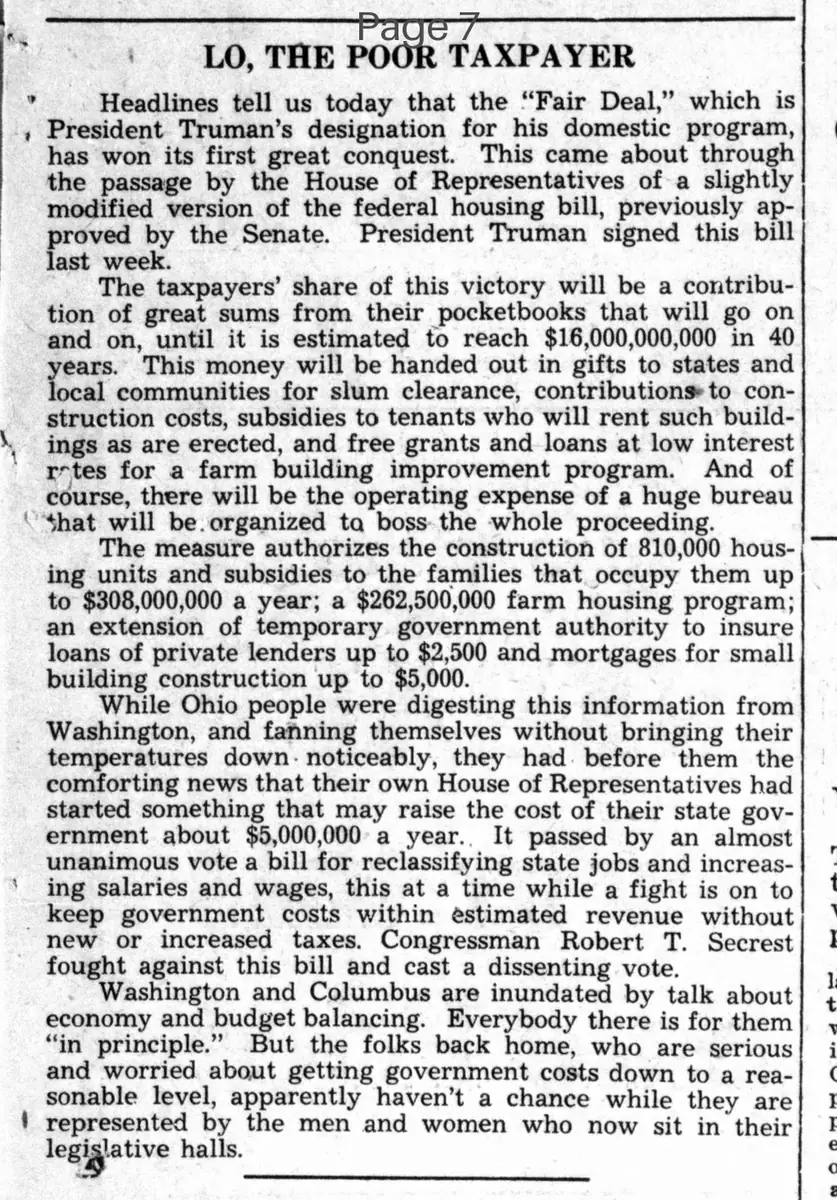
WOE TO THE POOR TAXPAYER
Headlines tell us today that the "Fair Deal," which is President Truman's designation for his domestic program, has won its first great conquest. This came about through the passage by the House of Representatives of a slightly modified version of the federal housing bill, previously approved by the Senate. President Truman signed this bill last week.
The taxpayers' share of this victory will be a contribution of great sums from their pocketbooks that will go on and on, until it is estimated to reach $16,000,000,000 in 40 years. This money will be handed out in gifts to states and local communities for slum clearance, contributions to construction costs, subsidies to tenants who will rent such buildings as are erected, and free grants and loans at low interest rates for a farm building improvement program. And of course, there will be the operating expense of a huge bureau that will be organized to boss the whole proceeding.
The measure authorizes the construction of 810,000 housing units and subsidies to the families that occupy them up to $308,000,000 a year; a $262,500,000 farm housing program; an extension of temporary government authority to insure loans of private lenders up to $2,500 and mortgages for small building construction up to $5,000.
While Ohio people were digesting this information from Washington, and fanning themselves without bringing their temperatures down noticeably, they had before them the comforting news that their own House of Representatives had started something that may raise the cost of their state government about $5,000,000 a year. It passed by an almost unanimous vote a bill for reclassifying state jobs and increasing salaries and wages, this at a time while a fight is on to keep government costs within estimated revenue without new or increased taxes. Congressman Robert T. Secrest fought against this bill and cast a dissenting vote.
Washington and Columbus are inundated by talk about economy and budget balancing. Everybody there is for them "in principle." But the folks back home, who are serious and worried about getting government costs down to a reasonable level, apparently haven't a chance while they are represented by the men and women who now sit in their legislative halls.
Headlines tell us today that the "Fair Deal," which is President Truman's designation for his domestic program, has won its first great conquest. This came about through the passage by the House of Representatives of a slightly modified version of the federal housing bill, previously approved by the Senate. President Truman signed this bill last week.
The taxpayers' share of this victory will be a contribution of great sums from their pocketbooks that will go on and on, until it is estimated to reach $16,000,000,000 in 40 years. This money will be handed out in gifts to states and local communities for slum clearance, contributions to construction costs, subsidies to tenants who will rent such buildings as are erected, and free grants and loans at low interest rates for a farm building improvement program. And of course, there will be the operating expense of a huge bureau that will be organized to boss the whole proceeding.
The measure authorizes the construction of 810,000 housing units and subsidies to the families that occupy them up to $308,000,000 a year; a $262,500,000 farm housing program; an extension of temporary government authority to insure loans of private lenders up to $2,500 and mortgages for small building construction up to $5,000.
While Ohio people were digesting this information from Washington, and fanning themselves without bringing their temperatures down noticeably, they had before them the comforting news that their own House of Representatives had started something that may raise the cost of their state government about $5,000,000 a year. It passed by an almost unanimous vote a bill for reclassifying state jobs and increasing salaries and wages, this at a time while a fight is on to keep government costs within estimated revenue without new or increased taxes. Congressman Robert T. Secrest fought against this bill and cast a dissenting vote.
Washington and Columbus are inundated by talk about economy and budget balancing. Everybody there is for them "in principle." But the folks back home, who are serious and worried about getting government costs down to a reasonable level, apparently haven't a chance while they are represented by the men and women who now sit in their legislative halls.
What sub-type of article is it?
Taxation
Economic Policy
Partisan Politics
What keywords are associated?
Taxpayer Burden
Fair Deal
Housing Bill
Government Spending
Budget Balancing
State Salaries
What entities or persons were involved?
President Truman
Congressman Robert T. Secrest
Editorial Details
Primary Topic
Criticism Of Federal Housing Bill And State Salary Increases
Stance / Tone
Anti Government Spending
Key Figures
President Truman
Congressman Robert T. Secrest
Key Arguments
Federal Housing Bill Will Cost Taxpayers $16,000,000,000 Over 40 Years Through Subsidies And Grants
Bill Authorizes 810,000 Housing Units With Annual Subsidies Up To $308,000,000
State Bill For Reclassifying Jobs And Increasing Salaries May Raise Costs By $5,000,000 A Year
Legislators Talk Economy But Pass Spending Measures
Taxpayers Have No Chance With Current Representatives