Thank you for visiting SNEWPapers!
Sign up free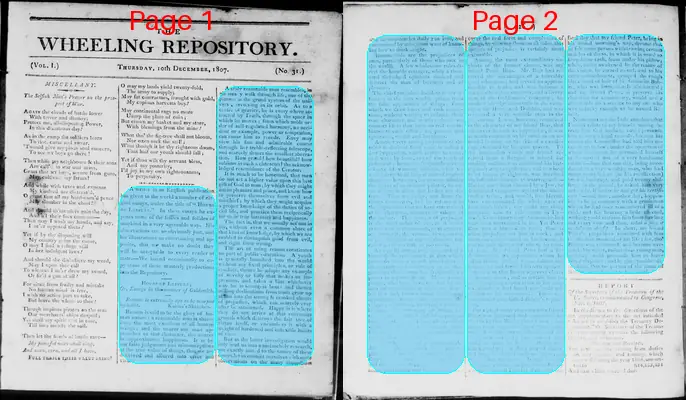
Literary
December 10, 1807
The Wheeling Repository
Wheeling, Ohio County, West Virginia
What is this article about?
An introduction praises 'Hours of Leisure' essays imitating Goldsmith for exposing human follies entertainingly. The featured essay explores how reason is warped by habit and prejudices, using metaphors, examples of biases, and an anecdote about engraver Peter Bias's stubborn prejudices leading to humorous mishaps.
Merged-components note: Continuation of the essay on reason and prejudices across pages, text flows directly.
Clippings
1 of 2
OCR Quality
82%
Good
Full Text
A writer in an English publication has given to the world a number of elegant essays, under the title of "Hours of Leisure." In these essays he exposes some of the follies and foibles of mankind in a very agreeable way. His observations are so obviously just, and his illustrations so entertaining and apposite, that we make no doubt they will be acceptable to every reader of taste. We intend occasionally to copy some of these masterly productions into the Repository.
HOURS OF LEISURE;
Or, Essays in the manner of Goldsmith.
Reason is extremely apt to be warped by habit.
Kaims's Sketches.
Reason is said to be the glory of human nature: a reasonable man is therefore, the most excellent of all human beings; and the nearer any man approaches to that character, the nearer he approximates to happiness.
It is by our false judgments and misconceptions of the true value of things, that we are deceived and allured into error: and vice.
A truly reasonable man resembles, in his steady walk through life, one of the planets in the grand system of the universe, revolving in its orbit. As to a centre of gravity, he is every where attracted by Truth, through the space in which he moves; from which noble order of self-regulated harmony, no accident or example, power or temptation, can cause him to recede. Envy may view his fine and admirable course through her treble-reflecting telescope, and scarcely detect the smallest aberration.
How grand! how beautiful! how sublime is such a character! the acknowledged resemblance of the Creator.
It is much to be lamented, that men do not set a higher value upon this best gift of God to man; by which they might attain pleasure and peace, and know how to preserve themselves from evil and mischief; by which they might acquire a proper knowledge of the duties of social life, and practice them reciprocally for their true interests and happiness.
The fact is, that we usually set out in life, without even a common share of that kind of knowledge, by which we are enabled to distinguish good from evil, and right from wrong:
The art of using reason constitutes no part of public education. A youth is generally launched into the world without any fixed principles, or rule of conduct, thence he adopts any example of novelty or folly that makes an impression, and takes a bias whichever way he is strongest bent: and thence trifling declinations from truth grow up at last into the strong & crooked shoots of prejudice, which can scarcely ever after be straitened.
Happy is it where they do not arrive at that enormous growth which destroys the fair tree of virtue itself, or encumbers it with a weight of hardened and inflexible habits of vice.
But as the latter investigation would only lead us into a melancholy research, not exactly suited to the nature of these essays, let us content ourselves with some observations on the many absurdities
and inconsistencies daily run into, and entertained by men, from want of knowing how to think aright.
Innumerable are the prejudices of men, particularly of those who mix in the world. A few wholesome rules direct the humble cottager, while a thousand ill-judged opinions mislead and distract the man of business and of pleasure.
The chief prejudice incident to our situation in the busy world, springs from the false appearance of things; from which we draw hasty and rash conclusions, without waiting to estimate their true character and worth: thence we connect ideas that have no real resemblance to each other; as, poverty and ignorance, wealth and happiness.
Another very strong prejudice of the mind is derived from what is called a first impression, which carries us away, as it were by force, out of the reach of judgment: hence we frequently give to a knave of winning address, what we would deny to an honest man of coarser manners: hence too, because we admire the works of an eminent painter, we are not willing to allow that he has any defects. Thus we judge, not from the things themselves, but by reference to the impression that we have entertained of the character, manners or talents of the author. This species of prejudice is the most unfair of any, as it never permits us to distinguish, or to appreciate properly, the virtues, vices, merits or imperfections of our neighbours, but either gives too little or too much.
An equally strong prejudice, and of a kind with the two former, is that which proceeds from a casual association of ideas, connected so strongly by the imagination, that reason has frequently no power to separate them. Hence young people, who have been terrified by the idea of apparitions at night, are never left in a dark room without thinking of apparitions: thence also proceeds the vulgar prejudice of avoiding a particular name in christening an infant, because some one called so had been partial to ill-luck. These ideas, which are idle cavils and jests, are mere follies of those in station, which our judgment shown correct.
A fourth kind of prejudice is, the inclination which men may to placed at the dinner table which the very ones; a conoton and unsociable in much penetration and judgment to cover the real form and complexion of things, by viewing them on all sides, this species of prejudice is certainly most excusable.
Among the most extraordinary sophists of the former classes, was my friend Peter Bias. Mr. Bias had received the advantages of a tolerably good education; had served an apprenticeship to trade, and was become a master silverplate engraver, and a livery man of the Goldsmiths' company; he smoked his pipe constantly in the evening at the Horse and Dolphin, and was reckoned a very sensible man in the club-room. It was, however, remarked in the character of my friend Bias, that whenever he took an impression, it was as much engraven on his mind as an armorial bearing on the side of a caudle-cup, executed by his own graver. To the impression which my friend received from a flogging at school for stealing codlins, was attributed his lasting antipathy to apple-pie; and to a long fit of illness at eighteen, was ascribed his inflexible distaste to water-gruel. Having once been cheated by a Jew, he denounced vengeance against the whole twelve tribes, and would, like Herod, have exterminated the whole race of Israelitish babes; nor could any thing persuade him to ride again in Thomas's Kentishtown stage, because he had once been overturned in it. Yet Peter Bias was a benevolent man; that is when prejudice set him at work; and when once established in his favour, it was no easy matter for one to be turned out. My friend Peter had a little dirty boy, an apprentice, whom he called Bobby, and of whose talents and honesty he had formed his own opinion. Certain it is, that Bobby was very clever at shining shoes; and as certain that he once brought a crown piece to his master, which he had found carelessly left by him on the shop-board. These circumstances established Bobby's reputation.
For a great many years my poor friend Peter was harassed and tormented by the tricks that Bobby played him: his snors were neglected, his clothes worn out before they were left off, and his loose cash pilfered gave one of this could be done by Bobby: Bobby was still a good lad: a deal pair of shoes. and a recollection of the crown piece, set other thing to right. It was in vain O any ventured to pronounce Bobby a rogue: he still kept his place; til one fatal day that my friend Peter, being in his sound morning's nap, dreamt that he felt some person withdrawing certain articles of dress, in which it is usual to keep loose cash, from under his pillow; when, being awakened by the reality of the vision, he turned round, and to his utter astonishment, grasped the rough black head of hair of his favourite Bobby, who was immediately discharged; and my friend Peter, to preserve his character for consistency, would never afterwards do a service to any one who was unlucky enough to be named Robert.
Numerous are the little anecdotes that I could relate of my friend: among the rest, how that nothing could persuade him to seek a legal remedy, because his cousin the Counsellor had told him never to go to law; under the operation of which resolution he permitted himself to be ousted out of a very handsome estate: how that one day, being introduced to a very wealthy man, who had many years before (in his recollection) been a bankrupt, and paid twenty shillings in the pound, he asked him very earnestly, whether he had got his certificate--and how, another day, happening to be in company with a gentleman whom he had once remembered ill of a cold, and his hearing a little affected, nothing could restrain him from bawling out every now and then, what a pity it is he's so deaf! In short, my friend Peter's prejudices remained with him til the last moment of his life; for, tho' Bobby was reformed, and become a remarkably sober, industrious young man, nothing could persuade him to leave him a sixpence: and he gave positive directions, that no person of the name of Robert should assist at his burial.
HOURS OF LEISURE;
Or, Essays in the manner of Goldsmith.
Reason is extremely apt to be warped by habit.
Kaims's Sketches.
Reason is said to be the glory of human nature: a reasonable man is therefore, the most excellent of all human beings; and the nearer any man approaches to that character, the nearer he approximates to happiness.
It is by our false judgments and misconceptions of the true value of things, that we are deceived and allured into error: and vice.
A truly reasonable man resembles, in his steady walk through life, one of the planets in the grand system of the universe, revolving in its orbit. As to a centre of gravity, he is every where attracted by Truth, through the space in which he moves; from which noble order of self-regulated harmony, no accident or example, power or temptation, can cause him to recede. Envy may view his fine and admirable course through her treble-reflecting telescope, and scarcely detect the smallest aberration.
How grand! how beautiful! how sublime is such a character! the acknowledged resemblance of the Creator.
It is much to be lamented, that men do not set a higher value upon this best gift of God to man; by which they might attain pleasure and peace, and know how to preserve themselves from evil and mischief; by which they might acquire a proper knowledge of the duties of social life, and practice them reciprocally for their true interests and happiness.
The fact is, that we usually set out in life, without even a common share of that kind of knowledge, by which we are enabled to distinguish good from evil, and right from wrong:
The art of using reason constitutes no part of public education. A youth is generally launched into the world without any fixed principles, or rule of conduct, thence he adopts any example of novelty or folly that makes an impression, and takes a bias whichever way he is strongest bent: and thence trifling declinations from truth grow up at last into the strong & crooked shoots of prejudice, which can scarcely ever after be straitened.
Happy is it where they do not arrive at that enormous growth which destroys the fair tree of virtue itself, or encumbers it with a weight of hardened and inflexible habits of vice.
But as the latter investigation would only lead us into a melancholy research, not exactly suited to the nature of these essays, let us content ourselves with some observations on the many absurdities
and inconsistencies daily run into, and entertained by men, from want of knowing how to think aright.
Innumerable are the prejudices of men, particularly of those who mix in the world. A few wholesome rules direct the humble cottager, while a thousand ill-judged opinions mislead and distract the man of business and of pleasure.
The chief prejudice incident to our situation in the busy world, springs from the false appearance of things; from which we draw hasty and rash conclusions, without waiting to estimate their true character and worth: thence we connect ideas that have no real resemblance to each other; as, poverty and ignorance, wealth and happiness.
Another very strong prejudice of the mind is derived from what is called a first impression, which carries us away, as it were by force, out of the reach of judgment: hence we frequently give to a knave of winning address, what we would deny to an honest man of coarser manners: hence too, because we admire the works of an eminent painter, we are not willing to allow that he has any defects. Thus we judge, not from the things themselves, but by reference to the impression that we have entertained of the character, manners or talents of the author. This species of prejudice is the most unfair of any, as it never permits us to distinguish, or to appreciate properly, the virtues, vices, merits or imperfections of our neighbours, but either gives too little or too much.
An equally strong prejudice, and of a kind with the two former, is that which proceeds from a casual association of ideas, connected so strongly by the imagination, that reason has frequently no power to separate them. Hence young people, who have been terrified by the idea of apparitions at night, are never left in a dark room without thinking of apparitions: thence also proceeds the vulgar prejudice of avoiding a particular name in christening an infant, because some one called so had been partial to ill-luck. These ideas, which are idle cavils and jests, are mere follies of those in station, which our judgment shown correct.
A fourth kind of prejudice is, the inclination which men may to placed at the dinner table which the very ones; a conoton and unsociable in much penetration and judgment to cover the real form and complexion of things, by viewing them on all sides, this species of prejudice is certainly most excusable.
Among the most extraordinary sophists of the former classes, was my friend Peter Bias. Mr. Bias had received the advantages of a tolerably good education; had served an apprenticeship to trade, and was become a master silverplate engraver, and a livery man of the Goldsmiths' company; he smoked his pipe constantly in the evening at the Horse and Dolphin, and was reckoned a very sensible man in the club-room. It was, however, remarked in the character of my friend Bias, that whenever he took an impression, it was as much engraven on his mind as an armorial bearing on the side of a caudle-cup, executed by his own graver. To the impression which my friend received from a flogging at school for stealing codlins, was attributed his lasting antipathy to apple-pie; and to a long fit of illness at eighteen, was ascribed his inflexible distaste to water-gruel. Having once been cheated by a Jew, he denounced vengeance against the whole twelve tribes, and would, like Herod, have exterminated the whole race of Israelitish babes; nor could any thing persuade him to ride again in Thomas's Kentishtown stage, because he had once been overturned in it. Yet Peter Bias was a benevolent man; that is when prejudice set him at work; and when once established in his favour, it was no easy matter for one to be turned out. My friend Peter had a little dirty boy, an apprentice, whom he called Bobby, and of whose talents and honesty he had formed his own opinion. Certain it is, that Bobby was very clever at shining shoes; and as certain that he once brought a crown piece to his master, which he had found carelessly left by him on the shop-board. These circumstances established Bobby's reputation.
For a great many years my poor friend Peter was harassed and tormented by the tricks that Bobby played him: his snors were neglected, his clothes worn out before they were left off, and his loose cash pilfered gave one of this could be done by Bobby: Bobby was still a good lad: a deal pair of shoes. and a recollection of the crown piece, set other thing to right. It was in vain O any ventured to pronounce Bobby a rogue: he still kept his place; til one fatal day that my friend Peter, being in his sound morning's nap, dreamt that he felt some person withdrawing certain articles of dress, in which it is usual to keep loose cash, from under his pillow; when, being awakened by the reality of the vision, he turned round, and to his utter astonishment, grasped the rough black head of hair of his favourite Bobby, who was immediately discharged; and my friend Peter, to preserve his character for consistency, would never afterwards do a service to any one who was unlucky enough to be named Robert.
Numerous are the little anecdotes that I could relate of my friend: among the rest, how that nothing could persuade him to seek a legal remedy, because his cousin the Counsellor had told him never to go to law; under the operation of which resolution he permitted himself to be ousted out of a very handsome estate: how that one day, being introduced to a very wealthy man, who had many years before (in his recollection) been a bankrupt, and paid twenty shillings in the pound, he asked him very earnestly, whether he had got his certificate--and how, another day, happening to be in company with a gentleman whom he had once remembered ill of a cold, and his hearing a little affected, nothing could restrain him from bawling out every now and then, what a pity it is he's so deaf! In short, my friend Peter's prejudices remained with him til the last moment of his life; for, tho' Bobby was reformed, and become a remarkably sober, industrious young man, nothing could persuade him to leave him a sixpence: and he gave positive directions, that no person of the name of Robert should assist at his burial.
What sub-type of article is it?
Essay
Satire
What themes does it cover?
Moral Virtue
Social Manners
What keywords are associated?
Reason
Prejudice
Folly
Bias
Goldsmith
Essays
Human Nature
Literary Details
Title
Hours Of Leisure; Or, Essays In The Manner Of Goldsmith.
Subject
Reason Warped By Habit And Prejudices
Form / Style
Essays In The Manner Of Goldsmith
Key Lines
A Truly Reasonable Man Resembles, In His Steady Walk Through Life, One Of The Planets In The Grand System Of The Universe, Revolving In Its Orbit. As To A Centre Of Gravity, He Is Every Where Attracted By Truth, Through The Space In Which He Moves; From Which Noble Order Of Self Regulated Harmony, No Accident Or Example, Power Or Temptation, Can Cause Him To Recede.
Innumerable Are The Prejudices Of Men, Particularly Of Those Who Mix In The World. A Few Wholesome Rules Direct The Humble Cottager, While A Thousand Ill Judged Opinions Mislead And Distract The Man Of Business And Of Pleasure.
Among The Most Extraordinary Sophists Of The Former Classes, Was My Friend Peter Bias.