Thank you for visiting SNEWPapers!
Sign up free
The Enquirer
Richmond, Henrico County, Virginia
What is this article about?
On January 7, 1805, the U.S. House of Representatives debated receding the District of Columbia's territory to Maryland and Virginia. Speakers including Mr. Smilie (PA), Mr. Early, and Mr. Eppes (VA) argued on constitutional authority, expediency, potential dangers of retained jurisdiction, and separation from removing the seat of government.
Clipping
OCR Quality
Full Text
MONDAY, January 7, 1805.
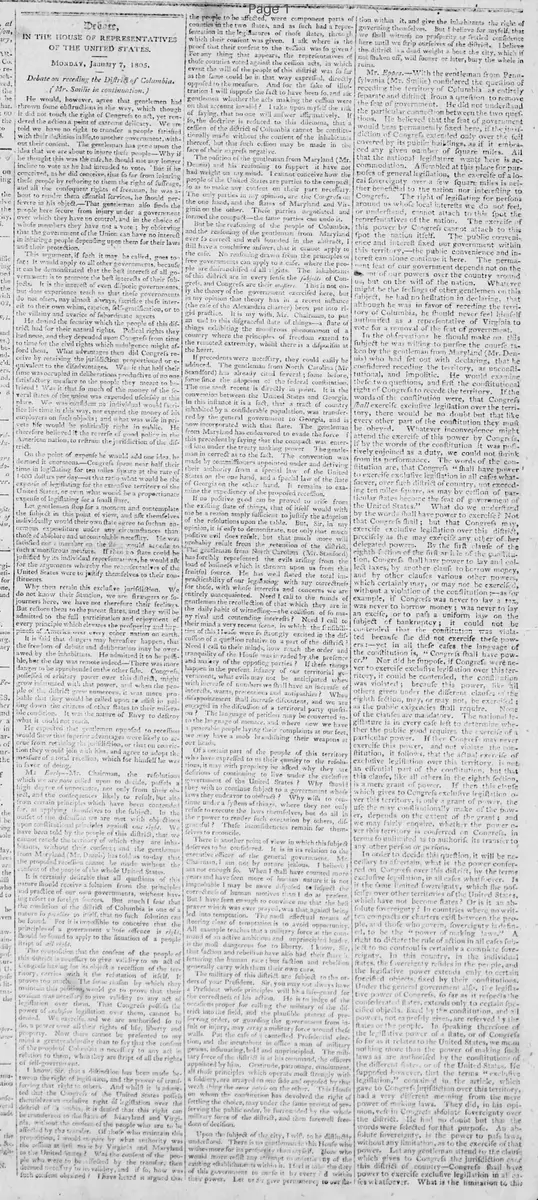
Debate on receding the District of Columbia. (Mr. Smilie in continuation.)
He would, however, agree that gentlemen had thrown some obstructions in the way, which though it did not touch the right of Congress to act, yet rendered the action a point of extreme delicacy. We are told we have no right to transfer a people satisfied with their destinies in life, to another government, without their consent. The gentleman has gone upon the idea that we are about to injure these people—Why if he thought this was the case, he should not any longer incline to vote as he had intended to vote. But if he conceived, as he did conceive, that so far from injuring these people by restoring to them the right of suffrage, and all the consequent rights of freemen, he was about to render them essential services, he should persevere in his object.—That gentleman also finds the people here secure from injury under a government over which they have no control, and in the choice of whose members they have not a vote; by observing that the government of the Union can have no interest in injuring a people depending upon them for their laws and their protection.
This argument, if such it may be called, goes too far; It would apply to all other governments, because it can be demonstrated that the best interest of all governments is to promote the best interests of their subjects. It is the interest of even despotic governments, but does experience teach us that these governments do not often, nay almost always, sacrifice these interests to their own whim, caprice, self-gratification, or to the villainy and avarice of subordinate agents
He denied the security which the people of this district had for their natural rights. Political rights they had none, and they depended upon Congress from time to time for the civil rights which indulgence might afford them. What advantages then did Congress receive by retaining the jurisdiction proportioned or equivalent to the disadvantages. Was it that half their time was occupied in deliberations productive of no one satisfactory measure to the people they meant to befriend! Was it that so much of the money of the several states of the union was expended uselessly at this place. We was confident no individual would sacrifice his time in this way, nor expend the money of his employers on such objects; and what was wise in private life would be politically right in public. He therefore believed it the reverse of good policy in the American nation, to restrain the jurisdiction of the district.
On the point of expense he would add one idea, he deemed it enormous.—Congress spent near half their time in legislating for ten miles square at the rate of 1400 dollars per day—at that ratio what would be the expense of legislating for the extensive territory of the United States, or even what would be a proportionate expense of legislating for a small state.
Let gentlemen stop for a moment and contemplate the subject in this point of view, and ask themselves individually would their own state agree to such an enormous expenditure under any circumstances than those of absolute and uncontrollable necessity. He was satisfied no member on the floor would accede to such a monstrous measure. If then no state could be justified by its individual representatives, he would ask for the arguments whereby the representatives of the United States were to justify themselves to their constituents.
Why then retain this exclusive jurisdiction. We do not know their situation, we are strangers or sojourners here, we have not therefore their feelings. But restore them to the parent states, and they will be admitted to the full participation and enjoyment of every principle which elevates the prosperity and happiness of America over every other nation on earth.
It is said that dangers may hereafter happen, that the freedom of debate and deliberation may be overawed by the inhabitants. He admitted it to be possible, but the day was remote indeed—There was more danger to be apprehended on the other side. Congress, possessed of arbitrary power over this district, might grow infatuated with that power, and when the people of this district grew numerous, it was more probable that they would be called upon to assist in pulling down the citizens of other states to their miserable condition. It was the nature of Envy to destroy what it could not reach.
He expected that gentlemen opposed to recession would show that superior advantages were likely to accrue from retaining the jurisdiction, or that on conviction they would join with him, and agree to adopt the measure of a total recession, which for himself he was in favor of doing.
Mr. Early—Mr. Chairman, the resolutions which we are now called upon to decide, possess a high degree of importance, not only from their object, and the consequences likely to result, but also from certain principles which have been contended for, as applying themselves to the subject. In the outset of the discussion we are met with objections upon constitutional principles against our right. We have been told by the people of this district, that we cannot recede the territory of which they are inhabitants, without their consent; and the gentleman from Maryland (Mr. Dennis) has told us to-day that the proposed recession cannot be made without the consent of the people of the whole United States.
It is certainly desirable that all questions of this nature should receive a solution from the principles and practice of our own governments, without having resort to foreign sources. But much I fear that the condition of the district of Columbia is one of a nature so peculiar to itself, that no such solution can be found. For it is impossible to conceive that the principles of a government whose essence is right should be found to apply to the situation of a people stripped of all right.
The proposition that the consent of the people of this district is necessary to give validity to an act of Congress having for its object a recession of the territory, carries with it the refutation of itself. It proves too much. The same reason by which they maintain this position, would go to prove that their consent was necessary to give validity to any act of legislation over them. That Congress possess the power of exclusive legislation over them, cannot be denied. We exercise, and we are authorized so to do, a power over all their rights of life, liberty and property. Now there cannot be presented to my mind a greater absurdity than to say that the consent of the people of Columbia is necessary to any act in relation to them, when they are stripped of all the rights of self-government.
I know, Sir, that a distinction has been made between the right of legislation, and the power of transferring that right to others. And while it is admitted that the Congress of the United States possess themselves an exclusive right of legislation over the district of Columbia, it is denied that this right can be transferred to the states of Maryland and Virginia, without the consent of the people who are to be affected by this transfer. Of those who maintain this proposition, I would enquire by what authority was the cession at first made by Virginia and Maryland to the United States? Was the consent of the people who were to be affected by the transfer, then deemed necessary to its validity, and if so, how was such consent obtained? I have heard it argued that the people to be affected, were component parts of counties in the two states, and as such had a representation in the legislatures of those states, through which their consent was given. I ask where is the proof that their consent to the cession was so given? For any thing that appears, the representatives of those counties voted against the cession acts, in which event the will of the people of this district was so far as the same could be in that way expressed, directly opposed to the measure. And for the sake of illustration I will suppose the fact to have been so, and ask gentlemen whether the acts making the cession were on that account invalid? I take upon myself the risk of saying, that no one will answer affirmatively. If so, the doctrine is reduced to this dilemma, that a cession of the district of Columbia cannot be constitutionally made without the consent of the inhabitants thereof, but that such cession may be made in the face of their express negative.
The position of the gentleman from Maryland (Mr. Dennis) and his reasoning to support it have not had weight on my mind. I cannot conceive how the people of the United States are parties to the compact, so as to make any consent on their part necessary. The only parties in my opinion, are the Congress on the one hand, and the states of Maryland and Virginia on the other. These parties negotiated and formed the compact—the same parties can undo it.
But be the reasoning of the people of Columbia, and the reasoning of the gentleman from Maryland ever so correct and well founded in the abstract, I still have a conclusive answer, that it cannot apply to the case. No reasoning drawn from the principles of free governments can apply to a case, where the people are disfranchised of all rights. The inhabitants of this district are in every sense the subjects of Congress, and Congress are their masters. This is not only the theory of the government exercised here, but in my opinion that theory has in a recent instance (the case of the Alexandria charter) been put into rigid practice. It is my wish, Mr. Chairman, to put an end to this disgraceful state of things—a state of things exhibiting the monstrous phenomenon of a country where the principles of freedom extend to the remotest extremity, whilst there is a despotism at the heart.
If precedents were necessary, they could easily be adduced. The gentleman from North Carolina (Mr. Stanford) has already cited several; some before, some since the adoption of the federal constitution. The one most recent is directly in point. It is the convention between the United States and Georgia. In this instance it is a fact, that a tract of country inhabited by a considerable population, was transferred by the general government to Georgia, and is now incorporated with that state. The gentleman from Maryland has endeavored to evade the force of this precedent by saying that the compact was entered into under the treaty making power. The gentleman is correct as to the fact. The convention was made by commissioners appointed under and deriving their authority from a special law of the United States on the one hand, and a special law of the state of Georgia on the other hand.
It remains to examine the expediency of the proposed recession. If no positive good can be proved to arise from the existing state of things, that of itself would with me be a reason amply sufficient to justify the adoption of the resolutions upon the table. But, Sir, in my opinion, it is easy to demonstrate, not only that much positive evil does result, but that much more will probably result from the retention of the district.
The gentleman from North Carolina (Mr. Stanford) has forcibly represented the evils arising from the load of business which is thrown upon us from this fruitful source. He has well stated the total impracticability of our legislating with any correctness for those, with whose interests and concerns we are entirely unacquainted. Need I call to the minds of gentlemen the recollection of that which they are in the daily habit of witnessing—the collision of so many rival and contending interests? Need I call to their mind a very recent scene, in which the sensibilities of this House were so strongly excited in the discussion of a question relative to a part of the district? Need I call to their minds, how much the order and tranquility of the House was invaded by the presence and anxiety of the opposing parties? If these things happen in the present infancy of our territorial government, what evils may not be anticipated when with increase of numbers we shall have an increase of interests, wants, pretensions and antipathies? When disappointment shall increase discontent, and we are engaged in the discussion of a territorial party question? The language of petition may be converted into the language of menace, and where now we have a peaceable people laying their complaints at our feet, we may have a mob brandishing their weapons at our head.
Of a certain part of the people of this territory who have expressed to us their enmity to the resolutions, it may with propriety be asked why they are desirous of continuing to live under the exclusive government of the United States? Why should they wish to continue subject to a government whose laws they endeavor to obstruct? Why wish to continue under a system of things, where they not only refuse to execute the laws themselves, but do all in their power to render such execution by others, disgraceful? These inconsistencies remain for themselves to reconcile.
There is another point of view in which this subject deserves to be considered. It is in its relation to the executive officer of the general government. Mr. Chairman, I am not by nature jealous. I believe I am not enough so. When I shall have counted more years and have seen more of human nature it is not improbable I may be more disposed to suspect the correctness of human motives than I do at present. But I have seen enough to convince me that the best prayer which was ever prayed, was that against being led into temptation. The most effectual means of steering clear of temptation is to avoid opportunity. All experience teaches that a military force at the command of an active ambitious and unprincipled leader, is the most dangerous foe to liberty. I know, Sir, that faction and rebellion have also had their share in fettering the human race; but faction and rebellion generally carry with them their own cure.
The military of this district are subject to the orders of your President. Sir, you may not always have a President whose principles will be a safe-guard for the correctness of his action. He is to judge of the occasions proper for calling the military of the district into the field, and the plausible pretext of preserving order, or guarding the government from insult or injury, may array a military force around these walls. Put the case of a contested Presidential election, and the incumbent in office a man of military genius, insinuating, bold and unprincipled. The military force of the district is at his command, the officers appointed by him. Gratitude, patronage, emolument, all those principles which operate most strongly with a soldiery, are arrayed on one side and opposed by that weak thing the amor patriae on the other. This House on whom the constitution has devolved the right of settling the choice, may under the same pretext of preserving the public order, be surrounded by the whole military force of the district, and then farewell freedom of decision.
Upon the subject of the city, I wish to be distinctly understood. There is no gentleman in this House who wishes more for its prosperity than myself. None who would more resist any attempt to unsettle any of the existing establishments within it. It is the duty of this government to nurse it by every aid within their power. Let us give permanency to our situation within it, and give the inhabitants the right of governing themselves. But I believe for myself, that we shall witness no prosperity or settled confidence here until we strip ourselves of the district. I believe the district is a dead weight about the city, which if not shaken off, will sooner or later, bury the whole in ruins.
Mr. Eppes.—With the gentleman from Pennsylvania (Mr. Smilie) considered the question of receding the territory of Columbia as entirely separate and distinct from a question to remove the seat of government. He did not understand the particular connection between the two questions. He believed that the seat of government would be as permanently fixed here, if the jurisdiction of Congress extended only over the soil covered by its public buildings, as if it embraced any given number of square miles. All that the national legislature wants here is accommodation. Assembled at this place for purposes of general legislation, the exercise of a local sovereignty over a few square miles is neither beneficial to the nation nor interesting to Congress. The right of legislating for persons around us whose local interests we do not feel, or understand, cannot attach to this spot the representatives of the nation. The exercise of this power by Congress cannot attach to this spot the nation itself. The public convenience and interest fixed our government within this territory,—the public convenience and interest can alone continue it here. The permanent seat of our government depends not on the extent of our powers over the country around us, but on the will of the nation. Whatever might be the feelings of other gentlemen on this subject. he had no hesitation in declaring, that although he was in favor of receding the territory of Columbia, he should never feel himself authorized as a representative of Virginia to vote for a removal of the seat of government.
In the observations he should make on this subject he was willing to pursue the course taken by the gentleman from Maryland (Mr. Dennis) who had set out with declaring, that he considered receding the territory, as unconstitutional, and impolitic. He would examine these two questions, and first the constitutional right of Congress to recede the territory. If the words of the constitution were, that Congress shall exercise exclusive legislation over the territory, there would be no doubt but that like every other part of the constitution they must be obeyed. Whatever inconvenience might attend the exercise of this power by Congress, if by the words of the constitution it was positively enjoined as a duty, we could not shrink from its performance. The words of the constitution are, that Congress "shall have power to exercise exclusive legislation in all cases whatsoever, over such district of country, not exceeding ten miles square, as may by cession of particular states become the seat of government of the United States." What do we understand by the words shall have power to exercise? Not that Congress shall; but that Congress may, exercise exclusive legislation over this district, precisely as she may exercise any other of her delegated powers. By the first clause of the eighth section of the first article of the constitution, Congress shall have power to lay and collect taxes, by another clause to borrow money, and by other clauses various other powers, which certainly may, or may not be exercised, without a violation of the constitution ;—as for example, if Congress was never to lay a tax, was never to borrow money; was never to lay an excise, or to pass a uniform law on the subject of bankruptcy; it could not be contended that the constitution was violated because she did not exercise these powers:—yet in all these cases the language of the constitution is, "Congress shall have power." Nor did he suppose, if Congress were never to exercise exclusive legislation over this territory, it could be contended, the constitution was violated; because this power, like all others given under the different clauses of the eighth section, may, or may not, be exercised ; as the public exigencies shall require. None of the clauses are mandatory. The national legislature is in every case left to determine whether the public good requires the exercise of a particular power. If then Congress may never exercise this power, and not violate the constitution, it follows, that the actual exercise of exclusive legislation over this territory, is not an essential part of the constitution, but that this clause, like all others in the eighth section, is a mere grant of power. If then this clause which gives to Congress exclusive legislation over this territory, is only a grant of power, the use they may constitutionally make of the power, depends on the extent of the grant: and we may fairly enquire, whether the power over this territory is conferred on Congress, in terms so unlimited as to authorize its transfer to any other person or persons.
In order to decide this question, it will be necessary to ascertain, what is the power conferred on Congress over this district, by the terms exclusive legislation, in all cases whatsoever. Is it the same limited sovereignty, which she possesses over other territories of the United States, which have not become states? Or is it an absolute sovereignty? In countries where no written compacts or charters exist between the people, and those who govern, sovereignty is defined, to be the "power of making laws.?" A right to dictate the rule of action in all cases subject to no controul is certainly a complete sovereignty. In this country, in the individual states. the sovereignty resides in the people, and the legislative power extends only to certain specified objects, fixed by their constitutions. Under the general government also, the legislative power of Congress, so far as it respects the confederated states, extends only to certain specified objects. fixed by the constitution, and all powers, not expressly given, are reserved by the states or the people. In speaking therefore of the legislative power of a state, or of Congress so far as it relates to the United States, we mean nothing more than the power of making such laws as are authorized by the constitutions of the different state, or of the United States. He supposed however, that the terms "exclusive legislation," contained in the article, which gave to Congress jurisdiction over this territory, had a very different meaning from the mere power of making laws. They did, in his opinion, vest in Congress absolute sovereignty over the district. He had no doubt but that the words were selected for that purpose. An absolute sovereignty, is the power to pass laws, without any limitation, as to the exercise of that power. Let any gentleman attend to the clause which gives to Congress the jurisdiction over this district of country—Congress Shall have power to exercise exclusive legislation in all cases whatsoever. What is the limitation to this power?
What sub-type of article is it?
What keywords are associated?
What entities or persons were involved?
Where did it happen?
Domestic News Details
Primary Location
District Of Columbia
Event Date
January 7, 1805
Key Persons
Event Details
Debate in the House of Representatives on resolutions to recede the District of Columbia territory to Maryland and Virginia, covering constitutional authority, consent requirements, expediency, potential future dangers, and separation from seat of government removal.