Thank you for visiting SNEWPapers!
Sign up free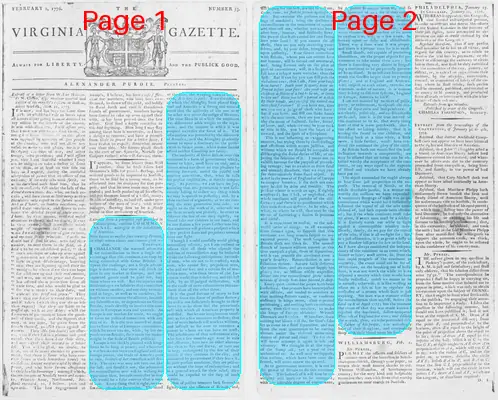
The Virginia Gazette
Williamsburg, Virginia
What is this article about?
Extracts from Thomas Paine's 'Common Sense' pamphlet, challenging reconciliation with Britain and advocating American independence. Argues no benefits from connection, risks of European wars, natural separation due to distance and history, critiques reconciliation supporters, and deems independence inevitable for security and posterity.
Merged-components note: This is a direct continuation of the extract from Thomas Paine's 'Common Sense' pamphlet across pages 1 and 2, as the text flows seamlessly. The content is an opinion piece advocating for independence, fitting the 'editorial' label better than 'domestic_news'.
Clippings
1 of 2
OCR Quality
Full Text
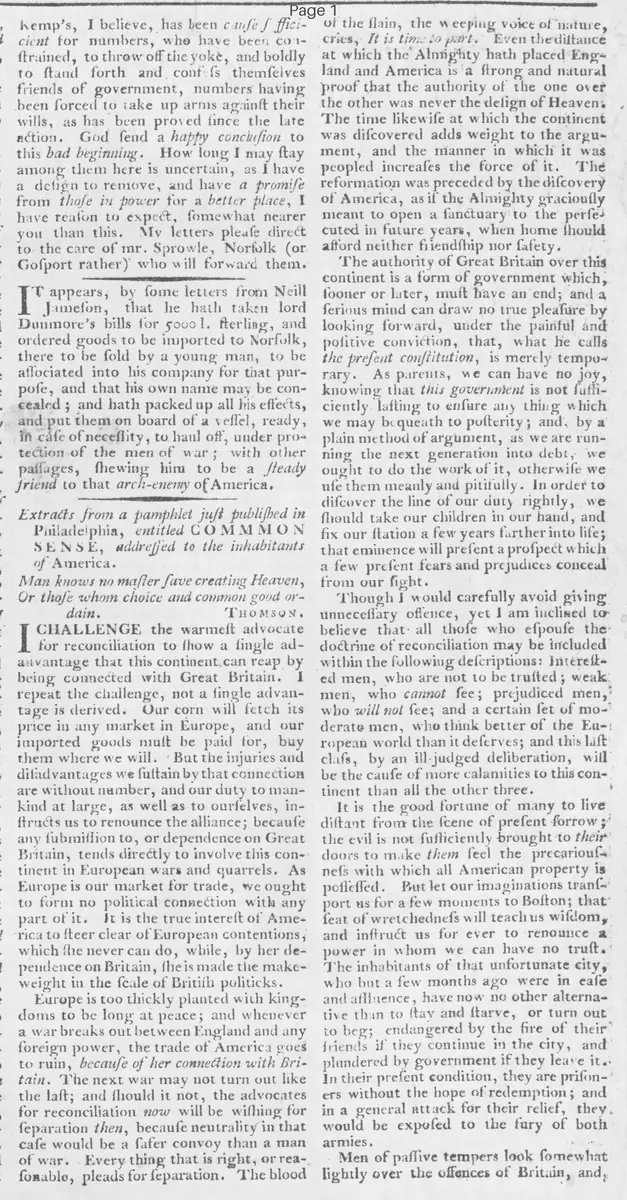
Man knows no master save creating Heaven,
Or those whose choice and common good ordain.
THOMSON.
I CHALLENGE the warmest advocate for reconciliation to show a single advantage that this continent can reap by being connected with Great Britain. I repeat the challenge, not a single advantage is derived. Our corn will fetch its price in any market in Europe, and our imported goods must be paid for, buy them where we will. But the injuries and disadvantages we sustain by that connection are without number, and our duty to mankind at large, as well as to ourselves, instructs us to renounce the alliance; because any submission to, or dependence on Great Britain, tends directly to involve this continent in European wars and quarrels. As Europe is our market for trade, we ought to form no political connection with any part of it. It is the true interest of America to steer clear of European contentions, which she never can do, while, by her dependence on Britain, she is made the makeweight in the scale of British politics.
Europe is too thickly planted with kingdoms to be long at peace; and whenever a war breaks out between England and any foreign power, the trade of America goes to ruin, because of her connection with Britain. The next war may not turn out like the last; and should it not, the advocates for reconciliation now will be wishing for separation then, because neutrality in that case would be a safer convoy than a man of war. Every thing that is right, or reasonable, pleads for separation. The blood of the slain, the weeping voice of nature, cries, It is time to part. Even the distance at which the Almighty hath placed England and America is a strong and natural proof that the authority of the one over the other was never the design of Heaven: The time likewise at which the continent was discovered adds weight to the argument, and the manner in which it was peopled increases the force of it. The reformation was preceded by the discovery of America, as if the Almighty graciously meant to open a sanctuary to the persecuted in future years, when home should afford neither friendship nor safety.
The authority of Great Britain over this continent is a form of government which, sooner or later, must have an end; and a serious mind can draw no true pleasure by looking forward, under the painful and positive conviction, that, what he calls the present constitution, is merely temporary. As parents, we can have no joy, knowing that this government is not sufficiently lasting to ensure any thing which we may bequeath to posterity; and, by a plain method of argument, as we are running the next generation into debt, we ought to do the work of it, otherwise we use them meanly and pitifully. In order to discover the line of our duty rightly, we should take our children in our hand, and fix our station a few years farther into life; that eminence will present a prospect which a few present fears and prejudices conceal from our sight.
Though I would carefully avoid giving unnecessary offence, yet I am inclined to believe that all those who espouse the doctrine of reconciliation may be included within the following descriptions: Interested men, who are not to be trusted; weak men, who cannot see; prejudiced men, who will not see; and a certain set of moderate men, who think better of the European world than it deserves; and this last class, by an ill-judged deliberation, will be the cause of more calamities to this continent than all the other three.
It is the good fortune of many to live distant from the scene of present sorrow; the evil is not sufficiently brought to their doors to make them feel the precariousness with which all American property is possessed. But let our imaginations transport us for a few moments to Boston; that seat of wretchedness will teach us wisdom, and instruct us for ever to renounce a power in whom we can have no trust. The inhabitants of that unfortunate city, who but a few months ago were in ease and affluence, have now no other alternative than to stay and starve, or turn out to beg; endangered by the fire of their friends if they continue in the city, and plundered by government if they leave it. In their present condition, they are prisoners without the hope of redemption; and in a general attack for their relief, they would be exposed to the fury of both armies.
Men of passive tempers look somewhat lightly over the offences of Britain, and,
Still hoping for the best, are apt to call out.
Come, come, we shall be friends again for all this. But examine the passions and feelings of mankind; bring the doctrine of reconciliation to the touchstone of nature, and then tell me, whether you can hereafter love, honour, and faithfully serve, the power that hath carried fire and sword into your land? If you cannot do all these, then are you only deceiving yourselves, and, by your delay, bringing ruin upon posterity. Your future connection with Britain, whom you can neither love nor honour, will be forced and unnatural, and, being formed only on the plan of present convenience, will, in a little time, fall into a relapse more wretched than the first. But if you say you can still pass the violations over, then I ask, Hath your house been burnt? Hath your property been destroyed before your face? Are your wife and children destitute of a bed to lie on, or bread to live on? Have you lost a parent or a child by their hands, and yourself the ruined and wretched survivor? If you have not, then are you not a judge of those who have; but if you have, and still can shake hands with the murderers, then are you unworthy the name of husband, father, friend, or lover, and, whatever may be your rank or title in life, you have the heart of a coward, and the spirit of a sycophant.
This is not inflaming or exaggerating matters, but trying them by those feelings and affections which nature justifies, and without which we should be incapable of discharging the social duties of life, or enjoying the felicities of it. I mean not to exhibit horror for the purpose of provoking revenge, but to awaken us from fatal and unmanly slumbers, that we may pursue determinately some fixed object. It is not in the power of England or of Europe to conquer America, if she doth not conquer herself by delay and timidity. The present winter is worth an age, if rightly employed; but if lost, or neglected, the whole continent will partake of the misfortune: and there is no punishment which that man doth not deserve, be he who, or what, or where he will, that may be the means of sacrificing a season so precious and useful.
It is repugnant to reason, to the universal order of things, to all examples from former ages, to suppose that this continent can long remain subject to any external power. The most sanguine in Britain doth not think so. The utmost stretch of human wisdom cannot at this time compass a plan, short of separation, which can promise the continent even a year's security. Reconciliation is now a fallacious dream. Nature hath deserted the connection, and art cannot supply her place; for, as Milton wisely expresses,
Never can true reconcilement grow where wounds of deadly hate have pierced so deep.
Every quiet method for peace hath been ineffectual. Our prayers have been rejected with disdain, and tended to convince us that nothing flatters vanity, or confirms obstinacy in kings more, than repeated petitioning; and nothing hath contributed more, than that very measure, to make the kings of Europe absolute: Witness Denmark and Sweden. Wherefore, since nothing but blows will do, for God's sake let us come to a final separation, and not leave the next generation to be cutting throats under the violated unmeaning names of parent and child. To say they will never attempt it again is idle and visionary. We thought so at the repeal of the stamp act, yet a year or two undeceived us. As well may we suppose, that nations, which have been once defeated, will never renew the quarrel.
As to government matters, it is not in the power of Britain to do this continent justice. The business of it will soon be too weighty and intricate to be managed, with any tolerable degree of convenience, by a power so distant from us, and so very ignorant of us; for if they cannot conquer us, they cannot govern us. To be always running three or four thousand miles with a tale or a petition, waiting four or five months for an answer, which, when obtained, requires five or six more to explain it in, will, in a few years, be looked upon as folly and childishness. There was a time when it was proper, and there is a proper time for it to cease. Small islands, not capable of protecting themselves, are the proper objects for government to take under their care; but there is something very absurd in supposing a continent to be perpetually governed by an island. In no instance hath nature made the satellite larger than its primary planet; and as England and America, with respect to each other, reverses the common order of nature, it is evident they belong to different systems, England to Europe, America to itself.
I am not induced by motives of pride, party, or resentment, to espouse the doctrine of separation and independence. I am clearly, positively, and conscientiously persuaded, that it is the true interest of this continent to be so, that every thing short of that is mere patchwork, that it can afford no lasting felicity, that it is leaving the sword to our children, and shrinking back at a time when, a little more, a little farther, would have rendered this continent the glory of the earth. As Britain hath not manifested the least inclination towards a compromise, we may be assured that no terms can be obtained worthy the acceptance of the continent, or any ways equal to the expense of blood and treasure we have already been put to.
The object, contended for, ought always to bear some just proportion to the expense. The removal of North, or the whole detestable junto, is a matter unworthy the millions we have expended. A temporary stoppage of trade was an inconvenience which would have sufficiently balanced the repeal of all the acts complained of, had such repeals been obtained; but if the whole continent must take up arms, if every man must be a soldier, it is scarcely worth our while to fight against a contemptible ministry only. Dearly, dearly, do we pay for the repeal of the acts, if that is all we fight for; for, in a just estimation, it is as great a folly to pay a Bunker-hill price for law as for land.
As I have always considered the independency of this continent as an event which, sooner or later, must arrive, so, from the late rapid progress of the continent to maturity, the event could not be far off. Wherefore, on the breaking out of hostilities, it was not worth the while to have disputed a matter which time would have finally redressed, unless we meant to be in earnest; otherwise, it is like wasting an estate on a suit at law to regulate the trespasses of a tenant whose lease is just expiring. No man was a warmer wisher for reconciliation than myself, before the fatal 19th of April 1775; but the moment the event of that day was made known I rejected the hardened, sullen-tempered Pharaoh of England for ever, and disdained the wretch, that, with the pretended title of father of his people, can unfeelingly hear of their slaughter, and composedly sleep with their blood upon his soul.
What sub-type of article is it?
What keywords are associated?
What entities or persons were involved?
Editorial Details
Primary Topic
Advocacy For American Separation And Independence From Great Britain
Stance / Tone
Strongly Pro Independence And Anti Reconciliation
Key Figures
Key Arguments