Thank you for visiting SNEWPapers!
Sign up free
Literary
December 3, 1853
West Jersey Pioneer
Bridgeton, Cumberland County, New Jersey
What is this article about?
Extract from Rev. Henry Giles' lecture at Brooklyn on 'Love of the Beautiful,' exploring the desire to realize ideas in nature through philosophy and art. Discusses how physical sciences gain dignity when inspired by love of beauty, centrality of humanity in art, Greek deification of humanity, and architecture's relation to home and worship.
Clipping
OCR Quality
95%
Excellent
Full Text
MORAL.
LOVE OF THE BEAUTIFUL.
We take the following beautiful extract from a recent lecture of the Rev. Henry Giles delivered at Brooklyn one evening last week.
One strong desire that includes every other, lies at the bottom of all deep, sincere study into nature. It is to find realized into facts what corresponds with that conceived of in the mind. To find that complement which shall perfect the completeness of his knowledge by the wholeness of his idea, is the effort of every profound thinker. The history of all great discoveries, is but the record of what this has accomplished. It is by a love of nature that this feeling is inspired; and thus philosophy and art belong to the same principle of our nature. Philosophy is its theorem; art its problem. Philosophy seeks to arrive at the perfect, and art endeavors to embody it. It is, as thus inspired and thus sustained that the physical sciences properly belong to philosophy, and that they have dignity; for it is only as thus inspired and sustained that they unite themselves with the grander workings of the intellect, and become incitements to the imagination. Physical science studied only in reference to profit, does not rise above the level of a trade.
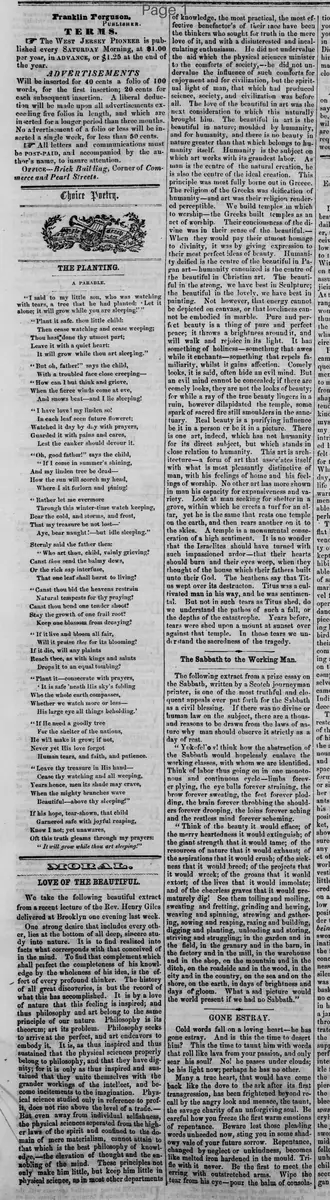
But even away from individual selfishness, the physical sciences separated from the higher laws of the spirit and confined to the domain of mere materialism, cannot attain to that which is the best philosophy of knowledge, the elevation of thought and the ennobling of the mind. These principles not only make him little, but keep him little in physical science, as in most other departments of knowledge, the most practical, the most effective benefactors of their race have been the thinkers who sought for truth in the mere love of it, and with a disinterested and incalculating enthusiasm. He did not undervalue the aid which the physical sciences minister to the comforts of society,—he did not undervalue the influence of such comforts for enjoyment and for civilization, but the spiritual light of man, that which had produced science, society, and civilization was before all. The love of the beautiful in art was the next consideration to which this naturally brought him. The beautiful in art is the beautiful in nature; moulded by humanity, and for humanity, and there is no beauty in nature greater than that which belongs to humanity itself. Humanity is the subject on which art works with its grandest labor. As man is the centre of the natural creation, he is also the centre of the ideal creation. This principle was most fully borne out in Greece. The religion of the Greeks was deification of humanity—and art was their religion rendered perceptible. We build temples in which to worship—the Greeks built temples as an act of worship. Their consciousness of the divine was in their sense of the beautiful. When they would pay their utmost homage to divinity, it was by giving expression to their most perfect ideas of beauty. Humanity deified is the centre of the beautiful in Pagan art—humanity canonized is the centre of the beautiful in Christian art. The beautiful in the strong, we have best in Sculpture; the beautiful in the lovely, we have best in painting. Not however, that energy cannot be depicted on canvass, or that loveliness cannot be embodied in marble. Pure and perfect beauty is a thing of pure and perfect peace; it throws a brightness around it, and will walk and rejoice in its light. It has something of holiness—something that awes while it enchants—something that repels familiarity, whilst it gains affection. Comely looks, it is said, often hide an evil mind. But an evil mind cannot be concealed; if there are comely looks, they are not the looks of beauty; for while a ray of the true beauty lingers in a ruin, however dilapidated the temple, some spark of sacred fire still smoulders in the sanctuary. Real beauty is a purifying influence be it in a person or be it in a picture. There is one art, indeed, which has not humanity for its direct subject, but which stands in close relation to humanity. This art is architecture—a form of art that associates itself with what is most pleasantly distinctive of man, with his feelings of home and his feelings of worship. No other art has more shown in man his capacity for expansiveness and variety. Look at man seeking for shelter in a grove, within which he erects a turf for an altar. Yet he is the same that rests one temple on the earth, and then rears another on it to the skies. A temple is a monumental creation of a high sentiment. It is no wonder that the Israelites should have turned with such impassioned ardor—that their hearts should burn and their eyes weep, when they thought of the house which their fathers built unto their God. The heathens say that Titus wept over its destruction. Titus was a cultivated man in his way, and he was sentimental. But not in such tears as Titus shed, do we understand the pathos of such a fall, or the depths of the catastrophe. Years before, tears were shed upon a mount at sunset over against that temple. In those tears we understand the sacredness of the tragedy.
LOVE OF THE BEAUTIFUL.
We take the following beautiful extract from a recent lecture of the Rev. Henry Giles delivered at Brooklyn one evening last week.
One strong desire that includes every other, lies at the bottom of all deep, sincere study into nature. It is to find realized into facts what corresponds with that conceived of in the mind. To find that complement which shall perfect the completeness of his knowledge by the wholeness of his idea, is the effort of every profound thinker. The history of all great discoveries, is but the record of what this has accomplished. It is by a love of nature that this feeling is inspired; and thus philosophy and art belong to the same principle of our nature. Philosophy is its theorem; art its problem. Philosophy seeks to arrive at the perfect, and art endeavors to embody it. It is, as thus inspired and thus sustained that the physical sciences properly belong to philosophy, and that they have dignity; for it is only as thus inspired and sustained that they unite themselves with the grander workings of the intellect, and become incitements to the imagination. Physical science studied only in reference to profit, does not rise above the level of a trade.
But even away from individual selfishness, the physical sciences separated from the higher laws of the spirit and confined to the domain of mere materialism, cannot attain to that which is the best philosophy of knowledge, the elevation of thought and the ennobling of the mind. These principles not only make him little, but keep him little in physical science, as in most other departments of knowledge, the most practical, the most effective benefactors of their race have been the thinkers who sought for truth in the mere love of it, and with a disinterested and incalculating enthusiasm. He did not undervalue the aid which the physical sciences minister to the comforts of society,—he did not undervalue the influence of such comforts for enjoyment and for civilization, but the spiritual light of man, that which had produced science, society, and civilization was before all. The love of the beautiful in art was the next consideration to which this naturally brought him. The beautiful in art is the beautiful in nature; moulded by humanity, and for humanity, and there is no beauty in nature greater than that which belongs to humanity itself. Humanity is the subject on which art works with its grandest labor. As man is the centre of the natural creation, he is also the centre of the ideal creation. This principle was most fully borne out in Greece. The religion of the Greeks was deification of humanity—and art was their religion rendered perceptible. We build temples in which to worship—the Greeks built temples as an act of worship. Their consciousness of the divine was in their sense of the beautiful. When they would pay their utmost homage to divinity, it was by giving expression to their most perfect ideas of beauty. Humanity deified is the centre of the beautiful in Pagan art—humanity canonized is the centre of the beautiful in Christian art. The beautiful in the strong, we have best in Sculpture; the beautiful in the lovely, we have best in painting. Not however, that energy cannot be depicted on canvass, or that loveliness cannot be embodied in marble. Pure and perfect beauty is a thing of pure and perfect peace; it throws a brightness around it, and will walk and rejoice in its light. It has something of holiness—something that awes while it enchants—something that repels familiarity, whilst it gains affection. Comely looks, it is said, often hide an evil mind. But an evil mind cannot be concealed; if there are comely looks, they are not the looks of beauty; for while a ray of the true beauty lingers in a ruin, however dilapidated the temple, some spark of sacred fire still smoulders in the sanctuary. Real beauty is a purifying influence be it in a person or be it in a picture. There is one art, indeed, which has not humanity for its direct subject, but which stands in close relation to humanity. This art is architecture—a form of art that associates itself with what is most pleasantly distinctive of man, with his feelings of home and his feelings of worship. No other art has more shown in man his capacity for expansiveness and variety. Look at man seeking for shelter in a grove, within which he erects a turf for an altar. Yet he is the same that rests one temple on the earth, and then rears another on it to the skies. A temple is a monumental creation of a high sentiment. It is no wonder that the Israelites should have turned with such impassioned ardor—that their hearts should burn and their eyes weep, when they thought of the house which their fathers built unto their God. The heathens say that Titus wept over its destruction. Titus was a cultivated man in his way, and he was sentimental. But not in such tears as Titus shed, do we understand the pathos of such a fall, or the depths of the catastrophe. Years before, tears were shed upon a mount at sunset over against that temple. In those tears we understand the sacredness of the tragedy.
What sub-type of article is it?
Essay
What themes does it cover?
Moral Virtue
Nature
Religious
What keywords are associated?
Love Of Beauty
Philosophy And Art
Humanity In Art
Greek Religion
Architecture
Temple Destruction
What entities or persons were involved?
Rev. Henry Giles
Literary Details
Title
Love Of The Beautiful
Author
Rev. Henry Giles
Subject
Lecture Delivered At Brooklyn
Form / Style
Prose Extract From A Lecture
Key Lines
Philosophy Is Its Theorem; Art Its Problem.
The Beautiful In Art Is The Beautiful In Nature; Moulded By Humanity, And For Humanity.
Humanity Deified Is The Centre Of The Beautiful In Pagan Art—Humanity Canonized Is The Centre Of The Beautiful In Christian Art.
Real Beauty Is A Purifying Influence Be It In A Person Or Be It In A Picture.
A Temple Is A Monumental Creation Of A High Sentiment.