Thank you for visiting SNEWPapers!
Sign up free
Domestic News
August 17, 1871
The Home Journal
Winchester, Franklin County, Tennessee
What is this article about?
Dr. J. W. Morton and Rev. Fountain E. Pitts successfully cultivate opium poppies in Tennessee using seeds from Calcutta and Smyrna, yielding 50-75 pounds per acre and potential profits, reducing reliance on imports.
Clipping
OCR Quality
95%
Excellent
Full Text
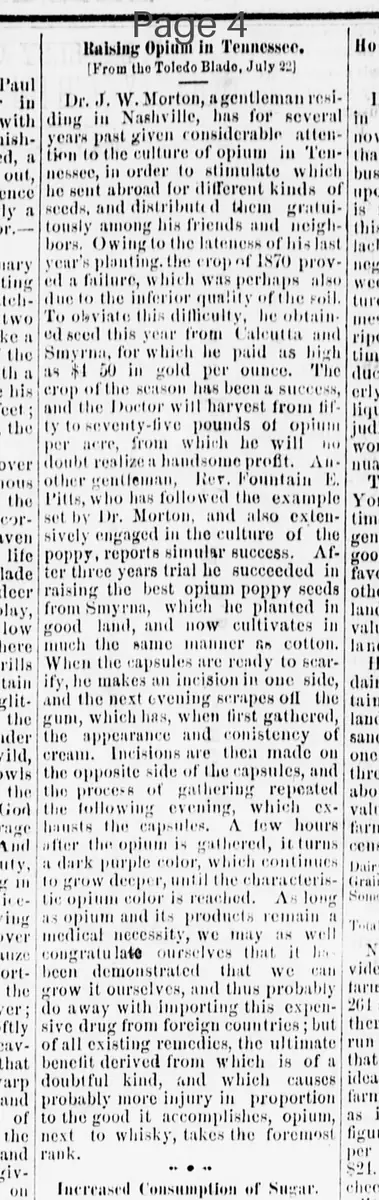
[From the Toledo Blade, July 22]
Raising Opium in Tennessee.
Dr. J. W. Morton, a gentleman residing in Nashville, has for several years past given considerable attention to the culture of opium in Tennessee, in order to stimulate which he sent abroad for different kinds of seeds, and distributed them gratuitously among his friends and neighbors. Owing to the lateness of his last year's planting, the crop of 1870 proved a failure, which was perhaps also due to the inferior quality of the soil. To obviate this difficulty, he obtained seed this year from Calcutta and Smyrna, for which he paid as high as $150 in gold per ounce. The crop of the season has been a success, and the Doctor will harvest from fifty to seventy-five pounds of opium per acre, from which he will no doubt realize a handsome profit. Another gentleman, Rev. Fountain E. Pitts, who has followed the example set by Dr. Morton, and also extensively engaged in the culture of the poppy, reports similar success. After three years trial he succeeded in raising the best opium poppy seeds from Smyrna, which he planted in good land, and now cultivates in much the same manner as cotton. When the capsules are ready to scarify, he makes an incision in one side, and the next evening scrapes off the gum, which has, when first gathered, the appearance and consistency of cream. Incisions are then made on the opposite side of the capsules, and the process of gathering repeated the following evening, which exhausts the capsules. A few hours after the opium is gathered, it turns a dark purple color, which continues to grow deeper, until the characteristic opium color is reached. As long as opium and its products remain a medical necessity, we may as well congratulate ourselves that it has been demonstrated that we can grow it ourselves, and thus probably do away with importing this expensive drug from foreign countries; but of all existing remedies, the ultimate benefit derived from which is of a doubtful kind, and which causes probably more injury in proportion to the good it accomplishes, opium, next to whisky, takes the foremost rank.
Raising Opium in Tennessee.
Dr. J. W. Morton, a gentleman residing in Nashville, has for several years past given considerable attention to the culture of opium in Tennessee, in order to stimulate which he sent abroad for different kinds of seeds, and distributed them gratuitously among his friends and neighbors. Owing to the lateness of his last year's planting, the crop of 1870 proved a failure, which was perhaps also due to the inferior quality of the soil. To obviate this difficulty, he obtained seed this year from Calcutta and Smyrna, for which he paid as high as $150 in gold per ounce. The crop of the season has been a success, and the Doctor will harvest from fifty to seventy-five pounds of opium per acre, from which he will no doubt realize a handsome profit. Another gentleman, Rev. Fountain E. Pitts, who has followed the example set by Dr. Morton, and also extensively engaged in the culture of the poppy, reports similar success. After three years trial he succeeded in raising the best opium poppy seeds from Smyrna, which he planted in good land, and now cultivates in much the same manner as cotton. When the capsules are ready to scarify, he makes an incision in one side, and the next evening scrapes off the gum, which has, when first gathered, the appearance and consistency of cream. Incisions are then made on the opposite side of the capsules, and the process of gathering repeated the following evening, which exhausts the capsules. A few hours after the opium is gathered, it turns a dark purple color, which continues to grow deeper, until the characteristic opium color is reached. As long as opium and its products remain a medical necessity, we may as well congratulate ourselves that it has been demonstrated that we can grow it ourselves, and thus probably do away with importing this expensive drug from foreign countries; but of all existing remedies, the ultimate benefit derived from which is of a doubtful kind, and which causes probably more injury in proportion to the good it accomplishes, opium, next to whisky, takes the foremost rank.
What sub-type of article is it?
Agriculture
Economic
What keywords are associated?
Opium Cultivation
Tennessee Agriculture
Poppy Farming
Opium Harvest
Domestic Production
What entities or persons were involved?
Dr. J. W. Morton
Rev. Fountain E. Pitts
Where did it happen?
Tennessee
Domestic News Details
Primary Location
Tennessee
Event Date
1871
Key Persons
Dr. J. W. Morton
Rev. Fountain E. Pitts
Outcome
successful harvest of 50-75 pounds of opium per acre with handsome profit; demonstration of domestic production reducing imports.
Event Details
Dr. J. W. Morton in Nashville cultivated opium using seeds from Calcutta and Smyrna after 1870 failure; Rev. Fountain E. Pitts also succeeded with Smyrna seeds, cultivating like cotton and gathering gum from capsules.