Thank you for visiting SNEWPapers!
Sign up free
Atlanta Tri Weekly Journal
Atlanta, Fulton County, Georgia
What is this article about?
Article reflects on Magna Carta's signing on June 15, 1215, at Runnymede, where King John yielded to barons' demands for liberties. It traces English constitutional history through Habeas Corpus, Bill of Rights, to American Constitution, emphasizing eternal vigilance for freedom. Preceded by Proverbs on justice and righteousness.
Clipping
OCR Quality
Full Text
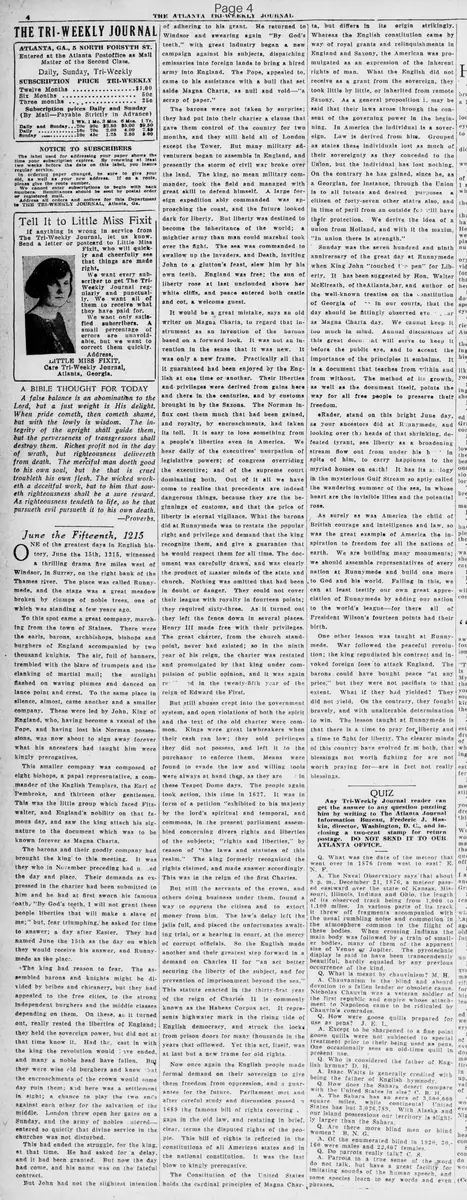
A false balance is an abomination to the Lord, but a just weight is His delight.
When pride cometh, then cometh shame, but with the lowly is wisdom. The integrity of the upright shall guide them, but the perverseness of transgressors shall destroy them. Riches profit not in the day of wrath, but righteousness delivereth from death. The merciful man doeth good to his own soul, but he that is cruel troubleth his own flesh. The wicked worketh a deceitful work, but to him that soweth righteousness shall be a sure reward. As righteousness tendeth to life, so he that pursueth evil pursueth it to his own death.
Proverbs.
June the Fifteenth. 1215
One of the greatest days in English history, June the 15th, 1215, witnessed a thrilling drama five miles west of Windsor, in Surrey, on the right bank of the Thames river. The place was called Runnymede, and the stage was a great meadow broken by clumps of noble trees, one of which was standing a few years ago.
To this spot came a great company, marching from the town of Staines. There were the earls, barons, archbishops, bishops and burghers of England accompanied by two thousand knights. The air, full of banners, trembled with the blare of trumpets and the clanking of martial mail; the sunlight flashed on waving plumes and danced on lance point and crest. To the same place in silence, almost, came another and a smaller company. These were led by John, King of England, who, having become a vassal of the Pope, and having lost his Norman possessions, was now about to sign away forever what his ancestors had taught him were kingly prerogatives.
This smaller company was composed of eight bishops, a papal representative, a commander of the English Templars, the Earl of Pembroke, and thirteen other gentlemen.
This was the little group which faced Fitzwalter, and England's nobility on that famous day, and saw the king attach his signature to the document which was to be known forever as Magna Charta.
The barons and their goodly company had brought the king to this meeting. It was they who in November preceding had named the day and place. Their demands as expressed in the charter had been submitted to him and he had at first sworn his famous oath, "By God's teeth, I will not grant these people liberties that will make a slave of me;" but, fear triumphing, he asked for time to answer; a day after Easter. They had named June the 15th as the day on which they would receive his answer, and Runnymede as the place.
The king had reason to fear. The assembled barons and knights might be divided by bribes and chicanery, but they had appealed to the free cities, to the strong independent burghers and the middle classes depending on them. On these, as it turned out, really rested the liberties of England; they held the sovereign power, but did not at that time know it. Had they cast in with the king the revolution would have ended, and many a noble head have fallen. But they were wise old burghers and knew that the encroachments of the crown would some day ruin them; and here was a settlement in sight; a chance to play the two ends against each other for the salvation of the middle. London threw open her gates on a Sunday, and the army of nobles entered so quietly that divine service in the churches was not disturbed.
This had ended the struggle, for the king, at that time. He had asked for a delay, and it had been granted. But now the day had come, and his name was on the fateful contract.
But John had not the slightest intention of adhering to his grant. He returned to Windsor and swearing again "By God's teeth," with great industry began a new campaign against his subjects, dispatching emissaries into foreign lands to bring a hired army into England. The Pope, appealed to, came to his assistance with a bull that set aside Magna Charta, as null and void--a "scrap of paper."
The barons were not taken by surprise; they had put into their charter a clause that gave them control of the country for two months, and they still held all of London except the Tower. But many military adventurers began to assemble in England, and presently the storm of civil war broke over the land. The king, no mean military commander, took the field and managed with great skill to defend himself. A large foreign expedition ably commanded was approaching the coast, and the future looked dark for liberty. But liberty was destined to become the inheritance of the world; a mightier army than man could marshal took over the fight. The sea was commanded to swallow up the invaders, and Death, inviting John to a glutton's feast, slew him by his own teeth. England was free; the sun of liberty rose at last unclouded above her white cliffs, and peace entered both castle and cot, a welcome guest.
It would be a great mistake, says an old writer on Magna Charta, to regard that instrument as an invention of the barons based on a forward look. It was not an invention in the sense that it was new. It was only a new frame. Practically all that it guaranteed had been enjoyed by the English at one time or another. Their liberties and privileges were derived from gains here and there in the centuries, and by customs brought in by the Saxons. The Norman influx cost them much that had been gained, and royalty, by encroachments, had taken its toll. It is easy to lose something from a people's liberties even in America. We hear daily of the executive's usurpation of legislative powers; of congress overriding the executive; and of the supreme court dominating both. Out of it all we have come to realize that precedents are indeed dangerous things, because they are the beginnings of customs, and that the price of liberty is eternal vigilance. What the barons did at Runnymede was to restate the popular right and privilege and demand that the king recognize them, and give a guarantee that he would respect them for all time. The document was carefully drawn, and was clearly the product of master minds of the state and church. Nothing was omitted that had been in doubt or danger. They could not cover their league with royalty in fourteen points; they required sixty-three. As it turned out they left the fence down in several places. Henry III made free with their privileges. The great charter, from the church standpoint, never had existed; so in the ninth year of his reign, the charter was restated and promulgated by that king under compulsion of public opinion, and it was again reissued in the twenty-fifth year of the reign of Edward the First.
But still abuses crept into the government system, and open violations of both the spirit and the text of the old charter were common. Kings were great lawbreakers when their cash ran low; they sold privileges they did not possess, and left it to the purchaser to enforce them. Means were found to evade the law and willing tools were always at hand then, as they are in these Teapot Dome days. The people again took action, this time in 1627. It was in form of a petition "exhibited to his majesty by the lords' spiritual and temporal, and commons, in the present parliament assembled concerning divers rights and liberties of the subjects;" rights and liberties, by reason of "the laws and statutes of this realm." The king formerly recognized the rights claimed, and made answer accordingly. This was in the reign of the first Charles.
But still the servants of the crown, and others doing business under them, found a way to oppress the citizen and to extort money from him. The law's delay left the jails full, and placed the unfortunates awaiting trial, or a hearing in court, at the mercy of corrupt officials. So the English made another and their greatest step forward in a demand on Charles II for "an act better securing the liberty of the subject, and for prevention of imprisonment beyond the sea."
This statute enacted in the thirty-first year of the reign of Charles II is commonly known as the Habeas Corpus act. It represents highwater mark in the rising tide of English democracy, and struck the locks from prison doors for many thousands in the years that followed. Yet this act, itself, was at last but a new frame for old rights.
Now once again the English people made formal demand on their sovereign to give them freedom from oppression, and a guarantee for the future. Parliament met and after careful study and discussion passed in 1689 the famous bill of rights covering the gaps in the old law, and restating in brief, clear terms the disputed rights of the people.
This bill of rights is reflected in the constitutions of all American states and in the national constitution. It was the last blow to kingly prerogative.
The Constitution of the United States holds the cardinal principles of Magna Charta, but differs in its origin strikingly.
Whereas the English constitution came by way of royal grants and relinquishments in England and Saxony, the American was promulgated as an expression of the inherent rights of man. What the English did not receive as a grant from the sovereign, they took little by little, or inherited from remote Saxony. As a general proposition it may be said that their laws arose through the consent of the governing power in the beginning. In America the individual is a sovereign. Law is derived from him. Grouped as states these individuals lost as much of their sovereignty as they conceded to the Union, but the individual has lost nothing. On the contrary he has gained, since he, as a Georgian, for instance, through the Union is to all intents and purposes a citizen of forty-seven other states also, and in time of peril from an outside foe will have their protection. We derive the idea of a union from Holland, and with it the maxim, "In union there is strength."
Sunday was the seven hundred and ninth anniversary of the great day at Runnymede when King John "touched the pen" for Liberty. It has been suggested by Hon. Walter McElreath, of the Atlanta bar, and author of the well-known treatise on the constitution of Georgia used in our courts, that the day should be fittingly observed every year as Magna Charta day. We cannot keep it too much in mind. Annual discussions of this great document will serve to keep it before the public eye, and to accent the importance of the principles it embalms. It is a document that teaches from within and from without. The method of its growth, as well as the document itself, points the way for all free people to preserve their freedom.
Reader, stand on this bright June day, as your ancestors did at Runnymede, and looking over the heads of that shrinking, defeated tyrant, see liberty as a broadening stream flow out from under his hand in spite of him, to carry happiness to the myriad homes on earth! It has its analogy in the mysterious Gulf Stream so aptly called the wandering summer of the sea, in whose heart are the invisible lilies and the potential rose.
As surely as was America the child of British courage and intelligence and law, so was the great example of America the inspiration to freedom for all the nations of earth. We are building many monuments; we should assemble representatives of every nation at Runnymede and build one more to God and his world. Failing in this, we can at least testify our own great appreciation of Runnymede by adding our nation to the world's league--for there all of President Wilson's fourteen points had their birth.
One other lesson was taught at Runnymede.
War followed the peaceful revolution: the king repudiated his contract and invoked foreign foes to attack England. The barons could have bought peace "at any price," but they were not pacifists to that extent. What if they had yielded? They did not yield. On the contrary, they fought bravely, and with unalterable determination to win. The lesson taught at Runnymede is that there is a time to pray for liberty and a time to fight for liberty. The clearer minds of this country have evolved from both, that blessings not worth fighting for are not worth praying for--are in fact not really blessings.
What sub-type of article is it?
What themes does it cover?
What keywords are associated?
What entities or persons were involved?
Where did it happen?
Story Details
Key Persons
Location
Runnymede, Five Miles West Of Windsor, Surrey, On The Right Bank Of The Thames River
Event Date
June 15, 1215
Story Details
King John signs Magna Carta at Runnymede under pressure from barons and burghers, granting liberties; he later repudiates it, leading to civil war and his death; document restated multiple times, influencing Habeas Corpus Act, Bill of Rights, and American Constitution as foundation of freedoms requiring vigilance.