Thank you for visiting SNEWPapers!
Sign up free
Gazette Of The United States
New York, New York County, New York
What is this article about?
Detailed report of debates in the U.S. House of Representatives on the Militia Bill from December 16-21, including discussions on arming the poor, age limits for service (reduced to 45), exemptions for Congress members (retained), and other amendments. Also covers passage of supplementary debt bill and other petitions and reports.
Merged-components note: This is a continuous report of the proceedings and debates in the House of Representatives, primarily focused on the Militia Bill, spanning multiple pages. Components merged due to sequential reading order and textual continuation. Label adjusted to domestic_news for consistency as it covers national legislative news.
Clippings
1 of 3
OCR Quality
Full Text
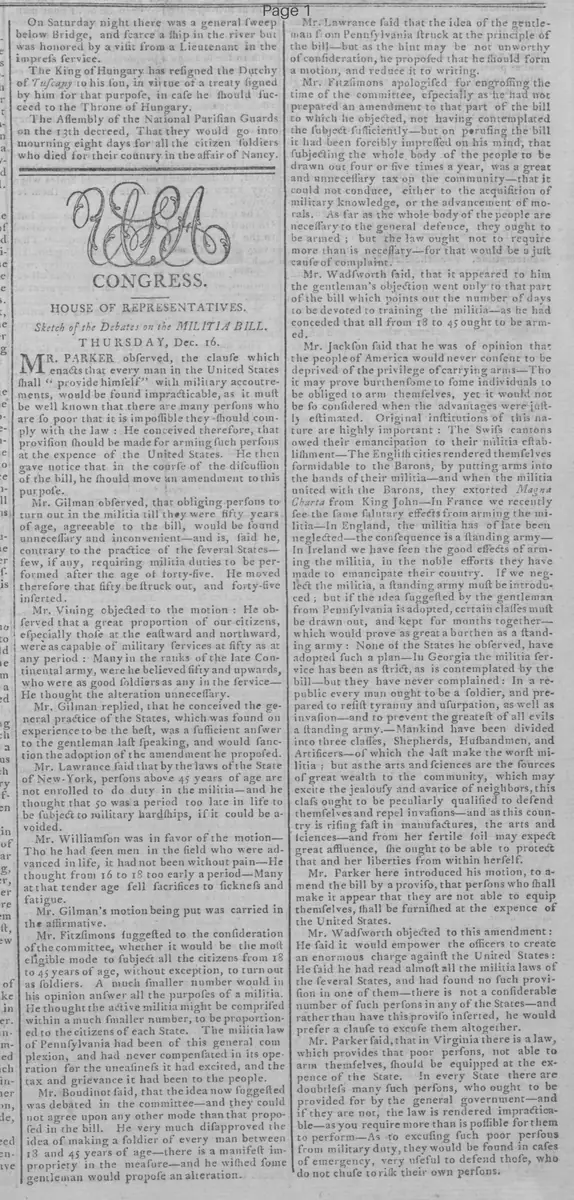
Sketch of the Debates on the MILITIA BILL.
THURSDAY, Dec. 16.
MR. PARKER observed, the clause which enacts that every man in the United States shall "provide himself" with military accoutrements, would be found impracticable, as it must be well known that there are many persons who are so poor that it is impossible they should comply with the law: He conceived therefore, that provision should be made for arming such persons at the expense of the United States. He then gave notice that in the course of the discussion of the bill, he should move an amendment to this purpose.
Mr. Gilman observed, that obliging persons to turn out in the militia till they were fifty years of age, agreeable to the bill, would be found unnecessary and inconvenient—and is, said he, contrary to the practice of the several States—few, if any, requiring militia duties to be performed after the age of forty-five. He moved therefore that fifty be struck out, and forty-five inserted.
Mr. Vining objected to the motion: He observed that a great proportion of our citizens, especially those at the eastward and northward, were as capable of military services at fifty as at any period: Many in the ranks of the late Continental army, were he believed fifty and upwards, who were as good soldiers as any in the service—He thought the alteration unnecessary.
Mr. Gilman replied, that he conceived the general practice of the States, which was founded on experience to be the best, was a sufficient answer to the gentleman last speaking, and would sanction the adoption of the amendment he proposed.
Mr. Lawrance said that by the laws of the State of New-York, persons above 45 years of age are not enrolled to do duty in the militia—and he thought that 50 was a period too late in life to be subject to military hardships, if it could be avoided.
Mr. Williamson was in favor of the motion—Tho he had seen men in the field who were advanced in life, it had not been without pain—He thought from 16 to 18 too early a period. Many at that tender age fell sacrifices to sickness and fatigue.
Mr. Gilman's motion being put was carried in the affirmative.
Mr. Fitzsimons suggested to the consideration of the committee, whether it would be the most eligible mode to subject all the citizens from 18 to 45 years of age, without exception, to turn out as soldiers. A much smaller number would in his opinion answer all the purposes of a militia. He thought the active militia might be comprised within a much smaller number, to be proportioned to the citizens of each State. The militia law of Pennsylvania had been of this general complexion, and had never compensated in its operation for the uneasiness it had excited, and the tax and grievance it had been to the people.
Mr. Boudinot said, that the idea now suggested was debated in the committee—and they could not agree upon any other mode than that proposed in the bill. He very much disapproved the idea of making a soldier of every man between 18 and 45 years of age—there is a manifest impropriety in the measure—and he wished some gentleman would propose an alteration.
Mr. Lawrance said that the idea of the gentleman from Pennsylvania struck at the principle of the bill—but as the hint may be not unworthy of consideration, he proposed that he should form a motion, and reduce it to writing.
Mr. Fitzsimons apologized for engrossing the time of the committee, especially as he had not prepared an amendment to that part of the bill to which he objected, not having contemplated the subject sufficiently—but on perusing the bill it had been forcibly impressed on his mind, that subjecting the whole body of the people to be drawn out four or five times a year, was a great and unnecessary tax on the community—that it could not conduce, either to the acquisition of military knowledge, or the advancement of morals. As far as the whole body of the people are necessary to the general defence, they ought to be armed; but the law ought not to require more than is necessary—for that would be a just cause of complaint.
Mr. Wadsworth said, that it appeared to him the gentleman's objection went only to that part of the bill which points out the number of days to be devoted to training the militia—as he had conceded that all from 18 to 45 ought to be armed.
Mr. Jackson said that he was of opinion that the people of America would never consent to be deprived of the privilege of carrying arms—Tho it may prove burdensome to some individuals to be obliged to arm themselves, yet it would not be so considered when the advantages were justly estimated. Original institutions of this nature are highly important: The Swiss cantons owed their emancipation to their militia establishment—The English cities rendered themselves formidable to the Barons, by putting arms into the hands of their militia—and when the militia united with the Barons, they extorted Magna Charta from King John—In France we recently see the same salutary effects from arming the militia—In England, the militia has of late been neglected—the consequence is a standing army—In Ireland we have seen the good effects of arming the militia, in the noble efforts they have made to emancipate their country. If we neglect the militia, a standing army must be introduced; but if the idea suggested by the gentleman from Pennsylvania is adopted, certain classes must be drawn out, and kept for months together—which would prove as great a burden as a standing army: None of the States he observed, have adopted such a plan—In Georgia the militia service has been as strict, as is contemplated by the bill but they have never complained: In a republic every man ought to be a soldier, and prepared to resist tyranny and usurpation, as well as invasion—and to prevent the greatest of all evils a standing army.—Mankind have been divided into three classes, Shepherds, Husbandmen, and Artificers—of which the last make the worst militia; but as the arts and sciences are the sources of great wealth to the community, which may excite the jealousy and avarice of neighbors, this class ought to be peculiarly qualified to defend themselves and repel invasions—and as this country is rising fast in manufactures, the arts and sciences—and from her fertile soil may expect great affluence, she ought to be able to protect that and her liberties from herself.
Mr. Parker here introduced his motion, to amend the bill by a proviso, that persons who shall make it appear that they are not able to equip themselves, shall be furnished at the expense of the United States.
Mr. Wadsworth objected to this amendment: He said it would empower the officers to create an enormous charge against the United States: He said he had read almost all the militia laws of the several States, and had found no such provision in one of them—there is not a considerable number of such persons in any of the States—and rather than have this proviso inserted, he would prefer a clause to excuse them altogether.
Mr. Parker said, that in Virginia there is a law, which provides that poor persons, not able to arm themselves, should be equipped at the expense of the State. In every State there are doubtless many such persons, who ought to be provided for by the general government—and if they are not, the law is rendered impracticable—as you require more than is possible for them to perform—As to excusing such poor persons from military duty, they would be found in cases of emergency, very useful to defend those, who do not choose to risk their own persons.
Mr. Huntington said if the gentleman would vary his motion, so that the expense should be incurred by the State, he did not know but he should agree to it. There is one State (said he) in which every person is obliged to provide himself with arms and accoutrements—and no difficulty has resulted from the law—Penalties on default are exacted and collected—but this proposition will produce great inequalities—it will excite jealousies and discord between the governments—but if left to the States the officers will be more exact to prevent impositions on the particular State from which they receive their appointments.
Mr. Parker agreed to alter his motion agreeable to Mr. Huntington's idea.
Mr. Boudinot said that there did not appear to be any necessity for the amendment, as the bill makes provision for excepting persons who are unable to purchase arms, in case the state legislatures choose to make such exceptions.
Mr. Giles said he was opposed to the motion on principle; but if that was not the case he should object to it in its present form as it was not full enough: He did not suppose that it was intended that the United States should make a present of the arms thus furnished—but the motion does not provide for their return, when not in use. His principal objection to the motion however arose from its being an improper interference with the authority of the state governments: They may, or may not comply with the law—If they should not, it would prove nugatory—and render the authority of the United States, contemptible. For these reasons, and others which had been advanced, he thought the amendment improper.
Mr. Bloodworth observed that as the militia was to be organized and disciplined under the authority of the United States, and to be employed for the general defence, whenever and wherever Congress should direct, it appeared but reasonable that those who were benefited by them, should be at the expense of arming them.
Mr. Sherman said it appeared to him, that by the Constitution, the United States were to be put to no expense about the militia, except when called into actual service. The clause is not so explicit as might have been wished; but it will be difficult to fix the construction mentioned by the gentleman from North Carolina. What relates to arming and disciplining means nothing more than a general regulation in respect to the arms and accoutrements—There are so few freemen in the United States who are not able to provide themselves arms and accoutrements, that any provision on the part of the United States is unnecessary and improper: He had no doubt that the people if left to themselves would provide such arms as are necessary, without inconvenience or complaint; but if they are furnished by the United States, the public Arsenals would soon be exhausted—and experience shows, that public property of this kind, from the careless manner in which many persons use it, is soon lost—The expense and inconvenience would, in his opinion, far overbalance any good that would be derived from such a provision.
Mr. Vining observed, that the greatest objection against the motion is, that it stops short in the regulation of the business: No provision, it is said, is made for the return of the arms to the public—and it gives a discretionary power to the officers to dispose of the property of the United States; but he conceived these difficulties were not beyond the reach of remedies; the wisdom of the house, he doubted not, would devise such as were adequate to the object. He asked by what means minors were to provide themselves with the requisite articles? Many of them are apprentices: If you put arms into their hands they will make good soldiers; but how are they to procure them? It is said, if they are supplied by the United States the property will be lost; if this is provided against, every objection may be obviated. He then offered an addition to the motion, providing for the return of the arms to the commanding officer.
The Chairman then stated the motion with the amendment.
Mr. Tucker observed, that the motion in its present form, differed from the original proposed by the gentleman from Virginia. He conceived the gentleman had no right to alter it, nor could it be done without a vote of the committee. He preferred the motion in its original state—for the United States may without doubt, furnish the arms—but he very much questioned their right to call on the individual States to do it.
Mr. Williamson was in favour of the question's being taken with the amendment admitted by Mr. Parker. He wished to know whether Congress meant to tax the individual states in this unusual manner. Perhaps as they had assumed the state debts upon this principle, or rather without any principle, they might think they had a right to call upon them to furnish quotas in proportion, this would be getting something for something—and not like the other measure, losing something for nothing.
Mr. Vining said he could not understand what was meant by saying that the amendment was dictating to the states: What is the whole bill but dictating—a law that affects every individual, touches the whole community. With respect to the constitutionality of the measure, there can be no doubt—every grant of power to Congress necessarily implies a conveyance of every incidental power requisite to carry the grant into effect.
Mr. Wadsworth apologized for detaining the attention of the committee a moment, while he asked the gentlemen who favored the motion, what was the extent of their wishes?—The motion at first appeared to be in favor of poor men, who are unable to purchase a firelock; but now it seems, minors and apprentices are to be provided for—is there a man in this house who would wish to see so large a proportion of the community, perhaps one-third, armed by the United States, and liable to be disarmed by them? Nothing would tend more to excite suspicion, and rouse a jealousy dangerous to the union. With respect to apprentices, every man knew that they were liable to this tax, and they were taken under the idea of being provided for by their masters—as to minors, their parents or guardians would prefer furnishing them with arms themselves, to depending on the United States when they knew they were liable to having them reclaimed.
The question on Mr. Parker's motion was lost.
On motion of Mr. Heister, a proviso was added to the section in the following words—“That every citizen so enrolled, and providing himself with the arms and accoutrements required as aforesaid, shall hold the same exempt from all executions, or suits for debt, or for the payment of taxes."
Mr. Fitzsimons moved to strike out the words "provide himself," and insert "shall be provided"
This motion was objected to by Messrs. Boudinot, Huntington, Jackson, Partridge, Vining and Madison. It was said that it would be destructive of the bill, as it would leave it optional with the states, or individuals, whether the militia should be armed or not.
This motion was lost by a great majority.—The second section comprises the characters that are to be exempted from enrollment or militia duty.
Mr. Madison moved to strike out that part which related to members of Congress, their officers and servants, attending either house—and to insert "members of the Senate and house of Representatives whilst travelling to, attending at, or returning from the sessions of Congress.—He saw no reason for a total exemption from militia service—exceptions in favor of the framers of laws ought not to be extended beyond what is evidently necessary.—The members of Congress during the recess are at liberty to pursue their ordinary avocations, and may participate in the duties and exercises of their fellow citizens.—They ought to bear a part in the burdens they lay on others, which may check an abuse of the powers with which they are vested.
Mr. Jackson observed that this alteration might interfere with the public interest in cases of alarm or invasion, the members might be called to a great distance in the militia at the moment when their presence was required to attend the session of the legislature. It would be well therefore to consider whether their services in the militia would be of equal importance to the public interest, as their services in Congress.
Mr. Boudinot objected to the amendment—not that he would exempt Members of Congress from burdens imposed on their fellow-citizens—but the motion he conceived was inconsistent with this very idea. The bill provides that exempts shall pay a certain equivalent; it would be unjust to impose this equivalent, and compel the Members of Congress to turn out in the militia. He concluded by saying that he conceived the independence of the legislature was connected with this exemption.
Mr. Wadsworth said that he thought there was no necessity to exempt Members of Congress: If the Constitution did not grant them such a privilege, he doubted whether they could assume it by an act of their own: He was therefore for leaving this matter to the discretion of the state legislatures—no inconvenience would result if this was done.
Mr. Hartley was in favor of the exemptions being specified by act of Congress; and he conceived they had the plainest directions to follow, in the universal practice of all the state legislatures—and this practice was founded in the reason of things, the incompatibility of the duties; they are distinct in their natures, and cannot be exercised together.
Mr. Madison supported his motion, he considered it as important that the governors and the governed should feel their mutual relation to each other; on this principle he thought that no exemption should be allowed, except in cases where an attendance on militia duty, was incompatible with the performance of other duties; for these reasons he wished that the whole clause should be struck out—in cases of difficulty a court martial would be competent to doing justice to the parties.
Mr. Giles followed Mr. Madison in a similar train of reasoning in respect to rulers sympathizing with the ruled in all public burdens; he adverted to the different plans of organizing the militia which had been contemplated by the committee, and the reasons which induced them to adopt that in the bill; with respect to the plan of electing particular classes to form a militia, it could not in his opinion be done, but by enlistments, which was a mode that the freemen of America revolted from. He said that no insuperable difficulties would result from rendering all liable to be called upon. Should the clause be struck out, the equivalent mentioned in another part of the bill will be unnecessary, and the article may be expunged. He concluded by saying, that if it was thought proper that the Members of Congress should be exempted, it would be best that the exemptions should be made by the state legislatures.
Mr. Sherman said it was the practice of the several States to exempt their own legislatures, and the other descriptions of persons mentioned in the clause: He conceived a seat in the federal legislature, would equally entitle to an exemption: He was opposed to the amendment, tho he would agree to strike out the whole, and leave the business to the state legislatures.
Mr. Jackson observed that leaving the exemptions from militia duty, to the discretion of the state legislatures might be productive of great inequalities; besides it would not comport with the idea of the bill in the grand object of uniformity: Some states might make great exceptions, others none at all this would make the burthen very unequal on the whole, which would be palpably unjust.—The example of the state legislatures is sufficient said he to shew that some exemptions are agreeable to the ideas of the people—& the independence of the legislature being essentially concerned leave no room to doubt the propriety of the measure—he informed the committee that when they came to the clause specifying the sum proposed as an equivalent for personal service, he should move for an alteration.
Mr. Hartley observed that the constitution declares that the persons of members shall be privileged from arrest during their attendance on Congress—in going to and returning from the session; with a special reference to the independence of the legislature—he conceived that it would counteract the spirit of the constitution to render the members liable to be called on to discharge duties incompatible in their nature—on this principle also it would be in the power of a designing president, should such a character ever be elected, to prevent the members assembling by calling out individuals to attend military duties at the moment when their attendance would be necessary in Congress.—The states individually, as well as the parliament of Great-Britain have set us a good example in this respect.
Mr. Boudinot, agreed in sentiment with Mr. Hartley, that the independence of the members was an important object.—The ideas of the gentlemen from Virginia [Mr. Madison and Mr. Giles] that legislators ought to participate in the burthens imposed on others, ought never to be lost sight of—but in the present instance, the doctrine would be carried into practice—for at the end of every two years, the Members would revert to the mass of citizens, and feel in common with others the influence of the laws.—The business of legislation is more arduous and momentous than any other—and ought not to be impeded, or rendered liable to be frustrated by any other. This he thought would be the case by adopting the amendment.
Mr. Madison supposed nothing would be risked by the amendment, as the Constitution had sufficiently secured the independence of the members—He had not anticipated so much debate on the motion—He was satisfied in his own mind of its propriety—The possible cases which had been stated, did not in his opinion justify the violation of the great principle he had mentioned; but to simplify the question he would withdraw his motion, so far as only to propose to strike out from the exemptions, "the members of Congress."
Mr. Tucker said that it appeared to him that some general ideas on the subject of exemptions should be incorporated in the bill. If the committee descend to particulars they will find it extremely difficult to make such distinctions as are proper. He was opposed to leaving the exemptions to be made by the state governments—It might create difficulties, as some States might exempt their members, and others might not—These partial exemptions would be attended with great inconveniences; the Members may be necessarily engaged in making their arrangements to attend their duty in Congress, previous to the time of setting out for the seat of government, and be interrupted by being called to the field to attend militia duty. The number of persons it will be found eligible to exempt, will not be so great, as to render the defence of the United States precarious for want of their personal services in the militia, He concluded by observing that the principle of uniformity, and the competency of the federal Legislature to making adequate provision in the case, point out the impropriety of leaving the business to the state legislatures.
Mr. Smith pursued the idea of Mr. Tucker, and observed, that to be consistent, the motion ought to go farther, and extend to exempting Ministers of the Gospel, only while engaged in preaching—The School-Master, while teaching—The Miller while attending his Mill, &c. In short it ought to be so particular as to amount to no exemption at all.
Mr. White spoke in favor of the motion: The Constitution, said he, has sufficiently defined the privileges of the Members. With respect to the State officers, he was in favor of leaving them to be exempted by the state legislatures—nor was he apprehensive they would abuse the power by exempting half their citizens, as this would only encrease the burden on the other half.
Mr. Jackson said he must be still opposed to the motion from this interesting consideration, if no other existedThat it mightin its operation deprive 30000 citizens of their vote in the national legislature.
Mr. Vining added a few observations in favor of the motion—and then the question being taken, it was negatived 24 to 18.
FRIDAY, Dec. 17.
The subject of exemptions was this day further discussed-the propriety of vesting the power in the state legislatures, so far as it respects the legislative, executive and judicial officers of the particular states, was alternately advocated and opposed :-It was finally determined that the several exemptions should be particularized in the bill.
Mr. Seney, moved toadd to theexempts, " persons authorized and received to teach or preach the gospel by the societies ofwhich they are respectively members."—This was agreed to.
Mr. Jackson proposed to add public printers and pilots. The question on the former was negatived :-On the latter agreed to.
Mr. Boudinot proposed to add all such as now do, or may hereafter bear a commission in the militia.—Agreed.
This finished the discussion of the second section.
Mr. Jackson touched on the subject of penalties, for neglecting militia duty, and the equivalent to be paid by the exempts ; but as this will probably occasion considerable debate when the 16th section comes under consideration, we reserve ourselves to that occasion.
The third section being read, Mr. Fitzsimons moved an amendment, by which the power of arranging the militia in divisions, brigades, &c. is to be vested in the President of the United States, instead of the respective governors of the states.
This motion occasioned some debate; it was finally carried in the affirmative.
The clause giving rank to aids-de-camp was struck out—and " to be taken from the line" added
MONDAY, Dec. 20.
Mr Stone took his seat this day
A bill to continue in force for the term of five years, an act entitled an act. declaring the assent of Congress to certain acts of the states of Rhode-Island, Maryland and Georgia, was brought in engrossed, read a third time, and passed.
A bill supplementary to an act making further provision for the debts of the United States, was read a second, and ordered to be read a third time to-morrow.
Mr. Benson, from the committee appointed for that purpose, reported the following bills, viz.
A bill declaring the officer who, in case of the death, removal, or disability of the President or Vice-President, shall exercise the officeof President
A bill for determining the respective times when the electors for a President and Vice-President shall be chosen, and the time when they shall give their votes,
A bill directing the mode in which the lists of the votes for President and Vice-President shall be transmitted to the seat of the government of the United States; all which were read a first time.
Mr. Partridge presented the petition of Barnabas Lucas, read, and referred to the Secretary of War.
Mr. Huntington presented the petition of William Robinson, respecting a lostcertificate; read and referred to the committee appointed to bring in a bill directing the mode in which the evid ences of the public debt shall be renewed.
Mr. Gerry presented the petition of John Miller Russell, praying the remission ot the new duty on a quantity of hemp by him imported ; read, and referred to the Secretary of the Treasury.
Mr. Fitzsimons presented a petition from a number of the merchants and traders of Philadelphia, praying for the erection of additional piers at Chester, in the river Delaware ; read, and referred to the Secretary of the Treasury.
Mr. Gerry laid the following motion on the table, That the Secretary of State be directed to procure and keep in his office, all Charters, Patents, and Documents, which respect the jurisdictional and territorial rights of the respective States.
Mr. Smith laid the following motion on the table, That provision be made for erecting a Beacon at the entrance of the port of Georgetown, South-Carolina; read, and referred to the Secretary of the Treasury.
In committee of the whole on the Militia Bill
Progress was made in the discussion as far as the 8th section.
TUESDAY. Dec. 21.
The bill supplementary to an act making provision for the debts of the United States, was read the third time and passed.
The three bills reported by Mr. Benson yesterday, were read the Second time, and made the order ofthe day for Monday next.—100 copies of each of these bills were ordered to be printed for the use of the House.
Mr. Fitzsimons presented a memorial from the Trustees of Wilmington College, which was read, and referred to the Secretary of the Treasury.—Also a Memorial and remonstrance from a committee of a number of the creditors of the United States in Philadelphia.
Mr.Seney presented a petition from R. Ford. a mariner, wounded in the service of the United States, referred to the Secretary of war.
Mr. Seney of the committee appointed on the petition of sundry inhabitants of Baltimore, praying for the establishment of an health office, brought in a report, which was in favor of the petition—and recommendatory of a similar institution in every port where they are wanted.
This report beingaccepted by the house, a committee of five was appointed to prepare and bring in a bill accordingly.
Mr. Williamson gave notice that he should tomorrow move for a committee to bring in a bill to prevent invalid pensioners from transferring the right to their pensions, before they become due.
A report from the commissioners appointed the last session to superintend the purchase of the public debt, was communicated to the house by the Speaker, by which it appears, that the Treasurer of the United States, pursuant to orders received from the commissioners, has purchased the sum of two hundred seventy-eight thousand six hundred and eighty-seven dollars; for which, the sum of one hundred and fifty thousand two hundred and thirty-nine dollars, in specie, has been paid
In committee of the whole on the Militia Bill.
The committee finished the discussion this day —and the Chairman reported the same to the House with sundry amendments.
It was ordered that it should lie on the table
Adjourned.
What sub-type of article is it?
What keywords are associated?
What entities or persons were involved?
Where did it happen?
Domestic News Details
Primary Location
House Of Representatives
Event Date
Thursday, Dec. 16. To Tuesday, Dec. 21.
Key Persons
Outcome
gilman's motion to change age limit to 45 carried; parker's motion to arm poor at us expense lost; fitzsimons' motion to change 'provide himself' lost; madison's motion to limit congress exemptions negatived 24-18; exemptions for ministers, pilots, militia officers added; power to arrange militia vested in president; militia bill discussion finished with amendments; supplementary debt bill passed; other bills reported and passed.
Event Details
Debates on Militia Bill in House of Representatives covering impracticability of self-arming for poor, age limits for service, selecting smaller active militia, exemptions including for Congress members, organization powers, and penalties. Additional proceedings include passing bills on state acts assent, debts, presidential succession, electors; petitions on various matters referred; report on public debt purchase.