Thank you for visiting SNEWPapers!
Sign up free
Constitutional Whig
Richmond, Virginia
What is this article about?
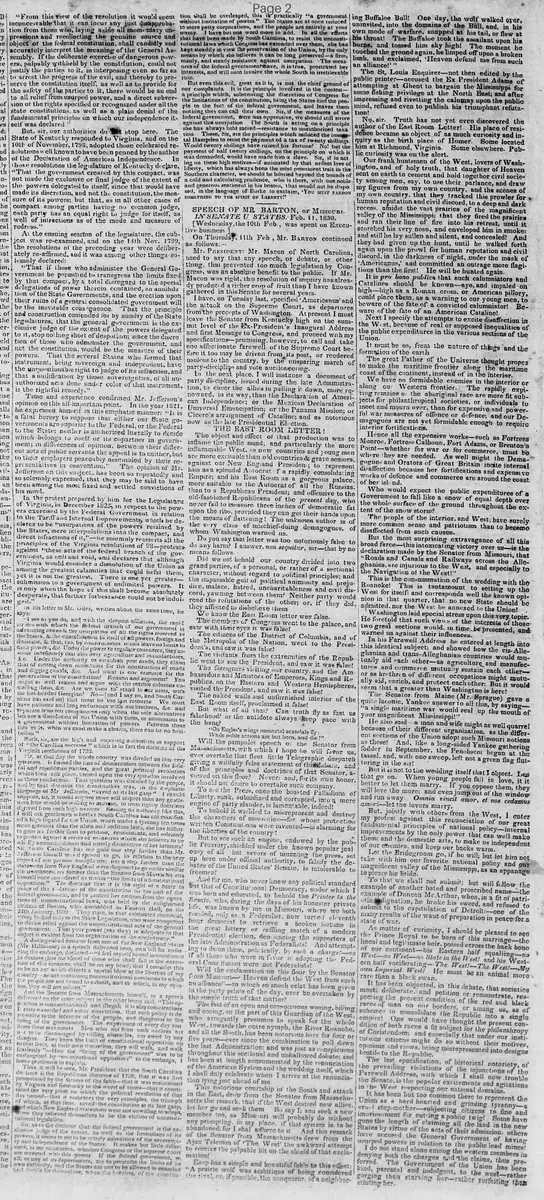
Senator David Barton of Missouri delivers a speech in the U.S. Senate on February 11, 1830, criticizing political deceptions, party discipline, and sectional divisions, referencing the East Room Letter, violations of Washington's Farewell Address, and Western interests in internal improvements.
Merged-components note: Merged continuation of Mr. Barton's speech across pages 2 and 3; relabeled from editorial as it is part of the speech transcript.
Clippings
1 of 2
OCR Quality
Full Text
IN SENATE U. STATES. Feb. 11, 1830.
[Wednesday, the 10th Feb., was spent on Executive business. On Thursday, 11th Feb., Mr. Barton continued as follows:]
Mr. President: Mr. Macon of North Carolina, used to say that any speech, or debate, or other thing, that prevented too much legislation by Congress, was an absolute benefit to the public. If Mr. Macon was right, this resolution of inquiry has already produced a richer crop of fruit than I have known gathered in this Senate for several years.
I have, on Tuesday last, specified Americanus' and the attack on the Supreme Court, as departures from the precepts of Washington. At present I must leave the Senator from Kentucky high on the summit level of the Ex-President's Inaugural Address and first Message to Congress, and proceed with my specifications—promising, however, to call and take one affectionate farewell of the Supreme Court before it too may be driven from its post, or rendered useless to the country, by the unsparing march of party-discipline and vote auctioneering.
In the next place, I will instance a document of party discipline, issued during the late Administration, to cheer the allies in pulling it down, more renowned, in its way, than the Declaration of American Independence; or the Mexican Declaration of Universal Emancipation; or the Panama Mission; or Cicero's arraignment of Catiline; and as notorious now as the late Presidential Election.
THE EAST ROOM LETTER!
The object and effect of that production was to inflame the public mind, and particularly the more inflammable West, as new countries and young men are more excitable than old countries & grave seniors, against our New England President; to represent him as a splendid Autocrat of a rapidly consolidating Empire; and his East Room as a gorgeous palace, more suitable to the Autocrat of all the Russias, than to a Republican President; and offensive to the old-fashioned Republicans of the present day, who never fail to measure three inches of democratic fat upon the ribs, provided they can get their hands upon the means of flattening! The unknown author is of the very class of mischief-doing demagogues, of whom Washington warned us.
Do you say that letter was too notoriously false to do any harm? I answer, non sequitur, sir—that by no means follows.
Did we not behold our country divided into two grand parties, of a personal, or rather of a sectional character, without regard to political principles; and the impassable gulf of political animosity and prejudice, malice, hatred, uncharitableness and civil discord, yawning between them? Neither party would read the refutations of the other; or, if they did, they affected to disbelieve them.
We know the East Room letter was false. The members of Congress went to the palace, and saw with their eyes it was false! The citizens of the District of Columbia, and of the Metropolis of the Nation, went to the President's, and saw it was false! The visitants from the extremities of the Republic went to see the President, and saw it was false! The foreigners visiting our country, and the Ambassadors and Ministers of Emperors, Kings and Republics, on the Eastern and Western Hemispheres visited the President, and saw it was false! The naked walls and unfurnished interior of the East Room itself, proclaimed it false!
But what of all that? Can truth fly as fast as falsehood? or the antidote always keep pace with the bane?
'On Eagle's wings immortal scandals fly:
While noble actions are but born, and die!'
Will the pamphlet speech of the Senator from Massachusetts, with which I hope he will favor us, ever overtake that fleet little Telegraphic despatch giving a willfully false statement of this debate, and of the principles and doctrines of that Senator, avowed on this floor? Never: and, for its own honor, it should not desire to overtake such company.
To see the Press, once the boasted Palladium of Liberty, sunk, subsidized and corrupted, into a mere engine of party slander, is lamentable, indeed! To behold it wielded to misrepresent and destroy the characters of minorities—for whose protection written Constitutions were invented—is alarming for the liberties of the country!
But to see such an engine, endowed by the public Treasury, shielded under the known popular jealousy of all that savors of muzzling the press, set up here under official authority, to falsify the debates of the United States' Senate, is intolerable to freemen!
And for me, who never knew any political standard but that of Constitutional Democracy, under which I was born and educated, to behold the Printer to the Senate, who, during the days of his honester private life, was known by me in Missouri, where we both resided, only as a Federalist, now turned eleventh hour democrat to retrieve a broken fortune in the great lottery or raffling match of a modern Presidential election, denouncing the supporters of the late Administration as Federalists! And attempting to damn them, politically, by such a charge!—as if all those who were in favor of adopting the Federal Constitution were not Federalists!
Will the exclamation on this floor by the Senator from Missouri—'Heaven defend the West from such an alliance!'—to which so much eclat has been given in the party prints of the day, ever be overtaken by the simple truth of that matter?
The fact of an open and conspicuous wooing, billing and cooing, on the part of this Guardian of the West, who arrogantly presumes to speak for the whole West, towards the outre nymph, the River Roanoke, and all the South, has been notorious here for four or five years—ever since the combination to pull down the last Administration; and was just as conspicuous throughout this sectional and unhallowed debate: and has been at length consummated by the renunciation of the American System and the wedding itself, which I shall duly celebrate when I arrive at the renunciation lying just ahead of me.
This notorious courtship in the South and attack in the East, drew from the Senator from Massachusetts the remark, that if the West desired new allies, let her go and seek them. So say I; and seek a new member too, as Missouri will probably do without any prompting, in my place, if that system is to be abandoned; for I shall adhere to it. And this remark of the Senator from Massachusetts drew from the 'Ajax Telamon of The West' the awkward attempt to receive the palpable hit on the shield of that exclamation!
Esop has a simple and beautiful fable to this effect: 'A prairie wolf, was ambitious of being considered the rival, or, if possible, the conqueror, of a neighboring Buffaloe Bull! One day, the wolf walked over, uninvited, into the domains of the Bull, and, in his own mode of warfare, snapped at his tail, or flew at his throat! The Buffaloe took the assailant upon his horns, and tossed him sky high! The moment he touched the ground again, he limped off upon a broken limb, and exclaimed, Heaven defend me from such an alliance!'
The St. Louis Enquirer—not then edited by the public printer—accused the Ex President Adams of attempting at Ghent to bargain the Mississippi for some fishing privilege at the North East; and after impressing and riveting the calumny upon the public mind, refused even to publish his triumphant refutation!
No, sir. Truth has not yet even discovered the author of the East Room Letter! His place of residence became an object of as much curiosity and inquiry as the birth place of Homer. Some located him at Richmond, Virginia. Some elsewhere. Public curiosity was on the alert.
Our frank huntsmen of the West, lovers of Washington, and of holy truth, that daughter of Heaven sent on earth to cement and hold together civil society among men, say, to use their parlance, and draw my figures from my own country, and the scenes of my own country, that they tracked this prowler for human reputation and civil discord, to a deep and dark recess, amidst the vast prairies of the magnificent valley of the Mississippi; that they fired the prairies and ran their line of fire into his retreat, until it scorched his very nose, and enveloped him in smoke: and still he lay sullen and silent, and concealed! And they had given up the hunt, until he walked forth again upon the prowl for human reputation and civil discord, in the darkness of night, under the mask of 'Americanus,' and committed an outrage more flagitious than the first! He will be hunted again.
It is pro bono publico that such calumniators and Catalines should be known—aye, and impaled—on high—high as a Roman cross, or American pillory, could place them, as a warning to our young men, to beware of the fate of a convicted calumniator! Beware of the fate of an American Cataline!
Next I specify the attempts to excite disaffection in the West, because of real or supposed inequalities of the public expenditures in the various sections of the Union.
It must be so, from the nature of things and the formation of the earth. The great Father of the Universe thought proper to make the maritime frontier along the maritime coast of the continent, instead of in the interior. We have no formidable enemies in the interior or along our Western frontier. The rapidly expiring remains of the aboriginal race are more fit subjects for philanthropical societies, or individuals to meet and mourn over, than for expensive and powerful war measures of offence or defence; and our Demagogues are not yet formidable enough to require interior fortifications.
Hence all the expensive works—such as Fortress Monroe, Fortress Calhoun, Fort Adams, or Brenton's Point—whether for war or for commerce, must be where they are needed. As well might the Demagogues and Orators of Great Britain incite internal disaffection because her fortifications and expensive works of defence and commerce are around the coast of her island.
Who would expect the public expenditures of a Government to fall like a snow of equal depth over the whole surface of the ground throughout the extent of the snow storm?
The people of the interior and West, have surely more common sense and patriotism than to become disaffected from such causes.
But the most surprising extravagance of all this broad farce—this intoxicating victory over us—is the declaration made by the Senator from Missouri, that 'Roads and Canals and Railways across the Alleghanies, are injurious to the West, and especially to the Navigation of the West!'
This is the consummation of the wedding with the Roanoke! This is tantamount to setting up the West for itself: and corresponds well the known opinion in that quarter, that no new State should be admitted, nor the West be annexed to the Union!
Washington laid special stress upon this very topic. He foretold that such views of the interests of those two great sections would, in time, be presented, and warned us against their influences.
In his Farewell Address he entered at length into this identical subject; and showed how the cis-Alleghanian and trans-Alleghanian countries would mutually aid each other—as agriculture and manufactures and commerce mutually sustain each other—or as brethren of different occupations might mutually aid, enrich, and protect each other: But it would seem that a greater than Washington is here!
The Senator from Maine (Mr. Sprague) gave a quite laconic, Yankee answer to all this, by saying—'a single maritime war would seal up the mouth of your magnificent Mississippi!'
He also said—a man and wife might as well quarrel because of their different organization, as the different sections of the Union adopt such Missouri notions as these! And, like a long-sided Yankee gathering fodder in September, the Penobscot began at the tassel, and, with one sweep, left not a green flag fluttering in the air!
But it is not to the wedding itself that I object. Let that go on. When young people fall in love, it is better to let them marry. If you oppose them, they will love the more; and even jump out of the window and run away. Omnia vincit amor, et nos cedamus amori—let the lovers marry.
But, jointly with others from the West, I enter my protest against this renunciation of our great fundamental principles of national policy—internal improvements by the only power that can well make them; and the domestic arts, to make us independent of our enemies, and keep our backs warm.
Let the Bridegroom go, if he will; but let him not take with him our favorite national policy and our magnificent valley of the Mississippi, as an appanage to please his bride.
To that we shall not submit; but will follow the example of another hated and proscribed name—the example of Duncan McArthur, when, in a fit of patriotic indignation, he broke his sword, and refused to submit to the capitulation of Detroit:—one of the many results of the want of preparation in peace for a state of war.
As matter of curiosity, I should be pleased to see the Prince Royal to be born of this marriage—the lineal and legitimate heir, poised across the back bone of our continent—his Eastern half squalling—no West—no West—no State in the West! and his Western half vociferating—The West!—The West!—My own Imperial West! He must be an animal more rare than a black swan.
It has been objected, in this debate, that societies meet, deliberate, and petition or remonstrate, respecting the present condition of the red and black races of man on our borders, or among us, as of schemes to consolidate the Republic into a single empire! One would have thought the present condition of both races a fit subject for the philanthropy of Christendom; and especially that under our institutions citizens might do so without their motives, opinions and views, being misrepresented into designs hostile to the Republic.
The last specification, of historical notoriety, of the prevailing violations of the injunctions of the Farewell Address, with which I shall now trouble the Senate, is the popular excitements and agitations in the West respecting our national domains.
It has been but too common there to represent the Union as a hard hearted and grinding tyranny—a cruel step-mother—subjecting citizens to fine and imprisonment for cutting a public twig! Some have gone the length of claiming all the land in the new States by virtue of the acts of their admission. others have accused the General Government of having usurped powers in relation to the public lands!
I do not stand alone among the western members in denying both the charges and the claims, thus preferred. The Government of the Union has been kind, parental and indulgent, to the west—rather gorging than starving her—rather surfeiting than stinting her.
What sub-type of article is it?
What themes does it cover?
What keywords are associated?
What entities or persons were involved?
Where did it happen?
Story Details
Key Persons
Location
In Senate U. States
Event Date
Feb. 11, 1830
Story Details
Mr. Barton continues his Senate speech criticizing political deceptions like the East Room Letter, party slanders, sectional alliances against the West, renunciation of internal improvements, and violations of Washington's Farewell Address, defending national policy and Western interests.