Thank you for visiting SNEWPapers!
Sign up free
Martinsburgh Gazette
Martinsburg, Berkeley County, West Virginia
What is this article about?
Maj. Gen. Samuel Smith reports the successful repulsion of a British force of 7-8,000 men landing at North Point near Baltimore on Sept. 19, 1814. Gen. Stricker's brigade fought a delaying action, suffering ~150 casualties. Fort McHenry endured heavy bombardment with 27 losses. British losses: 600-700, including Gen. Ross killed; they retreated and embarked by Sept. 21.
Clipping
OCR Quality
Full Text
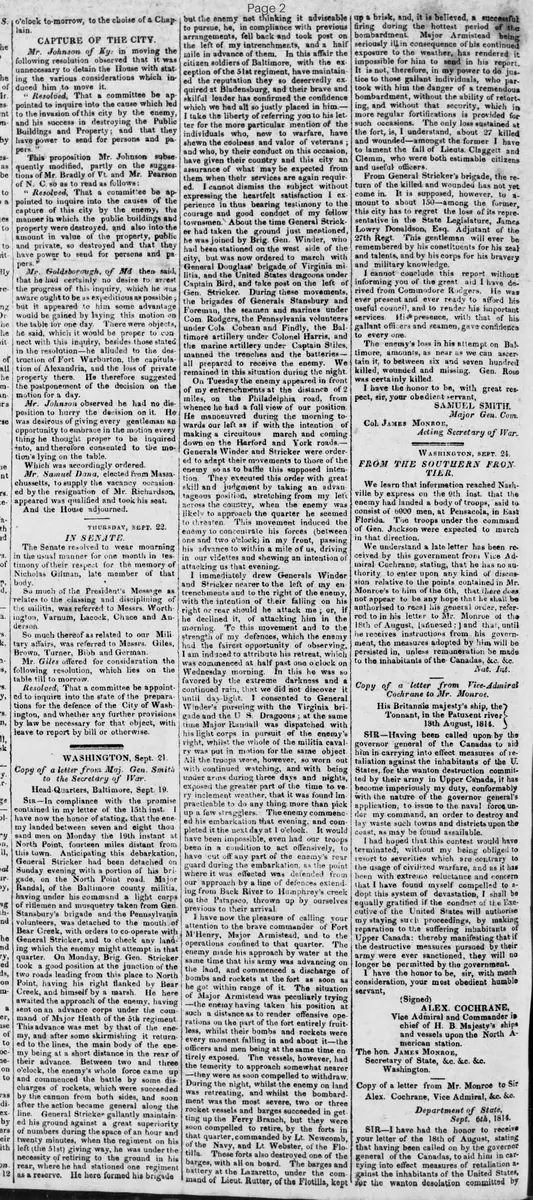
Copy of a letter from Maj. Gen. Smith to the Secretary of War.
Head-Quarters, Baltimore, Sept. 19
SIR—In compliance with the promise contained in my letter of the 15th inst. I have now the honor of stating, that the enemy landed between seven and eight thousand men on Monday the 19th instant at North Point, fourteen miles distant from this town. Anticipating this debarkation, General Stricker had been detached on Sunday evening with a portion of his brigade, on the North Point road. Major Randal, of the Baltimore county militia, having under his command a light corps of riflemen and musketry taken from Gen. Stansbury's brigade and the Pennsylvania volunteers, was detached to the mouth of Bear Creek, with orders to co-operate with General Stricker, and to check any landing which the enemy might attempt in that quarter. On Monday, Brig. Gen. Stricker took a good position at the junction of the two roads leading from this place to North Point, having his right flanked by Bear Creek, and himself by a marsh. He here awaited the approach of the enemy, having sent on an advance corps under the command of Major Heath of the 5th regiment. This advance was met by that of the enemy, and after some skirmishing it returned to the lines, the main body of the enemy being at a short distance in the rear of their advance. Between two and three o'clock, the enemy's whole force came up and commenced the battle by some discharges of rockets, which were succeeded by the cannon from both sides, and soon after the action became general along the line. General Stricker gallantly maintained his ground against a great superiority of numbers during the space of an hour and twenty minutes, when the regiment on his left (the 51st) giving way, he was under the necessity of retiring to the ground in his rear, where he had stationed one regiment as a reserve. He here formed his brigade but the enemy not thinking it advisable to pursue, he, in compliance with previous arrangements, fell back and took post on the left of my intrenchments, and a half mile in advance of them. In this affair the citizen soldiers of Baltimore, with the exception of the 51st regiment, have maintained the reputation they so deservedly acquired at Bladensburg, and their brave and skilful leader has confirmed the confidence which we had all so justly placed in him. I take the liberty of referring you to his letter for the more particular mention of the individuals who, new to warfare, have shewn the coolness and valor of veterans; and who, by their conduct on this occasion, have given their country and this city an assurance of what may be expected from them when their services are again required. I cannot dismiss the subject without expressing the heartfelt satisfaction I experience in thus bearing testimony to the courage and good conduct of my fellow townsmen. About the time General Stricker had taken the ground just mentioned, he was joined by Brig. Gen. Winder, who had been stationed on the west side of the city, but was now ordered to march with General Douglas's brigade of Virginia militia, and the United States dragoons under Captain Bird, and take post on the left of Gen. Stricker. During these movements, the brigades of Generals Stansbury and Foreman, the seamen and marines under Com. Rodgers, the Pennsylvania volunteers under Cols. Cobean and Findly, the Baltimore artillery under Colonel Harris, and the marine artillery under Captain Stiles, manned the trenches and the batteries—all prepared to receive the enemy. We remained in this situation during the night.
On Tuesday the enemy appeared in front of my entrenchments at the distance of 2 miles, on the Philadelphia road, from whence he had a full view of our position. He manoeuvred during the morning towards our left as if with the intention of making a circuitous march and coming down on the Harford and York roads. Generals Winder and Stricker were ordered to adapt their movements to those of the enemy so as to baffle this supposed intention. They executed this order with great skill and judgment by taking an advantageous position, stretching from my left across the country, when the enemy was likely to approach the quarter he seemed to threaten. This movement induced the enemy to concentrate his forces (between one and two o'clock) in my front, passing his advance to within a mile of us, driving in our videttes and shewing an intention of attacking us that evening.
I immediately drew Generals Winder and Stricker nearer to the left of my entrenchments and to the right of the enemy, with the intention of their falling on his right or rear should he attack me: or, if he declined it, of attacking him in the morning. To this movement and to the strength of my defences, which the enemy had the fairest opportunity of observing, I am induced to attribute his retreat, which was commenced at half past one o'clock on Wednesday morning. In this he was so favored by the extreme darkness and a continued rain, that we did not discover it until day-light. I consented to General Winder's pursuing with the Virginia brigade and the U S. Dragoons; at the same time Major Randall was dispatched with his light corps in pursuit of the enemy's right, whilst the whole of the militia cavalry was put in motion for the same object. All the troops were, however, so worn out with continued watching, and with being under arms during three days and nights, exposed the greater part of the time to very inclement weather, that it was found impracticable to do any thing more than pick up a few stragglers. The enemy commenced his embarkation that evening, and completed it the next day at I o'clock. It would have been impossible, even had our troops been in a condition to act offensively, to have cut off any part of the enemy's rear guard during the embarkation, as the point where it was effected was defended from our approach by a line of defences extending from Back River to Humphrey's creek on the Patapsco, thrown up by ourselves previous to their arrival.
I have now the pleasure of calling your attention to the brave commander of Fort M'Henry, Major Armistead, and to the operations confined to that quarter. The enemy made his approach by water at the same time that his army was advancing on the land, and commenced a discharge of bombs and rockets at the fort as soon as he got within range of it. The situation of Major Armistead was peculiarly trying—the enemy having taken his position at such a distance as to render offensive operations on the part of the fort entirely fruitless, whilst their bombs and rockets were every moment falling in and about it—the officers and men being at the same time entirely exposed. The vessels, however, had the temerity to approach somewhat nearer—they were as soon compelled to withdraw. During the night, whilst the enemy on land was retreating, and whilst the bombardment was the most severe, two or three rocket vessels and barges succeeded in getting up the Ferry Branch, but they were soon compelled to retire, by the forts in that quarter, commanded by Lt. Newcomb, of the Navy, and Lt. Webster, of the Flotilla. These forts also destroyed one of the barges, with all on board. The barges and battery at the Lazaretto, under the command of Lieut. Rutter, of the Flotilla, kept up a brisk, and, it is believed, a successful firing during the hottest period of the bombardment. Major Armistead being seriously ill in consequence of his continued exposure to the weather, has rendered it impossible for him to send in his report. It is not, therefore, in my power to do justice to those gallant individuals, who partook with him the danger of a tremendous bombardment, without the ability of retorting, and without that security, which in more regular fortifications is provided for such occasions. The only loss sustained at the fort, is, I understand, about 27 killed and wounded—amongst the former I have to lament the fall of Lieuts. Claggett and Clemm, who were both estimable citizens and useful officers.
From General Stricker's brigade, the return of the killed and wounded has not yet come in. It is supposed, however, to amount to about 150—among the former, this city has to regret the loss of its representative in the State Legislature, James Lowry Donaldson, Esq. Adjutant of the 27th Regt. This gentleman will ever be remembered by his constituents for his zeal and talents, and by his corps for his bravery and military knowledge.
I cannot conclude this report without informing you of the great aid I have derived from Commodore Rodgers. He was ever present and ever ready to afford his useful council, and to render his important services. His presence, with that of his gallant officers and seamen, gave confidence to every one.
The enemy's loss in his attempt on Baltimore, amounts, as near as we can ascertain it, to between six and seven hundred killed, wounded and missing. Gen. Ross was certainly killed.
I have the honor to be, with great respect, sir, your obedient servant,
SAMUEL SMITH,
Major Gen. Com.
Col. James Monroe,
Acting Secretary of War.
What sub-type of article is it?
What keywords are associated?
What entities or persons were involved?
Where did it happen?
Domestic News Details
Primary Location
Baltimore
Event Date
Sept. 19 21, 1814
Key Persons
Outcome
american casualties: ~150 in stricker's brigade, ~27 at fort m'henry (including lieuts. claggett and clemm killed, james lowry donaldson killed). british: 600-700 killed, wounded, missing; gen. ross killed. enemy retreated and embarked.
Event Details
British forces landed 7-8,000 men at North Point on Sept. 19. Gen. Stricker's brigade engaged in battle, holding for 80 minutes before orderly retreat to entrenchments. Enemy maneuvered but retreated overnight Sept. 20-21. Fort M'Henry withstood bombardment; supporting batteries repelled enemy vessels. Pursuit captured few stragglers.