Thank you for visiting SNEWPapers!
Sign up free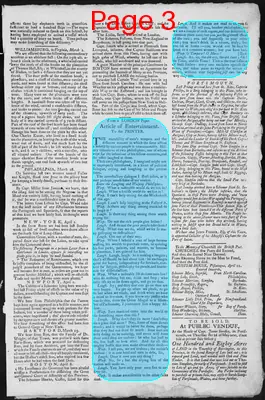
Literary
April 12, 1765
The New Hampshire Gazette And Historical Chronicle
Portsmouth, Greenland, Rockingham County, New Hampshire
What is this article about?
A satirical prose dialogue between the Weeping and Laughing Philosophers critiques the mutability of human tempers, political corruption, bribery, national debt, and personal follies in contemporary society, presented as an entertaining letter to a printer from a London paper.
Clipping
OCR Quality
95%
Excellent
Full Text
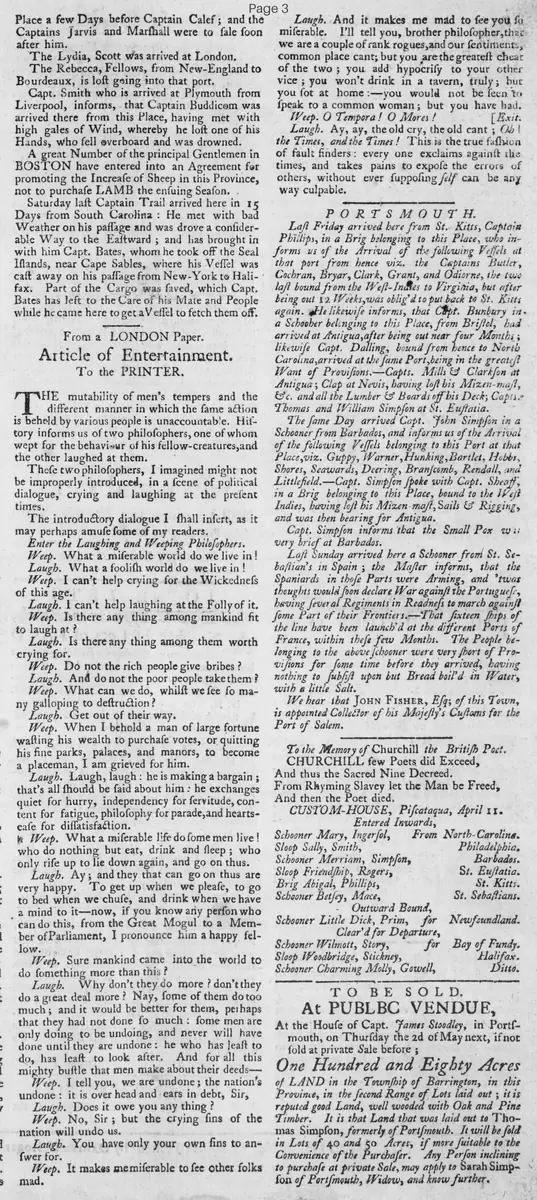
From a LONDON Paper.
Article of Entertainment.
To the PRINTER.
The mutability of men's tempers and the different manner in which the same action is beheld by various people is unaccountable. History informs us of two philosophers, one of whom wept for the behaviour of his fellow-creatures, and the other laughed at them.
These two philosophers, I imagined might not be improperly introduced, in a scene of political dialogue, crying and laughing at the present times.
The introductory dialogue I Shall insert, as it may perhaps amuse some of my readers.
Enter the Laughing and Weeping Philosophers.
Weep. What a miserable world do we live in!
Laugh. What a foolish world do we live in!
Weep. I can't help crying for the Wickedness of this age.
Laugh. I can't help laughing at the Folly of it.
Weep. Is there any thing among mankind fit to laugh at?
Laugh. Is there any thing among them worth crying for.
Weep. Do not the rich people give bribes?
Laugh. And do not the poor people take them?
Weep. What can we do, whilst we see so many galloping to destruction?
Laugh. Get out of their way.
Weep. When I behold a man of large fortune wasting his wealth to purchase votes, or quitting his fine parks, palaces, and manors, to become a placeman, I am grieved for him.
Laugh. Laugh, laugh: he is making a bargain; that's all should be said about him: he exchanges quiet for hurry, independency for servitude, content for fatigue, philosophy for parade, and heart's ease for dissatisfaction.
Weep. What a miserable life do some men live! who do nothing but eat, drink and sleep; who only rise up to lie down again, and go on thus.
Laugh. Ay; and they that can go on thus are very happy. To get up when we please, to go to bed when we choose, and drink when we have a mind to it--now, if you know any person who can do this, from the Great Mogul to a Member of Parliament, I pronounce him a happy fellow.
Weep. Sure mankind came into the world to do something more than this?
Laugh. Why don't they do more? don't they do a great deal more? Nay, some of them do too much; and it would be better for them, perhaps that they had not done so much: some men are only doing to be undoing, and never will have done until they are undone: he who has least to do, has least to look after. And for all this mighty bustle that men make about their deeds--
Weep. I tell you, we are undone; the nation's undone: it is over head and ears in debt, Sir,
Laugh. Does it owe you any thing?
Weep. No, Sir; but the crying sins of the nation will undo us.
Laugh. You have only your own sins to answer for.
Weep. It makes me miserable to see other folks mad.
Laugh. And it makes me mad to see you so miserable. I'll tell you, brother philosopher, that we are a couple of rank rogues, and our sentiments, common place cant; but you are the greatest cheat of the two; you add hypocrisy to your other vice; you won't drink in a tavern, truly; but you sot at home:--you would not be seen to speak to a common woman; but you have had.
Weep. O Tempora! O Mores!
[Exit.
Laugh. Ay, ay, the old cry, the old cant; Oh! the Times, and the Times! This is the true fashion of fault finders: every one exclaims against the times, and takes pains to expose the errors of others, without ever supposing self can be any way culpable.
Article of Entertainment.
To the PRINTER.
The mutability of men's tempers and the different manner in which the same action is beheld by various people is unaccountable. History informs us of two philosophers, one of whom wept for the behaviour of his fellow-creatures, and the other laughed at them.
These two philosophers, I imagined might not be improperly introduced, in a scene of political dialogue, crying and laughing at the present times.
The introductory dialogue I Shall insert, as it may perhaps amuse some of my readers.
Enter the Laughing and Weeping Philosophers.
Weep. What a miserable world do we live in!
Laugh. What a foolish world do we live in!
Weep. I can't help crying for the Wickedness of this age.
Laugh. I can't help laughing at the Folly of it.
Weep. Is there any thing among mankind fit to laugh at?
Laugh. Is there any thing among them worth crying for.
Weep. Do not the rich people give bribes?
Laugh. And do not the poor people take them?
Weep. What can we do, whilst we see so many galloping to destruction?
Laugh. Get out of their way.
Weep. When I behold a man of large fortune wasting his wealth to purchase votes, or quitting his fine parks, palaces, and manors, to become a placeman, I am grieved for him.
Laugh. Laugh, laugh: he is making a bargain; that's all should be said about him: he exchanges quiet for hurry, independency for servitude, content for fatigue, philosophy for parade, and heart's ease for dissatisfaction.
Weep. What a miserable life do some men live! who do nothing but eat, drink and sleep; who only rise up to lie down again, and go on thus.
Laugh. Ay; and they that can go on thus are very happy. To get up when we please, to go to bed when we choose, and drink when we have a mind to it--now, if you know any person who can do this, from the Great Mogul to a Member of Parliament, I pronounce him a happy fellow.
Weep. Sure mankind came into the world to do something more than this?
Laugh. Why don't they do more? don't they do a great deal more? Nay, some of them do too much; and it would be better for them, perhaps that they had not done so much: some men are only doing to be undoing, and never will have done until they are undone: he who has least to do, has least to look after. And for all this mighty bustle that men make about their deeds--
Weep. I tell you, we are undone; the nation's undone: it is over head and ears in debt, Sir,
Laugh. Does it owe you any thing?
Weep. No, Sir; but the crying sins of the nation will undo us.
Laugh. You have only your own sins to answer for.
Weep. It makes me miserable to see other folks mad.
Laugh. And it makes me mad to see you so miserable. I'll tell you, brother philosopher, that we are a couple of rank rogues, and our sentiments, common place cant; but you are the greatest cheat of the two; you add hypocrisy to your other vice; you won't drink in a tavern, truly; but you sot at home:--you would not be seen to speak to a common woman; but you have had.
Weep. O Tempora! O Mores!
[Exit.
Laugh. Ay, ay, the old cry, the old cant; Oh! the Times, and the Times! This is the true fashion of fault finders: every one exclaims against the times, and takes pains to expose the errors of others, without ever supposing self can be any way culpable.
What sub-type of article is it?
Dialogue
Satire
What themes does it cover?
Political
Moral Virtue
What keywords are associated?
Laughing Philosopher
Weeping Philosopher
Political Satire
Bribery
National Debt
Human Folly
Hypocrisy
What entities or persons were involved?
From A London Paper
Literary Details
Author
From A London Paper
Subject
Political Dialogue Crying And Laughing At The Present Times
Form / Style
Satirical Dialogue In Prose
Key Lines
Weep. What A Miserable World Do We Live In!
Laugh. What A Foolish World Do We Live In!
Weep. Do Not The Rich People Give Bribes?
Laugh. And Do Not The Poor People Take Them?
Laugh. You Have Only Your Own Sins To Answer For.
Weep. O Tempora! O Mores!