Thank you for visiting SNEWPapers!
Sign up free
Editorial
December 18, 1946
The Key West Citizen
Key West, Monroe County, Florida
What is this article about?
Editorial argues that while government takes significant sums from families (e.g., $27/week now vs. $8 in 1929), much is for WWII; urges evaluating non-war expenditures for adequate return and economy without assuming all is wasted.
Clipping
OCR Quality
95%
Excellent
Full Text
RETURN IS IMPORTANT
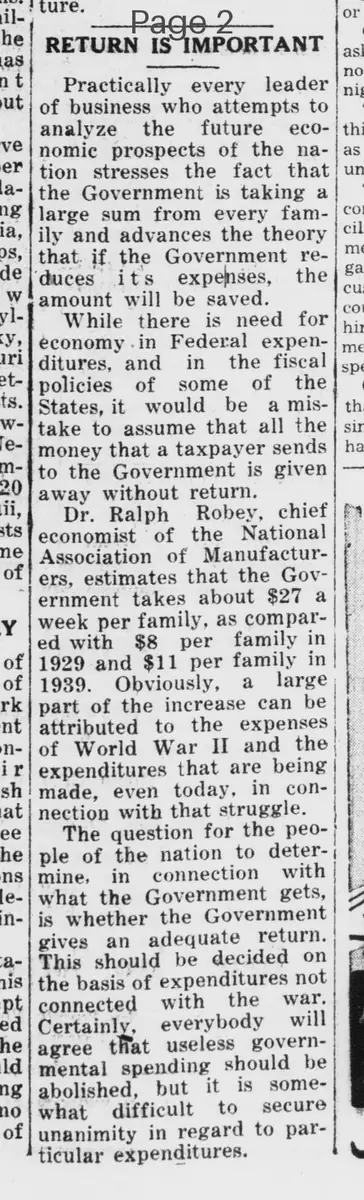
Practically every leader of business who attempts to analyze the future economic prospects of the nation stresses the fact that the Government is taking a large sum from every family and advances the theory that if the Government reduces its expenses, the amount will be saved.
While there is need for economy in Federal expenditures, and in the fiscal policies of some of the States, it would be a mistake to assume that all the money that a taxpayer sends to the Government is given away without return.
Dr. Ralph Robey, chief economist of the National Association of Manufacturers, estimates that the Government takes about $27 a week per family, as compared with $8 per family in 1929 and $11 per family in 1939. Obviously, a large part of the increase can be attributed to the expenses of World War II and the expenditures that are being made, even today, in connection with that struggle.
The question for the people of the nation to determine, in connection with what the Government gets, is whether the Government gives an adequate return. This should be decided on the basis of expenditures not connected with the war.
Certainly, everybody will agree that useless governmental spending should be abolished, but it is somewhat difficult to secure unanimity in regard to particular expenditures.
Practically every leader of business who attempts to analyze the future economic prospects of the nation stresses the fact that the Government is taking a large sum from every family and advances the theory that if the Government reduces its expenses, the amount will be saved.
While there is need for economy in Federal expenditures, and in the fiscal policies of some of the States, it would be a mistake to assume that all the money that a taxpayer sends to the Government is given away without return.
Dr. Ralph Robey, chief economist of the National Association of Manufacturers, estimates that the Government takes about $27 a week per family, as compared with $8 per family in 1929 and $11 per family in 1939. Obviously, a large part of the increase can be attributed to the expenses of World War II and the expenditures that are being made, even today, in connection with that struggle.
The question for the people of the nation to determine, in connection with what the Government gets, is whether the Government gives an adequate return. This should be decided on the basis of expenditures not connected with the war.
Certainly, everybody will agree that useless governmental spending should be abolished, but it is somewhat difficult to secure unanimity in regard to particular expenditures.
What sub-type of article is it?
Economic Policy
Taxation
What keywords are associated?
Government Spending
Federal Expenditures
Tax Burden
Post War Economy
Fiscal Policy
What entities or persons were involved?
Dr. Ralph Robey
National Association Of Manufacturers
Government
Editorial Details
Primary Topic
Importance Of Return On Government Spending
Stance / Tone
Advocates Evaluating Value Of Non War Expenditures
Key Figures
Dr. Ralph Robey
National Association Of Manufacturers
Government
Key Arguments
Government Takes About $27 A Week Per Family Currently Compared To $8 In 1929 And $11 In 1939
Increase Largely Due To World War Ii Expenses
Need For Economy In Federal And State Expenditures
Assess If Government Provides Adequate Return On Non War Spending
Useless Government Spending Should Be Abolished But Agreement On Specifics Is Difficult