Thank you for visiting SNEWPapers!
Sign up free
The Rhode Island American, And General Advertiser
Providence, Providence County, Rhode Island
What is this article about?
Report on the successful Alms-House Farm in Salem, MA, established 1816 to employ poor in agriculture, yielding substantial produce 1817-1819 under Mr. Upton's management. Compares to Fellenberg's Swiss model for educating mendicant children through farm labor and instruction.
Merged-components note: Merged across pages as clear continuation of the Alms-House Farm at Salem article.
Clipping
OCR Quality
Full Text
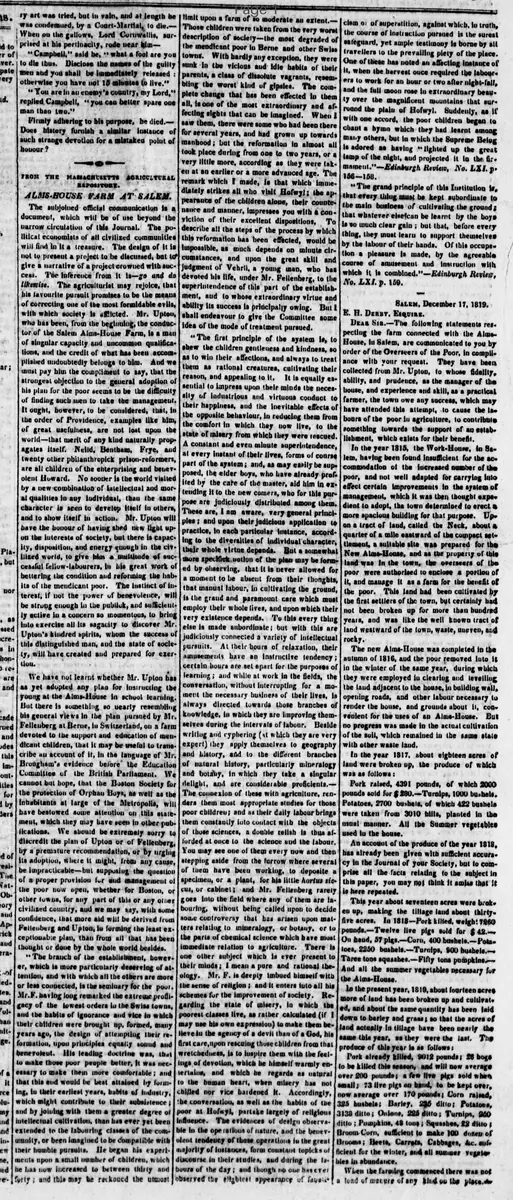
ALMS-HOUSE FARM AT SALEM.
The subjoined official communication is a document, which will be of use beyond the narrow circulation of this Journal. The political economists of all civilized communities will find in it a treasure. The design of it is not to present a project to be discussed, but to give a narrative of a project crowned with success.
The inference from it is—go and do likewise. The agriculturist may rejoice, that his favourite pursuit promises to be the means of correcting one of the most formidable evils, with which society is afflicted. Mr. Upton, who has been, from the beginning, the conductor of the Salem Alms-House Farm, is a man of singular capacity and uncommon qualifications, and the credit of what has been accomplished undoubtedly belongs to him. And we must pay him the compliment to say, that the strongest objection to the general adoption of his plan for the poor seems to be the difficulty of finding such men to take the management.
It ought, however, to be considered, that, in the order of Providence, examples like him, of great usefulness, are not lost upon the world—that merit of any kind naturally propagates itself. Neild, Bentham, Frye, and twenty other philanthropick prison-reformers, are all children of the enterprising and benevolent Howard. No sooner is the world visited by a new combination of intellectual and moral qualities in any individual, than the same character is seen to develop itself in others, and to show itself in action. Mr. Upton will have the honour of having shed new light upon the interests of society, but there is capacity, disposition, and energy enough in the civilized world, to give him a multitude of successful fellow-labourers, in his great work of bettering the condition and reforming the habits of the mendicant poor. The instinct of interest, if not the power of benevolence, will be strong enough in the publick, and sufficiently active in a concern so momentous, to bring into exercise all its sagacity to discover Mr. Upton's kindred spirits, whom the success of this distinguished man, and the state of society, will have created and prepared for exertion.
We have not learnt whether Mr. Upton has as yet adopted any plan of instructing the young at the Alms-House in school learning. But there is something so nearly resembling his general views in the plan pursued by Mr. Fellenberg at Hofwyl, in Switzerland, on a farm devoted to the support and education of mendicant children, that it may be useful to transcribe an account of it, in the language of Mr. Brougham's evidence before the Education Committee of the British Parliament. We cannot but hope, that the Boston Society for the protection of Orphan Boys, as well as the Inhabitants at large of the Metropolis, will have bestowed some attention on this statement, which they may have seen in other publications.
We should be extremely sorry to discredit the plan of Upton or of Fellenberg, by a premature recommendation, or by urging its adoption, where it might, from any cause, be impracticable—but supposing the question of a proper provision for and management of the poor now open, whether for Boston, or other towns, for any part of this or any other civilized country, and we may say, with some confidence, that more aid will be derived from Fellenberg and Upton, in forming the least exceptionable plan, than from all that has been thought or done by the whole world besides.
The branch of the establishment, however, which is more particularly deserving of attention, and with which all the others are more or less connected, is the seminary for the poor. Mr. F. having long remarked the extreme profligacy of the lowest orders in the Swiss towns, and the habits of ignorance and vice in which their children were brought up, formed, many years ago, the design of attempting their reformation, upon principles equally sound and benevolent. His leading doctrine was, that to make those poor people better, it was necessary to make them more comfortable; and that this end would be best attained by forming, in their earliest years, habits of industry, which might contribute to their subsistence; and by joining with them a greater degree of intellectual cultivation, than has ever yet been extended to the labouring classes of the community, or been imagined to be compatible with their humble pursuits. He began his experiment upon a small number of children, which he has now increased to between thirty and forty upon a farm of so moderate an extent.—
Those children were taken from the very worst description of society—the most degraded of the mendicant poor in Berne and other Swiss towns. The complete change that has been effected in them all, is one of the most extraordinary and affecting sights that can be imagined. When I saw them, there were some who had been there for several years, and had grown up towards manhood; but the reformation in almost all took place during from one to two years, or a very little more, according as they were taken at an earlier or a more advanced age. The remark which I made, is that which immediately strikes all who visit Hofwyl: the appearance of the children alone, their countenance and manner, impresses you with a conviction of their excellent dispositions. To describe all the steps of the process by which this reformation has been effected, would be impossible, as much depends on minute circumstances, and upon the great skill and judgment of Vehrli, a young man, who has devoted his life, under Mr. Fellenberg, to the superintendence of this part of the establishment, and to whose extraordinary virtue and ability its success is principally owing. But I shall endeavour to give the Committee some idea of the mode of treatment pursued.
"The first principle of the system is, to show the children gentleness and kindness, so as to win their affections, and always to treat them as rational creatures, cultivating their reason, and appealing to it. It is equally essential to impress upon their minds the necessity of industrious and virtuous conduct to their happiness, and the inevitable effects of the opposite behaviour, in reducing them from the comfort in which they now live, to the state of misery from which they were rescued. A constant and even minute superintendence, at every instant of their lives, forms of course part of the system; and, as may easily be supposed, the elder boys, who have already profited by the care of the master, aid him in extending it to the new comers, who for this purpose are judiciously distributed among them.
These are, I am aware, very general principles; and upon their judicious application to practice, in each particular instance, according to the diversities of individual character their whole virtue depends. But a somewhat more specific notion of the plan may be formed by observing, that it is never allowed for a moment to be absent from their thoughts, that manual labour, in cultivating the ground, is the grand and paramount care which must employ their whole lives, and upon which their very existence depends. To this every thing else is made subordinate; but with this are judiciously connected a variety of intellectual pursuits. At their hours of relaxation, their amusements have an instructive tendency; certain hours are set apart for the purposes of learning; and while at work in the fields, the conversation, without interrupting or a moment the necessary business of their lives, is always directed towards those branches of knowledge, in which they are improving themselves during the intervals of labour. Besides writing and cyphering (at which they are very expert) they apply themselves to geography and history, and to the different branches of natural history, particularly mineralogy and botany, in which they take a singular delight, and are considerable proficients.—
The connexion of these with agriculture, renders them most appropriate studies for those poor children; and as their daily labour brings them constantly into contact with the objects of those sciences, a double relish is thus afforded at once to the science and the labour. You may see one of them every now and then stepping aside from the furrow where several of them have been working, to deposite a specimen, or a plant, for his little hortus siccus, or cabinet; and Mr. Fellenberg rarely goes into the field where any of them are labouring, without being called upon to decide some controversy that has arisen upon matters relating to mineralogy, or botany, or to the parts of chemical science which have most immediate relation to agriculture. There is one other subject which is ever present to their minds; I mean a pure and rational theology. Mr. F. is deeply imbued himself with the sense of religion; and it enters into all his schemes for the improvement of society. Regarding the state of misery, in which the poorest classes live, as rather calculated (if I may use his own expression) to make them believe in the agency of a devil than of a God, his first care, upon rescuing those children from that wretchedness, is to inspire them with the feelings of devotion, which he himself warmly entertains, and which he regards as natural to the human heart, when misery has not chilled nor vice hardened it. Accordingly, the conversation, as well as the habits of the poor at Hofwyl, partake largely of religious influence. The evidences of design observable in the operations of nature, and the benevolent tendency of those operations in the great majority of instances, form constant topicks of discourse in their studies, and during the labour of the day; and though no one has ever observed the slightest appearance of fanaticism or of superstition, against which, in truth, the course of instruction pursued is the surest safeguard, yet ample testimony is borne by all travellers to the prevailing piety of the place.
One of these has noted an affecting instance of it, when the harvest once required the labourers to work for an hour or two after night-fall, and the full moon rose in extraordinary beauty over the magnificent mountains that surround the plain of Hofwyl. Suddenly, as if with one accord, the poor children began to chant a hymn which they had learnt among many others, but in which the Supreme Being is adored as having "lighted up the great lamp of the night, and projected it in the firmament."—Edinburgh Review, No. LXI. p. 156-158.
"The grand principle of this Institution is, that every thing must be kept subordinate to the main business of cultivating the ground; that whatever else can be learnt by the boys is so much clear gain; but that, before every thing, they must learn to support themselves by the labour of their hands. Of this occupation a pleasure is made, by the agreeable course of amusement and instruction with which it is combined."—Edinburgh Review, No. LXI. p. 159.
Salem, December 17, 1819.
E. H. Derby, Esquire.
Dear Sir.—The following statements respecting the farm connected with the Alms-House, in Salem, are communicated to you by order of the Overseers of the Poor, in compliance with your request. They have been collected from Mr. Upton, to whose fidelity, ability, and prudence, as the manager of the House, and experience and skill, as a practical farmer, the town owe any success, which may have attended this attempt, to cause the labours of the poor in agriculture, to contribute something towards the support of an establishment, which exists for their benefit.
In the year 1815, the Work-House, in Salem, having been found insufficient for the accommodation of the increased number of the poor, and not well adapted for carrying into effect certain improvements in the system of management, which it was then thought expedient to adopt, the town determined to erect a more spacious building for that purpose. Upon a tract of land, called the Neck, about a quarter of a mile eastward of the compact settlement, a suitable site was prepared for the New Alms-House, and as the property of this land was in the town, the overseers of the poor were authorised to enclose a portion of it, and manage it as a farm for the benefit of the poor. This land had been cultivated by the first settlers of the town, but certainly had not been broken up for more than a hundred years, and was like the well known tract of land westward of the town, waste, uneven, and rocky.
The new Alms-House was completed in the autumn of 1816, and the poor removed into it in the winter of the same year, during which they were employed in clearing and levelling the land adjacent to the house, in building walls, opening roads, and other labour necessary to render the house, and grounds about it, convenient for the uses of an Alms-House. But no progress was made in the actual cultivation of the soil, which remained in the same state with other waste land.
In the year 1817, about eighteen acres of land were broken up, the produce of which was as follows:
Pork raised, 4391 pounds, of which 2000 pounds sold for $280.—Turnips, 1000 bushels, Potatoes, 2700 bushels, of which 422 bushels were taken from 3½ rods, planted in the usual manner. All the Summer vegetables used in the house.
An account of the produce of the year 1818, has already been given with sufficient accuracy in the Journal of your Society, but to comprehend all the facts relating to the subject in this paper, you may not think it amiss that it is here repeated.
This year about seventeen acres were broken up, making the tillage land about thirty-five acres. In 1818—Pork killed, weighing 7960 pounds.—Twelve live pigs sold for $42.—On hand, 57 pigs.—Corn, 400 bushels.—Potatoes, 2250 bushels. Turnips, 900 bushels.—Three tons squashes.—Fifty tons pumpkins.—And all the summer vegetables necessary for the Alms-House.
In the present year, 1819, about fourteen acres more of land has been broken up and cultivated, and about the same quantity has been laid down to barley and grass so that the acres of land actually in tillage have been nearly the same this year, as they were the last. The produce of this year is as follows;
Pork already killed, 9012 pounds; 28 hogs to be killed this season, and will now average over 200 pounds; a few live pigs sold when small; 73 live pigs on hand, to be kept over, now average over 170 pounds; Corn raised, 325 bushels; Barley, 236 ditto; Potatoes, 3138 ditto; Onions, 225 ditto; Turnips, 260 ditto; Pumpkins, 48 tons; Squashes, 22 ditto; Broom Corn, sufficient to make 100 dozen of Brooms; Beets, Carrots, Cabbages, &c. sufficient for the winter, and all summer vegetables in abundance,
When the farming commenced there was not a load of manure of any kind on the place,
What sub-type of article is it?
What keywords are associated?
What entities or persons were involved?
Where did it happen?
Domestic News Details
Primary Location
Salem
Event Date
1815 1819
Key Persons
Outcome
successful agricultural production supporting the alms-house: yields including pork, corn, potatoes, turnips, pumpkins, squashes, and vegetables from 1817-1819; no manure initially, land reclaimed from waste.
Event Details
The Alms-House Farm in Salem was established in 1816 on previously uncultivated land to employ the poor in agriculture for self-support. Managed by Mr. Upton, it produced significant crops and livestock from 1817-1819. The article praises this model and compares it to Mr. Fellenberg's farm school for poor children in Hofwyl, Switzerland, emphasizing industry, education, and moral reform.