Thank you for visiting SNEWPapers!
Sign up free
The News & Observer
Raleigh, Wake County, North Carolina
What is this article about?
Biographical profile of George Eugene Bryson, influential American journalist in Cuba, advisor to President Palma pushing for U.S. annexation, with adventurous tales from South American revolutions and Cuban independence, including a daring warship incident in Venezuela and exploits with General Maceo.
Clipping
OCR Quality
Full Text
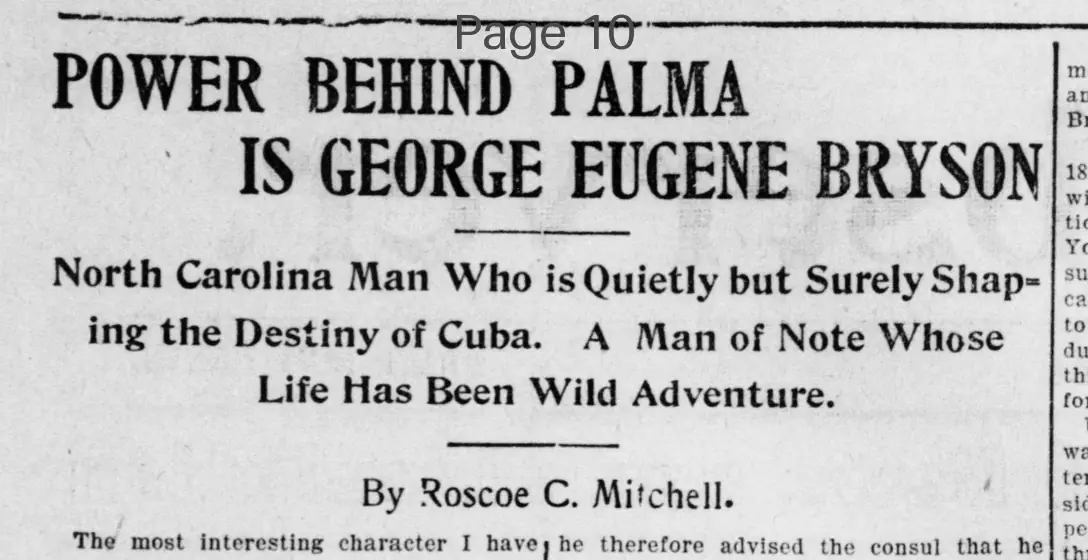
IS GEORGE EUGENE BRYSON
North Carolina Man Who is Quietly but Surely Shaping the Destiny of Cuba.
A Man of Note Whose Life Has Been Wild Adventure.
By Roscoe C. Mitchell.
The most interesting character I have ever met is George Eugene Bryson, a native of North Carolina, but now a resident of Havana, Cuba. Mr. Bryson was born near Bryson City, Jackson county about thirty-six years ago, but moved with his parents to Florida when eleven years old.
At the age of sixteen Mr. Bryson began the publication of a paper in his adopted State and since that day he has been connected with the newspaper profession, and today his name stands at the head of the list and he is known and recognized as one of the foremost American newspaper correspondents. His reputation is not alone confined to this country, but extends throughout South America, Cuba, and into many parts of Europe.
He is today the most influential man in the Republic of Cuba and is really "the middle man" between President Roosevelt and President Palma. He is the man who is slowly but surely making the sentiment which will at no distant day bring about the annexation of the island Republic to the United States of America.
For many years he has been the close friend and advisor of Thomas Estrada Palma; and only a few days after Senor Palma's election to the presidency of the new republic I was permitted to read a long letter from the president-elect to his old friend, Bryson. He took occasion in this letter to thank Mr. Bryson for the great service he had rendered in behalf of the struggling patriots of the island and said that he was one of the greatest heroes in the struggle for Cuban independence. He urged Mr. Bryson to join him at his country home in New York State for an important conference.
I learned later, not from Mr. Bryson however, that at this conference President Palma urged Bryson to accompany him to Cuba when he left to be inaugurated as the first president of the little republic. Palma had been absent from the island since the ten year war and he realized the fact that there was no man more familiar with the men and affairs of the new Republic than George Eugene Bryson.
Today he is the power behind the throne in Cuba; he is the man who has dictated the policy of the republic and kept it in a straight path and thereby retained the friendship of the Government at Washington.
Cuba will never have another President; before the term of President Palma expires the island will be a part of the United States, and George Eugene Bryson is the man who will bring about this result.
It is my purpose to give a brief review of the wonderful career of Mr. Bryson. He and I are warm personal friends and I am taking the liberty of preparing this sketch without his knowledge or permission. The first thing which attracted me to him was his love for, and devotion to the Old North State; he is proud of the fact that he was born a Tar Heel, and claims that it is his greatest ambition to return to his old mountain home and spend the remainder of his days.
It was during the latter part of the eighties that Mr. Bryson undertook the task of organizing the South American service for the New York Herald. He was engaged in this work for a number of years during which time he took an active part in seventeen different revolutions. He has related to me many of his interesting experiences during the time he spent in South America. He has on many occasions been the guest of honor of presidents and vice-presidents, of generals commanding the armies, and many times has he existed on the scant food given the prisoners while peeping through the bars charged with being a spy of the opposing party or army in some petty revolution.
One of the most interesting stories that Mr. Bryson related to me was the time he borrowed a Spanish War ship and bombarded a town in Venezuela. The incident occurred in 1891 at La Guayra and Bryson had arrived there only a week before. He had heard of the intention of Dictator Mendoza to send General Pepper to this place to raid the town and imprison the various consuls stationed there and hold them for a large ransom. On the day scheduled for the arrival of General Pepper's forces, Bryson went to Phillip C. Hanna, the American Consul, and told him of his impending danger and advised him to go up the river a few miles and wait developments. Mr. Hanna took the correspondent's advice and in a few hours the rebel general arrived in town with his forces and proceeded to arrest and imprison all the foreign merchants and foreign consuls in the town and to cut off all telegraphic and cable connections.
After the general had settled down in the British consulate with the happy satisfaction of having everything his own way, Bryson sent a runner up the river to notify the American consul that "if he had finished taking his bath," that it would be well for him to report at the American consulate. Mr. Hanna was not long in arriving there and was fully informed by Bryson as to what had taken place. Consul Hanna was a new man in the service and he was very much at sea as to what steps to take, but Bryson, who was anticipating a story which would call for a "circus poster head" on the front page of his paper, the New York Herald, was very free with advice.
He suggested to the consul that he at once notify General Pepper that if he did not release the imprisoned consuls that as the representative of the United States Government, he would proceed to bombard the town. Consul Hanna, however, had some misgivings as to whether the Government at Washington would uphold him in any such rash action. Mr. Bryson was not long in removing this doubt from the Consul's mind he explained to him that it was impossible, owing to the fact that all communications were cut off, for him to communicate with the home Government or the American Minister at Caracas he therefore advised the consul that he was supreme, and in such a case was the "whole United States government," and that the President of the United States would have to back him up in any action he might see fit to take in order to protect the interests of the United States.
Hanna took Bryson's advice, but neither of them had taken into consideration the fact that there was only one vessel in the harbor, and that a little Spanish ship with three small guns, detailed for coast duty. Her commanding officer was Eulate, then a sub-lieutenant in the Spanish Navy.
After talking the matter over, the consul and the newspaper correspondent decided to borrow a boat and go out and interview the Spanish officer. They boarded the Jorge Juan and Lieut. Eulate received them with marked courtesy, and listened graciously to their story.
Bryson detailed the startling events that had occurred, and asked the aid of the Spanish gunboat in rescuing the imprisoned Consuls. Eulate listened with much interest. He replied that Spain was one of the first nations to recognize the independence of the American Colonies when they were struggling to be released from the yoke of Great Britain and that he could not now decline to assist the United States at a time like the present. He said his ship was at the disposal of the American consul, and asked what he intended to do. "We propose to demand the release of the imprisoned consuls," was the reply.
Bryson asked for thirty Spanish Marines, the request was granted. He then ordered the crew to prepare for action. The marines were embarked in the launch and Consul Hanna landed with them and notified General Pepper that he would allow him just twenty minutes to release the imprisoned consuls, saying if this was not done the gunboat would open fire on the town. Bryson, in the meantime, had taken charge of the little vessel, hauled down the Spanish flag and run up the Stars and Stripes. Before General Pepper's time expired one of the Spanish marines had been run over by a rebel soldier who was starting on horseback to notify the Dictator, Mendoza. The Spanish soldier fired at the rebel, and Bryson taking this as a signal from Consul Hanna, opened fire on the custom house, where the consuls were imprisoned. The fire from the little vessel tore down one side of the building, and the prisoners piled out. General Pepper was glad to accept any kind of terms and at Consul Hanna's demand, his troops evacuated the city. Bryson then hauled down the American flag and turned the vessel over to the Spanish officer. The marines were returned to the ship and Consul Hanna and the released consuls warmly thanked the Spanish officer for his kindness. And Bryson took a boat and went in search of a cable office to file his "scoop."
This, however, was not the end of the matter. The Spanish Government was indignant at the action of its lieutenant. He was ordered back to Havana, deprived of his command, and sent to Morro Castle. A court-martial was ordered, the lieutenant being charged with piratical acts at La Guayra. Before a verdict was rendered, the Spanish Government had officially received the thanks of nineteen foreign governments, ranging from the gigantic Empire of Russia to the Queen of Hawaii. This opened the eyes of Spain. She recognized the injustice done to Eulate. He was released from custody, was awarded one of the highest naval decorations, and placed on waiting orders. Within a short time he was made a captain in the Spanish navy and appointed chief of the arsenal in Havana.
When it was determined to send the Vizcaya to New York, just after the Maine had been blown up in the Havana harbor, Captain Eulate was placed in command. It was believed that his action at La Guayra would especially commend him to the American people. Spain thought that she could not offer a greater act of courtesy. Unfortunately, the action of Eulate at La Guayra had never attracted the attention of the American newspapers. The public were in ignorance of the facts. They remembered only that Eulate had presided over the court that sentenced the Competitor prisoners to death. When the court-martial was held up by orders from Madrid, Captain Eulate resented the action. He indignantly asked for leave of absence and went into retirement at Puerto Rico.
This is only one of a great many of Mr. Bryson's interesting experiences in South America. On one occasion, while at Port Limon, Costa Rica, he received a cablegram from the managing editor of the New York Herald telling him that a revolution would likely break out near Rio de Janeiro, in Brazil, and requesting him to proceed there at once. When he reached Colon he struck up the acquaintance of an expert cable operator, who informed him that the fighting was likely to begin in Brazil at any hour. Bryson wired the Herald this fact and said that he would cover the story if a liberal expense account was allowed. His paper answered at once to cover story at any cost. He then chartered a tug, employed the expert operator, took on the necessary supplies and put to sea. It was four o'clock in the morning when they left Colon and before the sun went down they had succeeded in locating the cable and had connected their instrument on board with the cable wire which ran from Rio de Janeiro to Kingston. They waited two days before they caught the story they were waiting for, but on the night of the second day the London Mail correspondent put his story on the wire.
The operator on the tug took down the story in full. The correspondent had given his paper a full account and Bryson soon had the story "worked over" and was making ready to return to Colon to put his story on the wire, when the operator caught this special from the correspondent to the managing editor of the "Mail:"
"Have world scoop. No American paper represented." But he was sadly mistaken. The full story appeared in the New York Herald the next morning, dated Rio de Janeiro, Brazil and over the signature of George Eugene Bryson.
When the Cuban revolution began in 1895, Mr. Bryson resigned his position with the Herald and accepted the position as Cuban correspondent for the New York Journal. Through the Journal he succeeded in bringing before the American people the true situation in Cuba and to him, more than to any one man, is due the credit for enlisting the sympathies of the people of the United States for the struggling Cubans.
Until General Maceo was killed, Bryson was his most trusted and faithful lieutenant. He was always by the General's side, and many times he has been compelled to send messages to his paper through the Spanish lines in order to get them to the cable office. Bryson, though a member of Maceo's staff and a loyal Cuban patriot, had succeeded in securing passes through all Spanish lines. These passes were signed by General Weyler and given to Bryson as the New York Journal correspondent. Weyler was not aware of the fact that he was the faithful lieutenant of Maceo. In fact, not until the revolution was near a close, did the Captain General of Cuba discover that during the three years that Bryson had been going in and out of the Spanish lines at his pleasure, that he was a regular commissioned officer on the staff of the great Cuban General, Antonio Maceo.
The late Amos Cummings was a warm friend of Bryson's, and just before his death he related to me the following very interesting story of Bryson's experience as a Cuban soldier.
"General Maceo, accompanied by Mr. Bryson and his staff, after a long march reached the outskirts of the town of San Luis by midnight. The march had been terrific, and horses and men were nearly fagged. With sparse supplies this pace had been kept up for hours. The sun had gone down and the moon was flooding the fronds of the palms with pale, silvery light, and was half way down the sky. Maceo sat upon his horse surveying the scene below him long and silently. The little town was aglow with electric lights, and the whistles of locomotives resounded in the valley. Over three thousand Spanish troops were quartered in the town, and their movements were plainly discernible. Through a field glass Maceo watched the stirring scene. He turned the glass beyond the town, and gazed through it patiently, betraying a trace of anxiety. Finally he alighted and conferred with Colonel Miro, his chief of staff. A moment afterwards came the order to dismount. Three hundred troopers obeyed, and were about to tether their horses when they were called to attention. A second order reached their ears. They were told to stand motionless with both feet on the ground, and to await further orders with their right hands on their saddles. In the moonlight beneath the scattered palms they stood as silent as if petrified.
Among them was Bryson. He had joined the column just after the battle of Paralejo. In obedience to orders, he stood with his arm over the back of his horse, blinking at the enlivening scene below him. Exhausted by the day's march, his eyes closed, and he found it impossible to keep awake. A moment later he fastened the bridle to his foot, wrapped himself in his rubber coat, placed his satchel under his head, and fell asleep in the wet grass.
The adjutant soon awoke him, telling him that he had better get up, as they were going to have a fight. He thanked the adjutant, who told him there were over three thousand Spanish soldiers in San Luis, and that it was surrounded with fourteen blockhouses. The correspondent soon curled himself on the grass a second time and was in a sound slumber, when he was again aroused by the adjutant, who told him he was in positive danger if he persisted in disobeying the order of General Maceo. A third time his heavy eyelids closed, and he was in a dead sleep, when startled by a peremptory shake. Jesus Mascons, Maceo's secretary, stood over him. "Get up this instant," said he. "The General wants to see you immediately."
In a second Bryson was on his feet. The whistles were still blowing and the electric lights still glowing in the valley and the moon was on the horizon. He went forward in some trepidation, fancying that the General was going to upbraid him for disobeying his orders. He was surprised to find him very pleasant. Maceo always spoke in a low tone, as he had been shot twice through the lungs.
"Are you not hungry?" he asked.
"No," the correspondent replied, wondering what was in the wind.
"I thought possibly you might want something to eat," General Maceo said, with a smile. "I have a boiled egg here, and I want to divide it with you." As he uttered these words he drew out his machete and cut the egg straight through the center. Passing half of it to the correspondent he said: "Share it; it will do you good." The newspaper man thanked the General and they ate the egg in silence.
I talked with Bryson about this afterwards and related what Mr. Cummings had told me. In speaking of the incident he said: "It reminded me of General Marion's breakfast with a British officer. I had read the incident in Peter Parley's history of the Revolution, when a school boy. Marion raked a baked sweet potato out of the ashes of a camp fire, and divided with his British guest."
Bryson said that he and the General were both regretting the absence of salt while eating the egg. "After munching the egg we both sat for some time observing the stirring scene in the valley below us. The moon had gone down, but by the glow of the electric lights we could see that the activity among the Spaniards was as great as ever. Suddenly the General turned to me and said abruptly, "Were you asleep when Jesus called you?"
"Oh, no," I replied. "I was not asleep, General; I was only just tired-that was all."
The General looked at me searchingly, and then said, 'Don't worry; it is all right. We are going through that town in a few minutes, there may be a fierce fight and you will need a clear head. The egg will give you strength.'"
"Within twenty minutes," Bryson continued, "the little column of three hundred men was on the move. We led our horses down the hill about an hour before daybreak with the General in the lead. Silently and stealthily we entered the outskirts of the town. We passed two blockhouses without being observed, and when the day broke we were on the road to Baracoa. Meantime the Spaniards had discovered us. The town was aroused and a hundred and fifty Spanish cavalry headed the pursuit. The road wound through fields of cane. A strong column of Spanish infantry followed the cavalry. Maceo held his men in reserve and continued his march, the Spanish troops trailing after us like so many wild cats. Suddenly to our astonishment, Quintin Bandera's infantry arose on either side of the road and almost annihilated the pursuing column. We then marched on without fear for we knew that another step had been taken to bring about "Cuba Libre."
What sub-type of article is it?
What themes does it cover?
What keywords are associated?
What entities or persons were involved?
Where did it happen?
Story Details
Key Persons
Location
Havana, Cuba; South America (Venezuela: La Guayra; Brazil: Rio De Janeiro; Costa Rica: Port Limon); Cuba: San Luis; North Carolina; Florida
Event Date
Born About Thirty Six Years Ago; Late 1880s (South American Service); 1891 (La Guayra Incident); 1895 (Cuban Revolution)
Story Details
George Eugene Bryson, North Carolina-born journalist, rises to influence Cuban politics as advisor to President Palma, shaping path to U.S. annexation; recounts adventures including borrowing Spanish warship to bombard Venezuelan town, scooping Brazilian revolution via cable, and serving as lieutenant to General Maceo during Cuban independence struggle, sharing boiled egg with the general before raid.