Thank you for visiting SNEWPapers!
Sign up free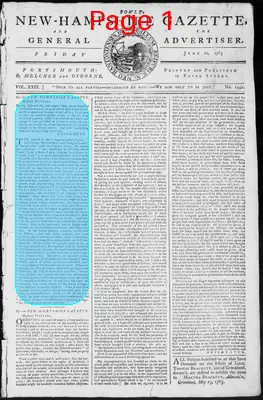
Letter to Editor
June 10, 1785
Fowle's New Hampshire Gazette And General Advertiser
Portsmouth, Rockingham County, New Hampshire
What is this article about?
A reader submits an extract from a 1783 London sermon to the New-Hampshire Gazette, arguing that religious virtue fosters durable obedience and societal tranquility, while vice leads to national decay and loss of liberties, urging serious consideration in the United States.
Clipping
OCR Quality
98%
Excellent
Full Text
FOR THE NEW-HAMPSHIRE GAZETTE.
Messieurs Printers,
Having observed that your papers have lately been filled with political pieces, many of which have been personal, and by no means entertaining, or instructive; I beg leave to turn the attention of your readers to the following extract of a sermon, which I accidentally met with, and though it was published in London in 1783, the sentiments are worthy the serious consideration of every individual in the United States: and your republishing them will at least oblige one of your
CUSTOMERS.
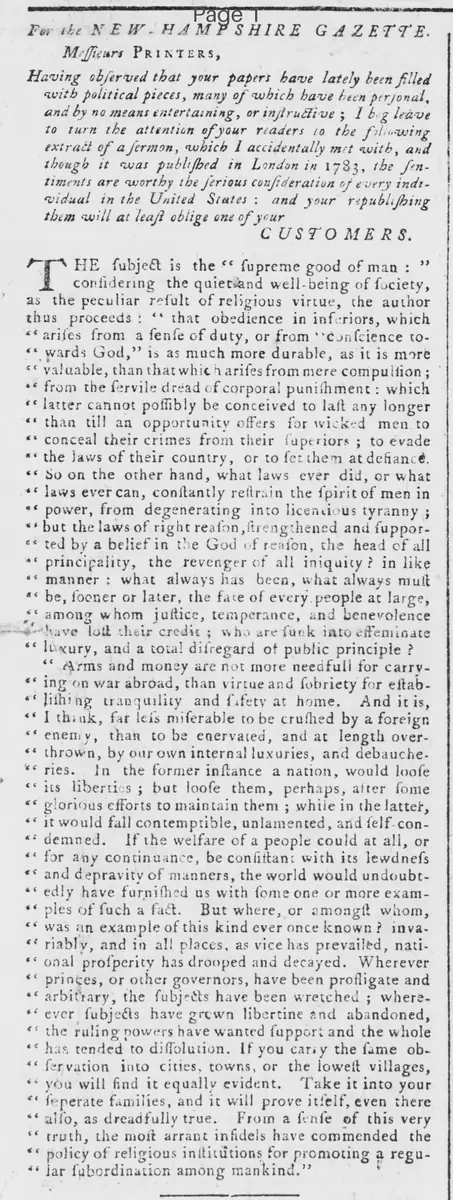
THE subject is the "supreme good of man: considering the quiet and well-being of society, as the peculiar result of religious virtue, the author thus proceeds: "that obedience in inferiors, which arises from a sense of duty, or from conscience towards God," is as much more durable, as it is more valuable, than that which arises from mere compulsion; from the servile dread of corporal punishment: which latter cannot possibly be conceived to last any longer than till an opportunity offers for wicked men to conceal their crimes from their superiors; to evade the laws of their country, or to set them at defiance. So on the other hand, what laws ever did, or what laws ever can, constantly restrain the spirit of men in power, from degenerating into licentious tyranny; but the laws of right reason, strengthened and supported by a belief in the God of reason, the head of all principality, the revenger of all iniquity? in like manner: what always has been, what always must be, sooner or later, the fate of every people at large, among whom justice, temperance, and benevolence have lost their credit; who are sunk into effeminate luxury, and a total disregard of public principle?
Arms and money are not more needful for carrying on war abroad, than virtue and sobriety for establishing tranquility and safety at home. And it is, I think, far less miserable to be crushed by a foreign enemy, than to be enervated, and at length overthrown, by our own internal luxuries, and debaucheries. in the former instance a nation, would lose its liberties; but lose them, perhaps, after some glorious efforts to maintain them; while in the latter, it would fall contemptible, unlamented, and self-condemned. If the welfare of a people could at all, or for any continuance, be consistent with its lewdness and depravity of manners, the world would undoubtedly have furnished us with some one or more examples of such a fact. But where, or amongst whom, was an example of this kind ever once known? invariably, and in all places, as vice has prevailed, national prosperity has drooped and decayed. Wherever princes, or other governors, have been profligate and arbitrary, the subjects have been wretched; wherever subjects have grown libertine and abandoned, the ruling powers have wanted support and the whole has tended to dissolution. If you carry the same observation into cities, towns, or the lowest villages, you will find it equally evident. Take it into your separate families, and it will prove itself, even there also, as dreadfully true. From a sense of this very truth, the most arrant infidels have commended the policy of religious institutions for promoting a regular subordination among mankind."
Messieurs Printers,
Having observed that your papers have lately been filled with political pieces, many of which have been personal, and by no means entertaining, or instructive; I beg leave to turn the attention of your readers to the following extract of a sermon, which I accidentally met with, and though it was published in London in 1783, the sentiments are worthy the serious consideration of every individual in the United States: and your republishing them will at least oblige one of your
CUSTOMERS.
THE subject is the "supreme good of man: considering the quiet and well-being of society, as the peculiar result of religious virtue, the author thus proceeds: "that obedience in inferiors, which arises from a sense of duty, or from conscience towards God," is as much more durable, as it is more valuable, than that which arises from mere compulsion; from the servile dread of corporal punishment: which latter cannot possibly be conceived to last any longer than till an opportunity offers for wicked men to conceal their crimes from their superiors; to evade the laws of their country, or to set them at defiance. So on the other hand, what laws ever did, or what laws ever can, constantly restrain the spirit of men in power, from degenerating into licentious tyranny; but the laws of right reason, strengthened and supported by a belief in the God of reason, the head of all principality, the revenger of all iniquity? in like manner: what always has been, what always must be, sooner or later, the fate of every people at large, among whom justice, temperance, and benevolence have lost their credit; who are sunk into effeminate luxury, and a total disregard of public principle?
Arms and money are not more needful for carrying on war abroad, than virtue and sobriety for establishing tranquility and safety at home. And it is, I think, far less miserable to be crushed by a foreign enemy, than to be enervated, and at length overthrown, by our own internal luxuries, and debaucheries. in the former instance a nation, would lose its liberties; but lose them, perhaps, after some glorious efforts to maintain them; while in the latter, it would fall contemptible, unlamented, and self-condemned. If the welfare of a people could at all, or for any continuance, be consistent with its lewdness and depravity of manners, the world would undoubtedly have furnished us with some one or more examples of such a fact. But where, or amongst whom, was an example of this kind ever once known? invariably, and in all places, as vice has prevailed, national prosperity has drooped and decayed. Wherever princes, or other governors, have been profligate and arbitrary, the subjects have been wretched; wherever subjects have grown libertine and abandoned, the ruling powers have wanted support and the whole has tended to dissolution. If you carry the same observation into cities, towns, or the lowest villages, you will find it equally evident. Take it into your separate families, and it will prove itself, even there also, as dreadfully true. From a sense of this very truth, the most arrant infidels have commended the policy of religious institutions for promoting a regular subordination among mankind."
What sub-type of article is it?
Ethical Moral
Religious
Persuasive
What themes does it cover?
Religion
Morality
Social Issues
What keywords are associated?
Religious Virtue
Moral Obedience
National Decay
Societal Tranquility
Vice Luxury
Public Principle
What entities or persons were involved?
Messieurs Printers
Letter to Editor Details
Recipient
Messieurs Printers
Main Argument
religious virtue, rooted in conscience and belief in god, ensures durable obedience, societal tranquility, and national prosperity, while vice and luxury lead to inevitable decay and loss of liberties, as illustrated by historical patterns.
Notable Details
Extract From 1783 London Sermon On 'Supreme Good Of Man'
Contrasts Obedience From Duty Vs. Compulsion
Laws Of Right Reason Supported By Belief In God Restrain Tyranny
Vice Causes National Droop And Decay Across All Levels Of Society
Infidels Commend Religious Institutions For Subordination