Thank you for visiting SNEWPapers!
Sign up free
The Bismarck Tribune
Bismarck, Mandan, Burleigh County, Morton County, North Dakota
What is this article about?
Biography of U.S. Senator Porter J. McCumber from North Dakota, covering his modest origins, legal career, political rise, legislative contributions like pure food and grain laws, tariff advocacy, and appointment as Finance Committee chairman.
Clipping
OCR Quality
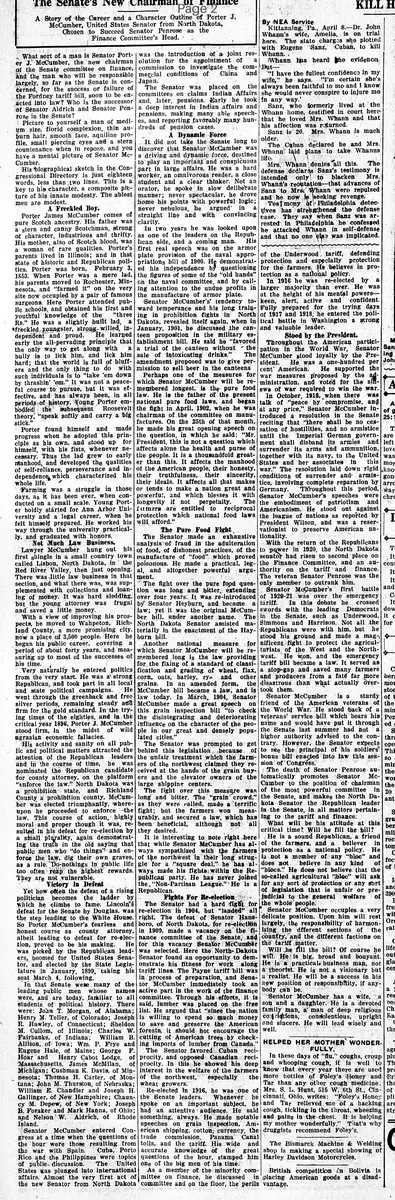
Full Text
What sort of a man is Senator Porter J. McCumber, the new chairman of the Senate committee on finance, and the man who will be responsible largely, so far as the Senate is concerned, for the success or failure of the Fordney tariff bill, soon to be enacted into law? Who is the successor of Senator Aldrich and Senator Penrose in the Senate?
Picture to yourself a man of medium size, florid complexion, thin auburn hair, smooth face, aquiline profile, small piercing eyes and a stern countenance when in repose, and you have a mental picture of Senator McCumber.
His biographical sketch in the Congressional Directory is just eighteen words, less than two lines. This is a key to his character, a composite picture of his innate modesty. The ablest men are modest.
A Freckled Boy.
Porter James McCumber comes of pure Scotch ancestry. His father was a stern and canny Scotchman, strong of character, industrious and thrifty. His mother, also of Scotch blood, was a woman of rare qualities. Porter's parents lived in Illinois; and in that state of historic and Republican politics, Porter was born, February 3, 1853. When Porter was a mere lad, his parents moved to Rochester, Minnesota, and "farmed it" on the very site now occupied by a pair of famous surgeons. Here Porter attended public schools, and obtained his first and youthful knowledge of the "three Rs." He was a slightly built lad, a freckled youngster, strong-willed, independent and proud. He learned early the all-pervading principle that the only way to get along with a bully is to lick him, and lick him hard; that the world is full of bluffers and the only thing to do with such individuals is to "take 'em down by thrashin' 'em." It was not a peaceful course to pursue, but it was effective, and has always been, in all periods of history. Young Porter embodied the subsequent Roosevelt theory, "speak softly and carry a big stick."
Porter found himself and made progress when he adopted this principle as his own, and stood up for himself, with his fists, whenever necessary. Thus the lad grew to early manhood, and developed the qualities of self-reliance, perseverance and independence which characterized his whole life.
Farming was a struggle in those days, as it has been ever, when conducted on a small scale. Young Porter boldly started for Ann Arbor University and a legal career, when he felt himself prepared. He worked his way through the university practically, and graduated with honors.
Not Much Law Business.
Lawyer McCumber hung out his first shingle in a small country town called Lisbon, North Dakota, in the Red River Valley, then just opening. There was little law business in that section, and what there was, was supplemented with collections and loaning of money. It was hard sledding, but the young attorney was frugal and saved a little money.
With a view of improving his prospects, he moved to Wahpeton, Richland County, a more promising city, now a place of 3,500 people. Here he began his public career, covering a period of about forty years, and measuring up to most of the successes of his time.
Very naturally he entered politics from the very start. He was a strong Republican, and took part in all local and state political campaigns. He went through the greenback and free silver periods, remaining steady and firm for the gold standard. In the trying times of the eighties, and in the critical year 1896, Porter J. McCumber stood firm, in the midst of wild agrarian economic fallacies.
His activity and sanity on all public and political matters attracted the attention of the Republican leaders and in the course of time, he was nominated the Republican candidate for county attorney, on the platform "enforce the law." North Dakota was a prohibition state, and Richland County a prohibition county. McCumber was elected triumphantly, whereupon he proceeded to enforce the law. This course of action, highly moral and proper though it was, resulted in his defeat for re-election by a small plurality, again demonstrating the truth in the old saying that public men who "do things" and enforce the law, dig their own graves, as a rule. Do-nothings in public life too often reap the highest rewards. They are not vulnerable.
Victory in Defeat
Yet how often the defeat of a rising politician becomes the ladder by which he climbs to fame. Lincoln's defeat for the Senate by Douglas, was the step leading to the White House. So Porter McCumber's fearless and honest course as county attorney, albeit leading to defeat for re-election, proved to be his making. He was picked by the Republican leaders, boomed for United States Senator, and elected by the State Legislature in January, 1899, taking his seat March 4, following.
In that Senate were many of the leading public men whose names were, and are today, familiar to all students of political history. There were: John T. Morgan, of Alabama; Henry M. Teller, of Colorado; Joseph R. Hawley, of Connecticut; Sheldon M. Cullom, of Illinois; Charles W. Fairbanks, of Indiana; William B. Allison, of Iowa; Wm. P. Frye and Eugene Hale, of Maine; George F. Hoar and Henry Cabot Lodge, of Massachusetts; James McMillan, of Michigan; Cushman K. Davis, of Minnesota; Thomas H. Carter, of Montana; John M. Thurston, of Nebraska; William E. Chandler and Joseph H. Gallinger, of New Hampshire; Chauncey M. Depew, of New York; Joseph B. Foraker and Mark Hanna, of Ohio; and Nelson W. Aldrich, of Rhode Island.
Senator McCumber entered Congress at a time when the questions of the hour were those resulting from the war with Spain. Cuba, Porto Rico and the Philippines were topics of public discussion. The United States was plunged into international affairs. Almost the very first act of the new Senator from North Dakota was the introduction of a joint resolution for the appointment of a commission to investigate the commercial conditions of China and Japan.
The Senator was placed on the committees on claims, Indian Affairs and, later, pensions. Early he took a deep interest in Indian affairs and pensions, making many able speeches, and reporting favorably many hundreds of pension cases.
A Dynamic Force
It did not take the Senate long to discover that Senator McCumber was a driving and dynamic force, destined to play an important and conspicuous part in large affairs. He was a hard worker, an omnivorous reader, a close student and a clear thinker. Not an orator, he spoke in slow deliberate manner; never spectacular, he drove home his points with powerful logic; never nebulous, he argued in straight line and with convincing clarity.
In two years he was looked upon as one of the leaders on the Republican side, and a coming man. His first real speech was on the armor plate provision of the naval appropriations bill of 1900. He demonstrated his independence by questioning the figures of some of the "old hands" on the naval committee, and by calling attention to the undue profits in the manufacture of armor plate.
Senator McCumber's tendency toward temperance and his long training in prohibition fights in North Dakota, revealed itself again, when in January, 1901, he discussed the canteen proposition in the military establishment bill. He said he "favored a trial of the canteen without the sale of intoxicating drinks."
The amendment proposed was to give permission to sell beer in the canteens.
Perhaps one of the measures for which Senator McCumber will be remembered longest, is the pure food law. He is the father of the present national pure food laws, and began the fight in April, 1902, when he was chairman of the committee on manufactures. On the 25th of that month, he made his great opening speech on the question, in which he said: "Mr. President, this is not a question which affects alone the health and purse of the people. It is a thousandfold greater than this. It affects the manhood of the American people, their honesty, their truthfulness, their sincerity, their ideals. It affects all that makes or tends to make a nation great and powerful, and which blesses it with longevity if not perpetuity. The farmers are entitled to reciprocal protection which national food laws will afford."
The Pure Food Fight
The Senator made an exhaustive analysis of fraud in the adulteration of food, of dishonest practices, of the manufacture of "food" which proved poisonous. He made a practical, legal, and altogether powerful argument.
The fight over the pure food question was long and bitter, extending over four years. It was re-introduced by Senator Heyburn, and became a law; yet it was the original McCumber bill, under another name. The North Dakota Senator assisted materially in the enactment of the Heyburn bill.
Another national measure for which Senator McCumber will be remembered long is the law providing for the fixing of a standard of classification and grading of wheat, flax, corn, oats, barley, rye and other grains. In an amended form, the McCumber bill became a law, and is law today. In March, 1904, Senator McCumber made a great speech on this grain inspection bill "to check the disintegrating and deteriorating influence on the character of the people in our great and densely populated cities."
The Senator was prompted to get behind this legislation because of the unfair treatment which the farmers of the northwest claimed they received at the hands of the grain buyers and the elevator owners of the large shipping centers.
The fight over this measure was long and bitter. The "grain crowd," as they were called, made a terrific fight; but the farmers won measurably, and secured a law, which has been beneficial, although not all they desired.
It is interesting to note right here that while Senator McCumber has always sympathized with the farmers of the northwest in their long struggle for a "square deal," he has always made his fights within the Republican party. He has never joined the "Non-Partisan League." He is a Republican.
Fights For Re-election
The Senator had a hard fight for re-election in 1904, but "landed" all right. The defeat of Senator Hansbrough, of North Dakota, for re-election in 1909, made a vacancy on the finance committee of the Senate, and for this vacancy Senator McCumber was selected. Here the North Dakota Senator found an opportunity to demonstrate his fitness for work along tariff lines. The Payne tariff bill was in process of preparation, and Senator McCumber immediately took an active part in the work of the finance committee. Through his efforts, it is said, lumber was placed on the free list. He argued that "since the nation is willing to spend so much money to save and preserve the American forests, it should not encourage the cutting of American trees by checking imports of lumber from Canada."
The Senator favored Cuban reciprocity, and opposed Canadian reciprocity. In this he showed his deep interest in the welfare of the farmers of the northwest, especially the wheat growers.
Re-elected in 1916, he was one of the Senate leaders. Whenever he spoke on an important subject, he had an attentive audience. He said something, always. He made notable speeches on grain inspection, American shipping, cotton, currency, the trade commission, Panama Canal tolls, and the tariff. His wide and accurate knowledge of the great questions of the hour, stamped him one of the big men of his time.
As a member of the minority committee on finance, he discussed in committee and on the floor, the perils of the Underwood tariff, defending protection and especially protection for the farmers. He believes in protection as a national policy.
In 1916 he was re-elected by a larger majority than ever. He was at the height of his mental powers—keen, alert, active and confident. Fully prepared for the trying days of 1917 and 1918, he entered the political battle in Washington a strong and valuable leader.
Stood by the President.
Throughout the American participation in the World War, Senator McCumber stood loyally by the President. He was a one-hundred per cent American. He supported the war measures proposed by the administration, and voted for the sinews of war required to win the war.
In October, 1918, when there was talk of "peace by compromise, and at any price," Senator McCumber introduced a resolution in the Senate reciting that "there shall be no cessation of hostilities, and no armistice until the Imperial German government shall disband its armies and surrender its arms and ammunition together with its navy, to the United States and her associates in this war." The resolution laid down rigid conditions of surrender and armistice, involving complete reparation by Germany. Throughout this period, Senator McCumber's speeches were the embodiment of patriotism and Americanism. He stood out against the league of nations as reported by President Wilson, and was a reservationist to preserve American nationality.
With the return of the Republicans to power in 1920, the North Dakota senator had risen to second place on the Finance Committee, and an authority on the tariff and finance. The veteran Senator Penrose was the only member to outrank him.
Senator McCumber's first battle of 1920-21 was over the emergency tariff. In this debate he crossed swords with the leading Democrats in the Senate, such as Underwood, Simmons and Harrison. Not all the Republicans were with him, but he stood his ground and made a magnificent fight to protect the agriculturists of the West and the Northwest. He won, and the emergency tariff bill became a law. It served as a stop-gap and saved many farmers and producers from a fate far more disastrous than what actually overtook them.
Senator McCumber is a sturdy friend of the American veterans of the World War. He stood back of a veterans' service bill which bears his name and would have put it through the Senate last summer had not a higher authority advised to the contrary. However, the Senator expects to see the principal of his soldiers bonus bill enacted into law this session of Congress.
The death of Senator Penrose automatically promotes Senator McCumber to the position of chairman of the most powerful committee in the Senate, and makes the North Dakota Senator the Republican leader in the Senate, in all matters pertaining to the tariff and finance.
What will be his attitude at this critical time? Will he fill the bill? He is a sound Republican, a friend of the farmers, and a believer in protection as a national policy. He is not a member of any bloc and does not believe in any kind of "blocs." He does not believe that the so-called agricultural bloc will ask for any sort of protection or any sort of legislation that is unfair or prejudicial to the general welfare of the whole people.
Senator McCumber occupies a very delicate position. Upon him will rest largely the responsibility of harmonizing the different sections of the country, and the different factions on the tariff matter.
Will he fill the bill? Of course he will. He is big, broad and buoyant. He is a practical business man, not a theorist. He is not a visionary but a realist. He will be a success in his new position of responsibility, if anybody can be.
Senator McCumber has a wife, a son and a daughter. He is a devoted family man, a man of deep religious convictions, conscientious, upright and sincere. He will lead wisely and well.
What sub-type of article is it?
What themes does it cover?
What keywords are associated?
What entities or persons were involved?
Where did it happen?
Story Details
Key Persons
Location
North Dakota, United States Senate
Event Date
February 3, 1853
Story Details
Porter J. McCumber, born in Illinois to Scotch parents, moved to Minnesota as a child, attended school, worked through university to become a lawyer in North Dakota. Entered politics as Republican, served as county attorney enforcing prohibition, elected Senator in 1899. Key achievements include pure food law, grain standards bill, tariff work, supported war efforts, rose to Finance Committee chairman after Penrose's death.