Thank you for visiting SNEWPapers!
Sign up free
New Hampshire Statesman And State Journal
Concord, Merrimack County, New Hampshire
What is this article about?
Heated congressional debate on the Tariff bill features Mr. Vinton's strong defense of the Constitution, prompting Mr. McDuffie's 'Robespierre!' cry and hisses in the House. Opposition mounts against Mr. Verplanck's bill from northern states, seen as a concession to South Carolina. Senate addresses Nullification. Detailed exchange between Mr. Wilde and Mr. Appleton over sugar duties highlights tensions.
Merged-components note: Merged sequential items on congressional debates and incidents into a single domestic news component on Congress.
Clipping
OCR Quality
Full Text
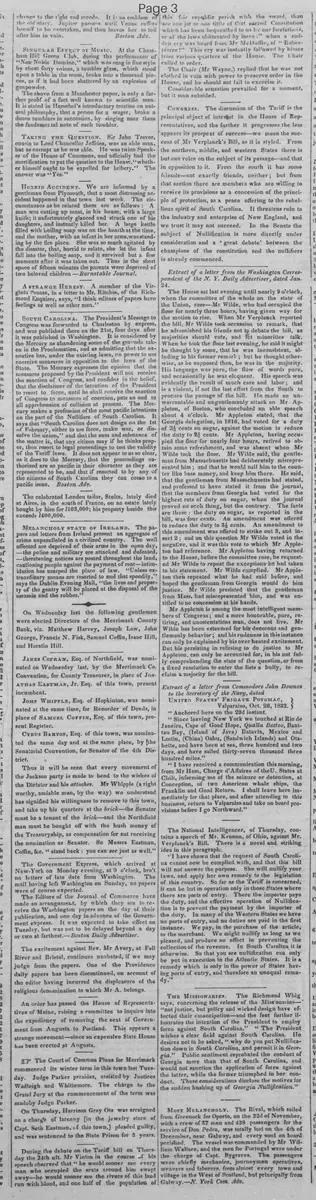
Congress. The discussion of the Tariff is the principal object of interest in the House of Representatives, and the further it progresses the less appears its prospect of success—we mean the success of Mr. Verplanck's Bill, as it is styled. From the northern, middle, and western States there is but one voice on the subject of its passage—and that in opposition to it. From the south it has some friends—not exactly friends, neither; but from that section there are members who are willing to receive its provisions as a concession of the principle of protection, as a peace offering to the rebellious spirit of South Carolina. It threatens ruin to the industry and enterprise of New England, and we trust it may not succeed. In the Senate the subject of Nullification is more directly under consideration and a great debate between the champions of the constitution and the nullifiers is already commenced.
Extract of a letter from the Washington Correspondent of the N. Y. Daily Advertiser, dated Jan. 24.
The House sat last evening until nearly 9 o'clock, when the committee of the whole on the state of the Union, rose—Mr. Wilde, who had occupied the floor for nearly three hours, having given way for the motion to rise. When Mr. Verplanck reported the bill, Mr. Wilde took occasion to remark, that he admonished his friends not to debate the bill, as majorities should vote, and let minorities talk. When he took the floor last evening, he said it might be thought by some, that he was inconsistent, alluding to his former remark; but he thought otherwise, as he supposed then, he was in the majority. His language was pure, the flow of words pure, and occasionally he was eloquent. His speech was evidently the result of much care and labor; and is a violent, if not the last effort from the South to procure the passage of the bill. He made an unwarrantable and ungentlemanly attack on Mr. Appleton, of Boston, who concluded an able speech about 4 o'clock. Mr. Appleton stated, that the Georgia delegation, in 1816, had voted for a duty of 3 cents on sugar, against the motion to reduce the duty to 2 cents. Mr. Appleton, having occupied the floor for nearly four hours, retired to obtain some refreshment, and was absent when Mr. Wilde took the floor. Mr. Wilde said, the gentleman from Massachusetts had deliberately misrepresented him; and that he would nail him to the counter like base money, and keep him there. He said, that the gentleman from Massachusetts had stated, and professed to have stated it from the journal, that the members from Georgia had voted for the highest rate of duty on sugar, when the journal proved no such thing, but the contrary. The facts are these: the duty on sugar, as reported in the bill, was four cents. An amendment was offered to reduce the duty to 3½ cents. An amendment to this amendment was offered to strike out 3, and insert 2; and on this question Mr. Wilde voted in the negative, and it was this vote to which Mr. Appleton had reference. Mr. Appleton having returned to the House, before the committee rose, he requested Mr. Wilde to repeat the exceptions he had taken to his statement. Mr. Wilde complied. Mr. Appleton then repeated what he had said before, and hoped the gentleman from Georgia would do him justice. Mr. Wilde persisted that the gentleman from Mass. had misrepresented him, and was entitled to no concession at his hands. Mr. Appleton is among the most intelligent members of Congress; and a more honorable, pure, retiring, and unostentatious man, does not live. Mr. Wilde has been esteemed for his decorous and gentlemanly behavior; and his rudeness in this instance can only be explained by his over heated excitement. But his persisting in refusing to do justice to Mr. Appleton, can only be accounted for, in his not fully comprehending the state of the question, or from a fixed resolution to enter the lists a bully, to reclaim a majority for the bill.
What sub-type of article is it?
What keywords are associated?
What entities or persons were involved?
Where did it happen?
Domestic News Details
Primary Location
Washington
Event Date
Thursday The 24th Ult.; Jan. 24
Key Persons
Outcome
considerable sensation prevailed for a moment, but it soon subsided. debate continues with growing opposition to the bill's passage from northern, middle, and western states.
Event Details
During the Tariff bill debate, Mr. Vinton spoke vehemently in defense of the Constitution, leading to Mr. McDuffie's cry of 'Robespierre!' and hisses in the House; the Chair, Mr. Wayne, called for order. The Verplanck bill faces opposition as a concession to South Carolina's rebellious spirit, threatening New England's industry. In the Senate, Nullification is debated. Mr. Wilde's speech attacked absent Mr. Appleton over sugar duty votes, later clarified but with Wilde refusing concession amid excitement.