Thank you for visiting SNEWPapers!
Sign up free
Literary
September 20, 1822
The Virginian
Lynchburg, Virginia
What is this article about?
Satirical essay critiquing 'modern impudence' as key to gaining attention and respect, despite lacking true talent or virtue. Describes pretenders posing as scholars, honest men, or socialites, while the deserving remain obscure. Signed by Civilis, dated September 14, 1822.
Clipping
OCR Quality
85%
Good
Full Text
FOR THE VIRGINIAN.
THE MISCELLANIST-No. III,
"O thou greatest of all the Deities.
"Modern impudence!"
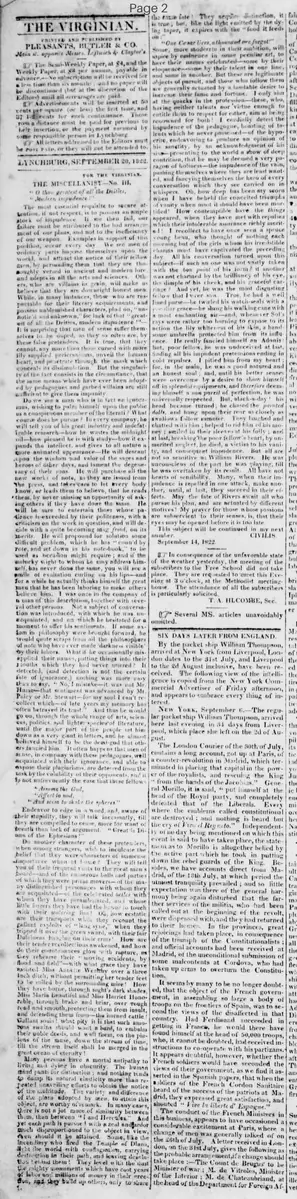
The most essential requisite to secure attention, if not respect, is to possess an ample stock of impudence. If we then fail, our failure must be attributed to the bad arrangement of our plans, and not to the inefficiency of our weapon. Examples in support of this position, occur every day. We see men of ordinary parts impose themselves upon the world, and attract the notice of their fellow men, by persuading them that they are thoroughly versed in ancient and modern lore and adepts in all the arts and sciences. Others, who are villains in grain, will make us believe that they are downright honest men. While, in many instances, those who are respectable for their literary acquirements, and possess unblemished characters, plod on, "unnoticed and unknown," for lack of that "greatest of all the Deities, modern impudence." It is surprising that men of sense suffer themselves to be duped, as they so often are, by these false pretenders. It is true, that they cannot, any more than those cursed with more ill supplied pericraniums, unveil the human heart, and penetrate through the mask which conceals its dissimulation. But the singularity of the fact consists in the circumstance, that the same means which have ever been adopted by pedagogues and garbed villains are still sufficient to give them impunity.
Do we see a man who is in fact an ignoramus, wishing to palm himself upon the public as a conspicuous member of the literati? What course does he pursue? In every company, he will tell you of his great industry and indefatigable research-how he wastes the midnight oil-how pleased he is with study-how it expands the intellect, and gives to all nature a more animated appearance. He will descant upon the wisdom and valor of the sages and heroes of other days, and lament the degeneracy of their sons. He will purchase all the new works of note, as they are issued from the press, and takes care to let everybody know, or leads them to believe, that he reads them, by never missing an opportunity of asking others if they have done the same. He will be sure to entertain those whose patience is exceeded by their politeness, with a criticism on the work in question, and will deride with a quite becoming sang froid, on its merits. He will propound for solution some difficult problem, which he has "conn'd by rote, and set down in his note-book," to be used as occasion might require: and if the unlucky wight to whom he may address himself, has never done the same, you will see a smile of exultation curling on his lips-and for a while he actually thinks himself the great man that he has been laboring to make others believe him. I was once in the company of a man of this description, together with several other persons. Not a subject of conversation was introduced, with which he was unacquainted, and on which he hesitated for a moment to offer his sentiments. If some axiom in philosophy were brought forward, he would quote scraps from all the philosophers of note who have ever made darkness visible by their labors. What if he occasionally misapplied their maxims, putting things into their mouths which they had never uttered? It was not detected, (and detection is not the certain fate of ignorance.) nothing was more easy than to say, "No, I mistake-it was not Mr. Hume-that sentiment was advanced by Mr. Paley or Mr. Stewart-for my soul I can't recollect which-of late years my memory has often betrayed its trust." And thus he would go on, through the whole range of arts, sciences, politics, and lighter species of literature, until the major part of the people set him down as a very giant in letters, and he almost believed himself to be the demi-god that others fancied him. It often happens that men of sense, in company with these pedagogues, well acquainted with their ignorance, and able to expose their plagiarisms, are deterred from the task by the volubility of their opponents, and it is not unfrequently the case that those fellows
Assume the God,
"Affect to nod,
"And seem to shake the spheres."
Endeavor to edge in a word, and, aware of their stupidity, they will talk incessantly, till they are compelled to cease, more for want of breath than lack of argument. "Great is Diana of the Ephesians."
Do another character of these pretenders, when among strangers, wish to inculcate the belief that they were characters of immense importance when at home? They will tell you of their frequent visits to the great man's board-and of the numerous balls and parties of which they were prime movers-of the many distinguished personages with whom they are acquainted-of the celebrated belles with whom they have perambulated, and whose little fingers they have had the honor to touch with their watering lips! Oh, how ecstatic are their transports while they recount the gallant exploits of "lang syne," when they tripped it over the green sward, with their fair beauties hanging on their arms! How are their tender recollections awakened, and how do their countenances glow with rapture, as they rehearse their "moving accidents, by flood and field"-with what grace they have assisted Miss Annette Wealthy over a three inch ditch, without permitting her tender feet to be soiled by the surrounding mire! How they have borne, through night's dark shades, Miss Maria Beautiful and Miss Harriet Honorable, through brake and briar, over rough road and smooth, protecting them from insult, and defending them from the horned cattle! Gallant souls! what pity it is that such amorous swains should want a bard, to embalm their noble deeds, and waft them, on the pinions of the muse, down the stream of time, till the stream itself shall be merged in the great ocean of eternity!
Many persons have a mortal antipathy to living and dying in obscurity. The human mind pants for distinction; and nothing tends to damp its natural elasticity more than repeated unavailing efforts to obtain the notice of the multitude. The variety and difference of the plans adopted by men, to attain this object, are worthy of remark. In many cases, there is not a jot more of similarity between them, than between "I and Hercules." And yet each path is pursued with a zeal and ardor much disproportioned to the object in view, even should it be attained. Some, like the incendiary who fired the Temple of Diana,
Might the world with conflagration, carrying destruction in their path, and leaving desolation behind them! They level with the dust the mighty monuments which have cost years of labor and millions of money in their erection, and they build up others, only to share the same fate! They require distinction, it is true; but, like the light emitted by the dying taper, it expires with the "food it feeds on:"
"One Caesar lives, a thousand are forgot!"
Some, more moderate in their ambition, will aspire by eminence in some peculiar art, to have their names celebrated-some by their eloquence-some by their talent in one line, and some in another. But these are legitimate objects of pursuit, and those who follow them are generally actuated by a laudable desire to increase their fame and fortune. I only aim at the quacks in the profession-these, who, having neither talents nor virtue enough to entitle them to respect for either, aim at being renowned for both. I cordially detest the impudence of the pedagogue, boasting of talents which he never possessed-of the hypocrite, endeavoring to produce an opinion of his sanctity, by an acknowledgment of his sins-presenting to the world a show of deep contrition, that he may be deemed a very patron of holiness-the impudence of the vain, pushing themselves where they are least wanted, and fancying themselves the hero of every conversation which they see carried on in whispers. Oh, how deep has been my scorn when I have beheld these conceited triumphs of vanity when most it should have been mortified! How contemptible have the things appeared, when they have met with repulses which their intolerable assurance richly merited! I recollect to have once seen a spruce young beau, who thought of nothing each morning but of the girls whom his irresistible charms must have captivated the preceding day. All his conversation turned upon this subject-if such an one was not vastly taken with the bon point of his form? if another was not charmed by the brilliancy of his eye, the dimple of his cheek, and his graceful carriage? And yet, he was the most disgusting fellow that I ever saw. True, he had a well lined purse-he twirled his watch-seals with a resilient grace-he slung his walking cane with a most enchanting air-and, whenever Sol's rays were rather too burning to expose to its action the lily whiteness of his skin, a handsome umbrella protected him from its influence. He really fancied himself an Adonis; but, poor fellow, he was undeceived at last, finding all his impudent pretensions ending in cold repulses. I pitied him from my heart; for, in the main, he was a good natured and an honest soul; and, until his better senses were overcome by a desire to show himself off in splendid equipments, and therefore deeming himself a non pareil of perfection, he was universally respected. But, alack-a-day! his head became turned; he chased the painted dolls, and hung upon their rear as closely as swallows follow summer. They laughed and chatted with him; helped to rid him of his money; smiled in their sleeves at his folly; and at last, breaking the poor fellow's heart, by unmerited neglect, he died, a victim to his vanity, and consequent impudence. But all are not so sensitive as William Rivers. He was unconscious of the part he was playing, till he was overtaken by its result. All have not hearts of sensibility. Many, when their impudence is repelled in one attack, make another, until, at last, they succeed in their efforts. May the fate of Rivers await all who pursue his plan, and are actuated by different motives! My prayer for those whose passions are subservient to their senses, is, that their eyes may be opened before it is too late.
This subject will be continued in my next number.
CIVILIS
September 14, 1822
THE MISCELLANIST-No. III,
"O thou greatest of all the Deities.
"Modern impudence!"
The most essential requisite to secure attention, if not respect, is to possess an ample stock of impudence. If we then fail, our failure must be attributed to the bad arrangement of our plans, and not to the inefficiency of our weapon. Examples in support of this position, occur every day. We see men of ordinary parts impose themselves upon the world, and attract the notice of their fellow men, by persuading them that they are thoroughly versed in ancient and modern lore and adepts in all the arts and sciences. Others, who are villains in grain, will make us believe that they are downright honest men. While, in many instances, those who are respectable for their literary acquirements, and possess unblemished characters, plod on, "unnoticed and unknown," for lack of that "greatest of all the Deities, modern impudence." It is surprising that men of sense suffer themselves to be duped, as they so often are, by these false pretenders. It is true, that they cannot, any more than those cursed with more ill supplied pericraniums, unveil the human heart, and penetrate through the mask which conceals its dissimulation. But the singularity of the fact consists in the circumstance, that the same means which have ever been adopted by pedagogues and garbed villains are still sufficient to give them impunity.
Do we see a man who is in fact an ignoramus, wishing to palm himself upon the public as a conspicuous member of the literati? What course does he pursue? In every company, he will tell you of his great industry and indefatigable research-how he wastes the midnight oil-how pleased he is with study-how it expands the intellect, and gives to all nature a more animated appearance. He will descant upon the wisdom and valor of the sages and heroes of other days, and lament the degeneracy of their sons. He will purchase all the new works of note, as they are issued from the press, and takes care to let everybody know, or leads them to believe, that he reads them, by never missing an opportunity of asking others if they have done the same. He will be sure to entertain those whose patience is exceeded by their politeness, with a criticism on the work in question, and will deride with a quite becoming sang froid, on its merits. He will propound for solution some difficult problem, which he has "conn'd by rote, and set down in his note-book," to be used as occasion might require: and if the unlucky wight to whom he may address himself, has never done the same, you will see a smile of exultation curling on his lips-and for a while he actually thinks himself the great man that he has been laboring to make others believe him. I was once in the company of a man of this description, together with several other persons. Not a subject of conversation was introduced, with which he was unacquainted, and on which he hesitated for a moment to offer his sentiments. If some axiom in philosophy were brought forward, he would quote scraps from all the philosophers of note who have ever made darkness visible by their labors. What if he occasionally misapplied their maxims, putting things into their mouths which they had never uttered? It was not detected, (and detection is not the certain fate of ignorance.) nothing was more easy than to say, "No, I mistake-it was not Mr. Hume-that sentiment was advanced by Mr. Paley or Mr. Stewart-for my soul I can't recollect which-of late years my memory has often betrayed its trust." And thus he would go on, through the whole range of arts, sciences, politics, and lighter species of literature, until the major part of the people set him down as a very giant in letters, and he almost believed himself to be the demi-god that others fancied him. It often happens that men of sense, in company with these pedagogues, well acquainted with their ignorance, and able to expose their plagiarisms, are deterred from the task by the volubility of their opponents, and it is not unfrequently the case that those fellows
Assume the God,
"Affect to nod,
"And seem to shake the spheres."
Endeavor to edge in a word, and, aware of their stupidity, they will talk incessantly, till they are compelled to cease, more for want of breath than lack of argument. "Great is Diana of the Ephesians."
Do another character of these pretenders, when among strangers, wish to inculcate the belief that they were characters of immense importance when at home? They will tell you of their frequent visits to the great man's board-and of the numerous balls and parties of which they were prime movers-of the many distinguished personages with whom they are acquainted-of the celebrated belles with whom they have perambulated, and whose little fingers they have had the honor to touch with their watering lips! Oh, how ecstatic are their transports while they recount the gallant exploits of "lang syne," when they tripped it over the green sward, with their fair beauties hanging on their arms! How are their tender recollections awakened, and how do their countenances glow with rapture, as they rehearse their "moving accidents, by flood and field"-with what grace they have assisted Miss Annette Wealthy over a three inch ditch, without permitting her tender feet to be soiled by the surrounding mire! How they have borne, through night's dark shades, Miss Maria Beautiful and Miss Harriet Honorable, through brake and briar, over rough road and smooth, protecting them from insult, and defending them from the horned cattle! Gallant souls! what pity it is that such amorous swains should want a bard, to embalm their noble deeds, and waft them, on the pinions of the muse, down the stream of time, till the stream itself shall be merged in the great ocean of eternity!
Many persons have a mortal antipathy to living and dying in obscurity. The human mind pants for distinction; and nothing tends to damp its natural elasticity more than repeated unavailing efforts to obtain the notice of the multitude. The variety and difference of the plans adopted by men, to attain this object, are worthy of remark. In many cases, there is not a jot more of similarity between them, than between "I and Hercules." And yet each path is pursued with a zeal and ardor much disproportioned to the object in view, even should it be attained. Some, like the incendiary who fired the Temple of Diana,
Might the world with conflagration, carrying destruction in their path, and leaving desolation behind them! They level with the dust the mighty monuments which have cost years of labor and millions of money in their erection, and they build up others, only to share the same fate! They require distinction, it is true; but, like the light emitted by the dying taper, it expires with the "food it feeds on:"
"One Caesar lives, a thousand are forgot!"
Some, more moderate in their ambition, will aspire by eminence in some peculiar art, to have their names celebrated-some by their eloquence-some by their talent in one line, and some in another. But these are legitimate objects of pursuit, and those who follow them are generally actuated by a laudable desire to increase their fame and fortune. I only aim at the quacks in the profession-these, who, having neither talents nor virtue enough to entitle them to respect for either, aim at being renowned for both. I cordially detest the impudence of the pedagogue, boasting of talents which he never possessed-of the hypocrite, endeavoring to produce an opinion of his sanctity, by an acknowledgment of his sins-presenting to the world a show of deep contrition, that he may be deemed a very patron of holiness-the impudence of the vain, pushing themselves where they are least wanted, and fancying themselves the hero of every conversation which they see carried on in whispers. Oh, how deep has been my scorn when I have beheld these conceited triumphs of vanity when most it should have been mortified! How contemptible have the things appeared, when they have met with repulses which their intolerable assurance richly merited! I recollect to have once seen a spruce young beau, who thought of nothing each morning but of the girls whom his irresistible charms must have captivated the preceding day. All his conversation turned upon this subject-if such an one was not vastly taken with the bon point of his form? if another was not charmed by the brilliancy of his eye, the dimple of his cheek, and his graceful carriage? And yet, he was the most disgusting fellow that I ever saw. True, he had a well lined purse-he twirled his watch-seals with a resilient grace-he slung his walking cane with a most enchanting air-and, whenever Sol's rays were rather too burning to expose to its action the lily whiteness of his skin, a handsome umbrella protected him from its influence. He really fancied himself an Adonis; but, poor fellow, he was undeceived at last, finding all his impudent pretensions ending in cold repulses. I pitied him from my heart; for, in the main, he was a good natured and an honest soul; and, until his better senses were overcome by a desire to show himself off in splendid equipments, and therefore deeming himself a non pareil of perfection, he was universally respected. But, alack-a-day! his head became turned; he chased the painted dolls, and hung upon their rear as closely as swallows follow summer. They laughed and chatted with him; helped to rid him of his money; smiled in their sleeves at his folly; and at last, breaking the poor fellow's heart, by unmerited neglect, he died, a victim to his vanity, and consequent impudence. But all are not so sensitive as William Rivers. He was unconscious of the part he was playing, till he was overtaken by its result. All have not hearts of sensibility. Many, when their impudence is repelled in one attack, make another, until, at last, they succeed in their efforts. May the fate of Rivers await all who pursue his plan, and are actuated by different motives! My prayer for those whose passions are subservient to their senses, is, that their eyes may be opened before it is too late.
This subject will be continued in my next number.
CIVILIS
September 14, 1822
What sub-type of article is it?
Essay
Satire
What themes does it cover?
Social Manners
Moral Virtue
What keywords are associated?
Impudence
Pretense
Satire
Literati
Social Climbers
Vanity
Hypocrisy
What entities or persons were involved?
Civilis
Literary Details
Title
The Miscellanist No. Iii
Author
Civilis
Subject
On Modern Impudence
Form / Style
Satirical Prose Essay
Key Lines
"O Thou Greatest Of All The Deities. Modern Impudence!"
"One Caesar Lives, A Thousand Are Forgot!"
The Most Essential Requisite To Secure Attention, If Not Respect, Is To Possess An Ample Stock Of Impudence.