Thank you for visiting SNEWPapers!
Sign up free
Oxford Democrat
Paris, South Paris, Oxford County, Maine
What is this article about?
A jealous suitor overhears a misunderstanding confession of love, leading to heartbreak, but an embroidered stocking reveals his beloved's presence at a seaside inn, resolving the mix-up involving her cousin's secret affection for another man, culminating in two weddings.
Merged-components note: Merged sequential reading order components that continue the same narrative story 'AN EMBROIDERED STOCKING'.
Clipping
OCR Quality
Full Text
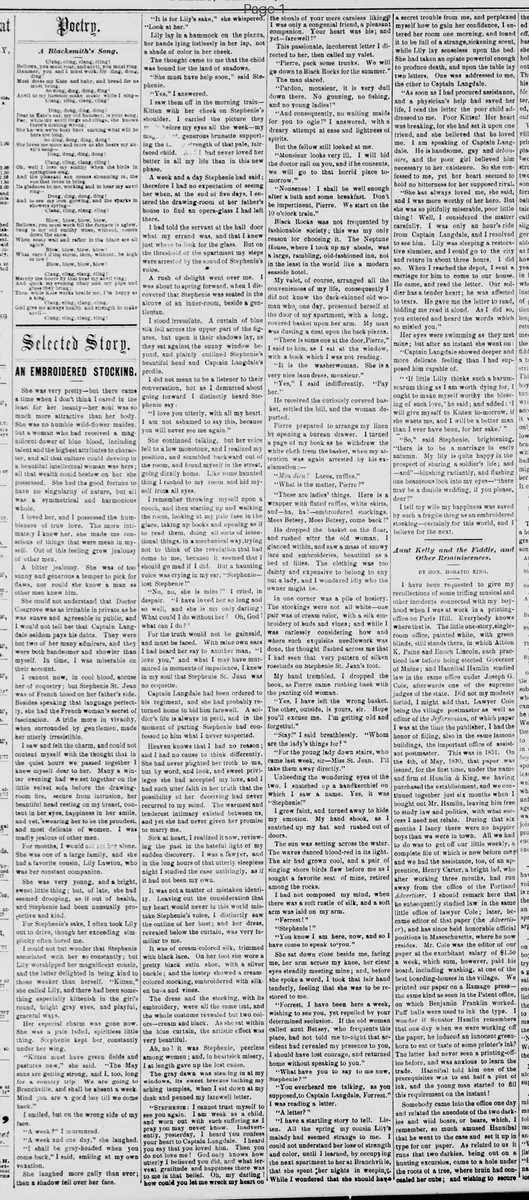
AN EMBROIDERED STOCKING.
She was very pretty—but there came a time when I don't think I cared in the least for her beauty—her soul was so much more attractive than her body.
She was no humble wild-flower maiden, but a woman who had received a magnificent dower of blue blood, including talent and the highest attributes to character, and all that culture could develop in a beautiful intellectual woman was hers; all that wealth could bestow on her she possessed. She had the good fortune to have no singularity of nature, but all was a symmetrical and harmonious whole.
I loved her, and I possessed the humbleness of true love. The more intimately I knew her, she made me conscious of things that were mean in myself. Out of this feeling grew jealousy of other men.
A bitter jealousy. She was of too sunny and generous a temper to pick for flaws, nor could she know a man as other men knew him.
She could not understand that Doctor Cosgrove was as irritable in private as he was suave and agreeable in public, and I would not tell her that Captain Langdale seldom pays his debts. They were but two of her many admirers, and they were both handsomer and showier than myself. In time, I was miserable on their account.
I cannot now, in cool blood, accuse her of coquetry; but Stephenie St. Jean was of French blood on her father's side. Besides speaking that language perfectly, she had the French woman's secret of fascination. A trifle more in vivacity, when surrounded by gentlemen, made her utterly irresistible.
I saw and felt the charm, and could not content myself with the thought that in the quiet hours we passed together I knew myself dear to her. Many a winter evening had we sat together on the little velvet sofa before the drawing-room fire, secure from intrusion, her beautiful head resting on my breast, content in her eyes, happiness in her smile, and yet, swearing her to be the proudest, and most delicate of women. I was madly jealous of other men.
For months I would not see her alone. She was one of a large family, and she had a favorite cousin, Lily Lawton, who was her constant companion.
She was very young, and a bright, sweet little thing; but, of late, she had seemed drooping, as if out of health, and Stephenie had been unusually protective and kind.
For Stephenie's sake, I often took Lily out to drive, though her exceeding simplicity often bored me.
I could not but wonder that Stephenie associated with her so constantly; but Lily worshipped her magnificent cousin, and the latter delighted in being kind to those weaker than herself. "Kitten," she called Lily, and there had been something especially kittenish in the girl's round, bright gray eyes, and playful, graceful ways.
Her especial charm was gone now. She was a pale faded, spiritless little thing. Stephenie kept her, constantly under her wing.
…Kitten must have green fields and pastures new," she said. "The May suns are getting strong, and I, too, long for a country trip. We are going to Branchville, and shall be absent a week. Mind you are a good boy till we come back."
I smiled, but on the wrong side of my face.
"A week?" I murmured.
"A week and one day," she laughed.
"I shall be gray-headed when you come back," I said, smiling at my own vexation.
She laughed more gaily than ever; then a shadow fell over her face.
"It is for Lily's sake," she whispered. "Look at her."
Lily lay in a hammock on the piazza, her hands lying listlessly in her lap, not a shade of color in her cheek.
The thought came to me that the child was bound for the land of shadows.
"She must have help soon," said Stephenie.
"Yes," I answered.
I saw them off in the morning train—Kitten with her cheek on Stephenie's shoulder. I carried the picture they made before my eyes all the week—my magnificent, generous brunette supporting the weakness of that pale, fair faced child. And I had never loved her better in all my life than in this new phase.
A week and a day Stephenie had said therefore I had no expectation of seeing her when, at the end of five days, I entered the drawing-room of her father's house to find an opera-glass I had left there.
I had told the servant at the hall door what my errand was, and that I knew just where to look for the glass. But on the threshold of the apartment my steps were arrested by the sound of Stephenie's voice.
A rush of delight went over me. I was about to spring forward, when I discovered that Stephenie was seated in the alcove of an inner-room, beside a gentleman.
I stood irresolute. A curtain of blue silk fell across the upper part of the figures, but upon it their shadows lay, as they sat against the sunny window beyond, and plainly outlined Stephenie's beautiful head and Captain Langdale's profile.
I did not mean to be a listener to their conversation, but as I demurred about going forward I distinctly heard Stephenie say:
"I love you utterly, with all my heart I am not ashamed to say this, because you will never see me again."
She continued talking, but her voice fell to a low monotone, and I realized my position, and stumbled backward out of the room, and found myself in the street, going dizzily home. Like some haunted thing I rushed to my room and hid myself from all eyes.
I remember throwing myself upon a couch, and then starting up and walking the room, looking at my pale face in the glace, taking up books and opening as if to read them, doing all sorts of intentional things, in a mechanical way, trying not to think of the revelation that had come to me, because it seemed that I should go mad if I did. But a haunting voice was crying in my ear. "Stephenie—lost Stephenie!"
"No, no, she is mine!" I cried, in despair. I have loved her so long and so well, and she is my only darling! What could I do without her? Oh, God! what can I do?'
For the truth would not be gainsaid, and must be faced. With mine own ears I had heard her say to another man, "I love you," and what I may have murmured in moments of impatience, I knew in my soul that Stephenie St. Jean was no coquette.
Captain Langdale had been ordered to his regiment, and she had probably returned home to bid him farewell. A soldier's life is always in peril, and in the moment of parting Stephenie had confessed to him what I never suspected.
Heaven knows that I had no reason; and I had no cause to think differently. She had never plighted her troth to me, but by word, and look, and sweet privileges she had accepted my love, and I had such utter faith in her truth that the possibility of her deceiving had never recurred to my mind. The warmest and tenderest intimacy existed between us, and yet she had never given her promise to marry me.
Sick at heart, I realized it now, reviewing the past in the hateful light of my sudden discovery. I was a lawyer, and in the long hours of that utterly sleepless night I studied the case untiringly, as if it had not been my own.
It was not a matter of mistaken identity. Leaving out the consideration that my heart would never in this world mistake Stephenie's voice, I distinctly saw the outline of her bust; and her dress, revealed below the curtain, was very familiar to me.
It was of cream-colored silk, trimmed with black lace. On her foot she wore a pretty black satin shoe, with a silver buckle; and the instep showed a cream colored stocking, embroidered with silk buds and vines.
The dress and the stocking, with its embroidery, were all the same tint, and the whole costume revealed but two colors—cream and black. As she sat within the blue curtain, the artistic effect was very beautiful.
Ah, no! it was Stephenie, peerless among women; and, in heartsick misery, I at length gave up the lost cause.
The gray dawn was stealing in at my windows, its sweet breezes bathing my aching temples, when I sat down at my desk and penned my farewell letter.
"Stephenie: I cannot trust myself to see you again. I am weak as a child, and worn out with such suffering as I pray you may never know. Inadvertently, yesterday, I heard you confess your heart to Captain Langdale. I heard you say that you loved him. Then you do not love me! God only knows how utterly I believed you did, and what infinite gratitude and happiness there was to me in that belief. Oh, my darling! how could you let me wreck my heart on the shoals of your mere careless liking! I was only a congenial friend, a pleasant companion. Your heart was his; and yet—farewell!"
This passionate, incoherent letter I directed to her, then called my valet.
"Pierre, pack some trunks. We will go down to Black Rocks for the summer."
The man stared.
"Pardon, monsieur, it is very dull down there. No gunning, no fishing, and no young ladies!"
"And consequently, no waiting maids for you to ogle!" I answered, with a dreary attempt at ease and lightness of spirits.
But the fellow still looked at me.
"Monsieur looks very ill. I will bid the doctor call on you, and if he consents, we will go to that horrid place to-morrow."
…Nonsense! I shall be well enough after a bath and some breakfast. Don't be impertinent, Pierre. We start on the 10 o'clock train."
Black Rocks was not frequented by fashionable society; this was my only reason for choosing it. The Neptune House, where I took up my abode, was a large, rambling, old-fashioned inn, not in the least in the world like a modern seaside hotel.
My valet, of course, arranged all the conveniences of my life, consequently I did not know the dark-skinned old woman who, one day, presented herself at the door of my apartment, with a long, covered basket upon her arm. My man was dusting a coat upon the back piazza.
"There is some one at the door, Pierre," I said to him, as I sat at the window, with a book which I was not reading.
"It is the washerwoman. She is a very nice laundress, monsieur."
"Yes," I said indifferently.
"Pay her."
He received the curiously covered basket, settled the bill, and the woman departed.
Pierre prepared to arrange my linen by opening a bureau drawer. I turned a page of my book as he withdrew the white cloth from the basket, when my attention was again arrested by his exclamation:-
"Mon Dieu! Laces, ruffles."
"What is the matter, Pierre?"
"These are ladies' things. Here is a wrapper with fluted ruffles, white skirts, and—ha, ha!—embroidered stockings. Mees Betsey, Mees Betsey, come back!"
He dropped the basket on the floor, and rushed after the old woman. I glanced within, and saw a mass of snowy lace and embroideries, beautiful as a bed of lilies. The clothing was too dainty and expensive to belong to any but a lady, and I wondered idly who the owner might be.
In one corner was a pile of hosiery. The stockings were not all white—one pair was of cream color, with a silk embroidery of buds and vines; and while I was carelessly considering how and where such exquisite needlework was done, the thought flashed across me that I had seen that very pattern of silken rosebuds on Stephenie St. Jean's foot.
My hand trembled, I dropped the book, as Pierre came rushing back with the panting old woman.
"Yes, I have left the wrong basket The other, outside, is yours, sir. Hope you'll excuse me. I'm getting old and forgetful."
"Stay!" I said breathlessly. "Whom are the lady's things for?"
"For the young lady down stairs, who came last week, sir—Miss St. Jean. I'll take them away directly."
Unheeding the wondering eyes of the two, I snatched up a handkerchief on which I saw a name. Yes, it was "Stephenie!"
I grew faint, and turned away to hide my emotion. My hand shook, as I snatched up my hat and rushed out of doors.
The sun was setting across the water. The waves danced blood-red in its light. The air had grown cool, and a pair of singing shore birds flew before me as I sought a favorite seat of mine, retired among the rocks.
I had not composed my mind, when there was a soft rustle of silk, and a soft arm was laid on my arm.
"Forrest!"
"Stephenie!"
"You know I am here, now, and so I have come to speak to you."
She sat down close beside me, facing me, her arm across my knee, her clear eyes steadily meeting mine; and, before she spoke a word, I took that fair hand tenderly, feeling that she was to be restored to me.
"Forrest, I have been here a week, wishing to see you, yet repelled by your determined seclusion. If the old woman called aunt Betsey, who frequents this place, had not told me to-night that accident had revealed my presence to you, I should have lost courage, and returned home without speaking to you."
"What have you to say to me now, Stephenie?"
"You overheard me talking, as you supposed, to Captain Langdale, Forrest."
I was reading a letter.
"A letter?"
"I have a startling story to tell. Listen. All the spring my cousin Lily's malady had seemed strange to me. I could not understand her loss of strength and color, until I learned, by occupying the next apartment to her at Branchville, that she spent her nights in weeping While I wondered that she should happen to have a secret trouble from me, and perplexed myself how to gain her confidence, I entered her room one morning, and found it to be full of a strange, sickening scent, while Lily lay senseless upon the bed.
She had taken an opiate powerful enough to produce death, and upon the table lay two letters. One was addressed to me, the other to Captain Langdale.
"As soon as I had procured assistance, and a physician's help had saved her life, I read the letter the poor child addressed to me. Poor Kitten! Her heart was breaking, for she had set it upon one friend, and she believed that he loved me. I am speaking of Captain Langdale. He is handsome, gay and debonnaire, and the poor girl believed him necessary to her existence. So she confessed to me, yet her heart seemed to hold no bitterness for her supposed rival. She has always loved me, she said, and I was more worthy of her hero. But she was so pitifully miserable, poor little thing! Well, I considered the matter carefully. I was only an hour's ride from Captain Langdale, and I resolved to see him. Lily was sleeping a restorative slumber, and I could go to the city and return in about three hours. I did so. When I reached the depot, I sent a carriage for him to come to our house. He came, and read the letter. Our soldier has a tender heart: he was affected to tears. He gave me the letter to read, bidding me read it aloud. As I did so, you entered and heard the words which so misled you."
Her eyes were swimming as they met mine; but after an instant she went on:
"Captain Langdale showed deeper and more delicate feeling than I had supposed him capable of.
"If little Lily thinks such a harum-scarum thing as I am worth dying for, I ought to make myself worthy the blessing of such love," he said; and added: 'I will give myself to Kitten to-morrow, if she wants me, and I will be a better man than I ever have been, for her sake.'"
"So," said Stephenie, brightening "there is to be a marriage in early autumn. My lily is quite happy in the prospect of sharing a soldier's life; and —and"—blushing radiantly, and flashing one beauteous look into my eyes—"there may be a double wedding, if you please, dear!"
I tell my wife my happiness was saved by such a fragile thing as an embroidered stocking—certainly for this world, and I believe for the next.
What sub-type of article is it?
What themes does it cover?
What keywords are associated?
What entities or persons were involved?
Where did it happen?
Story Details
Key Persons
Location
Branchville, Black Rocks
Story Details
Jealous narrator overhears Stephenie confessing love to Captain Langdale, but it's her reading Lily's suicide note aloud; misunderstanding resolved when embroidered stocking reveals Stephenie's presence at seaside, leading to explanations and double wedding.