Thank you for visiting SNEWPapers!
Sign up free
Editorial
August 2, 1935
The Independent
Elizabeth City, Pasquotank County, North Carolina
What is this article about?
Editorial argues that technological advances in agriculture and industry are displacing millions of workers, necessitating expanded government public works programs, potentially reaching $10 billion annually, as private capitalism cannot provide sufficient jobs.
Clipping
OCR Quality
95%
Excellent
Full Text
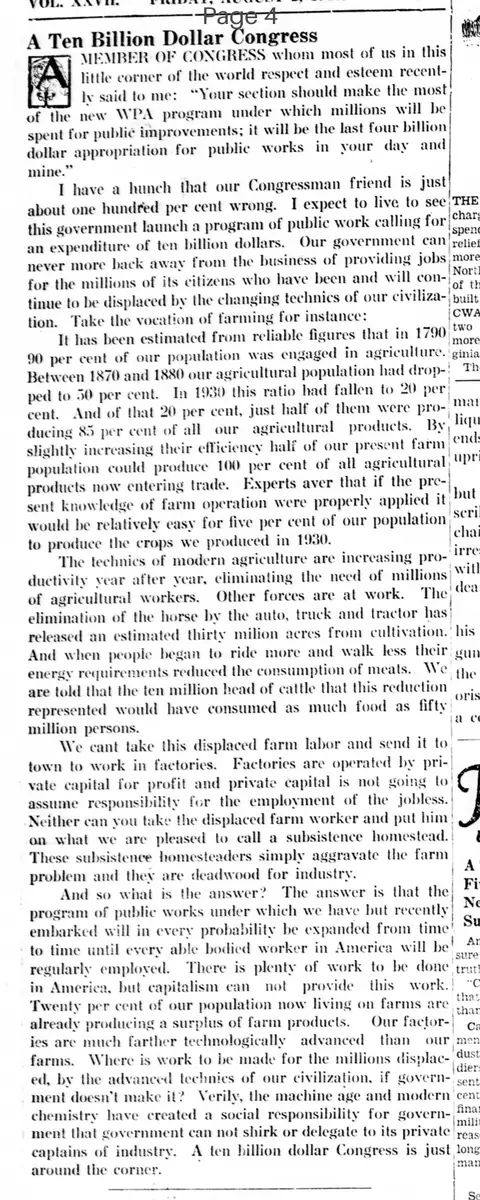
A Ten Billion Dollar Congress
MEMBER OF CONGRESS whom most of us in this
little corner of the world respect and esteem recently
said to me: "Your section should make the most
of the new WPA program under which millions will be
spent for public improvements; it will be the last four billion
dollar appropriation for public works in your day and
mine."
I have a hunch that our Congressman friend is just
about one hundred per cent wrong. I expect to live to see
this government launch a program of public work calling for
an expenditure of ten billion dollars. Our government can
never more back away from the business of providing jobs
for the millions of its citizens who have been and will con-
tinue to be displaced by the changing technics of our civiliza-
tion. Take the vocation of farming for instance:
It has been estimated from reliable figures that in 1790
90 per cent of our population was engaged in agriculture.
Between 1870 and 1880 our agricultural population had drop-
ped to 50 per cent. In 1930 this ratio had fallen to 20 per
cent. And of that 20 per cent, just half of them were pro-
ducing 85 per cent of all our agricultural products. By
slightly increasing their efficiency half of our present farm
population could produce 100 per cent of all agricultural
products now entering trade. Experts aver that if the pre-
sent knowledge of farm operation were properly applied it
would be relatively easy for five per cent of our population
to produce the crops we produced in 1930.
The technics of modern agriculture are increasing pro-
ductivity year after year, eliminating the need of millions
of agricultural workers. Other forces are at work. The
elimination of the horse by the auto, truck and tractor has
released an estimated thirty million acres from cultivation.
And when people began to ride more and walk less their
energy requirements reduced the consumption of meats. We
are told that the ten million head of cattle that this reduction
represented would have consumed as much food as fifty
million persons
We can't take this displaced farm labor and send it to
town to work in factories. Factories are operated by pri-
vate capital for profit and private capital is not going to
assume responsibility for the employment of the jobless.
Neither can you take the displaced farm worker and put him
on what we are pleased to call a subsistence homestead.
These subsistence homesteaders simply aggravate the farm
problem and they are deadwood for industry.
And so what is the answer? The answer is that the
program of public works under which we have but recently
embarked will in every probability be expanded from time
to time until every able bodied worker in America will be
regularly employed. There is plenty of work to be done
in America, but capitalism can not provide this work.
Twenty per cent of our population now living on farms are
already producing a surplus of farm products. Our factor-
ies are much farther technologically advanced than our
farms. Where is work to be made for the millions displac-
ed, by the advanced technics of our civilization, if govern-
ment doesn't make it? Verily, the machine age and modern
chemistry have created a social responsibility for govern-
ment that government can not shirk or delegate to its private
captains of industry. A ten billion dollar Congress is just.
around the corner.
MEMBER OF CONGRESS whom most of us in this
little corner of the world respect and esteem recently
said to me: "Your section should make the most
of the new WPA program under which millions will be
spent for public improvements; it will be the last four billion
dollar appropriation for public works in your day and
mine."
I have a hunch that our Congressman friend is just
about one hundred per cent wrong. I expect to live to see
this government launch a program of public work calling for
an expenditure of ten billion dollars. Our government can
never more back away from the business of providing jobs
for the millions of its citizens who have been and will con-
tinue to be displaced by the changing technics of our civiliza-
tion. Take the vocation of farming for instance:
It has been estimated from reliable figures that in 1790
90 per cent of our population was engaged in agriculture.
Between 1870 and 1880 our agricultural population had drop-
ped to 50 per cent. In 1930 this ratio had fallen to 20 per
cent. And of that 20 per cent, just half of them were pro-
ducing 85 per cent of all our agricultural products. By
slightly increasing their efficiency half of our present farm
population could produce 100 per cent of all agricultural
products now entering trade. Experts aver that if the pre-
sent knowledge of farm operation were properly applied it
would be relatively easy for five per cent of our population
to produce the crops we produced in 1930.
The technics of modern agriculture are increasing pro-
ductivity year after year, eliminating the need of millions
of agricultural workers. Other forces are at work. The
elimination of the horse by the auto, truck and tractor has
released an estimated thirty million acres from cultivation.
And when people began to ride more and walk less their
energy requirements reduced the consumption of meats. We
are told that the ten million head of cattle that this reduction
represented would have consumed as much food as fifty
million persons
We can't take this displaced farm labor and send it to
town to work in factories. Factories are operated by pri-
vate capital for profit and private capital is not going to
assume responsibility for the employment of the jobless.
Neither can you take the displaced farm worker and put him
on what we are pleased to call a subsistence homestead.
These subsistence homesteaders simply aggravate the farm
problem and they are deadwood for industry.
And so what is the answer? The answer is that the
program of public works under which we have but recently
embarked will in every probability be expanded from time
to time until every able bodied worker in America will be
regularly employed. There is plenty of work to be done
in America, but capitalism can not provide this work.
Twenty per cent of our population now living on farms are
already producing a surplus of farm products. Our factor-
ies are much farther technologically advanced than our
farms. Where is work to be made for the millions displac-
ed, by the advanced technics of our civilization, if govern-
ment doesn't make it? Verily, the machine age and modern
chemistry have created a social responsibility for govern-
ment that government can not shirk or delegate to its private
captains of industry. A ten billion dollar Congress is just.
around the corner.
What sub-type of article is it?
Economic Policy
Labor
Infrastructure
What keywords are associated?
Public Works
Technological Displacement
Government Employment
Agricultural Productivity
Machine Age
Wpa Program
What entities or persons were involved?
Congress
Wpa
Government
Editorial Details
Primary Topic
Expanded Government Public Works To Combat Technological Unemployment
Stance / Tone
Advocacy For Massive Government Spending On Jobs
Key Figures
Congress
Wpa
Government
Key Arguments
Technological Advances In Agriculture Have Reduced Farm Labor Needs From 90% In 1790 To Potentially 5% Today
Displacement Of Workers By Machines And Changing Consumption Patterns Requires Government Intervention
Private Capitalism Cannot Provide Jobs For The Displaced, So Public Works Must Expand To Employ All Able Bodied Workers
Prediction Of A $10 Billion Annual Public Works Program As Inevitable