Thank you for visiting SNEWPapers!
Sign up free
Story
January 19, 1926
The Daily Worker
Chicago, Cook County, Illinois
What is this article about?
Article discusses challenges and progress in reorganizing the Pioneer League, a youth organization for proletarian children, emphasizing school-based nuclei, centralization, and uniform ceremonial practices to integrate with class and school struggles.
Clipping
OCR Quality
98%
Excellent
Full Text
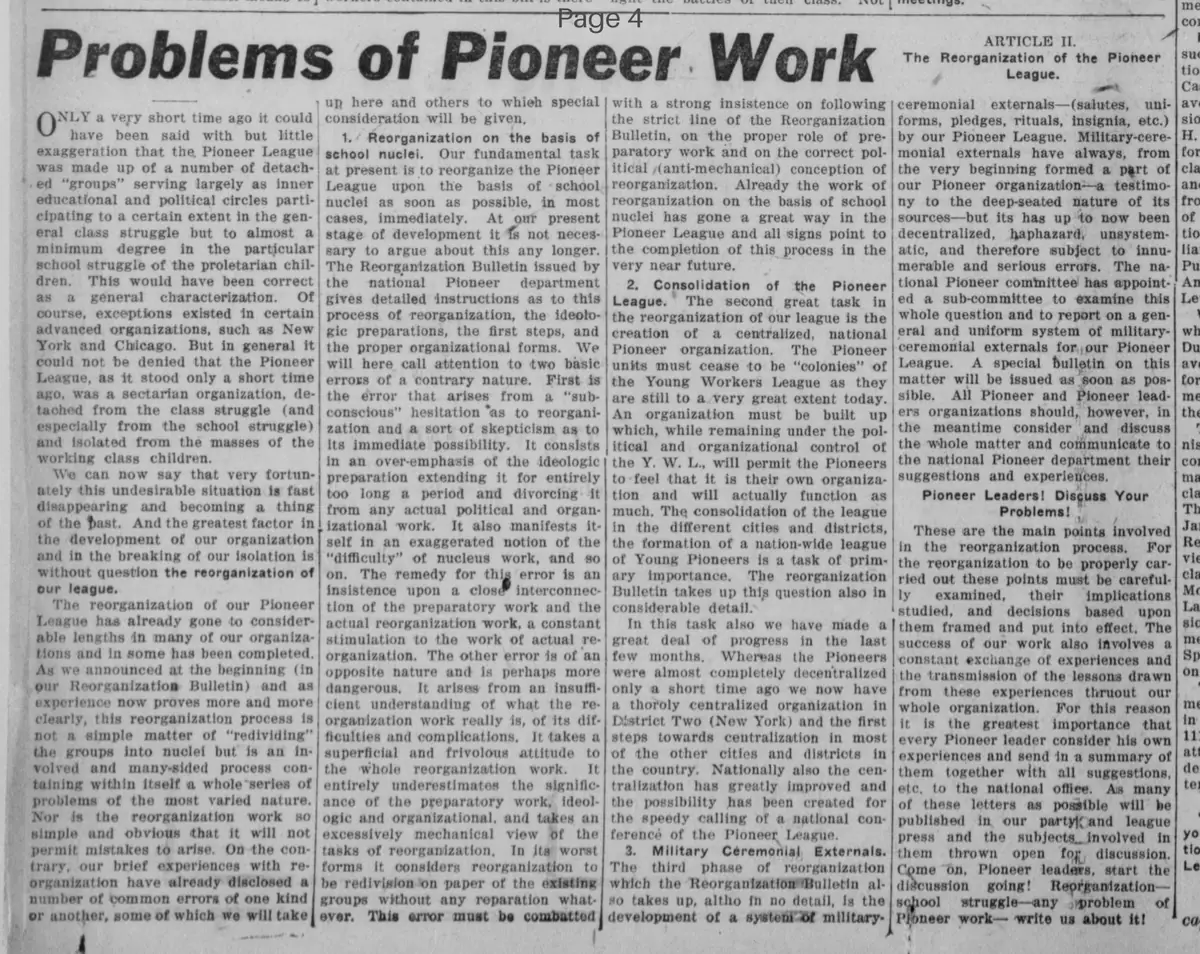
Problems of Pioneer Work
ONLY a very short time ago it could have been said with but little exaggeration that the Pioneer League was made up of a number of detached "groups" serving largely as inner educational and political circles participating to a certain extent in the general class struggle but to almost a minimum degree in the particular school struggle of the proletarian children.
This would have been correct as a general characterization. Of course, exceptions existed in certain advanced organizations, such as New York and Chicago. But in general it could not be denied that the Pioneer League, as it stood only a short time ago, was a sectarian organization, detached from the class struggle (and especially from the school struggle) and isolated from the masses of the working class children.
We can now say that very fortunately this undesirable situation is fast disappearing and becoming a thing of the past. And the greatest factor in the development of our organization and in the breaking of our isolation is without question the reorganization of our league.
The reorganization of our Pioneer League has already gone to considerable lengths in many of our organizations and in some has been completed. As we announced at the beginning (in our Reorganization Bulletin and as experience now proves more and more clearly), this reorganization process is not a simple matter of "redividing" the groups into nuclei but is an involved and many-sided process containing within itself a whole series of problems of the most varied nature.
Nor is the reorganization work so simple and obvious that it will not permit mistakes to arise. On the contrary, our brief experiences with reorganization have already disclosed a number of common errors of one kind or another, some of which we will take up here and others to which special consideration will be given.
1. Reorganization on the basis of school nuclei. Our fundamental task at present is to reorganize the Pioneer League upon the basis of school nuclei as soon as possible, in most cases, immediately.
At our present stage of development it is not necessary to argue about this any longer. The Reorganization Bulletin issued by the national Pioneer department gives detailed instructions as to this process of reorganization, the ideologic preparations, the first steps, and the proper organizational forms. We will here call attention to two basic errors of a contrary nature. First is the error that arises from a "sub-conscious" hesitation as to reorganization and a sort of skepticism as to its immediate possibility. It consists in an over-emphasis of the ideologic preparation extending it for entirely too long a period and divorcing it from any actual political and organizational work. It also manifests itself in an exaggerated notion of the "difficulty" of nucleus work, and so on. The remedy for this error is an insistence upon a close interconnection of the preparatory work and the actual reorganization work, a constant stimulation to the work of actual reorganization. The other error is of an opposite nature and is perhaps more dangerous. It arises from an insufficient understanding of what the reorganization work really is, of its difficulties and complications. It takes a superficial and frivolous attitude to the whole reorganization work. It entirely underestimates the significance of the preparatory work, ideologic and organizational, and takes an excessively mechanical view of the tasks of reorganization. In its worst forms it considers reorganization to be redivision on paper of the existing groups without any preparation whatever. This error must be combatted with a strong insistence on following the strict line of the Reorganization Bulletin, on the proper role of preparatory work and on the correct political (anti-mechanical) conception of reorganization. Already the work of reorganization on the basis of school nuclei has gone a great way in the Pioneer League and all signs point to the completion of this process in the very near future.
2. Consolidation of the Pioneer League. The second great task in the reorganization of our league is the creation of a centralized, national Pioneer organization. The Pioneer units must cease to be "colonies" of the Young Workers League as they are still to a very great extent today. An organization must be built up which, while remaining under the political and organizational control of the Y. W. L., will permit the Pioneers to feel that it is their own organization and will actually function as much. The consolidation of the league in the different cities and districts, the formation of a nation-wide league of Young Pioneers is a task of primary importance. The reorganization Bulletin takes up this question also in considerable detail.
In this task also we have made a great deal of progress in the last few months. Whereas the Pioneers were almost completely decentralized only a short time ago we now have a thoroly centralized organization in District Two (New York) and the first steps towards centralization in most of the other cities and districts in the country. Nationally also the centralization has greatly improved and the possibility has been created for the speedy calling of a national conference of the Pioneer League.
3. Military Ceremonial Externals.
The third phase of reorganization which the Reorganization Bulletin also takes up, altho in no detail, is the development of a system of military ceremonial externals-(salutes, uniforms, pledges, rituals, insignia, etc.) by our Pioneer League. Military-ceremonial externals have always, from the very beginning formed a part of our Pioneer organization-a testimony to the deep-seated nature of its sources-but it has up to now been decentralized, haphazard, unsystematic, and therefore subject to innumerable and serious errors. The national Pioneer committee has appointed a sub-committee to examine this whole question and to report on a general and uniform system of military-ceremonial externals for our Pioneer League. A special bulletin on this matter will be issued as soon as possible. All Pioneer and Pioneer leaders organizations should, however, in the meantime consider and discuss the whole matter and communicate to the national Pioneer department their suggestions and experiences.
Pioneer Leaders! Discuss Your Problems!
These are the main points involved in the reorganization process. For the reorganization to be properly carried out these points must be carefully examined, their implications studied, and decisions based upon them framed and put into effect. The success of our work also involves a constant exchange of experiences and the transmission of the lessons drawn from these experiences thruout our whole organization. For this reason it is of the greatest importance that every Pioneer leader consider his own experiences and send in a summary of them together with all suggestions, etc. to the national office. As many of these letters as possible will be published in our party and league press and the subjects involved in them thrown open for discussion.
Come on, Pioneer leaders, start the discussion going! Reorganization— school struggle-any problem of Pioneer work- write us about it!
ARTICLE II.
The Reorganization of the Pioneer League.
ONLY a very short time ago it could have been said with but little exaggeration that the Pioneer League was made up of a number of detached "groups" serving largely as inner educational and political circles participating to a certain extent in the general class struggle but to almost a minimum degree in the particular school struggle of the proletarian children.
This would have been correct as a general characterization. Of course, exceptions existed in certain advanced organizations, such as New York and Chicago. But in general it could not be denied that the Pioneer League, as it stood only a short time ago, was a sectarian organization, detached from the class struggle (and especially from the school struggle) and isolated from the masses of the working class children.
We can now say that very fortunately this undesirable situation is fast disappearing and becoming a thing of the past. And the greatest factor in the development of our organization and in the breaking of our isolation is without question the reorganization of our league.
The reorganization of our Pioneer League has already gone to considerable lengths in many of our organizations and in some has been completed. As we announced at the beginning (in our Reorganization Bulletin and as experience now proves more and more clearly), this reorganization process is not a simple matter of "redividing" the groups into nuclei but is an involved and many-sided process containing within itself a whole series of problems of the most varied nature.
Nor is the reorganization work so simple and obvious that it will not permit mistakes to arise. On the contrary, our brief experiences with reorganization have already disclosed a number of common errors of one kind or another, some of which we will take up here and others to which special consideration will be given.
1. Reorganization on the basis of school nuclei. Our fundamental task at present is to reorganize the Pioneer League upon the basis of school nuclei as soon as possible, in most cases, immediately.
At our present stage of development it is not necessary to argue about this any longer. The Reorganization Bulletin issued by the national Pioneer department gives detailed instructions as to this process of reorganization, the ideologic preparations, the first steps, and the proper organizational forms. We will here call attention to two basic errors of a contrary nature. First is the error that arises from a "sub-conscious" hesitation as to reorganization and a sort of skepticism as to its immediate possibility. It consists in an over-emphasis of the ideologic preparation extending it for entirely too long a period and divorcing it from any actual political and organizational work. It also manifests itself in an exaggerated notion of the "difficulty" of nucleus work, and so on. The remedy for this error is an insistence upon a close interconnection of the preparatory work and the actual reorganization work, a constant stimulation to the work of actual reorganization. The other error is of an opposite nature and is perhaps more dangerous. It arises from an insufficient understanding of what the reorganization work really is, of its difficulties and complications. It takes a superficial and frivolous attitude to the whole reorganization work. It entirely underestimates the significance of the preparatory work, ideologic and organizational, and takes an excessively mechanical view of the tasks of reorganization. In its worst forms it considers reorganization to be redivision on paper of the existing groups without any preparation whatever. This error must be combatted with a strong insistence on following the strict line of the Reorganization Bulletin, on the proper role of preparatory work and on the correct political (anti-mechanical) conception of reorganization. Already the work of reorganization on the basis of school nuclei has gone a great way in the Pioneer League and all signs point to the completion of this process in the very near future.
2. Consolidation of the Pioneer League. The second great task in the reorganization of our league is the creation of a centralized, national Pioneer organization. The Pioneer units must cease to be "colonies" of the Young Workers League as they are still to a very great extent today. An organization must be built up which, while remaining under the political and organizational control of the Y. W. L., will permit the Pioneers to feel that it is their own organization and will actually function as much. The consolidation of the league in the different cities and districts, the formation of a nation-wide league of Young Pioneers is a task of primary importance. The reorganization Bulletin takes up this question also in considerable detail.
In this task also we have made a great deal of progress in the last few months. Whereas the Pioneers were almost completely decentralized only a short time ago we now have a thoroly centralized organization in District Two (New York) and the first steps towards centralization in most of the other cities and districts in the country. Nationally also the centralization has greatly improved and the possibility has been created for the speedy calling of a national conference of the Pioneer League.
3. Military Ceremonial Externals.
The third phase of reorganization which the Reorganization Bulletin also takes up, altho in no detail, is the development of a system of military ceremonial externals-(salutes, uniforms, pledges, rituals, insignia, etc.) by our Pioneer League. Military-ceremonial externals have always, from the very beginning formed a part of our Pioneer organization-a testimony to the deep-seated nature of its sources-but it has up to now been decentralized, haphazard, unsystematic, and therefore subject to innumerable and serious errors. The national Pioneer committee has appointed a sub-committee to examine this whole question and to report on a general and uniform system of military-ceremonial externals for our Pioneer League. A special bulletin on this matter will be issued as soon as possible. All Pioneer and Pioneer leaders organizations should, however, in the meantime consider and discuss the whole matter and communicate to the national Pioneer department their suggestions and experiences.
Pioneer Leaders! Discuss Your Problems!
These are the main points involved in the reorganization process. For the reorganization to be properly carried out these points must be carefully examined, their implications studied, and decisions based upon them framed and put into effect. The success of our work also involves a constant exchange of experiences and the transmission of the lessons drawn from these experiences thruout our whole organization. For this reason it is of the greatest importance that every Pioneer leader consider his own experiences and send in a summary of them together with all suggestions, etc. to the national office. As many of these letters as possible will be published in our party and league press and the subjects involved in them thrown open for discussion.
Come on, Pioneer leaders, start the discussion going! Reorganization— school struggle-any problem of Pioneer work- write us about it!
ARTICLE II.
The Reorganization of the Pioneer League.
What sub-type of article is it?
Organizational Report
Political Instruction
What themes does it cover?
Triumph
Moral Virtue
What keywords are associated?
Pioneer League
Reorganization
School Nuclei
Centralization
Class Struggle
Youth Organization
Proletarian Children
Where did it happen?
New York, Chicago, District Two (New York), Various Cities And Districts
Story Details
Location
New York, Chicago, District Two (New York), Various Cities And Districts
Event Date
Recent, Last Few Months
Story Details
The article outlines the progress and challenges in reorganizing the Pioneer League from a sectarian, isolated group to a centralized organization integrated into class and school struggles, focusing on school nuclei, national consolidation, and uniform ceremonial externals.