Thank you for visiting SNEWPapers!
Sign up free
New York Daily Tribune
New York, New York County, New York
What is this article about?
Report criticizes the pro-slavery Kansas Constitutional Convention elected by a minority vote in June, excluding Free-State voters. The convention adjourns until after October elections, delaying slavery decision. Includes full text of President Gen. John Calhoun's speech emphasizing fair constitution to settle Kansas issues and preserve Union.
Clipping
OCR Quality
Full Text
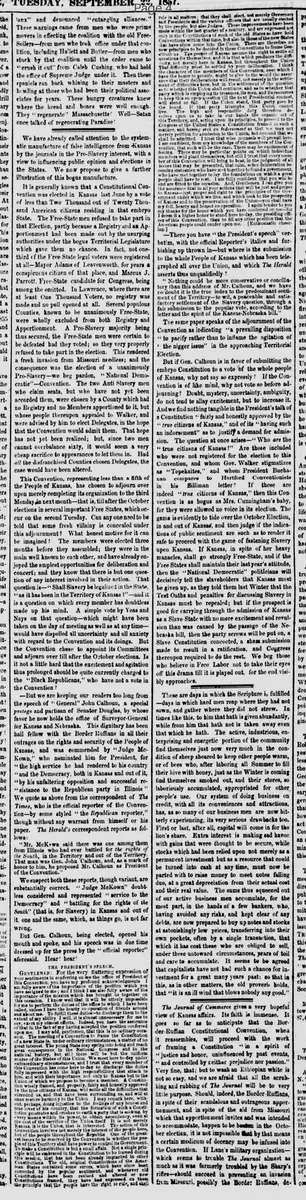
It is generally known that a Constitutional Convention was elected in Kansas last June by a vote of less than Two Thousand out of Twenty Thousand American citizens residing in that embryo State. The Free-State men refused to take part in that Election, partly because a Registry and an Apportionment had been made out by the usurping authorities under the bogus Territorial Legislature which gave them no chance. In fact, not one- third of the Free-State legal voters were registered at all-Mayor Adams of Leavenworth, for years a conspicuous citizen of that place, and Marcus J. Parrott, Free-State candidate for Congress, being among the omitted. In Lawrence, where there are at least One Thousand Voters, no registry was made and no poll opened at all. Several populous Counties, known to be unanimously Free-State, were wholly excluded from both Registry and Apportionment. A Pro-Slavery majority being thus secured, the Free-State men were certain to be defeated had they voted; so they very properly refused to take part in the election. This rendered a fresh invasion from Missouri needless; and the consequence was the election of a unanimously Pro-Slavery-we beg pardon, "National Democratic"-Convention. The two Anti Slavery men who claim seats, but who have not yet been accorded them, were chosen by a County which had no Registry and no Members apportioned to it, but whose people thereupon appealed to Walker, and were advised by him to elect Delegates, in the hope that the Convention would admit them. That hope has not yet been realized; but, since two men cannot overbalance sixty, it would seem a very cheap sacrifice to appearances to let them in. Had all the disfranchised Counties chosen Delegates, the case would have been altered
This Convention, representing less than a fifth of the People of Kansas, has chosen to adjourn over upon merely completing its organization to the third Monday in next month-that is, till after the October elections in several important Free States, which occur on the second Tuesday. Can any one need to be told that some fresh villainy is concealed under this adjournment? What honest motive for it can be imagined? The members were elected three months before they assembled; they were in the main well known to each other, and have already enjoyed the amplest opportunities for deliberation and concert; and they know that there is but one question of any interest involved in their action. That question is-"Shall Slavery be legalized in the State as it has been in the Territory of Kansas?"-and it is a question on which every member has doubtless made up his mind. A simple vote by Yeas and Nays on that question-which might have been taken on the day of meeting as well as at any time-would have dispelled all uncertainty and all anxiety with regard to the Convention and its doings. But the Convention chose to appoint its Committees and adjourn over till after the October elections. Is it not a little hard that the excitement and agitation thus prolonged should be quite currently charged to the "Black Republicans," who have not a vote in the Convention?
-But we are keeping our readers too long from the speech of "General" John Calhoun, a special protege and partisan of Senator Douglas, by whose favor he now holds the office of Surveyor-General for Kansas and Nebraska. This dignitary has been hail fellow with the Border Ruffians in all their outrages on the rights and security of the People of Kansas, and was commended by "Judge Mc." Kown," who nominated him for President, for "the high service he had rendered to his country and the Democracy, both in Kansas and out of it, by his unfaltering opposition and successful resistance to the Republican party in Illinois"
We quote as above from the correspondent of The Times, who is the official reporter of the Convention-by some styled "the Republican reporter," though without any warrant from himself or his paper. The Herald's correspondent reports as follows:
"Mr. McKewn said there was one among them from Illinois who had ever battled for the rights of the South, in the Territory and out of the Territory. That man was Gen. John Calhoun, and, as a mark of honor to him, he proposed Mr. Calhoun as President of the Convention."
We suspect both these reports, though variant, are substantially correct. "Judge McKown" doubtless considered and represented "service to the Democracy" and "battling for the rights of the South" (that is, for Slavery) in Kansas and out of it, one and the same, which, as things go, is not far wrong.
But Gen. Calhoun, being elected, opened his mouth and spoke, and his speech was in due time dressed up for the press by the "official reporter" aforesaid. Hear! hear!
THE PRESIDENT'S SPEECH.
Gentlemen: For the very flattering expression of your sentiments in conferring on me the office of President of this Convention, you have my profound acknowledgments I am fully aware of the importance of the position which you have assigned to me; and I think I am also fully aware of the importance of the mission which has brought us together on this occasion. I know well that it will be utterly impossible for me to perform the duties of the office to which I have been called, unless I have the hearty co-operation of friends around and about me. To fulfill these duties-to discharge them to the extent of my ability I will. it is almost unnecessary for me to say, exert my utmost efforts. Indeed, you have the assurance of that in the fact of my having accepted the position conferred upon me.
I may add, gentlemen, that this is no ordinary occasion. The meeting of a Convention to frame the Constitution of a new State is, under ordinary circumstances, a matter of no great interest. The young State may spring into being and reach its maturity without leaving any particular trace or making any particular impression upon the page of national history, but still there will be but the uniform consequence in the National Congress and in the course of the States of this Union. We meet here to-day under extraordinary circumstances, and I trust that every member of this Convention has come here to-day to discharge the duties fully impressed with the high responsibilities that attach to him, and with their importance not only to Kansas but to the Union of which we propose to become a member. A Constitution wisely framed, and properly, fairly and honestly approved by the true citizens of Kansas, will settle all the difficulties that surround us, and that have been surrounding us, and will at once restore harmony to the Union
I may remark here, with- out, perhaps, doing injustice to the feelings of any honest and true lover of his country, that the formation of such a Constitution prostrates and crushes to earth a party that is seeking, by every means within its power, to obtain ascendency, even at the cost of the sacrifice of the Union itself It is not merely Kansas, it is the Union, that is interested. The action of this Convention involves not merely the interest of the people here, but of the people throughout the Republic One of the greatest issues to be resolved by the Convention is whether the people of this Territory shall have power to control its Government. To make a Constitution is but a small affair. Not a single principle will be embraced in the Constitution to be framed during this session, that has not been already implanted in other Constitutions. The old, original Constitutions of the American States contained some errors, which have since been corrected by the popular sentiment, and whenever old Constitutions have been framed, they have had expressed on them the principle that the people have the right to rule, and to rule in all matters: that they shall elect, not merely Governor and President and the various officers that are usually elected by the people, but also Judges. These improvements have been made within the last quarter of a century, and are expressed not only in the Constitutions of such of the old States as have held Conventions within that time, but also in those of the new States that have since come into the Union. There are therefore no new principles to be decided in these Conventions to frame Constitutions. The people of Kansas assume the right to settle all questions for themselves, and it is that which produces the difficulty, not merely here in Kansas, but throughout the Union That difficulty must be settled by your deliberation. I think the character of the members of this Convention, over which I have the honor to preside, ought to give to the world the assurance that their deliberations will result, not merely in the settlement of difficulties here, but in the settlement of the question as to whether this Union shall continue, and as to whether that party which is employing its treasures, its men, and its resources to keep this an open question till the next Presidential contest, will stand or fall. If the Union stand, that party goes by the board. If that party triumphs, this Union cannot live.
The high and responsible duty therefore devolves upon us to take in our hands the organic act of this Territory, and, acting upon its principles, to present to the Congress of the United States a Constitution framed in such a manner, and having such an indorsement as that we may not merely petition for admission to the Union, but demand that we shall be admitted. I trust that wise counsels will prevail here. I am confident, from my knowledge of the members of the Convention, that such will be the case. There may be excitement of feeling. There may be particular points on which individual members will plant themselves, but still I trust that every member of this Convention will bring to bear, in the judgment of all issues that may be presented, that calm, sober deliberation becoming statesmen who have met together to found a government, who have met together to lay the foundations on which a great people shall have to rest. I am fully confident that you will be and are fitted to the occasion. And, Gentlemen, I can give you the assurance that in all your actions that will be just and proper to Kansas-just, proper and right to the principles of the Government under which we live, and which look to the prosperity of Kansas and to the preservation of the Union-you shall have my full, hearty and honest co-operation. I again tender to you my thanks for the honor which you have conferred on me-for I deem it a higher honor to stand here to-day, the presiding officer of this Convention, than to fill any other position that the American people could confer upon me.
[Enthusiastic cheering.]
There you have "the President's speech" verbatim, with the official Reporter's italics and furnishing up thrown in-but where is the submission to the whole People of Kansas which has been telegraphed all over the Union, and which The Herald asserts thus unqualifiedly?
"Nothing could be more conservative or conciliatory than this address of Mr. Calhoun, and we have no doubt it is the true index to the predominant sentiment of the Territory-to wit, a peaceable and satisfactory settlement of the Slavery question, through a fair submission to the popular vote, according to the letter and the spirit of the Kansas-Nebraska bill."
The same paper speaks of the adjournment of the Convention as indicating "a prevailing disposition to pacify rather than to inflame the agitation of the nigger issue" in the approaching Territorial Election.
But if Gen. Calhoun is in favor of submitting the embryo Constitution to a vote of the whole people of Kansas, why not say so expressly? If the Convention is of like mind, why not vote so before adjourning? Doubt, mystery, uncertainty, ambiguity do not tend to allay excitement, but to increase it. And we find nothing tangible in the President's talk of a Constitution "fairly and honestly approved by the true citizens of Kansas," and of its "having such an indorsement" as to justify a demand for admission. The question at once arises-"Who are the true citizens of Kansas?" Are those included who were not registered for the election to this Convention, and whom Gov. Walker stigmatizes as "Topekaites," and whom President Buchanan compares to Hartford Conventionists in his Silliman letter?
If these are indeed "true citizens of Kansas," then this Convention is as bogus as Mrs. Cunningham's baby for they were allowed no voice in its election. The game is evidently to tide over the October Election, in and out of Kansas, and then judge if the indications of public sentiment are such as to render it safe to proceed with the game of fastening Slavery upon Kansas. If Kansas, in spite of her heavy manacles, shall go strongly Free-State, and if the Free States shall maintain their last year's attitude, then the "National Democratic" politicians will decisively tell the slaveholders that Kansas must be given up, as they told them last Winter that the Test Oaths and penalties for discussing Slavery in Kansas must be repealed; but if the prospect is good for carrying through the admission of Kansas as a Slave State with no more excitement and revulsion than was caused by the passage of the Nebraska bill, then the party screws will be put on, a Slave Constitution concocted, a sham submission made to result in a ratification, and Congress thereupon required to do the rest. We beg those who believe in Free Labor not to take their eyes off this drama till it is played out, for the end visibly approaches.
What sub-type of article is it?
What keywords are associated?
What entities or persons were involved?
Where did it happen?
Foreign News Details
Primary Location
Kansas
Event Date
Last June; Adjourns To Third Monday In Next Month After October Elections
Key Persons
Outcome
convention elected unanimously pro-slavery with less than 2000 votes out of 20000; adjourns without deciding on slavery legalization; two anti-slavery delegates not admitted; aims to influence elections and potentially force slave constitution
Event Details
Pro-Slavery Constitutional Convention in Kansas elected by minority vote excluding Free-State voters through rigged registry and apportionment. Free-State men boycotted. Convention organizes, elects Gen. John Calhoun president, and adjourns until after October elections to delay slavery decision. Full text of Calhoun's speech provided, emphasizing fair constitution to settle issues and preserve Union, but criticized for ambiguity on submission to all voters.