Thank you for visiting SNEWPapers!
Sign up free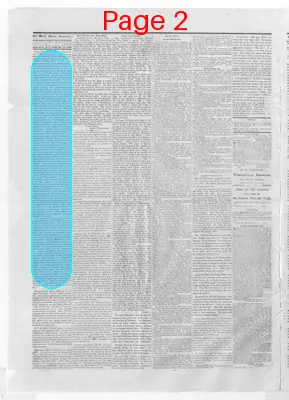
Editorial
March 31, 1865
Walla Walla Statesman
Walla Walla, Walla Walla County, Washington
What is this article about?
This editorial satirically critiques politicians who exploit claims of poverty to win elections, describing the 'poverty dodge' tactic and its effectiveness. It proposes an 'Anti-Poverty Dodge Society' to counter this by offering subscriptions to such candidates instead of votes, emphasizing merit-based elections.
Clipping

OCR Quality
98%
Excellent
Full Text
Poverty Stricken Politicians.—There is always a class of politicians in every community who put themselves forward and urge their claims for official positions upon the ground of necessity—extreme poverty. We are by no means unfavorable to a man's holding office for the simple reason that he is needy. On the contrary, we know that men of little means are as apt to be as honest, and as capable of filling office in a creditable manner as those who have plenty of means. But the class we allude to particularly, are those who make the plea of poverty a stepping stone to office. We recognize the fact that many men are 'poor, but honest,' but it is no less true that poor men are frequently dishonest, and it sometimes happens that the latter class set themselves up for important official positions, and urge their claims with such persistency and with such affecting allusions to their poverty as at once to gain the sympathy and the votes of a community. Perhaps we are a little hard-hearted in making the assertion: that honest poverty should be clothed with less assurance and found under a more modest and unassuming garb. But when a man makes a false plea of poverty in order to ride into office, he not only shows himself to be without modesty but also shows himself to be without honesty. The "poverty dodge" pervades all parties and all communities, and is practiced more than any other dodge by petty politicians because it is more successful, as it appeals directly to the sympathy of a community for support. The better the poverty dodge is played by the aspirant—the more helpless and dependent he can make himself out to be, the more public sympathy is by this means enlisted in behalf of his deplorable situation, and he is thus enabled to command more votes than he could get under any other circumstances. A melancholy and woe-begone expression of countenance, worn with becoming solemnity by the aspirant, helps his chances amazingly; and if he is a little weak-backed and suffers more or less from physical disabilities, so much the better. Well assumed poverty, together with real or imaginary physical infirmities, will secure a politician office without the aid of any positive qualifications. We have frequently watched the operations of this popular poverty dodge, in all its peculiar phases, and never knew it to fail yet when the part was well played. Now that there are a number of offices soon to be filled in this county by the popular vote, we recommend this plan to the various aspirants. The beauty of this system is, that a man need not depend upon the entire support of any political party for election, as he can get the unsuspecting sympathizers of all parties to vote him in. The aspirant should not adhere strictly to any political party before election, as his chances of success would be greatly diminished thereby; but after he is in office he can advocate the most extreme partizan views with impunity, and until near the expiration of his official term, when he must soften down and straddle the issues of the day, preparatory to a re-election. These hints are thrown out for the benefit particularly of those who have not yet become proficients in the politicians' code of "artful dodges," and they may take their cue therefrom and profit themselves accordingly.
In the meantime there is a project on foot among some parties, it is said, designed to overthrow the "poverty dodge." The way this is to be done is very simple, and the project looks quite feasible. The agitators propose to watch closely the maneuvers of all the aspiring office-seekers, and whenever one is heard to make his poverty a plea for seeking office, a subscription is to be raised for his benefit and the aspirant set aside. The only difficulty in the way of this project is the probability of having to levy too many contributions, as some inveterate bummers may announce themselves as candidates for office simply to get the subscription fee. However, this difficulty might be got over by a system of gradation—giving the candidates small or smaller sums according to their merits of "artful dodging." It is proposed to let every aspirant have a fair race for office, rich and poor alike, but woe unto the political manipulator who is caught springing the "poverty dodge," for this is to be considered the offense, and as the President says, 'woe unto him by whom offense cometh.' Every one is to be treated according to his merits, and each must run upon his merits alone, for otherwise he is to fall beneath the potent ban of the "Anti-Poverty Dodge Society" —for that is the name of the association. The Society has for its motto:— 'Poverty, of itself, is no recommendation to office.'
In the meantime there is a project on foot among some parties, it is said, designed to overthrow the "poverty dodge." The way this is to be done is very simple, and the project looks quite feasible. The agitators propose to watch closely the maneuvers of all the aspiring office-seekers, and whenever one is heard to make his poverty a plea for seeking office, a subscription is to be raised for his benefit and the aspirant set aside. The only difficulty in the way of this project is the probability of having to levy too many contributions, as some inveterate bummers may announce themselves as candidates for office simply to get the subscription fee. However, this difficulty might be got over by a system of gradation—giving the candidates small or smaller sums according to their merits of "artful dodging." It is proposed to let every aspirant have a fair race for office, rich and poor alike, but woe unto the political manipulator who is caught springing the "poverty dodge," for this is to be considered the offense, and as the President says, 'woe unto him by whom offense cometh.' Every one is to be treated according to his merits, and each must run upon his merits alone, for otherwise he is to fall beneath the potent ban of the "Anti-Poverty Dodge Society" —for that is the name of the association. The Society has for its motto:— 'Poverty, of itself, is no recommendation to office.'
What sub-type of article is it?
Partisan Politics
Satire
What keywords are associated?
Poverty Dodge
Politicians
Office Seeking
Satire
Elections
Sympathy
Merits
Anti Poverty Society
What entities or persons were involved?
Anti Poverty Dodge Society
Editorial Details
Primary Topic
Critique Of The Poverty Dodge In Politics
Stance / Tone
Satirical Criticism
Key Figures
Anti Poverty Dodge Society
Key Arguments
Poverty Is Exploited By Dishonest Politicians To Gain Sympathy And Votes
Honest Poverty Should Not Be Used As A Stepping Stone To Office
The Poverty Dodge Works Across Parties And Appeals To Community Sympathy
Proposed Society To Counter By Raising Subscriptions For Such Candidates
Elections Should Be Based On Merits Alone, Not Poverty Pleas