Thank you for visiting SNEWPapers!
Sign up free
The American Gazette, Or, The Constitutional Journal
Salem, Essex County, Massachusetts
What is this article about?
In the House of Lords on March 5, the Duke of Richmond criticizes treaties with the Landgrave of Hesse for hiring 17,300 troops at enormous cost, exceeding 1.5 million pounds, highlighting ambiguous terms, mercenary nature, and potential dangers, in the context of the American war and British finances.
Clipping
OCR Quality
Full Text
HOUSE OF LORDS,
Thursday, March 5.
Duke of Richmond.
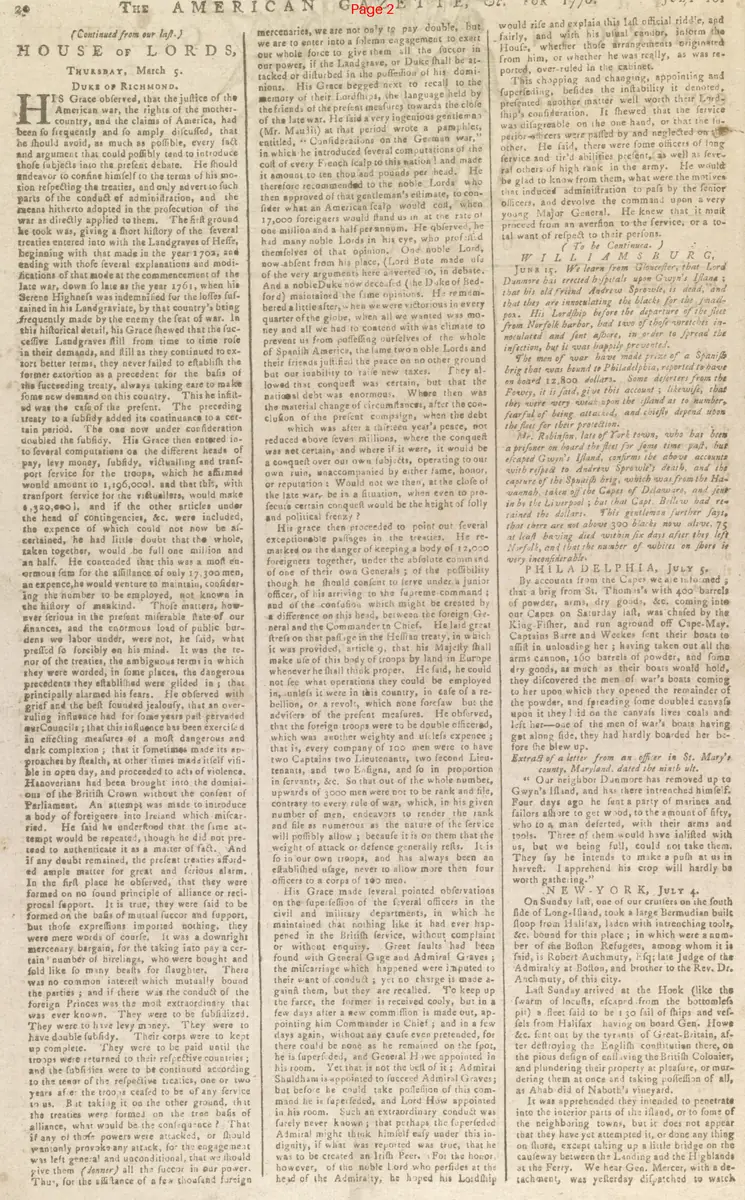
His Grace observed, that the justice of the country, and the claims of America, had been so frequently and so amply discussed, that he should avoid, as much as possible, every fact and argument that could possibly tend to introduce those subjects into the present debate. He should endeavor to confine himself to the terms of his motion respecting the treaties, and only advert to such parts of the conduct of administration, and the means hitherto adopted in the prosecution of the war as directly applied to them. The first ground he took was, giving a short history of the several treaties entered into with the Landgraves of Hesse, beginning with that made in the year 1702, and ending with those several explanations and modifications of that mode at the commencement of the late war, down so late as the year 1761, when his Serene Highness was indemnified for the losses sustained in his Landgraviate, by that country's being frequently made by the enemy the seat of war. In this historical detail, his Grace showed that the successive Landgraves still from time to time rose in their demands, and still as they continued to extort better terms, they never failed to establish the former extortion as a precedent for the basis of the succeeding treaty, always taking care to make some new demand on this country. This he insisted was the case of the present. The preceding treaty to a subsidy added a continuance to a certain period. The one now under consideration doubled the subsidy. His Grace then entered into several computations on the different heads of pay, levy money, subsidy, victualling and transport service for the troops, which he affirmed would amount to 1,196,000l. and that this, with transport service for the victuallers, would make 932,000l. and if the other articles under the head of contingencies, &c. were included, the expense of which could not now be ascertained, he had little doubt that the whole, taken together, would be full one million and an half. He contended that this was a most enormous sum for the assistance of only 17,300 men, an expense, he would venture to maintain, considering the number to be employed, not known in the history of mankind. Those matters, however serious in the present miserable state of our finances, and the enormous load of public burdens we labor under, were not, he said, what pressed so forcibly on his mind. It was the tenor of the treaties, the ambiguous terms in which they were worded, in some places, the dangerous precedents they established were glided in; that principally alarmed his fears. He observed with grief and the best founded jealousy, that an over-ruling influence had for some years past pervaded our Councils; that this influence has been exercised in effecting measures of a most dangerous and dark complexion; that it sometimes made its approaches by stealth, at other times made itself visible in open day, and proceeded to acts of violence. Hanoverians had been brought into the dominions of the British Crown without the consent of Parliament. An attempt was made to introduce a body of foreigners into Ireland which miscarried. He said he understood that the same attempt would be repeated, though he did not pretend to authenticate it as a matter of fact. And if any doubt remained, the present treaties afforded ample matter for great and serious alarm.
In the first place he observed, that they were formed on no sound principle of alliance or reciprocal support. It is true, they were said to be formed on the basis of mutual succor and support, but those expressions imported nothing, they were mere words of course. It was a downright mercenary bargain, for the taking into pay a certain number of hirelings, who were bought and sold like so many beasts for slaughter. There was no common interest which mutually bound the parties; and if there was the conduct of the foreign Princes was the most extraordinary that was ever known, They were to be subsidized. They were to have levy money. They were to have double subsidy. Their corps were to be kept up complete. They were to be paid until the troops were returned to their respective countries; and the subsidies were to be continued according to the tenor of the respective treaties, one or two years after the troops ceased to be of any service us. But taking it on the other ground, that the treaties were formed on the true basis of alliance, what would be the consequence? That if any of those powers were attacked, or should wantonly provoke any attack, so the engagement was left general and unconditional, that we should give them (donner) all the succor in our power. Thus, for the assistance of a few thousand foreign mercenaries, we are not only to pay double, but we are to enter into a solemn engagement to exert our whole force to give them all the succor in our power, if the Landgrave, or Duke shall be attacked or disturbed in the possession of his dominions. His Grace begged next to recall to the memory of their Lordships, the language held by the friends of the present measures towards the close of the late war. He said a very ingenious gentleman entitled, "Considerations on the German war," (Mr. Maurice) at that period wrote a pamphlet, in which he introduced several computations of the cost of every French scalp to this nation! and made it amount to ten thousand pounds per head. He therefore recommended to the noble Lords who then approved of that gentleman's estimate, to consider what an American scalp would cost, when 17,000 foreigners would stand us in at the rate of one million and a half per annum. He observed, he had many noble Lords in his eye, who professed themselves of that opinion. One noble Lord, now absent from his place, (Lord Bute) made use of the very arguments here adverted to, in debate. And a noble Duke now deceased (the Duke of Bedford) maintained those opinions. He remembered a little after, when we were victorious in every quarter of the globe, when all we wanted was money and all we had to contend with was climate to prevent us from possessing ourselves of the whole of Spanish America, the same two noble Lords and their friends justified the peace on no other ground but our inability to raise new taxes. They allowed that conquest was certain, but that the national debt was enormous. Where then was the material change of circumstances, after the conclusion of the present campaign, when the debt which was after a thirteen years peace, not reduced above seven millions, where the conquest was not certain, and where if it were, it would be a conquest over our own subjects, operating to our own ruin, unaccompanied by either fame, honor, or reputation: Would not we then, at the close of the late war, be in a situation, when even to prosecute certain conquest would be the height of folly and political frenzy?
His Grace then proceeded to point out several exceptionable passages in the treaties. He remarked on the danger of keeping a body of 12,000 foreigners together, under the absolute command of one of their own Generals; of the possibility though he should consent to serve under a junior officer, of his arriving to the supreme command; and of the confusion which might be created by difference on this head, between the foreign General and the Commander in Chief. He laid great stress on that passage in the Hessian treaty, in which it was provided, article 9, that his Majesty shall make use of this body of troops by land in Europe whenever he shall think proper. He said, he could not see what operations they could be employed in, unless it were in this country, in case of a rebellion, or a revolt, which none foresaw but the advisers of the present measures. He observed, that the foreign troops were to be double officered, which was another weighty and useless expense; that is, every company of 100 men were to have two Captains two Lieutenants, two second Lieutenants, and two Ensigns, and so in proportion in servants, &c. So that out of the whole number, upwards of 3000 men were not to be rank and file, contrary to every rule of war, which, in his given number of men, endeavors to render the rank and file as numerous as the nature of the service will possibly allow; because it is on them that the weight of attack or defence generally rests. It is so in our own troops, and has always been an established usage, never to allow more than four officers to a corps of 100 men.
His Grace made several pointed observations on the suspension of the several officers in the civil and military departments, in which he maintained that nothing like it had ever happened in the British service, without complaint or without enquiry. Great faults had been found with General Gage and Admiral Graves; the miscarriage which happened were imputed to their want of conduct; yet no charge is made against them, but they are recalled. To keep up the farce, the former is received coolly, but in a few days after a new commission is made out, appointing him Commander in Chief; and in a few days again, without any cause even pretended, for there could be none as he remained on the spot, he is superseded, and General Howe appointed in his room. Yet that is not the best of it; Admiral Shuldham is appointed to succeed Admiral Graves; but before he could take possession of this command he is superseded, and Lord Howe appointed in his room. Such an extraordinary conduct was surely never known; that perhaps the superseded Admiral might think himself easy under this indignity, if what was reported was true, that he was to be created an Irish Peer. For the honor, however, of the noble Lord who presides at the head of the Admiralty, he hoped his Lordship would rise and explain this last official riddle, and fairly, and with his usual candor, inform the House, whether those arrangements originated from him, or whether he was really, as was reported, over-ruled in the cabinet.
This chopping and changing, appointing and superseding, besides the instability it denoted, presented another matter well worth their Lordships consideration. It showed that the service was disagreeable on the one hand, or that the superior officers were passed by and neglected on the other. He said, there were some officers of long service and tried abilities present, as well as several others of high rank in the army. He would be glad to know from them, what were the motives that induced administration to pass by the senior officers, and devolve the command upon a very young Major General. He knew that it most proceed from an aversion to the service, or a total want of respect to their persons.
(To be Continued.)
What sub-type of article is it?
What keywords are associated?
What entities or persons were involved?
Where did it happen?
Foreign News Details
Primary Location
Hesse
Event Date
Thursday, March 5.
Key Persons
Outcome
expense for 17,300 hessian troops estimated at over 1.5 million pounds annually, including doubled subsidy, pay, levy money, victualling, transport, and contingencies; treaties include mutual succor clauses and provisions for use in europe.
Event Details
The Duke of Richmond delivers a speech in the House of Lords critiquing historical and current treaties with the Landgraves of Hesse for hiring troops, detailing escalating demands and costs, ambiguous alliance terms, mercenary nature, potential for use in Britain, double officering, and administrative instability in officer appointments for the American war.