Thank you for visiting SNEWPapers!
Sign up free
The Daily Advertiser
New York, New York County, New York
What is this article about?
In this letter to the printer, 'The Reviewer' defends his critical review of the poem 'Triumph of Infidelity' against strictures by J.M., arguing that the poem contains obscure language, unjust attacks on Chinese customs and figures like Dr. Chauncey, and promotes intolerance in religious opinions. He advocates for tolerance and critiques dogmatic judgments. Dated New-York, Sept. 2, 1788.
Clipping
OCR Quality
Full Text
SIR,
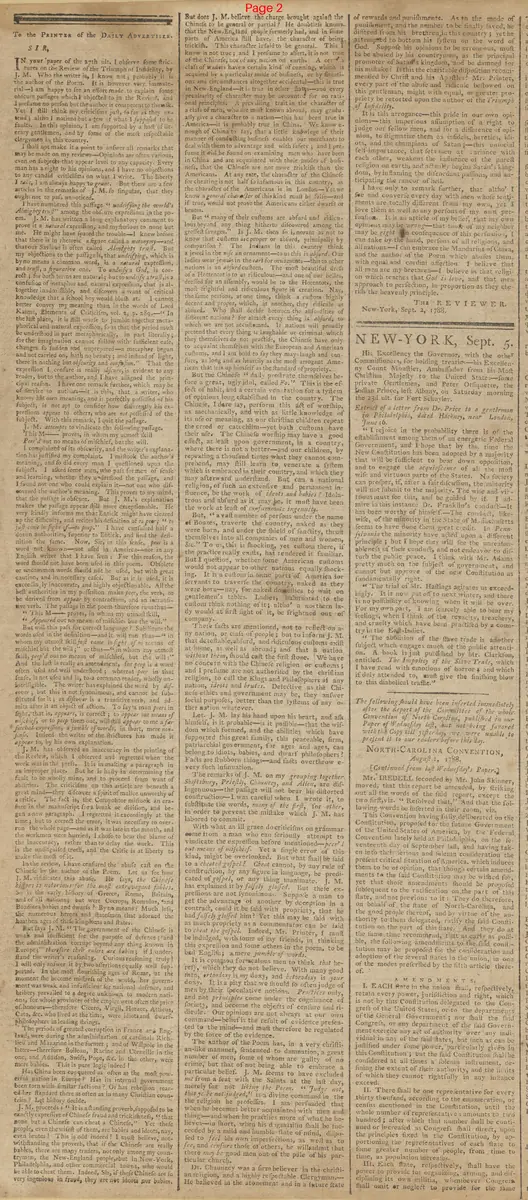
In your paper of the 27th ult. I observe some strictures on the Review of the Triumph of Infidelity, by J. M. Who the writer is, I know not; probably it is the author of the Poem. It is however very immaterial—I am happy to see an effort made to explain some obscure passages which I objected to in the Review, and I presume no person but the author is competent to the task.
Yet I still think my criticisms just, so far as they extend; altho I noticed but a few of what I supposed to be faults. In this opinion, I am supported by a host of literary gentlemen, and by some of the most respectable clergymen in this country.
I shall not make it a point to answer all remarks that may be made on my reviews—Opinions are often various, even on subjects that appear level to any capacity. Every man has a right to his opinions, and I have no objections to any candid criticisms on what I write. The liberty I take, I am always happy to grant. But there are a few articles in the remarks of J. M. so singular, that they ought not to pass unnoticed.
I have numbered this passage "undeifying the world's Almighty truth" among the obscure expressions in the poem. J. M. has written a long explanatory comment to prove it a natural expression, and mysterious to none but me. He might have spared the trouble—I knew before that there is in rhetoric a figure called a metonymy—and that our Saviour is often called Almighty truth. But my objections to the passage is, that undeifying, which is by no means a common word, is a natural expression, and truth, a figurative one. To undeify a God, is correct; for both terms are natural; but to undeify a truth, is a confusion of metaphor and natural expression, that is altogether inadmissible, and discovers a want of critical knowledge that a school boy would blush at. I cannot better convey my meaning than in the words of Lord Kames, Elements of Criticism, vol. 2, p. 289. "In the last place, it is still worse to jumble together metaphorical and natural expression, so as that the period must be understood in part metaphorically, in part literally; for the imagination cannot follow with sufficient ease, changes so sudden and unprepared—a metaphor begun and not carried on, hath no beauty; and instead of light, there is nothing but obscurity and confusion." That the expression I censure is really obscure, is evident to any reader, but to the author, and I have assigned the principal reason. I have one remark further, which may be of service to authors—it is this, that a writer, who knows his own meaning, and is perfectly possessed of his subject, is not apt to consider how differently his expressions appear to others, who are not possessed of the subject. With this remark, I quit the passage.
J. M. attempts to vindicate the following passage.
This M— proves, in whom my utmost skill
Peer'd out no means of mischief, but the will.
I complained of its obscurity, and the writer's explanation has justified my complaint. I mistook the author's meaning, and so did every man I questioned upon the subject. I asked some men, who pass or men of sense and learning, whether they understood the passage, and I found not one who could explain it—not one who discovered the author's meaning. This proves to my mind, that the passage is obscure. But J. M.'s explanation makes the passage appear still more exceptionable. He very kindly informs me that Entick might have cleared up the difficulty, and recites his definition of to peer; "to just come in sight of—to peep." I have consulted half a dozen authorities, superior to Entick, and find the definition the same. Now, Sir, in this sense, peer is a word not known—not used in America—nor in any English writer that I have seen: For this reason, the word should not have been used in this poem. Obsolete or uncommon words should not be used, but with great caution, and in necessary cases. But as it is used, it is exceedingly inaccurate, and highly objectionable. All the best authorities in my possession make peer, the verb, to be derived from appear by contraction, and an intransitive verb. The passage in the poem therefore runs thus—
"This M— proves, in whom my utmost skill,
Appeared out no means of mischief, but the will."
But will this pass for correct language? Substitute the words used in the definition—and it will run thus—"in whom my utmost skill just came in sight of no means of mischief but the will;" or thus—"in whom my utmost skill, peep'd out no means of mischief, but the will:" And the last is really an amendment, for peep is a word often used and well understood; whereas peer in that sense, is not used and is, to a common reader, wholly unintelligible. The writer has explained the word by discover; but this is not synonymous, and cannot be substituted for it; as discover is a transitive verb, and admits after it an object of action. To say a man peers in sight, that is, appears, is correct; to appear out means of mischief, or to peep them out, will still appear to me a far fetched expression, a jumble of words, in short, mere nonsense. Indeed the writer of the strictures has made it appear so, by his own explanation.
J. M. has observed an inaccuracy in the printing of the Review, which I observed and regretted when the work was in the press. It is in making a paragraph in an improper place. But he is hasty in determining the fault to be wholly mine, and to proceed from want of abilities. The criticisms on this article are beneath a great mind—they discover a spirit of malice unworthy of a critic. The fact is, the Compositor mistook an erasure in the manuscript for a break or division, and began a new paragraph. I regretted it exceedingly at the time; but to correct the error, it was necessary to over-run the whole page—and as it was late in the month, and the workmen were hurried, I chose to bear the blame of the inaccuracy, rather than to delay the work. This is the undisguised truth, and the Critic is at liberty to make the most of it.
In the review, I have censured the abuse cast on the Chinese by the author of the Poem. Let us see how J. M. vindicates this abuse. He says, the Chinese history is notorious for the most extravagant fables. So is the early history of Greece, Rome, Britain, and of all nations; but were Cecrops, Romulus, and Boadicea babies and dwarfs? By no means: Much less, the numerous heroes and statesmen that adorned the heathen ages of these kingdoms and states.
But says J. M. "The government of the Chinese is weak and inefficient for the purpose of defence; and the administration corrupt beyond any thing known in Europe;" therefore their rulers are babies; if I understand the writer's reasoning. Curious reasoning truly! I will only answer it by two assertions equally well supported. In the most flourishing ages of Rome, at the moment she became mistress of the world, her government was weak and insufficient for national defence, and bribery prevailed to a degree unknown to modern nations, for whole provinces of the empire were often the price of honours—therefore Cicero, Virgil, Horace, Atticus, Cato, &c. who lived at the time, were idiots and dwarf-philosophers in leading strings.
The periods of greatest corruption in France and England, were during the administration of cardinals Richelieu and Mazarine in the former; and of Walpole in the latter—therefore Boileau, Racine and Corneille in the one, and Addison, Swift, Pope, &c. in the other, were mere babies. This is pure logic indeed!
Has China been conquered as often as the most powerful nation in Europe? Has its internal government been torn with similar factions? Or has rebellion reared her standard there as often as in many Christian countries? Let history decide.
J. M. proceeds: "It is a standing proverb, supposed to be exactly expressive of Chinese fraud and trickishness, "that none but a Chinese can cheat a Chinese." Yet these people, even the wisest of them, are babies and idiots, nay, even brutes! This is odd indeed! I must believe, notwithstanding the proverb, that if the Chinese are really babies, there are many traders, not only among my countrymen, the New-England people, but in New-York, Philadelphia, and other commercial towns, who would be able to cheat them. Indeed, Sir, if these Chinese are so very ingenious in fraud, they are not idiots nor babies.
But does J. M. believe the charge brought against the Chinese to be general or partial? He doubtless knows that the New-England people formerly had, and in some parts of America still have, the character of being trickish. This character is said to be general. This I know is not true; and I presume to assert, it is not true of the Chinese, nor of any nation on earth. A class of traders have a certain kind of cunning, which is acquired by a particular mode of business, or by situations and circumstances altogether accidental—this is true in New-England—it is true in other states—and every peculiarity of character may be accounted for on rational principles. A prevailing trait in the character of a class of men, who are most known abroad, may gradually give a character to a nation—this has been true in America—it is probably true in China. We know enough of China to say, that a little knowledge of their manner of conducting business enables our merchants to deal with them to advantage and with safety; and I presume it will be found on examining men who have been in China and are acquainted with their modes of business, that the Chinese are not more trickish than the Americans. At any rate, the character of the Chinese for cheating is not half so infamous in this country, as the character of the Americans is in London—Yet we know a general character of this kind must be false—and if true, would not prove the Americans either dwarfs or brutes.
But "many of their customs are absurd and ridiculous beyond any thing hitherto discovered among the grossest savages." Is J. M. then so ignorant as not to know that customs are proper or absurd, principally by comparison? The Indians in this country think a jewel in the nose an ornament—to us this is absurd. Our ladies wear jewels in the ear for ornaments—this to other nations is an absurd custom. The most beautiful dress of a Hottentot is to us ridiculous—and one of our belles, dressed for an assembly, would be to the Hottentots, the most frightful and ridiculous figure in creation. Nay, the same persons, at one time, think a custom highly decent and proper, which, at another, they ridicule as absurd. Who shall decide between the absurdities of different nations? for almost every thing is absurd, to which we are not accustomed. If nations will proudly pretend that every thing is laughable or criminal which they themselves do not practice, the Chinese have only to acquaint themselves with the European and American customs, and I am bold to say they may laugh and censure, as long and as heartily as the most arrogant American that sets up himself as the standard of propriety.
But the Chinese "daily prostrate themselves before a great, ugly idol, called Fo." This is the effect of habit, and a certain veneration for a system of opinions long established in the country. The Chinese, I dare say, perform this act of worship, as mechanically, and with as little knowledge of its use or meaning, as our christian children repeat the creed or catechism—yet both customs have their use. The Chinese worship may have a good effect, at least upon government, in a country, where there is not a better—and our children, by repeating a thousand times what they cannot comprehend, may still learn to venerate a system which is embraced in their country, and which they may afterward understand. But can a national religion, of such an extensive and permanent influence, be the work of idiots and babies? Idolatrous and absurd as it may be, it must have been the work at least of consummate ingenuity.
But, a vast number of persons under the name of Bonzes, traverse the country, naked as they were born, and under the shield of sanctity, thrust themselves into all companies of men and women, &c." To us, this is shocking, yet custom there, if the practice really exists, has rendered it familiar. But I question, whether some American customs would not appear to other nations equally shocking. It is a custom in some parts of America for servants to traverse the country, naked as they were born—nay, for naked domestics to wait on gentlemen's tables. Ladies, habituated to the custom think nothing of it; altho' a northern lady would at first sight of it, be frightened out of company.
These facts are mentioned, not to reflect on any nation, or class of people; but to inform J. M. that detestable, absurd, and ridiculous customs exist at home, as well as abroad; and that a nation without them, should cast the first stone. We have no concern with the Chinese religion or customs; and I presume are not authorized by the christian religion, to call the Kings and Philosophers of any nation, idiots and brutes. Defective as the Chinese ethics and government may be, they answer social purposes, better than the systems of any other nation whatever.
Let J. M. lay his hand upon his heart, and ask himself, is it probable—is it possible—that the wisdom which formed, and the abilities which have supported this great family, this peaceable, firm, patriarchal government, for ages and ages, can belong to idiots, babies, and dwarf philosophers? Facts are stubborn things—and facts overthrow every such insinuation.
The remarks of J. M. on my grouping together Shaftsbury, Priestley, Chauncey, and Allen, are disingenuous—the passage will not bear his distorted construction—I was careful when I wrote it, to substitute the words, many of the first, for other, in order to prevent the mistake which J. M. has labored to commit.
With what an ill grace do criticisms on grammar come from a man who can seriously attempt to vindicate the expression before mentioned—peer'd out means of mischief. Yet a single error of this kind, might be overlooked. But what shall be said to a cheated gospel? Cheat cannot, by any rule of construction, by any figure in language, be predicated of gospel, or any thing inanimate. J. M. has explained it by falsely glossed. But these expressions are not synonymous. Suppose a man to get the advantage of another by deception in a contract, could it be said with propriety, that he had falsely glossed him? Yet this may be said with as much propriety as a commentator can be said to cheat the gospel. Indeed, Mr. Printer, I must be indulged, with some of my friends, in thinking this expression and some others in the poem, to be bad English; a mere jumble of words.
It is common for zealous men to think that heresy, which they do not believe. With many good men, orthodoxy is my doxy, and heterodoxy is your doxy. It is a pity that we should so often judge of men by their speculative notions. Practices only, and not principles come under the cognizance of society, and become the objects of censure and ridicule. Our opinions are not always at our own command—belief is the result of evidence presented to the mind—and must therefore be regulated by the force of the evidence.
The author of the Poem has, in a very christian-like manner, sentenced to damnation, a great number of men, some of whom are guilty of no crime, but that of not being able to embrace a particular belief. J. M. seems to have excluded me from a seat with the Saints at the last day, merely for not liking the Poem. "Judge not, that ye be not judged," is a divine command in the religion he professes. I am persuaded that when he becomes better acquainted with men and things—and when he practices more of what he believes—in short, when his dogmatism shall be succeeded by a mild and humble state of mind, disposed to feel his own imperfections, as well as to see, and censure those of others, he will admit that there may be good men out of the pale of his particular church.
Dr. Chauncey was a firm believer in the christian religion, and a highly respectable Clergyman.—He believed in the atonement and in a future state of rewards and punishments. As to the mode of punishment, and the number to be finally saved, he differed from his brethren in this country; yet he attempted to bottom his system on the word of God. Suppose his opinions to be erroneous, must he be abused by his countrymen, as the principal promoter of Satan's kingdom, and be damned for his mistake? Is this the charitable disposition recommended by Christ and his Apostles? Mr. Printer, every part of the abuse and ridicule bestowed on this gentleman, might with equal, or greater propriety be retorted upon the author of the Triumph of Infidelity.
It is this arrogance—this pride in our own opinions—this imperious assumption of a right to judge our fellow men, and for a difference of opinion, to stigmatize them as infidels, heretics, idiots, and the champions of Satan—this unsocial self-importance, that sets men at variance with each other, weakens the influence of the purest religion on earth, and actually begins Satan's kingdom, by inflaming the discordant passions, and anticipating the rancor of hell.
I have only to remark farther, that altho' I see and converse every day with men whose sentiments are totally different from my own, yet I love them as well as any persons of my own persuasion. It is an article of my belief, that my own opinions may be wrong—that those of my neighbor may be right. In consequence of this persuasion, I can take by the hand, persons of all religions, and all nations. I can embrace the Mandarins of China, and the author of the Poem which abuses them, with equal and cordial affection. I believe that all men are my brethren—I believe in that religion which teaches that God is love, and that men approach to perfection, in proportion as they cherish the heavenly principle.
THE REVIEWER.
New-York, Sept. 2, 1788.
What sub-type of article is it?
What themes does it cover?
What keywords are associated?
What entities or persons were involved?
Letter to Editor Details
Author
The Reviewer
Recipient
The Printer Of The Daily Advertiser
Main Argument
the reviewer defends his criticisms of the poem 'triumph of infidelity' against j.m.'s strictures, asserting that the poem's language is obscure and mixes metaphors improperly, its attacks on chinese customs and religious figures like dr. chauncey are unjust and intolerant, and advocates for religious tolerance over dogmatic judgments.
Notable Details