Thank you for visiting SNEWPapers!
Sign up free
The Newport Gazette
Newport, Newport County, Rhode Island
What is this article about?
On June 20, 1779, General Lincoln's American forces attacked British positions at Stono Ferry, South Carolina, but retreated after heavy fighting due to strong defenses. American casualties: 30 killed, 116 wounded, 2 missing. British losses estimated higher, around 280 killed per reports.
Merged-components note: These two components continue the same report on the Battle of Stono Ferry, with the text directly flowing from one to the next across pages; relabeling the second from 'story' to 'domestic_news' as it fits local American war reporting.
Clippings
1 of 2
OCR Quality
Full Text
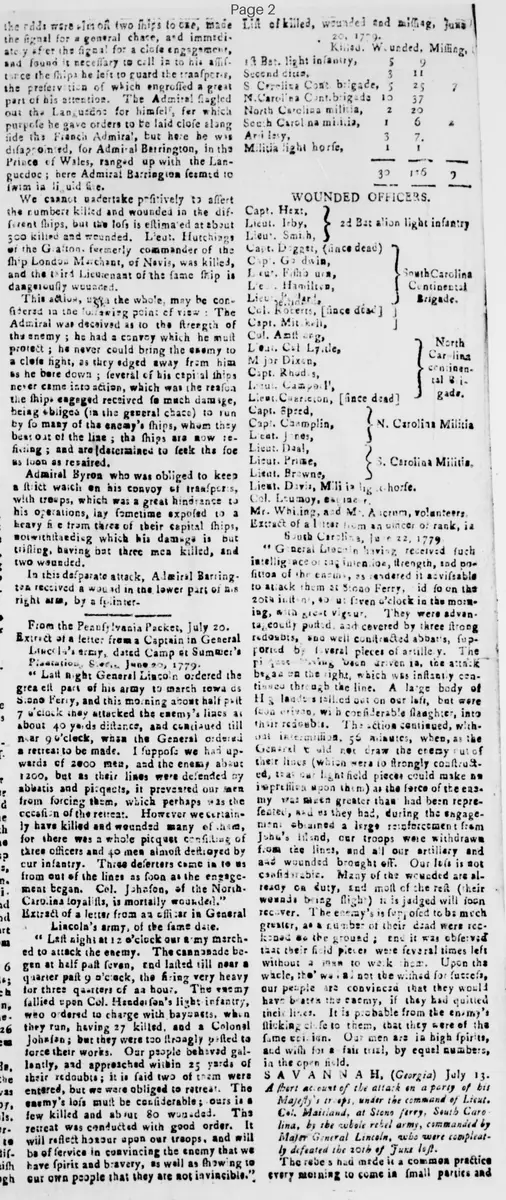
Extract of a letter from a Captain in General Lincoln's army, dated Camp at Summer's Plantation, S.C., June 20, 1779:
"Last night General Lincoln ordered the greater part of his army to march towards Stono Ferry, and this morning about half past 7 o'clock they attacked the enemy's lines at about 40 yards distance, and continued till near 9 o'clock, when the General ordered a retreat to be made. I suppose we had upwards of 800 men, and the enemy about 1200, but as their lines were defended by abattis and pickets, it prevented our men from forcing them, which perhaps was the occasion of the retreat. However we certainly have killed and wounded many of them, for there was a whole picquet consisting of three officers and 40 men almost destroyed by our infantry. Three deserters came in to us from out of the lines as soon as the engagement began. Col. Johnston, of the North-Carolina loyalists, is mortally wounded."
Extract of a letter from an officer in General Lincoln's army, of the same date.
"Last night at 12 o'clock our army marched to attack the enemy. The cannonade began at half past seven, and lasted till near a quarter past 8 o'clock, the firing very heavy for three quarters of an hour. The enemy sallied upon Col. Henderson's light infantry, who ordered to charge with bayonets, when they ran, having 27 killed, and a Colonel Johnson; but they were too strongly posted to force their works. Our people behaved gallantly, and approached within 25 yards of their redoubts: it is said two of them were entered, but we were obliged to retreat. The enemy's loss must be considerable; ours in a few killed and about 80 wounded. The retreat was conducted with good order. It will reflect honour upon our troops, and will be of service in convincing the enemy that we have spirit and bravery, as well as showing to our own people that they are not invincible."
List of killed, wounded and missing, June 20, 1779.
Killed. Wounded. Missing.
1st Battalion light infantry, 13 S 9
Second ditto, 3 11
South Carolina Continental brigade, 5 25 7
N. Carolina Cont. brigade 10 37
North Carolina militia, 2 20
South Carolina militia, 1 6
Artillery, 3 7
Militia light horse, 1 1
30 116 2
WOUNDED OFFICERS.
Capt. Hext, 2d Battalion light infantry
Lieut. Irby, 2d Battalion light infantry
Lieut. Smith,
Capt. Digget, (since dead)
Capt. Goodwin,
Lieut. Thomson,
South Carolina
Lieut. Hamilton, Continental
Lieutenant
see uns Brigade.
Col. Roberts, [since dead]
Capt. Mitchell,
Col. Ashmore, North
Carolina
Lieut. Col. Little,
Major Dixon, Continental
Capt. Rhodes,
tal Brigade
Lieut. Campell,
Lieut. Carleton, [since dead] gade.
Capt. Speed,
Capt. Campplin, N. Carolina Militia
Lieut. Rees,
Lieut. Deal,
Lieut. Prine, S. Carolina Militia.
Lieut. Browne
Lieut. Davis, Militia light horse.
Col. Rumsey, cavalry.
Mr. Whiting, and Mr. Scruggs, volunteers
Extract of a letter from an officer of rank, in South Carolina, June 22, 1779
"General Lincoln having received such intelligence of the position, strength, and situation of the enemy, as rendered it advisable to attack them at Stono Ferry, did so on the 20th inst. at eleven o'clock in the morning, and with great vigour. They were advantageously posted, and covered by three strong redoubts, and well constructed abattis, supported by several pieces of artillery. The picquets having been driven in, the attack began on the right, which was instantly continued through the line. A large body of Hessians sallied out on our left, but were driven, with considerable slaughter, into their redoubts. The action continued, without intermission, 56 minutes, when, as the General thought fit to draw the enemy out of their lines (which were so strongly constructed, that our light field pieces could make no impression upon them) as the force of the enemy was much greater than had been represented, and as they had, during the engagement obtained a large reinforcement from John's Island, our troops were withdrawn from the lines, and all our artillery and wounded brought off. Our loss is not considerable. Many of the wounded are already on duty, and most of the rest (their wounds being slight) it is judged will soon recover. The enemy's is supposed to be much greater, as a number of their dead were reckoned on the ground: and it was observed that their field pieces were several times left without a man to work them. Upon the whole, tho' we did not the wished for success, our people are convinced that they would have beaten the enemy, if they had quitted their lines. It is probable from the enemy's sticking close to them, that they were of the same opinion. Our men are in high spirits, and wish for a fair trial, by equal numbers, of in the open field."
SAVANNAH, (Georgia) July 13.
A brief account of the attack on a party of his Majesty's troops, under the command of Lieut. Col. Maitland, at Stono ferry, South Carolina, by the whole rebel army, commanded by Major General Lincoln, who were completely defeated the 20th of June last.
The rebels had made it a common practice every morning to come in small parties and...
From all our late intelligence. On the morning of the 20th of June, about seven o'clock we heard some firing at the head of our advanced posts, upon which Col. Maitland ordered Capt. Campbell, with two companies of the first battalion of the 71st regiment (not above 40 men in the whole) to go and reconnoitre the woods in front. About 300 yards from our sentries, Capt. Campbell fell in with the left of the rebel line, already formed, and did not perceive them, on account of the thickness of the woods, till he was close up to them. They gave him a heavy fire, which wounded him, all his officers and several of his men; our people returning the fire made the rebels give way. The few remaining of these two companies, exasperated at the loss of their brave officers, followed the rebels, determined to be revenged, till they were almost surrounded by parties advancing from the right of the rebel line. Capt. Campbell having his thigh broken, could not follow them; and his brave fellows gave themselves a life of revenge to their leaders; only ten returned unwounded; but what is more to their honour, they left none of their wounded behind, nor were any of them taken prisoners by the enemy.
Our pickets, in this time, were forced in, and we perceived the whole rebel army, with eight pieces of cannon, pushing for our redoubts. They made a stay about 70 yards from our lines, when our cannon and musketry made them instantly retreat to the woods, where they did rally, and made from thence a continual fire on our troops. The first battalion regiment of Trumbull, on our left, was at first overpowered by numbers; the rebels advanced to some abattis, and were going to cross it over, when the Caroline Royalists came to their assistance and prevented it. Capt. O'Farrel, of the Thunder galley, taking the advantage of our position, at this critical moment, flanked the rebels with his 24 pounders, which did great execution. The trenches being retaken at that time by two companies of the 2d battalion of the 71st regiment, soon retook their post, and drove the rebels away, their fire being well supported by their army and navy. The enemy (after an hour and a half) gave us a heavy discharge of their artillery; they frequently attempted our advanced, and were as often repulsed by the well directed fire of our republic; at last we perceived that the fire of their artillery slackened, and they drew off from two guns, (they had eight guns in the beginning of the action) which made us believe they were removing the others for fear of accident. Soon after they began to draw off, and Capt. Moncrief, commanding engineer, with his usual spirit, blocked their retreat, by making a fortis with a few men of the 71st regiment, and some Highlanders, being rather too weak to hazard following them without our whole force. He took an ammunition waggon when the rebels were endeavouring to get off. The 2d battalion of the 71st regiment arriving at that time, enabled us to follow them into the woods, where they did not attempt to make any stand. The light infantry coming up afterwards, we pursued them near two miles, but they had then too much the start of us to do them much harm. However they left near 70 men dead on the field of battle.
We heard from prisoners and deserters, that during the whole action, they employed negroes to carry off their dead and wounded, and loaded them on waggons brought for the purpose; and that they had 280 killed, amongst whom Col. Owen Roberts, of Artillery; That General Lincoln had called in all the militia he could collect, even the Silk Stockings company of Charlestown, having at least 2000 men with him before our lines.
Our Artillery was well served, and did great execution, notwithstanding it was unavoidably much exposed from the different directions we were obliged to place our guns in to oppose the enemy.
What sub-type of article is it?
What keywords are associated?
What entities or persons were involved?
Where did it happen?
Domestic News Details
Primary Location
Stono Ferry, South Carolina
Event Date
June 20, 1779
Key Persons
Outcome
american: 30 killed, 116 wounded, 2 missing; several officers wounded including capt. hext, lieut. irby, capt. digget (dead), col. roberts (dead), lieut. carleton (dead). british: estimated 70 dead on field, 280 killed total per reports; col. johnston mortally wounded; capt. campbell wounded.
Event Details
American forces under General Lincoln attacked British lines at Stono Ferry, engaging in heavy fighting for about an hour before retreating due to strong defenses including redoubts, abattis, and artillery. Americans approached within 25-40 yards but could not force the positions. British sallied out but were driven back. Retreat orderly; Americans claim to have inflicted heavy losses on British.