Thank you for visiting SNEWPapers!
Sign up free
Cleveland Morning Leader
Cleveland, Cuyahoga County, Ohio
What is this article about?
Exposure of large-scale bounty jumping frauds in New York, involving forged enlistment papers, duplicate recruitments, and escapes from service, leading to arrests by Colonel Baker and revelations of massive financial gains by brokers.
Merged-components note: These sequential components all cover related national news on bounty jumping frauds and disclosures; merged into a single domestic news unit.
Clipping
OCR Quality
Full Text
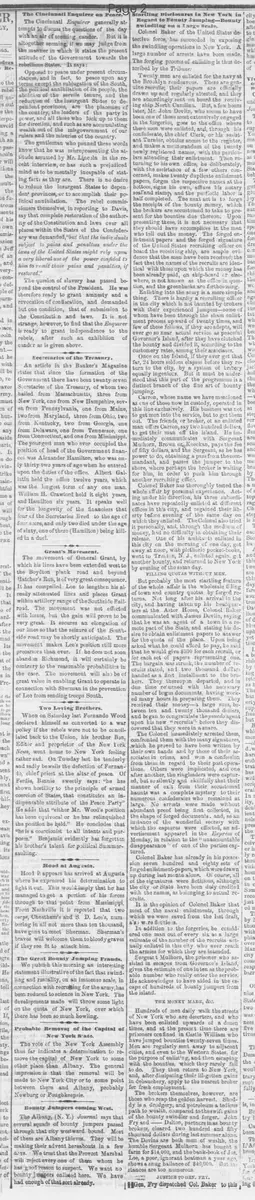
We publish this morning an interesting statement illustrative of the fact that swindling and rascality, on an immense scale, in connection with recruiting for the army, has been reduced to science in New York. The developments made will throw some light on the quota of New York, over which there has been so much howling.
Bounty Jumpers coming West.
The Albany, (N. Y.) Journal says that several squads of bounty jumpers passed through that city westward bound. Most of them are Albany thieves. They will be making their advent hereabouts in a few days. We trust that the Provost Marshal will reject every one of them whom he has good reason to suspect. We want no bounty jumpers enlisted here. We have had enough of that sort already.
Startling Disclosures in New York Regarding Bounty Jumping--Bounty Business on a Large Scale.
Colonel Baker of the United States detective force, has succeeded in exposing the swindling operations in New York. A large number of arrests have been made. The forging process of enlisting is thus described by the Tribune:
Twenty men are enlisted for the navy at the Brooklyn rendezvous. These are genuine recruits; their papers are officially drawn up and regularly attested; and they are accordingly sent on board the receiving ship North Carolina. But, a few hours later, Mr. John Devlin, who seems to have been one of those most extensively engaged in the forgeries, goes to the office where these men were enlisted, and, through his confederate, the chief Clerk, or his assistant Turner, obtains access to the register, and makes a memorandum of the twenty newly registered names, with the particulars attending their enlistment. Then returning to his own office, he deliberately, with the assistance of a few others concerned, makes twenty duplicate enlistment papers, forges the respective names at the bottom, signs his own, affixes his notary seal and stamp and the patriotic labor is half completed. The next act is to forge the receipts of the bounty money, which the brokers are accustomed to take to present for the bounties due thereon. Upon presenting these, it is not necessary that they should have accomplices in the men who pay out the money. The forged enlistment papers and the forged signature of the United States recruiting officer on board the receiving ship, are ample evidence that the men have been received; the fact that the names of the recruits are identical with those upon which the money has been already paid, on ship-board (or elsewhere, is not known as the office in question, and the greenbacks are forthcoming.
Enlisting into the army is a more simple thing. There is hardly a recruiting officer in the city which is not haunted by brokers with their experienced jumpers-some of whom have been through the sham enlistment process upward of twenty times, and few of these fellows, if they are adepts, will ever go so near actual service as peaceful Governor's Island, after they have clutched the bounty and divided it, according to the customary rates, among their associates. Once on the Island, if they ever get that far, 24 hours seldom elapses before they return to the city, by a system of bribery equally ingenious. But it must be understood that this part of the programme is a distinct branch of the fine art of bounty jumping.
Carron, whose name we have mentioned as one of those now in custody, operated in this line exclusively. His business was not to get men into the service, but to get them out. The friends or broker, of an enlisted man offers Carron, say two hundred dollars. to get their man off the island. He immediately communicates with Sergeant Mulhorn, Brown or Keegan, pays the fee of fifty dollars, and the Sergeant, as he has power to do, obtaining a pass from the commandant, and passes the jumper to the shore, where perhaps the broker is waiting for him, in order to push him through another recruiting office.
Colonel Baker has thoroughly tested the whole affair by personal experience. Acting under his direction, his three subordinates have repeatedly enlisted at different offices in this city, and regained their liberty before evening of the same day on which they enlisted. The Colonel also tried it personally, and, through the medium of money, had no difficulty in obtaining their release. One of his assistants enlisted in this city on the morning of one day, got away at noon, with plethoric pocket-books went to Trenton, N. J., enlisted again. got another bounty, and returned to New York by evening of the same day.
FILLING QUOTAS WITHOUT MEN.
But probably the most startling feature of the whole affair is the wholesale filling of town and country quotas by forged returns. Not long after his arrival in the city, and having taken up his headquarters at the Astor House, Colonel Baker communicated with James Devlin, saying that he was an agent of a town in a remote part of the State, and stating his desire to obtain enlistment papers to answer for the quota of the place. Upon being asked what he could afford to pay, he said that he would give $500 for each recruit, or for each set of papers representing one. The bargain was struck, the number of recruits stated, and two thousand dollars handed as a first installment to the brokers. They thereupon departed, and in due time returned with the necessary number of bogus documents, having worked many hours in preparing them. They received their money-a large sum, between ten and twenty thousand dollars and began to congratulate the pseudo agent upon his new "recruits" before they discovered that they were in a snare.
The Colonel immediately arrested them confronted them with the many signatures which he proved to have been written by their own hands and by those of their associates in crime, and won a confession from them in regard to their past operations. Others were implicated, and one after another, the ringleaders were captured, but so silently and skillfully that their manner of exit from their accustomed haunts was a complete mystery to their numerous confederates who remained at large. No arrests were made without abundant proof being first collected, in the shape of forged documents. and, as an instance of the wonderful secrecy with which the captures were effected, an advertisement appeared in the Express of Monday, in relation to the "unaccountable disappearance" of one of the parties captured.
Colonel Baker has already in his possession seven hundred and eighty sets of forged enlistment-papers, which were drawn up during last month alone. Of course, all of the signatures were fictitious, although the city or State have been duly credited with the names, as belonging to actual recruits.
It is the opinion of Colonel Baker that most of the naval enlistments, through which we were saved from the last draft, are fictitious.
In addition to the forgeries, he considered one man out of every six as a large estimate of the number of the recruits actually enlisted in this city who ever reach the armies for which they are intended.
Sergeant Mulhorn, the prisoner who assisted in escapes from Governor's Island, gives the estimate of one in ten as the probable number who really enter the service. He acknowledges to have aided in the escape of hundreds of bounty jumpers from the island.
THE MONEY MADE. &C
Hundreds of men daily walk the streets of New York who are deserters, and who have been enlisted upwards of a dozen times, and at the present time there are prisoners confined in Castle William who have jumped bounties twenty-seven times. Men are regularly sent away to adjacent cities, and even to the Western States, for the purpose of enlisting, and then escaping with the bounties, which they rarely fail to do. They then return to New York. and, after dissipating their ill-gotten gains in debauchery, apply to the nearest broker for fresh employment.
The brokers themselves, however. are those who reap the golden harvest. Shoddy is a drudgery, and petroleum a tedious path to wealth, compared to the swift gains of the bounty swindler and forger. John Fry and Dalton, partners in a bounty brokers, cleared two hundred and fifty thousand dollars during last summer alone. The Devlins are both men of wealth, the humble Sergeant Mulhorn has bought a farm for $14,000, and the bank-book of Jas. Lee, a poor, ignorant boatman a year ago, shows a snug balance of $40,000. But instances are too numerous.
JUSTICE TO GEN. FRY.
Gen. Fry dispatched Col. Baker to this city upon the errand. which has thus far been so successful, three weeks ago. It was after he heard from the Colonel in regard to the stupendous frauds which are now beginning to see the light, that Gen. Fry made the change in the quota for this city which has made him the subject of so much hasty and undeserved reproach from many of our journals. At least, the present state of facts shows vastly in his favor.
What sub-type of article is it?
What keywords are associated?
What entities or persons were involved?
Where did it happen?
Domestic News Details
Primary Location
New York
Key Persons
Outcome
a large number of arrests have been made. colonel baker has 780 sets of forged enlistment papers. brokers cleared large sums, e.g., john fry and dalton $250,000, sergeant mulhorn bought farm for $14,000, jas. lee has $40,000. many deserters and bounty jumpers at large.
Event Details
Swindling operations in recruiting for the army and navy in New York involve forging enlistment papers, duplicate enlistments, and bribing to escape service. Genuine recruits' papers are copied to claim bounties without additional men. Brokers and jumpers divide bounties. Escapes from Governor's Island facilitated by sergeants. Quotas filled with forged returns. Colonel Baker exposed the frauds, leading to arrests and confessions.