Thank you for visiting SNEWPapers!
Sign up free
Martinsburg Gazette And Public Advertiser
Martinsburg, Berkeley County, West Virginia
What is this article about?
Critique of fraudulent patent medicines, exposing discrepancies in claimed vs. actual compositions through examples like Dr. Solomon's brandy-based balm and others, and deceptive practices like high prices and hidden formulas.
Clipping
OCR Quality
Full Text
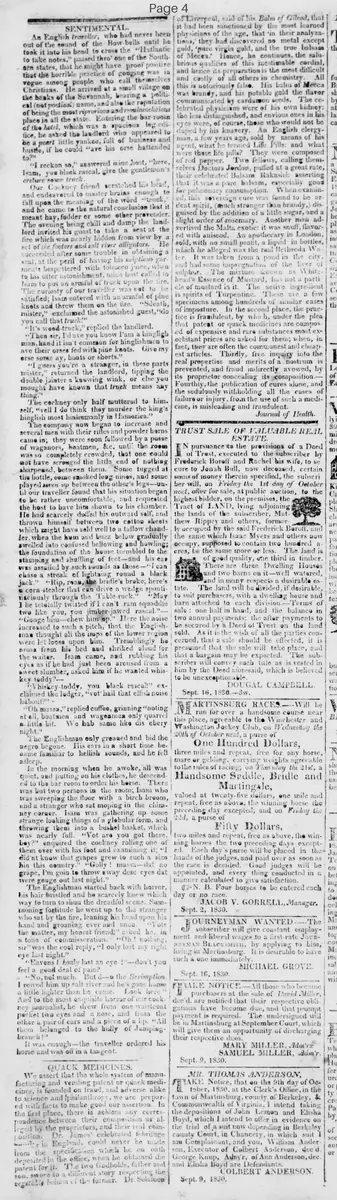
We assert that the whole system of manufacturing and vending patent or quack medicines, is founded on fraud, and adverse alike to science and philanthropy, we are prepared with facts to make good our assertion. In the first place, there is seldom any correspondence between their composition as alleged by the proprietors, and their real composition. Dr. James' celebrated febrifuge, had-er in England, could never be made from the specification which he on oath deposited in the office, when he obtained the patent for it. The two Godbolds, father and son, swore to a different story respecting the vegetable balsam of the former. Dr. Solomon of Liverpool, said of his Balm of Gilead, that it had been sanctioned by the most learned physicians of the age, that in their analysations, they had discovered no metal except gold, 'pure virgin gold, and the true balsam of Mecca.' Hence, he continues, the salubrious qualities of this inestimable cordial and hence its preparation is the most difficult and costly of all others in chemistry. All this is notoriously false. His balm of Mecca was brandy, and his potable gold the flavor communicated by cardamon seeds. The celebrated physicians were of his own kidney: the less distinguished, and envious ones in his eyes were, of course, those who would not be duped by his knavery. An English clergyman, a few years ago, sold by means of his agent, what he termed Life Pills: and what were these life pills? They were composed of red pepper. Two fellows, calling themselves Doctors Jordan, puffed at a great rate, their celebrated Balsam Rakasiri: asserting that it was a pure balsam, especially good for pulmonary consumption. When examined, this sovereign cure was found to be ardent spirit, (much stronger than brandy,) disguised by the addition of a little sugar, and a slight odor of rosemary. Another man advertised the Malta exotic: it was snuff, flavored with aniseed. An apothecary in London, sold, with no small profit, a liquid in bottles, which he alleged was the real Bethesda Water. It was taken from a pond in the city, and had some impregnation of the liver of sulphur. The mixture known as Whitehead's Essence of Mustard, has not a particle of mustard in it. The active ingredient is spirits of Turpentine. These are a few specimens among hundreds of similar cases of imposture. In the second place, the practice is fraudulent, by which, under the plea that patent or quack medicines are composed of expensive and rare substances most exorbitant prices are asked for them; when, in fact, they are often the commonest and cheapest articles. Thirdly, free enquiry into the real properties and merits of a nostrum is prevented, and fraud indirectly avowed, by its proprietor concealing its composition. Fourthly, the publication of cures alone, and the sedulously withholding all the cases of failure or injury, from the use of such a medicine, is misleading and fraudulent.
Journal of Health.
What sub-type of article is it?
What themes does it cover?
What keywords are associated?
What entities or persons were involved?
Where did it happen?
Story Details
Key Persons
Location
England
Story Details
The article criticizes the fraud in manufacturing and vending patent or quack medicines, providing examples of misrepresented compositions such as Dr. James' febrifuge, Godbold's vegetable balsam, Dr. Solomon's Balm of Gilead (brandy and cardamon), life pills (red pepper), Balsam Rakasiri (strong spirit with sugar and rosemary), Malta exotic (snuff with aniseed), Bethesda Water (pond water with liver of sulphur), and Whitehead's Essence of Mustard (spirits of turpentine). It highlights exorbitant prices for cheap ingredients, concealment of compositions, and selective publication of cures.