Thank you for visiting SNEWPapers!
Sign up free
Gazette Of The United States And Daily Evening Advertiser
Philadelphia, Philadelphia County, Pennsylvania
What is this article about?
In the British House of Commons on December 31, 1795, the Chancellor of the Exchequer delivers a speech opposing peace with the current Republican government in France, arguing for continued war to avoid insecurity, emphasizing French revolutionary principles as threats to order and religion, and highlighting Britain's superior resources compared to France's exhausted ones.
Merged-components note: Table on French distillers and taxes fits within the discussion of French finances in the continuation of the London speech on foreign intelligence; merged across pages.
Clippings
1 of 2
OCR Quality
Full Text
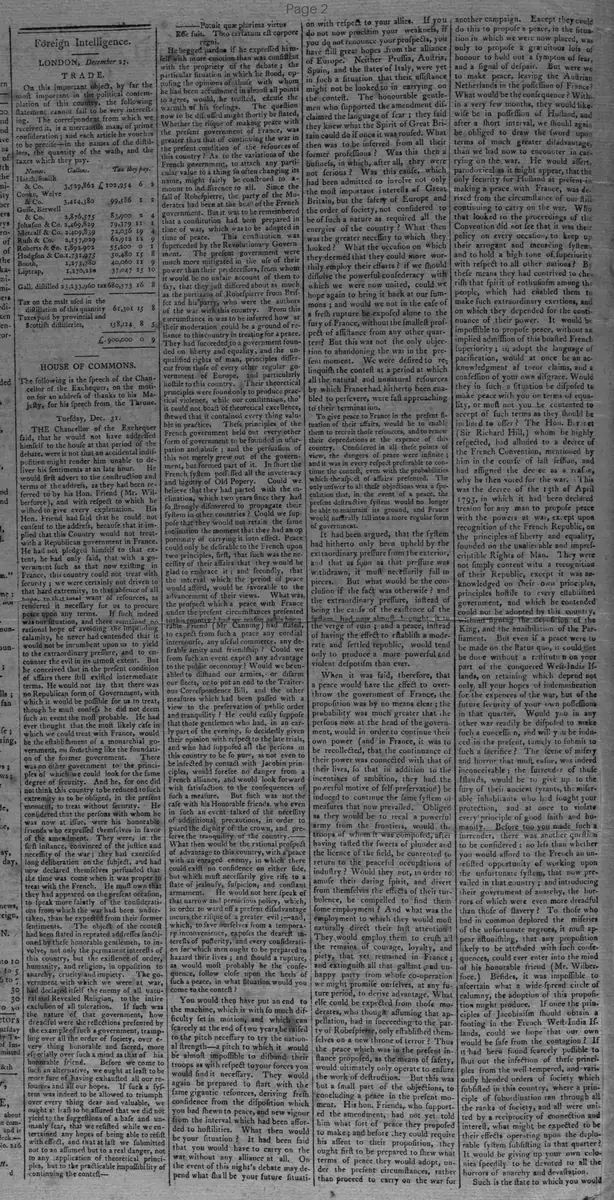
LONDON, December 27.
TRADE.
£. 900,000
HOUSE OF COMMONS.
The following is the speech of the Chancellor of the Exchequer, on the motion for an address of thanks to his Majesty, for his speech from the Throne.
Tuesday, Dec. 31.
THE Chancellor of the Exchequer said, that he would not have addressed himself to the house at that period of the debate, were it not that an accidental indisposition might render him unable to deliver his sentiments at a late hour. He would first advert to the construction and terms of the address, as they had been referred to by his Hon. Friend (Mr. Wilberforce), and with respect to which he wished to give every explanation. His Hon. Friend had said that he could not consent to the address, because that it implied that this Country would not treat with a Republican government in France. He had not pledged himself to that extent, he had only said, that with a government such as that now existing in France, this country could not treat with security; we were certainly not driven to that hard extremity, to that absence of all hope, to that total want of resources, as rendered it necessary for us to procure peace upon any terms. If such indeed was our situation, and there remained no rational hope of avoiding the impending calamity, he never had contended that it would not be incumbent upon us to yield to the extraordinary pressure, and to encounter the evil in its utmost extent. But he conceived that in the present condition of affairs there still existed intermediate terms. He would not say that there was no Republican form of Government, with which it would be possible for us to treat, though he must confess he did not deem such an event the most probable. He had ever thought that the most likely case in which we could treat with France, would be the establishment of a monarchical government, on something like the foundation of the former government. There was no other government to the principles of which we could look for the same degree of security. And he, for one did not think this country to be reduced to such extremity as to be obliged, in the present moment, to treat without security. He considered that the persons with whom he was now at issue, were his honorable friends who expressed themselves in favor of the amendment. They were, in the first instance, convinced of the justice and necessity of the war; they had exercised long deliberation on the subject, and had now declared themselves persuaded that the time was come when it was proper to treat with the French. He must own that they had appeared on the present occasion, to speak more faintly of the considerations from which the war had been undertaken, than he expected from their former sentiments. The object of the contest had been stated in repeated addresses sanctioned by these honorable gentlemen, to involve, not only the permanent interests of this country, but the existence of order, humanity, and religion, in opposition to anarchy, cruelty and impiety. The government with which we were at war, had declared itself the enemy of all natural and Revealed Religion, to the entire exclusion of all toleration. If such was the nature of that government, how dreadful were the reflections presented by the example of such a government, trampling over all the order of society, over every thing honorable and sacred, more especially over such a mind as that of his honorable friend. Before we come to such an alternative, we ought at least to be more sure of having exhausted all our resources and all our hopes. If such a system was indeed to be allowed to triumph over every thing dear and valuable, we ought at least to be assured that we did not yield to the suggestions of a base and unmanly fear, that we resisted while we entertained any hopes of being able to resist with effect, and that at last we submitted not to an assumed but to a real danger, no to any application of theoretical principles, but to the practicable impossibility of continuing the contest—
Potuit quæ plurima virtus
Heu fuit. Toto certatum et corpore regni.
He begged pardon if he expressed himself with more emotion than was consistent with the propriety of the debate; the particular situation in which he stood, opposing the opinions of those with whom he had been accustomed in almost all points to agree, would, he trusted, excuse the warmth of his feelings. The question now to be discussed might shortly be stated, Whether the risque of making peace with the present government of France, was greater than that of continuing the war in the present condition of the resources of this country? As to the variations of the French government, to attach any particular value to a thing so often changing its name, might fairly be construed to amount to indifference to all. Since the fall of Robespierre, the party of the Moderates had been at the head of the French government. But it was to be remembered that a constitution had been prepared in time of war, which was to be adopted in time of peace. This constitution was superseded by the Revolutionary Government. The present government were much more mitigated in the use of their power than their predecessors, from whom it would be no unfair account of them to say, that they just differed about as much as the partizans of Robespierre from Brissot and his party, who were the authors of the war with this country. From this circumstance it was to be inferred how far their moderation could be a ground of reliance to this country in treating for a peace. They had succeeded to a government founded on liberty and equality, and the unqualified rights of man, principles different from those of every other regular government of Europe, and particularly hostile to this country. Their theoretical principles were found only to produce practical violence, while our constitution, tho' it could not boast of theoretical excellence, shewed that it contained every thing valuable in practice. These principles of the French government held out every other form of government to be founded in usurpation and abuse; and the persuasion of this not merely grew out of the government, but formed part of it. In short the French system possessed all the inveteracy and bigotry of Old Popery. Could we believe that they had parted with the inclination, which two years since they had so strongly discovered to propagate their system in other countries? Could we suppose that they would not retain the same inclination the moment that they had an opportunity of carrying it into effect. Peace could only be desirable to the French upon two principles, first, that such was the necessity of their affairs that they would be glad to embrace it; and secondly, that the interval which the period of peace would afford, would be favorable to the advancement of their views. What was the prospect which a peace with France under the present circumstances presented to this country? had we reason as this honorable Friend (Mr Canning) had stated, to expect from such a peace any cordial intercourse, any useful commerce, any desirable amity and friendship? Could we from such an event expect any advantage to the public oeconomy? Would we be enabled to disband our armies, —or disarm our fleets, or to put an end to the Traiterous Correspondence Bill, and the other measures which had been passed with a view to the preservation of public order and tranquility? He could easily suppose that those gentlemen who had, in an early part of the evening, so decidedly given their opinion with respect to the late trials, and who had supposed all the persons in this country to be so pure, as not even to be infected by contact with Jacobin principles, would foresee no danger from a French alliance, and would look forward with satisfaction to the consequences of such a measure. But such was not the case with his Honorable friends, who even in such an event talked of the necessity of additional precautions, in order to guard the dignity of the crown, and preserve the tranquility of the country. What then would be the rational prospect of advantage to this country, with a peace with an enraged enemy, in which there could exist no confidence on either side, but which must necessarily give rise to a state of jealousy, suspicion, and constant armament. He would not here speak of that narrow and pernicious policy, which, in order to ward off a present disadvantage incurs the risque of a greater evil;and, which, to save ourselves from a temporary inconvenience, exposes the dearest interests of posterity, and every consideration for which men ought to be prepared to hazard their lives; and should a rupture, as would most probably be the consequence, follow close upon the heels of such a peace, in what situation would you come to the contest?
You would then have put an end to the machine, which is with so much difficulty set in motion, and which can scarcely at the end of two years be raised to the pitch necessary to try the national strength—a pitch to which it would be almost impossible to disband their troops as with respect to your forces you would find it necessary. They would again be prepared to start with the same gigantic resources, deriving fresh confidence from the disposition which you had shewn to peace, and new vigour from the interval which had been afforded to hostilities. What then would be your situation? It had been said that you would have to carry on the war without any alliance at all. On the event of this night's debate may depend what shall be your future situation with respect to your allies. If you do not now proclaim your weakness, if you do not renounce your prospects, you have still great hopes from the alliance of Europe. Neither Prussia, Austria, Spain, and the states of Italy, were yet in such a situation that their assistance might not be looked to in carrying on the contest. The honourable gentlemen who supported the amendment disclaimed the language of fear; they said they knew what the Spirit of Great Britain could do if once it was roused. What then was to be inferred from all their former professions? Was this then a business, in which, after all, they were not serious? Was this cause, which had been admitted to involve not only the most important interests of Great Britain, but the safety of Europe and the order of society, not considered to be of such a nature as required all the energies of the country? What then was the greater necessity to which they looked? What the occasion on which they deemed that they could more worthily employ their efforts? if we should dissolve the powerful confederacy with which we were now united, could we hope again to bring it back at our summons; and would we not in the case of a fresh rupture be exposed alone to the fury of France, without the smallest prospect of assistance from any other quarter? But this was not the only objection to abandoning the war in the present moment. We were desired to relinquish the contest at a period at which all the natural and unnatural resources by which France had hitherto been enabled to persevere, were fast approaching to their termination. To give peace to France in the present situation of their affairs, would be to enable them to recruit those resources, and to renew their depredations at the expence of this country. Considered in all these points of view, the dangers of peace were infinite; and it was in every respect preferable to continue the contest, even with the probabilities which the aspect of affairs presented. The only answer to all these objections was a speculation that, in the event of a peace, the present destructive system would no longer be able to maintain its ground, and France would naturally fall into a more regular form of government. It had been argued, that the system had hitherto only been upheld by the extraordinary pressure from the exterior, and that as soon as that pressure was withdrawn, it must necessarily fall in pieces. But what would be the conclusion if the fact was otherwise? and the extraordinary pressure, instead of being the cause of the existence of the system had now almost brought it to the verge of ruin; and a peace, instead of having the effect to establish a moderate and settled republic, would tend only to produce a more powerful and violent despotism than ever. When it was said, therefore, that a peace would have the effect to overthrow the government of France, the proposition was by no means clear; the probability was much greater that the persons now at the head of the government, would in order to continue their own power (and in France, it was to be recollected, that the continuance of their power was connected with that of their lives, so that in addition to the incentives of ambition, they had the powerful motive of self-preservation) be induced to continue the same system of measures that now prevailed. Obliged as they would be to recall a powerful army from the frontiers, would the troops of whom it was composed, after having tasted the sweets of plunder and the licence of the field, be contented to return to the peaceful occupations of industry? Would they not, in order to amuse their daring spirit, and divert from themselves the effects of their turbulence, be compelled to find them some employment? And what was the employment to which they would most naturally direct their first attention! They would employ them to crush all the remains of courage, loyalty, and piety, that yet remained in France; and extinguish all that gallant and unhappy party from whose co-operation we might promise ourselves, at any future period, to derive advantage, What else could be expected from those moderates, who though assuming that appellation, had in succeeding to the party of Robespierre, only established themselves on a new throne of terror? Thus the peace which was in the present instance proposed, as the means of safety, would ultimately only operate to ensure the work of destruction. But this was but a small part of the objections, to concluding a peace in the present moment. His hon. Friends, who supported the amendment, had not yet told him what sort of peace they proposed to make; and before they could require his assent to their proposition, they ought first to be prepared to shew what terms of peace they would adopt, under the present circumstances, rather than proceed to carry on the war for another campaign. Except they could do this to propose a peace, in the situation in which we were now placed, was only to propose a gratuitous loss of honour to hold out a symptom of fear, and a signal of despair. But were we to make peace, leaving the Austrian Netherlands in the possession of France? What would be the consequence? Within a very few months, they would likewise be in possession of Holland, and after a short interval, we should again be obliged to draw the sword upon terms of much greater disadvantage, than we had now to encounter in carrying on the war. He would assert, paradoxical as it might appear, that the only security for Holland at present—in making a peace with France, was derived from the circumstance of our still continuing to carry on the war. Who that looked to the proceedings of the Convention did not see that it was their policy on every occasion, to keep up their arrogant and menacing system and to hold a high tone of superiority with respect to all other nations? By these means they had contrived to cherish that spirit of enthusiasm among the people, which had enabled them to make such extraordinary exertions, and on which they depended for the continuance of their power. It would be impossible to propose peace, without an implied admission of this boasted French superiority; to adopt the language of pacification, would at once be an acknowledgment of their claims, and a confession of your own disgrace. Would they in such a situation be disposed to make peace with you on terms of equality, or must not you be contented to accept of such terms as they should be inclined to offer? The Hon. Baronet (Sir Richard Hill,) whom he highly respected, had alluded to a decree of the French Convention, mentioned by him in the course of last session, and had assigned the decree as a reason why he then voted for the war. This was the decree of the 19th of April 1793, in which it had been declared treason for any man to propose peace with the powers at war, except upon recognition of the French Republic, on the principles of liberty and equality, founded on the inalienable and imprescriptible Rights of Man. They were not simply content with a recognition of their Republic, except it was acknowledged on their own principles, principles hostile to every established government, and which he contended could not be adopted by this country, without signing the deposition of the King, and the annihilation of the Parliament. But even if a peace were to be made on the status quo, it could not be done without a restitution on your part of the conquered West-India Islands, on retaining which depend not only, all your hopes of indemnification for. the expences of the war, but of the future security of your own possessions in that quarter. Would you in any other war readily be disposed to make such a concession, and will you be induced in the present, tamely to submit to such a sacrifice? The scene of misery and horror that must ensue, was indeed inconceivable: the surrender of those Islands, would be to give up to the fury of their ancient tyrants, the miserable inhabitants who had sought your protection, and at once to violate every principle of good faith and humanity. Before too you made such a surrender, there was another question to be considered: no less than whether you would afford to the French an unresisted opportunity of working upon the unfortunate system, that now prevailed in that country; and introducing their government of anarchy, the horrors of which were even more dreadful than those of slavery? To those who had in common deplored the miseries of the unfortunate negroes, it must appear astonishing, that any proposition likely to be attended with such consequences, could ever enter into the mind of his honorable friend (Mr. Wilberforce.) Besides, it was impossible to ascertain what a wide-spread circle of calumny, the adoption of this proposition might produce. If once the principles of Jacobinism should obtain a footing in the French West-India Islands, could we hope that our own would be safe from the contagion? If it had been found scarcely possible to shut out the infection of these principles from the well-tempered, and variously blended orders of society which subsisted in this country, where a principle of subordination ran through all the ranks of society, and all were united by a reciprocity of connection and interest, what might be expected to be their effects operating upon the deplorable system subsisting in that quarter? It would be giving up your own colonies speedily to be devoted to all the horrors of anarchy and devastation. Such is the state to which you woul
| On this important object, by far the most important in the political contemplation of this country, the following flatment cannot fail to be very interesting. The correspondent from which we received it, is a mercantile man, of prime consideration; and each article he vouches to be precise—in the names of the diffillers, the quantity of the wahl, and the taxes which they pay. | |||
| Names. | Gallons. | Tax they pay. | |
| Hatch, Smith & Co. | 3,529,862 | £ 102,954 | 6 2 |
| Cooke, Welve & Co. | 3,414,380 | 99,586 | 1 2 |
| Goffe, Berwell & Co. | 2,876,575 | 83,900 | 2 4 |
| Johafon & Co. | 2,469,829 | 79,379 | 11 1 |
| Metcalf & Co. | 2,409,839 | 72,036 | 19 4 |
| Rufh & Co. | 2,157,029 | 62,912 | 12 9 |
| Roberts & Co. | 1,892,902 | 55,200 | 0 1 |
| Hodgfon & Co. | 1,731,975 | 50,480 | 15 8 |
| Booth, Liptrap, | 1,273,780 | 40,060 | 11 9 |
| 1,270,210 | 37,047 | 15 10 | |
| Gall. diffilled 23,233,960 tax 680,573 | 16 8 | ||
| Tax on the malt used in the distillation of this quantity | 61,301 | 15 8 | |
| Taxes paid by provincial and Scottish diffilleries, | 158,124 | 8 5 |
reduce yourselves by any proposition for peace in the present moment. Any confession of your own weakness.—such proposition must necessarily imply You must ask for peace, not indeed in the language, but in the posture of supplication. He had not yet heard our own difficulties stated in such terms, as shewed an absolute necessity of immediately having recourse to peace. What had chiefly been insisted on, was the unfortunate events of the last campaign. He was not disposed to diminish our prospect of the success of our operations. The speech of his majesty mentioned the reverses and disappointments, which had attended the progress of our arms. But was this a sufficient ground why we should all at once be induced to abandon the war, and to sue for peace? Was the enumeration which had been made of the checks and defeats which we had met in the last campaign to be considered as at all conclusive? Had not similar checks and defeats occurred in former wars, where the object was much less serious, and where, after all, the event had been successful? Would any man then from the experience of former wars, pretend to say, that the bare check of military operations, or the transfer of territory from one power to another, were sufficient ground of discouragement, or formed the ultimate criterion of success? No man would pretend to say such was the case. And if such was not the fact with respect to wars in general, much less would it hold with respect to the present war, as carried on by this country. All modern wars had been remarked to depend on a comparison of the means by which they were to be carried on. That power that possessed the superiority of resources had been found finally to be successful. The great question between Great Britain and France, in the present contest was, which should be able to hold out longest in point of pecuniary resources? At present, both the balance of territorial acquisitions, and of pecuniary resources, was on the side of Great-Britain- Nay, he should go farther, and venture to assert, that if all that had been lost by Austria, Prussia, and the states of Italy, were to be put together, it would not amount to the extent of the loss which had been sustained by France alone. With respect to the resources of France, they had existed, and they had ceased. These resources had originated from a rigorous system pervading every department of life. and every quarter of the country. They had been founded on a system of terror. That system, it was contended, had now ceased ; but the present, so far from deserving the name of a system of moderation; was to be considered so, only as it diminished the means by which the great engine of despotism, which formerly existed, had been enabled to produce such prodigious effects. - His honourable friend, (Mr. Canning) had stated the expense with which the French government had been attended since the commencement of the revolution. As to entering into details of this sort, he wished to observe, that if any member was desirous to be acquainted with the authorities upon which he proceeded, he was ready to enter into any particular discussion, and point out the sources from which he had derived his information. The Chancellor of the Exchequer here entered into a detail of the state of French finance, from the reports of Cambon, &c. He stated the whole expense of the government, since the revolution, to have amounted to 480 millions sterling, of which no less than 320 had been expended since the commencement of the war with this country. This enormous sum had been stated as a proof of the immense resources of the country. But at what price had it been procured ? At the expense of wresting from the possessors all the property of the country, and of putting in a state of requisition every necessary article of consumption. They had likewise been obliged to have recourse to an unlimited paper credit, which surpassed all calculation, and to which no bounds had been set. If it had even been stated by their own leader, that it had now been carried to that point, beyond which it could not be extended without ruin to the country, In former times the circulation of France had been stated to amount only to ninety millions annually, of which it may naturally be supposed that a great part remained inactive. He mentioned this, in order to shew how far the scale of their expenditures exceeded what might be supposed to be the natural resources of the country. He then entered into a detail of the depreciation of the paper money, and of the forcible means to which they had been obliged to have recourse, in order to introduce it into currency. He particularly mentioned the revolutionary committees, which had been appointed in every district, and were supported at the immense expense of twenty-six millions annually, and concluded with quoting the opinion of Tallien, " that it was only by diminishing the number of their forces that they could be able to reduce the scale of the public expenditure, and to preserve the credit of the country." It was this unlimited power which the French Convention had assumed to purchase or seize all property, as suited to their purposes, which accounted for the stupendous scale of operations, which they had been enabled to pursue. This circumstance solved the phenomenon which otherwise appeared so inexplicable, and was adequate to all those miraculous effects which had attended the progress of the French revolution, and which seemed to baffle all reasoning, as much as they had exceeded all human expectation. In all these circumstances, he would say, that we had sufficient inducements to carry on the war, if not with the certainty of faith, yet at least with the confidence of expectation. A war, the immediate termination of which would be attended with certain evil, and the prosecution of which, under the present circumstances, was at least not without great probable hope. If we looked to the situation of France, they were now attempting to have recourse to a milder and more moderate system, a system which would only deprive them of those prodigious energies which they had hitherto exerted with such astonishing effect : they no longer indeed possessed the same means, and could not therefore be expected to display the same exertions. Would it be possible for them all at once to restore the farmer to the occupations of agriculture, and the merchant to the pursuits of commerce, and to replace in an instant, the devastations of war and plunder by the arts of peace, and the exertions of industry. It would require years of tranquility to restore them even to the enjoyment of those ordinary resources, which they had possessed previous to the commencement of the present destructive war-resources which they could no longer employ. For even could it be supposed that Robespierre were raised from the dead, they would no longer be qualified to display the same energies which under his administration, had been called forth by the influence of a system of terror: the means by which these had been supplied were now exhausted. The question then was-had we, under the present circumstances, the prospect of being able to bring as great a force into the field as would require from the French the same degree of exertion which had been necessary in the former campaigns ?- Even let it be supposed that Holland should fail, & that circumstances should be such that we could no longer look for assistance from the court of Berlin, yet he could see no reason why the augmentation of the British force might not fully supply the loss, and do something more valuable in effect, with respect to the operations of the war. He could see no reason, if we gave to Austria the pecuniary aid which it required at its own expense, why we might not be able, in conjunction with the augmented force, which, from the assistance of our credit, it would be enabled to bring forward, along too with the powers of Spain- and the states of Italy, to effect a powerful diversion, and to accomplish the important purpose on which depended the permanent interest of this country, and the general safety of Europe.
[Mr. Fox's speech to-morrow.]
What sub-type of article is it?
What keywords are associated?
What entities or persons were involved?
Where did it happen?
Foreign News Details
Primary Location
France
Event Date
Tuesday, Dec. 31
Key Persons
Outcome
debate on motion for address of thanks; arguments against peace with current french government, favoring continued war due to security concerns and french resources nearing exhaustion; no final outcome reported.
Event Details
The Chancellor of the Exchequer speaks in the House of Commons against treating with the current Republican government in France, arguing it lacks security, promotes anarchy and anti-religious principles, and that Britain has superior resources; warns of dangers to allies like Austria, Prussia, Spain, Italy, and colonies in West Indies if peace is made now; details French financial exhaustion from revolution and war expenditures totaling 480 million sterling.