Thank you for visiting SNEWPapers!
Sign up free
Domestic News
November 22, 1883
Helena Weekly Herald
Helena, Lewis And Clark County, Montana
What is this article about?
A Washington correspondent reflects on the surviving Civil War generals eighteen years after the war's end, detailing their ages, appearances, current occupations, and locations, noting many are aging and some hold political or military roles.
Clipping
OCR Quality
98%
Excellent
Full Text
THE OLD WAR GENERALS
Those Now Living and their Present
Pursuits.
[Washington Correspondence.]
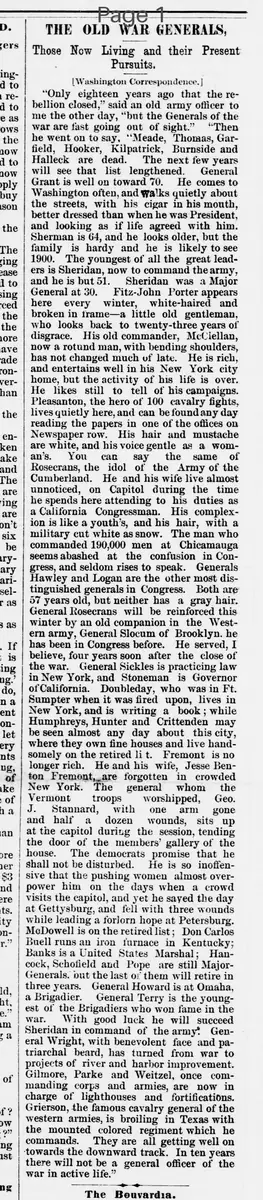
"Only eighteen years ago that the rebellion closed," said an old army officer to me the other day, "but the Generals of the war are fast going out of sight." Then he went on to say, "Meade, Thomas, Garfield, Hooker, Kilpatrick, Burnside and Halleck are dead. The next few years will see that list lengthened. General Grant is well on toward 70. He comes to Washington often, and walks quietly about the streets, with his cigar in his mouth, better dressed than when he was President, and looking as if life agreed with him. Sherman is 64, and he looks older, but the family is hardy and he is likely to see 1900." The youngest of all the great leaders is Sheridan, now to command the army, and he is but 51. Sheridan was a Major General at 30. Fitz-John Porter appears here every winter, white-haired and broken in frame—a little old gentleman, who looks back to twenty-three years of disgrace. His old commander, McClellan, now a rotund man, with bending shoulders, has not changed much of late. He is rich, and entertains well in his New York city home, but the activity of his life is over. He likes still to tell of his campaigns. Pleasanton, the hero of 100 cavalry fights, lives quietly here, and can be found any day reading the papers in one of the offices on Newspaper row. His hair and mustache are white, and his voice gentle as a woman's. You can say the same of Rosecrans, the idol of the Army of the Cumberland. He and his wife live almost unnoticed, on Capitol hill during the time he spends here attending to his duties as a California Congressman. His complexion is like a youth's, and his hair, with a military cut white as snow. The man who commanded 190,000 men at Chickamauga seems abashed at the confusion in Congress, and seldom rises to speak. Generals Hawley and Logan are the other most distinguished generals in Congress. Both are 57 years old, but neither has a gray hair General Rosecrans will be reinforced this winter by an old companion in the Western army, General Slocum of Brooklyn. He has been in Congress before. He served, I believe, four years soon after the close of the war. General Sickles is practicing law in New York, and Stoneman is Governor of California. Doubleday, who was in Ft. Sumter when it was fired upon, lives in New York, and is writing a book; while Humphreys, Hunter and Crittenden may be seen almost any day about this city, where they own fine houses and live handsomely on the retired list. Fremont is no longer rich. He and his wife, Jessie Benton Fremont, are forgotten in crowded New York. The general whom the Vermont troops worshipped, Geo. J. Stannard, with one arm gone and half a dozen wounds, sits up at the capitol during the session, tending the door of the members' gallery of the house. The democrats promise that he shall not be disturbed. He is so inoffensive that the pushing women almost overpower him on the days when a crowd visits the capitol, and yet he saved the day at Gettysburg, and fell with three wounds while leading a forlorn hope at Petersburg. McDowell is on the retired list: Don Carlos Buell runs an iron furnace in Kentucky; Banks is a United States Marshal: Hancock, Schofield and Pope are still Major-Generals, but the last of them will retire in three years. General Howard is at Omaha, a Brigadier. General Terry is the youngest of the Brigadiers who won fame in the war. With good luck he will succeed Sheridan in command of the army. General Wright, with benevolent face and patriarchal beard, has turned from war to projects of river and harbor improvement. Gilmore, Parke and Weitzel, once commanding corps and armies, are now in charge of lighthouses and fortifications. Grierson, the famous cavalry general of the western armies, is broiling in Texas with the mounted colored regiment which he commands. They are all getting well on towards the downward track. In ten years there will not be a general officer of the war in active life."
Those Now Living and their Present
Pursuits.
[Washington Correspondence.]
"Only eighteen years ago that the rebellion closed," said an old army officer to me the other day, "but the Generals of the war are fast going out of sight." Then he went on to say, "Meade, Thomas, Garfield, Hooker, Kilpatrick, Burnside and Halleck are dead. The next few years will see that list lengthened. General Grant is well on toward 70. He comes to Washington often, and walks quietly about the streets, with his cigar in his mouth, better dressed than when he was President, and looking as if life agreed with him. Sherman is 64, and he looks older, but the family is hardy and he is likely to see 1900." The youngest of all the great leaders is Sheridan, now to command the army, and he is but 51. Sheridan was a Major General at 30. Fitz-John Porter appears here every winter, white-haired and broken in frame—a little old gentleman, who looks back to twenty-three years of disgrace. His old commander, McClellan, now a rotund man, with bending shoulders, has not changed much of late. He is rich, and entertains well in his New York city home, but the activity of his life is over. He likes still to tell of his campaigns. Pleasanton, the hero of 100 cavalry fights, lives quietly here, and can be found any day reading the papers in one of the offices on Newspaper row. His hair and mustache are white, and his voice gentle as a woman's. You can say the same of Rosecrans, the idol of the Army of the Cumberland. He and his wife live almost unnoticed, on Capitol hill during the time he spends here attending to his duties as a California Congressman. His complexion is like a youth's, and his hair, with a military cut white as snow. The man who commanded 190,000 men at Chickamauga seems abashed at the confusion in Congress, and seldom rises to speak. Generals Hawley and Logan are the other most distinguished generals in Congress. Both are 57 years old, but neither has a gray hair General Rosecrans will be reinforced this winter by an old companion in the Western army, General Slocum of Brooklyn. He has been in Congress before. He served, I believe, four years soon after the close of the war. General Sickles is practicing law in New York, and Stoneman is Governor of California. Doubleday, who was in Ft. Sumter when it was fired upon, lives in New York, and is writing a book; while Humphreys, Hunter and Crittenden may be seen almost any day about this city, where they own fine houses and live handsomely on the retired list. Fremont is no longer rich. He and his wife, Jessie Benton Fremont, are forgotten in crowded New York. The general whom the Vermont troops worshipped, Geo. J. Stannard, with one arm gone and half a dozen wounds, sits up at the capitol during the session, tending the door of the members' gallery of the house. The democrats promise that he shall not be disturbed. He is so inoffensive that the pushing women almost overpower him on the days when a crowd visits the capitol, and yet he saved the day at Gettysburg, and fell with three wounds while leading a forlorn hope at Petersburg. McDowell is on the retired list: Don Carlos Buell runs an iron furnace in Kentucky; Banks is a United States Marshal: Hancock, Schofield and Pope are still Major-Generals, but the last of them will retire in three years. General Howard is at Omaha, a Brigadier. General Terry is the youngest of the Brigadiers who won fame in the war. With good luck he will succeed Sheridan in command of the army. General Wright, with benevolent face and patriarchal beard, has turned from war to projects of river and harbor improvement. Gilmore, Parke and Weitzel, once commanding corps and armies, are now in charge of lighthouses and fortifications. Grierson, the famous cavalry general of the western armies, is broiling in Texas with the mounted colored regiment which he commands. They are all getting well on towards the downward track. In ten years there will not be a general officer of the war in active life."
What sub-type of article is it?
Military
Politics
What keywords are associated?
Civil War Generals
Veterans Pursuits
Washington Correspondence
Army Officers
Congress Generals
What entities or persons were involved?
Grant
Sherman
Sheridan
Fitz John Porter
Mcclellan
Pleasanton
Rosecrans
Hawley
Logan
Slocum
Sickles
Stoneman
Doubleday
Humphreys
Hunter
Crittenden
Fremont
Jessie Benton Fremont
Geo. J. Stannard
Mcdowell
Don Carlos Buell
Banks
Hancock
Schofield
Pope
Howard
Terry
Wright
Gilmore
Parke
Weitzel
Grierson
Where did it happen?
Washington
Domestic News Details
Primary Location
Washington
Event Date
Eighteen Years After The Rebellion Closed
Key Persons
Grant
Sherman
Sheridan
Fitz John Porter
Mcclellan
Pleasanton
Rosecrans
Hawley
Logan
Slocum
Sickles
Stoneman
Doubleday
Humphreys
Hunter
Crittenden
Fremont
Jessie Benton Fremont
Geo. J. Stannard
Mcdowell
Don Carlos Buell
Banks
Hancock
Schofield
Pope
Howard
Terry
Wright
Gilmore
Parke
Weitzel
Grierson
Event Details
An old army officer discusses the surviving Civil War generals, their ages, current pursuits, locations, and appearances, noting many are in politics, retired, or in other roles, and predicting few will remain active in ten years.