Thank you for visiting SNEWPapers!
Sign up free
Editorial
September 5, 1803
The National Intelligencer And Washington Advertiser
Washington, District Of Columbia
What is this article about?
An editorial critiques 'paper heroes' in the press urging war, drawing on historical examples and quotes from Trenchard and Fénelon to condemn conquerors and false heroism, advocating peace and moral virtue over destructive ambition.
Merged-components note: Continuation of the opinion piece on 'HEROES' across pages; relabeled from literary to editorial as it fits opinionated essay.
Clippings
1 of 2
OCR Quality
95%
Excellent
Full Text
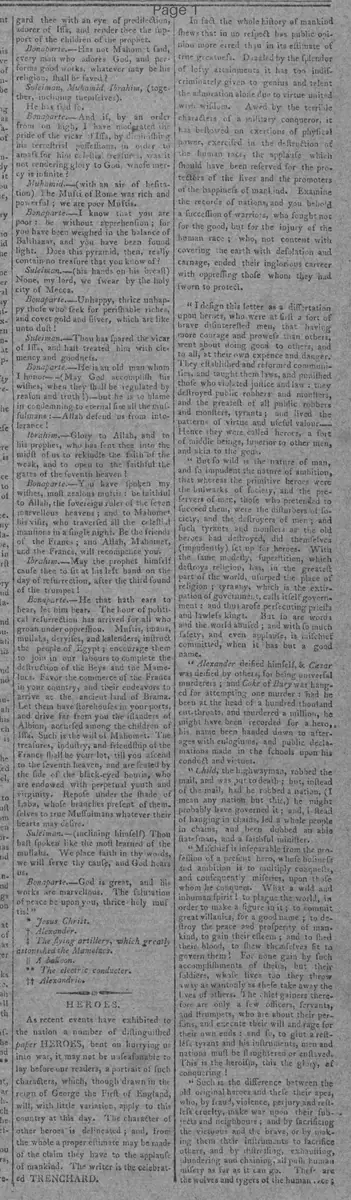
HEROES.
As recent events have exhibited to the nation a number of distinguished paper HEROES, bent on hurrying us into war, it may not be unreasonable to lay before our readers, a portrait of such characters, which, though drawn in the reign of George the First of England, will, with little variation, apply to this country at this day. The character of other heroes is delineated; and, from the whole a proper estimate may be made of the claim they have to the applause of mankind. The writer is the celebrated TRENCHARD.
In fact the whole history of mankind shews that in no respect has public opinion more erred than in its estimate of true greatness. Dazzled by the splendor of lofty attainments it has too indiscriminately given to genius and talent the admiration alone due to virtue united with wisdom. Awed by the terrible characters of a military conqueror, it has bestowed on exertions of physical power, exercised in the destruction of the human race, the applause which should have been reserved for the protectors of the lives and the promoters of the happiness of mankind. Examine the records of nations, and you behold a succession of warriors, who ought not for the good, but for the injury of the human race; who, not content with covering the earth with desolation and carnage, ended their inglorious career with oppressing those whom they had sworn to protect.
"I design this letter as a dissertation upon heroes, who were at first a sort of brave disinterested men, that having more courage and prowess than others, went about doing good to others, and to all, at their own expence and danger. They established and reformed communities, and taught them laws, and punished those who violated justice and law: they destroyed public robbers and monsters, and the greatest of all public robbers and monsters, tyrants; and lived the patterns of virtue and useful valour. Hence they were called heroes, a sort of middle beings, superior to other men, and akin to the gods.
"But so wild is the nature of man, and so impudent the nature of ambition, that whereas the primitive heroes were the bulwarks of society, and the preservers of men, those who pretended to succeed them, were the disturbers of society, and the destroyers of men: and such tyrants and monsters as the old heroes had destroyed, did themselves (impudently) set up for heroes. With the same modesty, superstition, which destroys religion, has, in the greatest part of the world, usurped the place of religion; tyranny, which is the extirpation of government, calls itself government: and thus arose persecuting priests and lawless kings. But so are words and the world abused; and with so much safety, and even applause, is mischief committed, when it has but a good name.
"Alexander deified himself, & Cæsar was deified by others, for being universal murderers; and Coke of Bury was hanged for attempting one murder: had he been at the head of a hundred thousand cut-throats, and murdered a million, he might have been recorded for a hero, his name been handed down to after-ages with eulogiums, and public declamations made in the schools upon his conduct and virtues.
"Child, the highwayman, robbed the mail, and was put to death; but, instead of the mail, had he robbed a nation, (I mean any nation but this, he might probably have governed it; and, instead of hanging in chains, led a whole people in chains, and been dubbed an able statesman, and a faithful minister.
"Mischief is inseparable from the profession of a present hero, whose business and ambition is to multiply conquests, and consequently miseries, upon those whom he conquers. What a wild and inhuman spirit! to plague the world, in order to make a figure in it; to commit great villanies, for a good name; to destroy the peace and prosperity of mankind, to gain their esteem; and to shed their blood, to shew themselves fit to govern them! For none gain by such accomplishments of theirs, but their soldiers, whose lives too they throw away as wantonly as they take away the lives of others. The chief gainers therefore are only a few officers, servants, and trumpets, who are about their persons, and execute their will and rage for their own ends: and so, to glut a restless tyrant and his instruments, men and nations must be slaughtered or enslaved. This is the heroism, this the glory, of conquering!
"Such is the difference between the old original heroes and these their apes, who, by fraud, violence, perjury and restless cruelty, make war upon their subjects and neighbours; and by sacrificing the virtuous and the brave, or by making them their instruments to sacrifice others, and by distressing, exhausting, plundering and chaining, all push human misery as far as it can go. They are the wolves and tygers of the human race;
imperial beasts of prey, who, if the world would preserve itself, ought to be driven out of the world, or hung up in it in terrorem; or like thee their more innocent brethren, who only kill for food, to be locked up in dens, and shewn, as they are, for monsters: or perhaps it would be still a more equitable punishment, if they could be caught, to shut up a number of them in a mad-house with their beloved arms about them, there to fight and tear one another's flesh, and spill their own detestable blood, till they had no more to spill. This would be giving a sort of satisfaction to mankind, for so much human blood outrageously and wantonly spilt.
But this is not the only mock hero in the world; there is yet another sort as mischievous, but still more ridiculous; and that is, a violent appetite for war, and victory, and conquest, without engaging personally in the danger, or coming near it; but being very valorous by proxy, and fond of fighting without drawing a sword. This was the pendant bravery of a late aged conqueror, who was never tired of war, yet never tired his own person in it; in the heat of a battle fought for his glory, he run no risk, but sat securely at a great distance with the wise old woman his mistress, waiting for laurels of other people's winning. When his agents had bought a town for him treacherously, or his generals stolen a province as treacherously, still it was victory, still fair conquest; and the glory was his at three hundred leagues distance: for every thing that he did was glorious, the meanest and the basest things; and by these means he became immortal, immortal in conquest without a scar.
The primitive heroes ventured their lives for the good of others: the mock-heroes expose others to danger and death for the good of themselves, and their own personal renown; and all the time stay at home, and wait for fame in a whole skin. They slaughter thousands who obey them, and undo millions who ought not to obey them; and all to enslave others, who neither wish nor do them any harm, and with whom they have nothing at all to do. Even most of the instruments which they make use of, are made as miserable as they make those whom they oppress; and few or none share the benefit of the plunder, but such as wanting merit of their own to gain an honest subsistence, prey upon the industry of those that do. So strongly does misery thrive under their influence, and nothing else!
They keep themselves poor, avaricious, and in a state of war with their own subjects, whom they justly treat as their worst enemies, because they supply them with constant reason to be so; and therefore they live in a perpetual state of rapine and enmity towards them, and in a continued dread of violence and revolts from them; instead of giving them fatherly protection on one side, and receiving from them dutiful and sincere allegiance on the other; and all for the fruitless and imaginary glory of conquest, and of dominion over their fellow-creatures against their will; or, in other words, of being skilful pillagers and oppressors and successful murderers.
It is, however, not to be wondered at, that whilst so many princes are beset with sycophants, always ready to applaud at a venture their wildest sallies and designs; or with traitors, who finding their own vile advantages in them, are ever determined to abet and execute them: I say, it is not strange, that princes in these circumstances should run frequently into wild freaks, and pernicious enterprises, to the ruin of themselves and their subjects. But it is stupendous, that these their baneful intrigues and worst foes should be able, in any instance, to persuade nations to dance after their destructive maggots, and be contented to be undone, to make some of the worst of men amongst themselves rich and saucy.
What have the people in any monarchical government ever gained by the conquests made by their prince, but to be made slaves; or if they were slaves before, worse slaves, and to have their chains rivetted yet faster? For, besides that these conquests give him a pretence and an ability to keep more troops, and consequently increase his power over them; the Conquered nation will find a sort of revenge in joining to reduce their new masters to the same wretched condition with themselves, and perhaps find an opportunity of conquering the conquerors. One nation will be played upon another, and neither will be trusted to the guard of their own countrymen; but the soldiers of one country will be quartered upon the other, and kept at a great distance from home, lest by constant conversation with their relations, friends and neighbours, they should, contrary to their duty, warp towards the love and interest of their Country: and indeed in most countries where troops are kept, they are always removed from place to place, to prevent their friendship and correspondence with the natives.
What did England gain formerly by their conquests upon the continent, but constant wars, slaughter and poverty to themselves, and to their princes precarious foreign provinces at an English expence; and had standing armies been then the fashion of the world, England would doubtless have conquered herself into slavery. The Romans, when they had extended their conquests so far and wide, that they were forced to keep provincial armies to awe and preserve the conquered countries, became a prey to those armies; and their emperors afterwards durst no longer trust to Roman troops, but increased their slavery by the help of those whom they had conquered, and who became, in their turns, masters of those who had mastered them.
When Alexander had ventured his own army of Macedonians, and the best men in Greece, to ruin Persia, and a great part of the world, which had given him no provocation; what advantages did Greece and Macedon reap from his mighty victories and conquests, but to become a little province of a great barbarous empire, which by their arms and prowess they conquered, and exhausted them of all their bravest men to preserve? Their condition would still have been worse if he had left a successor behind him to have preserved his whole empire entire, who would have made Persia, or some other province, the seat of it, and governed Greece at a distance by viceroys: as it was, he left it in a state of constant war and depredation, and they were tossed and tumbled from one oppression to another, till they found a sort of relief in being conquered by the Romans.
What did the French gain by the long wars and many conquests of their late great monarch, but extreme poverty, stricter servitude, great depopulation, and general bankruptcy? So much did they suffer by his acquisitions, and so dear did they pay for his pernicious glory.
What did the Swedes gain by the conquests of the late king, but to lose them again, as they got them, at a vast expence of blood and treasure; and to be reduced to such weakness, as to want the assistance of their neighbours to preserve them from falling under the power of a prince, whom, by conquering him, they thought to conquer them?
And if the conquering countries are such miserable losers by conquest, what must be the doleful condition of the conquered, which are considered only as the sources of plunder, and the professed objects of oppression? Almost all Europe are witnesses of the brutal havoc which the conquerors make, and of the dismal scenes of ruin that they leave behind them. If the late French king could have conquered, or bought, or surprised, the United Provinces (which by all these generous means he endeavored) from the richest and most populous republic upon earth, they would have been now a nest of beggarly fishermen, and in a lower condition, if possible, than any of the fine French provinces, which had the honor of being governed by that paternal prince. Never was such mockery, as for a prince to publish reasons to a people, with whom he had nothing to do, why they should be conquered by him: when, let their condition be as ill as it will, it is an hundred to one, nay it is almost certain, that he will make it ten times worse.
Alas for that nation whose prince is a hero! says an excellent and amiable French writer, who saw, with sorrow, the woful condition of his own nation, from the merciless and unnatural affectation of heroism in the then king.
The same admirable author, in another place, gives us a lively image of heroes and conquests in these words, which he makes Telemachus speak, as he views the field of battle filled with carcases, and drenched in blood: "Such are the heavy evils that follow wars! What blind fury urges unhappy mortals! So few are the days that they have to live upon this earth, and so miserable do they make these few days! Why will they run thus headlong into the jaws of death, which is of itself making hasty approaches to devour them? Why add so many frightful desolations to a short and bitter life, made so by heaven already? Men are all brethren, and they tear and butcher one another, more unnaturally fierce and cruel than the wild beasts of the desert! Lions make not war upon lions, nor tigers upon tigers: they attack only animals of a different species. Man! man alone, in spite of his reason, does things that creatures without reason would never do."
But why these consuming wars? Is there not land enough in the universe to satisfy all men with more than they can cultivate? Are there not vast tracts of desert lands, so vast that mankind is not sufficient to fill them? How then! A false glory, a vain title of conqueror, which a prince is fond of, kindles a war far and wide; and one single man, thrown by heaven into the world, in wrath, sacrifices brutally so many others to his vanity! his glory requires it, and all must perish before him: countries swim in blood, towns and cities suffer devouring flames; and what escapes from the sword and the fire, famine, more cruel than both, must consume; and all that this man, who thus sports himself with throwing all human nature into purgatory, may find in this general destruction his pleasure and his glory. What monstrous glory! Can we too much despise, too much abhor, these monstrous men, who have thus forgot humanity? Without being men, they set up for demi-gods; and earn the curses, instead of, what they aim at, the admiration, of ages to come.
Oh! with what tenderness should princes undertake wars! That they ought to be strictly just, is not enough; they must be strictly necessary, for the public good. The blood of the people, ought never to be shed but to save the people; and the occasion ought to be extreme. But flattering counsels, false ideas of glory, vain jealousies, boundless rapaciousness under specious disguises, and rash engagements, draw almost all princes precipitately or insensibly into wars which prove fatal to them. In them they hazard all without necessity, and do as much mischief to their subjects as to their enemies."
Thus the divine late archbishop of Cambray, from whom I have translated this affecting passage. It is a book that has ten thousand excellencies, and ought to be read by all mankind.
I will conclude with wishing, that all nations would learn the wisdom of the prudent Sancho, who, when the hero his master madly attacked the wind-mills and the lions, stood at a safe distance and in a whole skin. If their governing Don Quixottes will fight, right or wrong, let them fight by themselves, and not sit at home and wantonly sacrifice their people against wind-mills and fulling mills.
As recent events have exhibited to the nation a number of distinguished paper HEROES, bent on hurrying us into war, it may not be unreasonable to lay before our readers, a portrait of such characters, which, though drawn in the reign of George the First of England, will, with little variation, apply to this country at this day. The character of other heroes is delineated; and, from the whole a proper estimate may be made of the claim they have to the applause of mankind. The writer is the celebrated TRENCHARD.
In fact the whole history of mankind shews that in no respect has public opinion more erred than in its estimate of true greatness. Dazzled by the splendor of lofty attainments it has too indiscriminately given to genius and talent the admiration alone due to virtue united with wisdom. Awed by the terrible characters of a military conqueror, it has bestowed on exertions of physical power, exercised in the destruction of the human race, the applause which should have been reserved for the protectors of the lives and the promoters of the happiness of mankind. Examine the records of nations, and you behold a succession of warriors, who ought not for the good, but for the injury of the human race; who, not content with covering the earth with desolation and carnage, ended their inglorious career with oppressing those whom they had sworn to protect.
"I design this letter as a dissertation upon heroes, who were at first a sort of brave disinterested men, that having more courage and prowess than others, went about doing good to others, and to all, at their own expence and danger. They established and reformed communities, and taught them laws, and punished those who violated justice and law: they destroyed public robbers and monsters, and the greatest of all public robbers and monsters, tyrants; and lived the patterns of virtue and useful valour. Hence they were called heroes, a sort of middle beings, superior to other men, and akin to the gods.
"But so wild is the nature of man, and so impudent the nature of ambition, that whereas the primitive heroes were the bulwarks of society, and the preservers of men, those who pretended to succeed them, were the disturbers of society, and the destroyers of men: and such tyrants and monsters as the old heroes had destroyed, did themselves (impudently) set up for heroes. With the same modesty, superstition, which destroys religion, has, in the greatest part of the world, usurped the place of religion; tyranny, which is the extirpation of government, calls itself government: and thus arose persecuting priests and lawless kings. But so are words and the world abused; and with so much safety, and even applause, is mischief committed, when it has but a good name.
"Alexander deified himself, & Cæsar was deified by others, for being universal murderers; and Coke of Bury was hanged for attempting one murder: had he been at the head of a hundred thousand cut-throats, and murdered a million, he might have been recorded for a hero, his name been handed down to after-ages with eulogiums, and public declamations made in the schools upon his conduct and virtues.
"Child, the highwayman, robbed the mail, and was put to death; but, instead of the mail, had he robbed a nation, (I mean any nation but this, he might probably have governed it; and, instead of hanging in chains, led a whole people in chains, and been dubbed an able statesman, and a faithful minister.
"Mischief is inseparable from the profession of a present hero, whose business and ambition is to multiply conquests, and consequently miseries, upon those whom he conquers. What a wild and inhuman spirit! to plague the world, in order to make a figure in it; to commit great villanies, for a good name; to destroy the peace and prosperity of mankind, to gain their esteem; and to shed their blood, to shew themselves fit to govern them! For none gain by such accomplishments of theirs, but their soldiers, whose lives too they throw away as wantonly as they take away the lives of others. The chief gainers therefore are only a few officers, servants, and trumpets, who are about their persons, and execute their will and rage for their own ends: and so, to glut a restless tyrant and his instruments, men and nations must be slaughtered or enslaved. This is the heroism, this the glory, of conquering!
"Such is the difference between the old original heroes and these their apes, who, by fraud, violence, perjury and restless cruelty, make war upon their subjects and neighbours; and by sacrificing the virtuous and the brave, or by making them their instruments to sacrifice others, and by distressing, exhausting, plundering and chaining, all push human misery as far as it can go. They are the wolves and tygers of the human race;
imperial beasts of prey, who, if the world would preserve itself, ought to be driven out of the world, or hung up in it in terrorem; or like thee their more innocent brethren, who only kill for food, to be locked up in dens, and shewn, as they are, for monsters: or perhaps it would be still a more equitable punishment, if they could be caught, to shut up a number of them in a mad-house with their beloved arms about them, there to fight and tear one another's flesh, and spill their own detestable blood, till they had no more to spill. This would be giving a sort of satisfaction to mankind, for so much human blood outrageously and wantonly spilt.
But this is not the only mock hero in the world; there is yet another sort as mischievous, but still more ridiculous; and that is, a violent appetite for war, and victory, and conquest, without engaging personally in the danger, or coming near it; but being very valorous by proxy, and fond of fighting without drawing a sword. This was the pendant bravery of a late aged conqueror, who was never tired of war, yet never tired his own person in it; in the heat of a battle fought for his glory, he run no risk, but sat securely at a great distance with the wise old woman his mistress, waiting for laurels of other people's winning. When his agents had bought a town for him treacherously, or his generals stolen a province as treacherously, still it was victory, still fair conquest; and the glory was his at three hundred leagues distance: for every thing that he did was glorious, the meanest and the basest things; and by these means he became immortal, immortal in conquest without a scar.
The primitive heroes ventured their lives for the good of others: the mock-heroes expose others to danger and death for the good of themselves, and their own personal renown; and all the time stay at home, and wait for fame in a whole skin. They slaughter thousands who obey them, and undo millions who ought not to obey them; and all to enslave others, who neither wish nor do them any harm, and with whom they have nothing at all to do. Even most of the instruments which they make use of, are made as miserable as they make those whom they oppress; and few or none share the benefit of the plunder, but such as wanting merit of their own to gain an honest subsistence, prey upon the industry of those that do. So strongly does misery thrive under their influence, and nothing else!
They keep themselves poor, avaricious, and in a state of war with their own subjects, whom they justly treat as their worst enemies, because they supply them with constant reason to be so; and therefore they live in a perpetual state of rapine and enmity towards them, and in a continued dread of violence and revolts from them; instead of giving them fatherly protection on one side, and receiving from them dutiful and sincere allegiance on the other; and all for the fruitless and imaginary glory of conquest, and of dominion over their fellow-creatures against their will; or, in other words, of being skilful pillagers and oppressors and successful murderers.
It is, however, not to be wondered at, that whilst so many princes are beset with sycophants, always ready to applaud at a venture their wildest sallies and designs; or with traitors, who finding their own vile advantages in them, are ever determined to abet and execute them: I say, it is not strange, that princes in these circumstances should run frequently into wild freaks, and pernicious enterprises, to the ruin of themselves and their subjects. But it is stupendous, that these their baneful intrigues and worst foes should be able, in any instance, to persuade nations to dance after their destructive maggots, and be contented to be undone, to make some of the worst of men amongst themselves rich and saucy.
What have the people in any monarchical government ever gained by the conquests made by their prince, but to be made slaves; or if they were slaves before, worse slaves, and to have their chains rivetted yet faster? For, besides that these conquests give him a pretence and an ability to keep more troops, and consequently increase his power over them; the Conquered nation will find a sort of revenge in joining to reduce their new masters to the same wretched condition with themselves, and perhaps find an opportunity of conquering the conquerors. One nation will be played upon another, and neither will be trusted to the guard of their own countrymen; but the soldiers of one country will be quartered upon the other, and kept at a great distance from home, lest by constant conversation with their relations, friends and neighbours, they should, contrary to their duty, warp towards the love and interest of their Country: and indeed in most countries where troops are kept, they are always removed from place to place, to prevent their friendship and correspondence with the natives.
What did England gain formerly by their conquests upon the continent, but constant wars, slaughter and poverty to themselves, and to their princes precarious foreign provinces at an English expence; and had standing armies been then the fashion of the world, England would doubtless have conquered herself into slavery. The Romans, when they had extended their conquests so far and wide, that they were forced to keep provincial armies to awe and preserve the conquered countries, became a prey to those armies; and their emperors afterwards durst no longer trust to Roman troops, but increased their slavery by the help of those whom they had conquered, and who became, in their turns, masters of those who had mastered them.
When Alexander had ventured his own army of Macedonians, and the best men in Greece, to ruin Persia, and a great part of the world, which had given him no provocation; what advantages did Greece and Macedon reap from his mighty victories and conquests, but to become a little province of a great barbarous empire, which by their arms and prowess they conquered, and exhausted them of all their bravest men to preserve? Their condition would still have been worse if he had left a successor behind him to have preserved his whole empire entire, who would have made Persia, or some other province, the seat of it, and governed Greece at a distance by viceroys: as it was, he left it in a state of constant war and depredation, and they were tossed and tumbled from one oppression to another, till they found a sort of relief in being conquered by the Romans.
What did the French gain by the long wars and many conquests of their late great monarch, but extreme poverty, stricter servitude, great depopulation, and general bankruptcy? So much did they suffer by his acquisitions, and so dear did they pay for his pernicious glory.
What did the Swedes gain by the conquests of the late king, but to lose them again, as they got them, at a vast expence of blood and treasure; and to be reduced to such weakness, as to want the assistance of their neighbours to preserve them from falling under the power of a prince, whom, by conquering him, they thought to conquer them?
And if the conquering countries are such miserable losers by conquest, what must be the doleful condition of the conquered, which are considered only as the sources of plunder, and the professed objects of oppression? Almost all Europe are witnesses of the brutal havoc which the conquerors make, and of the dismal scenes of ruin that they leave behind them. If the late French king could have conquered, or bought, or surprised, the United Provinces (which by all these generous means he endeavored) from the richest and most populous republic upon earth, they would have been now a nest of beggarly fishermen, and in a lower condition, if possible, than any of the fine French provinces, which had the honor of being governed by that paternal prince. Never was such mockery, as for a prince to publish reasons to a people, with whom he had nothing to do, why they should be conquered by him: when, let their condition be as ill as it will, it is an hundred to one, nay it is almost certain, that he will make it ten times worse.
Alas for that nation whose prince is a hero! says an excellent and amiable French writer, who saw, with sorrow, the woful condition of his own nation, from the merciless and unnatural affectation of heroism in the then king.
The same admirable author, in another place, gives us a lively image of heroes and conquests in these words, which he makes Telemachus speak, as he views the field of battle filled with carcases, and drenched in blood: "Such are the heavy evils that follow wars! What blind fury urges unhappy mortals! So few are the days that they have to live upon this earth, and so miserable do they make these few days! Why will they run thus headlong into the jaws of death, which is of itself making hasty approaches to devour them? Why add so many frightful desolations to a short and bitter life, made so by heaven already? Men are all brethren, and they tear and butcher one another, more unnaturally fierce and cruel than the wild beasts of the desert! Lions make not war upon lions, nor tigers upon tigers: they attack only animals of a different species. Man! man alone, in spite of his reason, does things that creatures without reason would never do."
But why these consuming wars? Is there not land enough in the universe to satisfy all men with more than they can cultivate? Are there not vast tracts of desert lands, so vast that mankind is not sufficient to fill them? How then! A false glory, a vain title of conqueror, which a prince is fond of, kindles a war far and wide; and one single man, thrown by heaven into the world, in wrath, sacrifices brutally so many others to his vanity! his glory requires it, and all must perish before him: countries swim in blood, towns and cities suffer devouring flames; and what escapes from the sword and the fire, famine, more cruel than both, must consume; and all that this man, who thus sports himself with throwing all human nature into purgatory, may find in this general destruction his pleasure and his glory. What monstrous glory! Can we too much despise, too much abhor, these monstrous men, who have thus forgot humanity? Without being men, they set up for demi-gods; and earn the curses, instead of, what they aim at, the admiration, of ages to come.
Oh! with what tenderness should princes undertake wars! That they ought to be strictly just, is not enough; they must be strictly necessary, for the public good. The blood of the people, ought never to be shed but to save the people; and the occasion ought to be extreme. But flattering counsels, false ideas of glory, vain jealousies, boundless rapaciousness under specious disguises, and rash engagements, draw almost all princes precipitately or insensibly into wars which prove fatal to them. In them they hazard all without necessity, and do as much mischief to their subjects as to their enemies."
Thus the divine late archbishop of Cambray, from whom I have translated this affecting passage. It is a book that has ten thousand excellencies, and ought to be read by all mankind.
I will conclude with wishing, that all nations would learn the wisdom of the prudent Sancho, who, when the hero his master madly attacked the wind-mills and the lions, stood at a safe distance and in a whole skin. If their governing Don Quixottes will fight, right or wrong, let them fight by themselves, and not sit at home and wantonly sacrifice their people against wind-mills and fulling mills.
What sub-type of article is it?
War Or Peace
Moral Or Religious
Satire
What keywords are associated?
Paper Heroes
False Heroism
Military Conquest
Anti War
Moral Critique
Tyrants
Conquerors
Public Opinion
What entities or persons were involved?
Trenchard
George The First
Alexander
Cæsar
Coke Of Bury
Child The Highwayman
Late Aged Conqueror
French King
Archbishop Of Cambray
Sancho
Don Quixote
Editorial Details
Primary Topic
Critique Of Paper Heroes And Military Conquerors Urging War
Stance / Tone
Strongly Anti War And Condemnatory Of False Heroism
Key Figures
Trenchard
George The First
Alexander
Cæsar
Coke Of Bury
Child The Highwayman
Late Aged Conqueror
French King
Archbishop Of Cambray
Sancho
Don Quixote
Key Arguments
Public Opinion Errs In Admiring Military Conquerors Over Virtuous Leaders
Primitive Heroes Protected Society, But Modern Ones Destroy It
Conquerors Like Alexander And Caesar Are Glorified Murderers
Proxy War Mongers Seek Glory Without Personal Risk
Conquests Bring Misery, Slavery, And Poverty To Both Conquerors And Conquered
Wars Should Only Be Just And Necessary For Public Good
Nations Gain Nothing From Princes' Heroic Ambitions