Thank you for visiting SNEWPapers!
Sign up free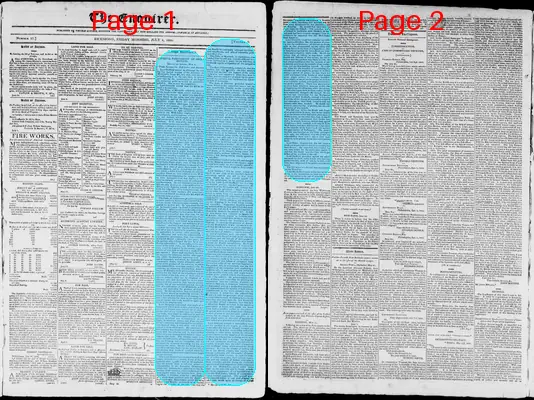
The Enquirer
Richmond, Henrico County, Virginia
What is this article about?
In the House of Lords on May 6, debate on the American and West-India Trade Bill allowing suspension of navigation laws for colonial supplies. Opponents feared harm to British shipping; supporters argued necessity for colonies during war. Bill read second time and committed.
Merged-components note: Continuation of the British Parliament debate on West Indies trade across pages, with seamless text flow.
Clippings
1 of 2
OCR Quality
Full Text
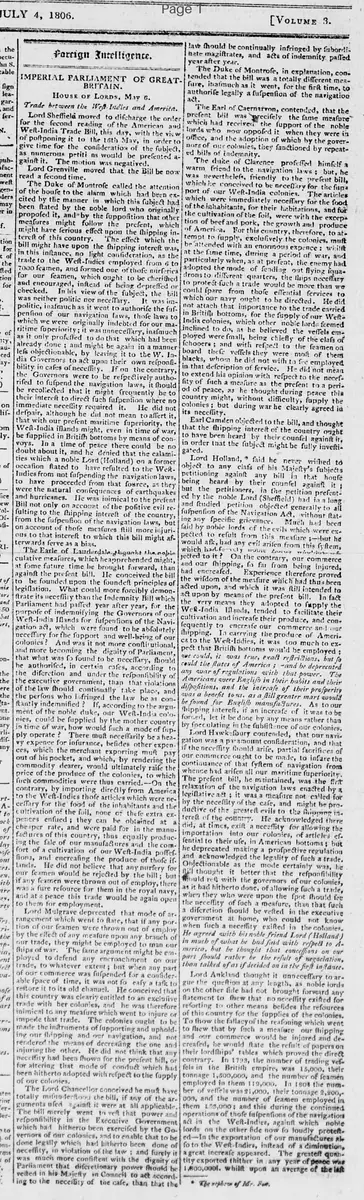
IMPERIAL PARLIAMENT OF GREAT BRITAIN.
House of Lords, May 6.
Trade between the West-Indies and America.
Lord Sheffield moved to discharge the order for the second reading of the American and West-India Trade Bill, this day, with the view of postponing it to the 16th May, in order to give time for the consideration of the subject, as numerous petitions would be presented against it. The motion was negatived.
Lord Grenville moved that the Bill be now read a second time.
The Duke of Montrose called the attention of the house to the alarm which had been excited by the manner in which this subject had been stated by the noble lord who originally proposed it, and by the supposition that other measures might follow the present, which might have serious effect upon the shipping interest of this country. The effect which the bill might have upon the shipping interest was, in this instance, no light consideration, as the trade to the West-Indies employed from 6 to 7000 seamen, and formed one of those nurseries for our seamen, which ought to be cherished and encouraged, instead of being depressed or checked. In his view of the subject, the bill was neither politic nor necessary. It was impolitic, inasmuch as it went to authorise the suspension of our navigation laws, those laws to which we were originally indebted for our maritime superiority; it was unnecessary, inasmuch as it only professed to do that which had been already done ; and might be again in a manner less objectionable, by leaving it to the W. India Governors to act upon their own responsibility in cases of necessity. If on the contrary, the Governors were to be respectively authorised to suspend the navigation laws, it should be recollected that it might frequently be to their interest to direct such suspension where no immediate necessity required it. He did not despair, although he did not mean to assert it, that with our present maritime superiority, the West-India islands might, even in time of war, be supplied in British bottoms by means of convoys. In a time of peace there could be no doubt about it, and he denied that the calamities which a noble Lord (Holland) on a former occasion stated to have resulted to the West Indies from not suspending the navigation laws, to have proceeded from that source, as they were the natural consequences of earthquakes and hurricanes. He was inimical to the present Bill not only on account of the positive evil resulting to the shipping interest of the country, from the suspension of the navigation laws, but on account of those measures still more injurious to that interest to which this bill might afterwards serve as a bias.
The Earl of Lauderdale thought speculative measures, which he apprehended might, at some future time be brought forward, than against the present bill. He conceived the bill to be founded upon the soundest principles of legislation. What could more forcibly demonstrate its necessity than the Indemnity Bill which Parliament had passed year after year, for the purpose of indemnifying the Governors of our West-India Islands for suspensions of the Navigation act, which were found to be absolutely necessary for the support and well-being of our colonies? And was it not more constitutional, and more becoming the dignity of Parliament, that what was so found to be necessary, should be authorised, in certain cases, according to the discretion and under the responsibility of the executive government, than that violations of the law should continually take place, and the persons who infringed the law be as constantly indemnified? If, according to the argument of the noble duke, our West-India colonies, could be supplied by the mother country in time of war, how would such a mode of supply operate ? There must necessarily be a heavy expense for insurance, besides other expenses, which the merchant exporting must pay out of his pocket, and which, by rendering the commodity dearer, would ultimately raise the price of the produce of the colonies. to which such commodities were thus carried.--On the contrary, by importing directly from America to the West-Indies those articles which were necessary for the food of the inhabitants and the cultivation of the soil, none of these extra expenses ensued; they can be obtained at a cheaper rate, and were paid for in the manufactures of this country, thus equally producing the sale of our manufactures and the comfort of a cultivation of our West-India possessions, and increasing the produce of those islands. He did not believe that any nursery for our seamen would be rejected by the bill; but if any seamen were thrown out of employ, there was a sure resource for them in the royal navy, and at a peace this trade would be again open to them for employment.
Lord Mulgrave deprecated that mode of arrangement which went to state, that if any portion of our seamen were thrown out of employ by the effect of any measure upon any branch of our trade, they might be employed to man our ships of war. The same argument might be employed to defend any encroachment on our trade, to whatever extent; but when any part of our commerce was suspended for a considerable space of time, it was not so easy a task to restore it to its old channel. He conceived that this country was clearly entitled to an exclusive trade with her colonies, and he was therefore inimical to any measure which went to injure or impede that trade. The colonies ought to be made the instruments of supporting and upholding our shipping and our navigation, and not rendered the means of decreasing the one and injuring the other. He did not think that any necessity had been shown for the present bill, or for altering that mode of conduct which had been hitherto adopted with respect to the supply of our colonies.
The Lord Chancellor conceived he must have totally misunderstood the bill, if any of the arguments used against it were at all applicable. The bill merely went to vest that power and responsibility in the Executive Government which had hitherto been exercised by the Governors of our colonies, and to enable that to be done legally which had hitherto been done of necessity, in violation of the law; and surely it was much more consistent with the dignity of Parliament that discretionary power should be vested in his Majesty in Council to act according to the necessity of the case, than that the laws should be continually infringed by subordinate magistrates, and acts of indemnity passed year after year.
The Duke of Montrose, in explanation, contended that the bill was a totally different measure, inasmuch as it went, for the first time, to authorise legally a suspension of the navigation act.
The Earl of Carnarvon, contended, that the present bill was precisely the same measure which had received the support of the noble lords who now opposed it when they were in office, and the adoption of which by the governors of our colonies, they sanctioned by repeated bills of indemnity.
The duke of Clarence professed himself a warm friend to the navigation laws ; but, he was nevertheless. friendly to the present bill, which he conceived to be necessary for the support of our West-India colonies. The articles which were immediately necessary for the food of the inhabitants, for their habitations, and for the cultivation of the soil, were with the exception of beef and pork, the growth and produce of America. For this country, therefore. to attempt to supply, exclusively the colonies. must be attended with an enormous expense: whilst at the same time, during a period of war, and particularly when, as at present, the enemy had adopted the mode of sending out flying squadrons to different quarters, the ships necessary to protect such a trade would be more than we could spare from those essential services to which our navy ought to be directed. He did not attach that importance to the trade carried in British bottoms, for the supply of our West-India colonies, which other noble lords seemed inclined to do, as he believed the vessels employed were small, being chiefly of the class of schooners ; and with respect to the seamen on board their vessels they were most of them blacks, whom he did not wish to see employed in that description of service. He did not mean to extend his opinion with respect to the necessity of such a measure as the present to a period of peace, as he thought during peace this country might, without difficulty, supply the colonies; but during war he clearly agreed in its necessity.
Earl Camden objected to the bill, and thought that the shipping interest of the country ought to have been heard by their counsel against it, in order that the subject might be fully investigated.
Lord Holland, said he never wished to object to any class of his Majesty's subjects petitioning against any bill in that house being heard by their counsel against it ; but the petitioners, in the petition presented by the noble Lord (Sheffield) had in a long and studied petition objected generally to all suspension of the Navigation Act, without stating any specific grievance. Much had been said by noble lords of the evils which were expected to result from this measure ;-but he would ask, had any evil arisen from this system, which several noble lords objected to it? On the contrary, our commerce and our shipping, so far from being injured. had increased. Experience therefore proved the wisdom of the measure which had thus been acted upon, and which it was still intended to act upon by means of the present bill. In fact the very means they adopted to supply the West-India Islands, tended to facilitate their cultivation and increase their produce, and consequently to increase our commerce and our shipping: In carrying the produce of America to the West-Indies, it was too much to expect that British bottoms would be employed ; we could, it was true, exact restrictions, but so could the States of America ; -and he deprecated any war of regulations with that power. The Americans were English in their habits and their dispositions, and the increase of their prosperity was a benefit to us, as a still greater mart would be found for English manufactures. As to our shipping interest, if an increase of it was to be forced, let it be done by any means rather than by peculating in the subsistence of our colonies.
Lord Hawkesbury contended, that our navigation was a paramount consideration, and that if the necessity should arise, partial sacrifices of our commerce ought to be made, to insure the continuance of that system of navigation from whence had arisen all our maritime superiority. The present bill, he maintained, was the first relaxation of the navigation laws enacted by a legislative act ; it was a measure not called for by the necessity of the case, and might be productive of the greatest evils to the Shipping interest of the country. He acknowledged there did, at times, exist a necessity for allowing the importation into our colonies, of articles essential to their use, in American bottoms: but he deprecated making a prospective regulation and acknowledged the legality of such a trade. Objectionable as the mode certainly was, he still thought it better that the responsibility should rest with the governors of our colonies, as it had hitherto done, of allowing such a trade, when they who were upon the spot should see the necessity of such a measure, than that such a discretion should be vested in the executive government at home, who could not know when such a necessity existed in the colonies. He agreed with his noble friend Lord (Holland) in much of what he had said with respect to America, but he thought that concessions on our part should rather be the result of negotiation, than talked of as if decided on in the first instance.
Lord Auckland thought it unnecessary to argue the question at any length, as noble lords on the other side had not brought forward any statement to shew that no necessity existed for resorting to other means besides the resources of this country for the supplies of the colonies. To shew the fallacy of the reasoning which went to shew that by such a measure our shipping and our commerce would be injured and decreased, he would state the result of papers on their lordships' tables which proved the direct contrary. In 1793, the number of trading vessels in the British empire, was 15,000, their tonnage 1,500,000, and the number of seamen employed in them 119,000. In 1801 the number of vessels was 21,000, their tonnage 2,200,000, and the number of seamen employed in them 155,000; and this during the continued operations of those suspensions of the navigation act in the West-Indies, against which noble lords on the other side now so loudly protested--In the exportation of our manufactures also to the West-Indies, instead of a diminution, a great increase appeared. The greatest quantity exported thither in any year of peace was 1,800,000 l. whilst upon an average of the last
In five years, the quantity was 5,500,000l. In every point of view, therefore, this measure was far from being detrimental to our commerce and our shipping. He denied that there was any alarm upon the subject. The provision trade of Ireland in particular was satisfied, as beef and pork had been recently excepted from the articles to be imported into the West-Indies from America.
Lord Grenville could not conceive the utility, upon a discussion like the present of entering into the consideration of abstract questions, such as that propounded by the noble lord (Hawkesbury) in the form of a supposition; that at some future period the interests of our commerce and navigation might clash. He did not believe that all history or experience would furnish any instance of this nature, nor did he believe that the question was likely to arise. He had always considered that the increase of our commerce produced the increase of our navigation, and our ship-building interest. He could not either see the necessity of introducing any discussion as what might be proper to be done during a period of peace: no man knew nor could any human being foresee at what period peace might arrive; to consider, therefore, what might, or might not be proper to be done at an indefinite period, was totally irrelevant to the present question. There was one error into which some men were apt to fall, that of supporting old institutions when the circumstances which gave birth to them ceased, or had been materially changed. He thought the noble lord had contended for our Navigation Laws in all their strictness, without a due consideration of the change of circumstances which had taken place since those certainly wise and salutary laws were enacted. He would not, however, enter further, at present, into the consideration of this subject.
The bill now before the House was founded on propositions so plain, that he was surprised at the debate which had taken place upon it. Noble Lords, on the other side, had, in objecting to the bill, condemned their former conduct: he would, however, defend them against themselves: their conduct, with respect to the West-Indies, had been dictated by a due regard to the interests of the Colonies, & had received the approbation of Parliament. The present measure was founded on the same principles, with only the difference, that the power and responsibility were vested where they ought properly to be placed, in the Executive government.
Lord Eldon thought that the bill went to enact a new principle for which no necessity had been shown. He regretted that counsel had not been heard for the petitioners against it, and that the House was therefore not in possession of the real state of the case.
Lord Sheffield protested against the assertions made by those noble Lords who had supported the bill, most of which, he said, could have been disproved if the petitioners had been heard.
The bill was read a second time and committed for Thursday.
Lord Hawkesbury gave notice that he should move, in the committee, to limit the duration of the bill either to the end of next session or to the commencement of the year 1808. Adjourned.
What sub-type of article is it?
What keywords are associated?
What entities or persons were involved?
Where did it happen?
Foreign News Details
Primary Location
West Indies
Event Date
May 6
Key Persons
Outcome
the bill was read a second time and committed for thursday. lord hawkesbury gave notice to limit its duration to the end of next session or 1808.
Event Details
Debate in the House of Lords on the American and West-India Trade Bill, which authorizes suspension of navigation laws to allow direct imports from America to West Indies for colonial necessities during war. Opponents, including Duke of Montrose and Lord Hawkesbury, argued it harms British shipping and seamen employment, preferring governors' discretion. Supporters, like Lord Grenville and Earl of Lauderdale, cited past indemnities, economic benefits, and colonial needs, noting increased trade and shipping under similar practices. Statistics from 1793-1801 showed growth in vessels, tonnage, and seamen despite suspensions.